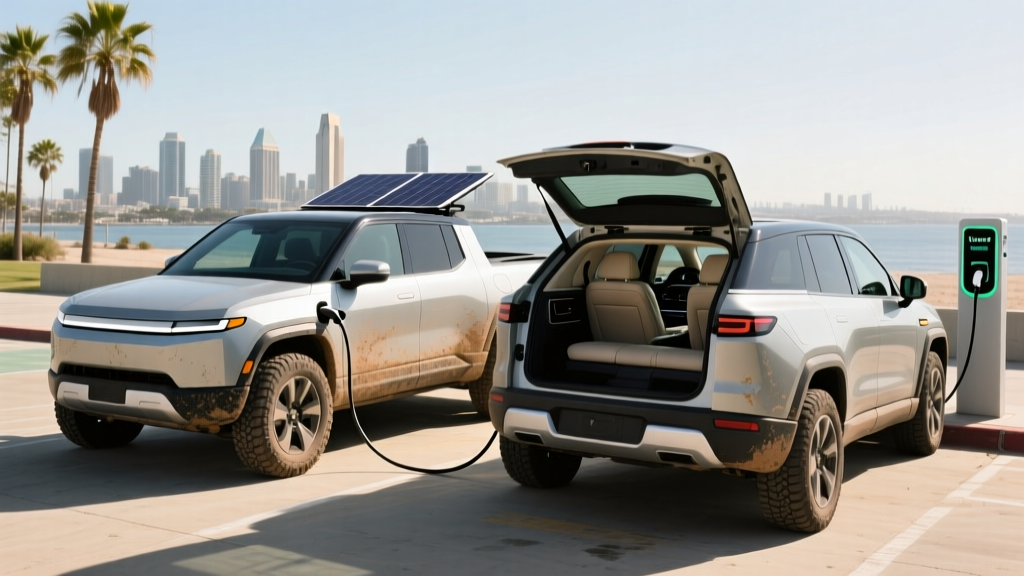
If you're researching Rivian San Diego ownership, you're likely weighing whether the R1T electric truck or R1S three-row SUV fits Southern California driving — from the 5 freeway commute to weekend trips up the Pacific Coast Highway and into the mountains. This guide breaks down the 2026 Rivian lineup with the exact numbers San Diego buyers need: EPA and real-world range, DC fast-charge curves, home Level 2 install realities in older neighborhoods, and federal tax credit eligibility under current IRS §30D rules.
2026 Rivian Lineup at a Glance: R1T vs R1S
Rivian offers two core vehicles on a shared platform: the R1T (a midsize four-door electric pickup) and the R1S (a three-row SUV variant). For the 2026 model year, both are available with the Standard, Large, and Max battery packs, as well as Dual-Motor and Quad-Motor powertrains. The second-generation architecture introduced in late 2024 continues to underpin the lineup, bringing improved efficiency, a revamped thermal management system, and the company's in-house Gen 2 drive units.
| Spec | R1T Dual-Motor (Large) | R1S Dual-Motor (Large) |
|---|---|---|
| EPA Range | 352 miles | 340 miles |
| Usable Battery | ~109 kWh (NMC) | ~109 kWh (NMC) |
| Horsepower | 533 hp | 533 hp |
| 0–60 mph | 4.5 sec | 4.6 sec |
| Drivetrain | AWD (Dual-Motor) | AWD (Dual-Motor) |
| MPGe (Combined) | 73 MPGe | 70 MPGe |
| Efficiency | 46 kWh/100 mi | 48 kWh/100 mi |
| Max DC Fast Charge | 220 kW | 220 kW |
| 10–80% DC Time | ~28 min | ~28 min |
| Level 2 Rate | 11.5 kW (~30 mi/hr) | 11.5 kW (~30 mi/hr) |
| Towing Capacity | 11,000 lbs | 7,700 lbs |
| Cargo (bed / behind 3rd row) | 54.1 cu ft bed + 11 cu ft frunk | 10.6 cu ft (3rd row up) + 11 cu ft frunk |
| Base MSRP | $71,700 | $76,700 |
| Battery/Powertrain Warranty | 8 yr / 175,000 mi | 8 yr / 175,000 mi |
Source: fueleconomy.gov and Rivian official specs. Quad-Motor and Max Pack configurations yield different figures.
Real-World Range: What San Diego Drivers Actually See
R1T EPA: 352 miles | Real-world highway (70–75 mph): ~280–310 miles
R1S EPA: 340 miles | Real-world highway (70–75 mph): ~270–300 miles
Cold-weather note: San Diego's mild winters mean minimal range loss locally. However, drives to Big Bear, Mammoth, or Flagstaff in winter can reduce range 20–30% due to cabin heating and battery thermal demands. Rivian's heat pump (standard on Gen 2) mitigates this compared to resistive heating.
The EPA cycle favors mixed city/highway driving with regenerative braking opportunities — exactly what you get on surface streets in La Jolla or North Park. Sustained 75 mph cruising on I-8 east toward El Centro or I-5 north to Camp Pendleton will pull the real-world figure down. The R1T's boxy truck profile and 5,500+ lb curb weight work against highway efficiency. Expect roughly 2.0–2.2 kWh/mile at freeway speeds, compared to the 1.7–1.8 kWh/mile you'll see in stop-and-go city traffic where regen thrives.
For San Diego owners, the practical implication is straightforward: the Large Pack comfortably covers a round trip to Los Angeles (~240 miles) with a buffer, but a round trip to the Bay Area (~900 miles) will require two DC fast-charge stops each way.
Charging in San Diego: DC Fast, Level 2, and Home Install
Rivian uses the NACS (Tesla-style) connector on all 2026 models, giving native access to the Tesla Supercharger network — the most reliable DC fast-charging network in the San Diego metro area. Superchargers at Fashion Valley, UTC, Del Mar, and Carlsbad all support the R1T/R1S without an adapter.
| Level | Power | Speed | Typical Use Case |
|---|---|---|---|
| Level 1 (120V) | 1.4 kW | ~3–4 mi/hr | Emergency trickle; not practical for daily use |
| Level 2 (240V, 48A) | 11.5 kW | ~30 mi/hr | Home overnight charging — full recharge in ~10 hrs |
| DC Fast (peak) | 220 kW | ~140 mi in 20 min | Road trips; Superchargers and Electrify America |
| DC Fast 10–80% | — | ~28 min | Practical road-trip stop time |
Charge Curve Reality
The 220 kW peak is not sustained across the entire session. Rivian's Gen 2 pack typically holds above 175 kW from roughly 10–40% State of Charge, then tapers progressively. From 60–80%, expect ~90–110 kW. Above 80%, charging slows dramatically to protect the NMC cells — this is why the 10–80% metric matters more than peak kW. On a road trip, plan to unplug at 80% and move on; the time penalty for 80–100% is often longer than the 0–80% session itself.
Home Level 2 Installation in San Diego
Most San Diego homes can support a 48-amp Level 2 charger on a 60-amp circuit, but older neighborhoods (Mission Hills, North Park, Point Loma) may have 100-amp main panels that require an upgrade. SDG&E's typical residential panel upgrade to 200 amps runs $2,500–$5,000 depending on trenching and permit complexity.
| Component | Cost Range |
|---|---|
| Level 2 charger (Rivian Wall Charger or Emporia/ChargePoint) | $400–$650 |
| Electrician labor (240V/60A circuit, ~40 ft run) | $800–$2,000 |
| Permit (City of San Diego) | $150–$350 |
| Panel upgrade (if needed, 100A → 200A) | $2,500–$5,000 |
| Total (no panel upgrade) | $1,350–$3,000 |
| Total (with panel upgrade) | $3,850–$8,000 |
Always get a site assessment from a licensed electrician. Final costs depend on conduit run length, panel location, and local code. SDG&E may offer time-of-use (TOU) EV rate plans that make overnight charging significantly cheaper — typically $0.09–$0.12/kWh off-peak vs. $0.35+ during peak.
Pricing, Trims, and Federal Tax Credit Eligibility
For 2026, the Rivian R1T starts at $71,700 (Dual-Motor Standard) and the R1S at $76,700 (Dual-Motor Standard). The popular Dual-Motor Large configuration — the sweet spot for range and value — lists around $79,200 (R1T) and $84,200 (R1S). Quad-Motor and Max Pack trims push well past $100,000.
| Configuration | MSRP | §30D Credit Eligible? | Effective Price |
|---|---|---|---|
| R1T Dual-Motor Standard | $71,700 | Yes (if buyer meets income + sourcing rules) | ~$64,200 |
| R1T Dual-Motor Large | $79,200 | Yes | ~$71,700 |
| R1S Dual-Motor Standard | $76,700 | Yes | ~$69,200 |
| R1S Dual-Motor Large | $84,200 | Yes | ~$76,700 |
| R1T Quad-Motor Max | $109,900 | No (exceeds $80K truck MSRP cap) | $109,900 |
§30D Tax Credit Rules That Matter
Rivian vehicles are manufactured in Normal, Illinois, and have consistently qualified for the up to $7,500 federal tax credit under IRS §30D. However, eligibility depends on multiple factors that buyers must verify for their specific situation:
- MSRP cap: Trucks/vans/SUVs must be under $80,000 MSRP. The R1T qualifies as a truck; the R1S qualifies as an SUV. Higher trims (Quad-Motor, Max Pack) may exceed this cap.
- Buyer income limits: Modified AGI must not exceed $300,000 (joint), $225,000 (head of household), or $150,000 (single).
- Battery sourcing: Critical minerals and battery components must meet escalating domestic-sourcing thresholds. Rivian has maintained compliance, but the IRS updates qualifying vehicle lists periodically — always check the latest at fueleconomy.gov.
- Point-of-sale transfer: As of 2024, buyers can transfer the credit to the dealer at purchase, reducing the upfront cost rather than waiting for a tax refund. Rivian supports this at delivery.
Consult a tax professional before relying on credit eligibility. Rules are subject to legislative change. Source: IRS.gov §30D.
Performance and Daily Driving in San Diego
The Dual-Motor R1T delivers 533 hp and a 4.5-second 0–60 mph time — genuinely quick for a 5,500-lb truck, and more than adequate for merging onto I-805 or passing on the I-8 mountain passes. The Quad-Motor variant drops 0–60 to roughly 3.0 seconds with 1,025 hp, but the performance gain comes at the cost of ~30 miles of EPA range and a significantly higher price.
Ride quality benefits from Rivian's air suspension, which offers adjustable ride height from 5.9 to 14.9 inches of ground clearance. For San Diego drivers, the practical benefit is twofold: lower the suspension for highway efficiency on the 5, raise it for fire roads in Cleveland National Forest or beach access at Torrey Pines.
Tech and Driver Assistance
Rivian's infotainment runs on a custom 15.6-inch center display with native navigation, over-the-air updates, and integrated trip planning that accounts for charging stops. The Driver+ suite provides SAE Level 2 highway assistance — adaptive cruise control with lane centering. It performs competently on long I-5 stretches but requires hands-on-wheel supervision at all times. This is not a self-driving system and should not be confused with Level 4 autonomy.
Rivian Driver+ is a Level 2 driver-assistance system. You must keep your hands on the wheel and eyes on the road. It does not navigate construction zones, handle all merge scenarios, or drive autonomously. It reduces fatigue on highway commutes — it does not replace the driver.
Notable Drawbacks
The R1T's rear seat is comfortable but not class-leading for legroom (38.6 inches) compared to a full-size crew-cab truck. The R1S third row is usable for children but tight for adults on longer drives. Cargo space in the R1S with all rows up is just 10.6 cu ft — you'll be folding the third row for any serious gear hauling. And the R1T's 54-cu-ft bed is shorter than a midsize Ranger or Tacoma, though the gear tunnel (11 cu ft pass-through) partially compensates.
Pros and Cons for San Diego Buyers
Pros
- NACS connector gives native Supercharger access — the best public charging network in San Diego
- Strong real-world range (280–310 mi highway) covers LA round trips without charging
- Air suspension and 14.9" ground clearance make it genuinely capable off-road
- 8-year/175,000-mile battery warranty exceeds the industry-standard 100,000 miles
- Over-the-air updates continuously add features and improve efficiency
- Qualifies for up to $7,500 federal credit on eligible trims
Cons
- MSRP starts at $71,700; well-equipped models push $85K–$95K
- Highway efficiency (46–48 kWh/100 mi) is poor vs. sedans and crossovers
- DC fast-charge taper above 80% makes 10–100% stops impractical
- R1S third row and cargo space are tight for a three-row SUV
- Insurance premiums in San Diego run 15–25% higher than comparable gas trucks
- Service center capacity in San Diego is limited — expect wait times for non-routine repairs
Who Should Buy a Rivian in San Diego?
Choose the R1T if: You want an electric truck for weekend adventures (kayaking at La Jolla Shores, camping in Cleveland National Forest, towing a boat up to 11,000 lbs), need a bed for gear, and have home charging access. The Large Pack is the value sweet spot.
Choose the R1S if: You need three rows for family duty, prioritize SUV comfort over truck utility, and your daily driving is under 100 miles round trip. The R1S Dual-Motor Large handles school runs, carpools, and Costco runs with room to spare — when the third row is folded.
Look elsewhere if: Your budget is under $55,000 (consider the Tesla Model Y or Hyundai Ioniq 5), you need maximum highway efficiency (a sedan like the Lucid Air or Hyundai Ioniq 6 will deliver 4+ mi/kWh vs. Rivian's ~2.1), or you lack home charging access and rely entirely on public infrastructure.
Frequently Asked Questions
What is the real-world range of the Rivian R1T and R1S in San Diego?
The Dual-Motor Large Pack R1T delivers an EPA-rated 352 miles; the R1S is rated at 340 miles. In real-world San Diego driving — a mix of city traffic and 65–75 mph freeway — expect 280–310 miles for the R1T and 270–300 miles for the R1S. Mountain driving east on I-8 with elevation gains will reduce range further.
How fast does a Rivian charge at home and on the road?
At home on a 240V/48A Level 2 charger, the R1T and R1S add roughly 30 miles of range per hour, fully recharging overnight in about 10 hours. On DC fast chargers (Tesla Superchargers, Electrify America), the Gen 2 Rivians peak at 220 kW and charge from 10–80% in approximately 28 minutes. Expect real-world road-trip stops of 25–35 minutes depending on starting SoC and charger availability.
Does the Rivian R1T or R1S qualify for the $7,500 federal EV tax credit?
Yes, eligible configurations qualify for up to $7,500 under IRS §30D. Key requirements: MSRP must be under $80,000 (trucks/SUVs), buyer income must be under $300K joint / $150K single, and battery sourcing must meet current-year thresholds. The credit can be transferred at point of sale to reduce your purchase price. Always verify current eligibility at fueleconomy.gov and consult a tax professional.
Is Rivian worth buying over the Tesla Cybertruck or Ford F-150 Lightning?
The R1T competes most directly with the F-150 Lightning (lower price, more conventional truck layout, less off-road capability) and the Cybertruck (stainless-steel polarizing design, 48V architecture, variable availability). The R1T wins on off-road capability (air suspension, quad-motor torque vectoring), interior build quality, and NACS Supercharger access. The Lightning wins on price and bed size. The Cybertruck's real-world ownership picture remains less proven. Your choice depends on budget and whether you prioritize trail capability or work-truck utility.
What are the biggest ownership costs beyond the purchase price?
San Diego Rivian owners should budget for: home Level 2 installation ($1,350–$3,000 without panel upgrade), electricity at ~$0.09–$0.12/kWh off-peak (SDG&E TOU rates), insurance premiums 15–25% above comparable gas trucks, and tire replacement (the R1T's 5,500+ lb weight and instant torque wear tires faster than gas trucks — expect 25,000–35,000 miles from a set). Rivian's 8-year/175,000-mile battery warranty provides long-term peace of mind.
Where can I service a Rivian in San Diego?
Rivian operates a service center in the San Diego metro area (Mission Valley area) and offers mobile service for many routine items. For major battery or drivetrain work, wait times can be longer than legacy brands due to Rivian's smaller service footprint. Factor this into your ownership calculus if you need a vehicle with zero downtime tolerance.
Specs and pricing reflect 2026 model year data available at time of publication. Always confirm current figures at rivian.com and verify tax credit eligibility with the IRS and a qualified tax professional before purchasing.