Rivian has gone from startup curiosity to mainstream electric contender. The company's quarterly delivery numbers have climbed steadily through 2025 and into 2026, and the reasons go beyond early-adopter enthusiasm. Updated R1T and R1S models built on Rivian's second-generation architecture have brought faster charging, new battery chemistries, and revised pricing that pushes the dual-motor variants closer to mass-market territory. If you've been tracking Rivian sales and wondering whether the hype matches the hardware, this profile breaks down the real numbers — EPA range, charging curves, tax-credit eligibility, and the ownership realities that spec sheets don't always reveal.
The Numbers That Matter: R1T and R1S at a Glance
| Spec | 2026 R1T Dual-Motor (Standard Battery) | 2026 R1S Dual-Motor (Standard Battery) |
|---|---|---|
| EPA Range | 270 miles | 260 miles |
| Battery Capacity | 92 kWh usable (LFP) | 92 kWh usable (LFP) |
| Drivetrain | Dual-Motor AWD | Dual-Motor AWD |
| Horsepower | 533 hp | 533 hp |
| 0–60 mph | 4.5 seconds | 4.6 seconds |
| Max DC Fast Charge | 200 kW peak | 200 kW peak |
| 10–80% DC Charge | ~29 minutes | ~29 minutes |
| Level 2 Home Charge | 11.5 kW (~25 mi/hr) | 11.5 kW (~25 mi/hr) |
| MPGe (Combined) | 73 MPGe | 70 MPGe |
| Base MSRP | $69,900 | $74,900 |
| Battery/Powertrain Warranty | 8 yr / 120,000 mi | 8 yr / 120,000 mi |
Source: EPA / fueleconomy.gov and Rivian official specifications. Figures reflect the Standard Battery pack with LFP chemistry; Max and Tri-Motor variants carry different specs.
Real-World Range: What the EPA Sticker Doesn't Tell You
Real-World Expectation: Plan for 220–245 miles on sustained highway driving at 70–80 mph. In cold weather (below 30°F), expect a further 15–25% reduction, bringing effective range to roughly 175–210 miles on a full charge. City driving with regenerative braking can match or slightly exceed the EPA number.
Rivian's LFP (lithium iron phosphate) Standard Battery is a deliberate trade-off. LFP chemistry sacrifices some energy density compared to NMC (nickel manganese cobalt), which is why the Standard pack delivers fewer miles than the older Large pack. But LFP offers two major ownership advantages: it tolerates regular 100% charging without accelerating degradation, and it carries a lower replacement cost if something goes wrong post-warranty. For daily commuters who charge at home nightly, the LFP pack is arguably the smarter long-term choice. Road-trippers who regularly drive 300+ miles between stops will want the Max Battery (NMC, up to 420 miles EPA in the R1T), which trades cost for range.
Charging Speed and Infrastructure: The Practical Picture
| Charging Level | Power | Speed (Miles Added) | Typical Use Case |
|---|---|---|---|
| Level 1 (120V outlet) | ~1.4 kW | ~3–4 mi/hr | Emergency / trickle top-off |
| Level 2 (240V home) | 11.5 kW | ~25 mi/hr | Daily home charging, full overnight refill |
| DC Fast Charge | 200 kW peak | ~140 mi in 15 min (peak) | Road trips, public fast-charging stations |
The 200 kW peak DC fast-charge rate is competitive but not class-leading — Hyundai's Ioniq 5 and Kia EV6 hit 350 kW on 800V architectures. Where Rivian holds its own is the charge curve. The R1T and R1S sustain close to peak rate through roughly 40% state of charge before tapering, meaning the 10–80% sprint lands around 29 minutes. Above 80%, charging slows significantly (as it does in all EVs) to protect the battery, so plan your road-trip stops to charge from 10–80% rather than topping off to full.
At home on a 48-amp Level 2 circuit (hardwired, requiring a 60-amp breaker), you'll add roughly 25 miles of range per hour. A full charge from 10% to 100% takes about 9–10 hours. Rivian's Wall Connector is a solid option, but any J1772-compatible Level 2 unit at 11.5 kW will work. Note: Rivian's Gen 2 vehicles ship with a NACS (Tesla-style) charge port, granting native access to the Tesla Supercharger network without an adapter — a meaningful advantage for road-trip charging reliability.
Pricing, Trims, and Federal Tax Credit Eligibility
| Trim / Config | MSRP | Est. After §30D Credit | Notes |
|---|---|---|---|
| R1T Dual-Motor Standard | $69,900 | $62,400* | Under $80K truck cap |
| R1T Dual-Motor Max | $83,900 | $83,900* | Exceeds $80K MSRP cap — no credit |
| R1S Dual-Motor Standard | $74,900 | $67,400* | Under $80K SUV cap |
| R1S Dual-Motor Max | $88,900 | $88,900* | Exceeds $80K MSRP cap — no credit |
*Tax credit estimates assume full $7,500 eligibility under IRS §30D rules. Eligibility depends on:
- MSRP Cap: Vans, SUVs, and pickups must not exceed $80,000 MSRP. The Standard Battery models clear this; Max and most Tri-Motor configs do not.
- Buyer Income Cap: Modified AGI must not exceed $150,000 (single), $225,000 (head of household), or $300,000 (joint).
- Battery Sourcing: Critical minerals and battery components must meet phased-in domestic-content thresholds that tighten each year through 2029. Rivian has worked to qualify, but verify current-year status at purchase.
- Point-of-Sale Transfer: As of 2024, you can transfer the credit to the dealer at purchase, reducing your out-of-pocket cost immediately rather than waiting for tax filing.
Always confirm eligibility with your tax professional and check the latest IRS guidance before purchase — sourcing rules and qualifying VIN lists update periodically.
Performance and Capability: More Than a Straight Line
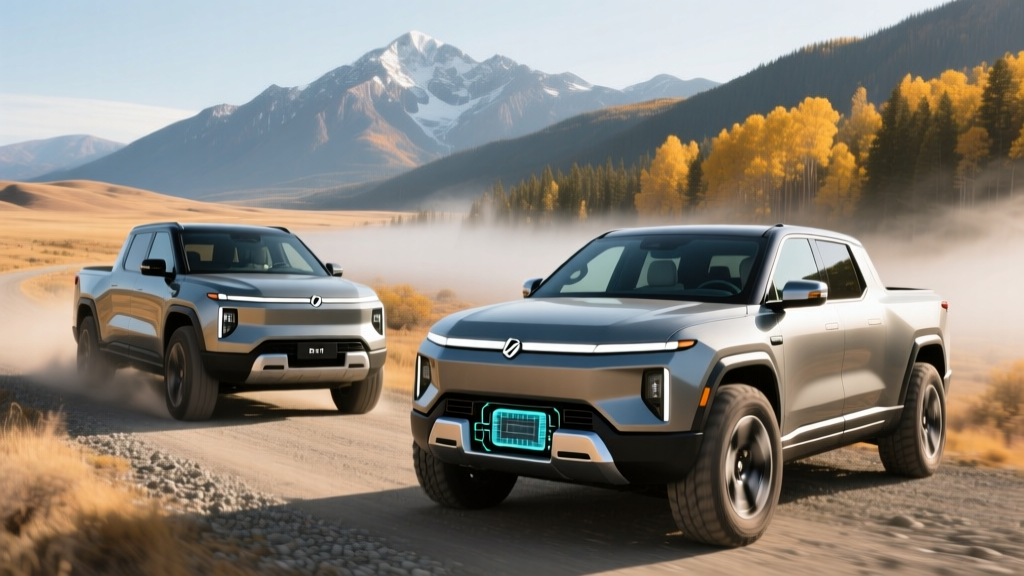
The dual-motor R1T delivers 533 horsepower and a 4.5-second 0–60 mph time, which is brisk for a 7,000-pound truck. The quad-motor Tri-Motor variant pushes past 1,000 hp and dips below 3.0 seconds, but that's a specialty trim for enthusiasts, not the volume seller driving Rivian sales figures.
Where the R1T earns its keep is capability beyond the drag strip. Ground clearance adjusts from 7.9 to 14.4 inches via the air suspension, and the truck wades through 36+ inches of water. The 4.5-foot bed is shorter than a full-size truck's, but the gear tunnel (an 11-cubic-foot lockable pass-through behind the cab) adds versatile, weather-sealed cargo space that competitors can't match. Towing capacity reaches 11,000 pounds on properly equipped models, though expect range to drop by 40–50% when towing near max weight at highway speeds — a reality that applies to every electric truck on the market.
The R1S three-row SUV seats up to seven and offers 104.7 cubic feet of cargo space behind the first row (with second and third rows folded). Third-row legroom is 30.4 inches — usable for children or short adults on moderate trips, but tight for six-footers on long hauls. For families with younger kids, the R1S is one of the few EVs that can genuinely serve as a three-row daily driver.
Tech, Driver Assistance, and Software
Rivian's infotainment runs on a proprietary 15.6-inch landscape touchscreen with a clean, phone-like interface. Wireless Apple CarPlay and Android Auto are not supported — Rivian insists on its native system. Most users find the native nav and media apps adequate, but if phone projection is a dealbreaker, know this going in.
The driver-assistance suite, branded Rivian Driver+, includes adaptive cruise control, lane-centering, and automatic emergency braking. This is an SAE Level 2 system, meaning you must keep your hands on the wheel and eyes on the road at all times. It is not self-driving. The system is competent for highway cruising but does not offer hands-free operation on mapped highways the way GM's Super Cruise or Ford's BlueCruise do. Rivian has been developing more advanced autonomy features, but as of 2026, no Level 3 or Level 4 consumer capability is available.
Unique tech touches include the camp kitchen (a slide-out induction cooktop and sink that integrates into the gear tunnel), over-the-air software updates that have meaningfully improved ride quality and range estimation accuracy, and a built-in air compressor accessible from the bed.
Who Should Buy — and Who Should Look Elsewhere
- You need a capable truck for weekend adventures, light towing, and gear hauling
- You have home Level 2 charging and a daily commute under 100 miles round-trip
- You value the gear tunnel and camp-ready features
- The Standard Battery trim fits your budget under the $80K tax-credit cap
- You need three rows for a growing family
- You want an EV SUV with genuine off-road capability
- You road-trip regularly and can spec the Max Battery for extended range
- You need a full-size 6.5-foot truck bed (the R1T's is 4.5 feet)
- Hands-free highway driving assist is a must-have (consider GM Super Cruise vehicles)
- You don't have access to home charging — public-only charging with a truck-sized battery is expensive and time-consuming
- Your budget can't accommodate the $70K+ starting price even after credits
Pros and Cons: The Honest Summary
- Genuine off-road and towing capability rare among EVs
- Gear tunnel is a unique, practical cargo solution
- LFP Standard Battery supports daily 100% charging without degradation worry
- NACS charge port gives native Tesla Supercharger access
- Over-the-air updates continuously improve the vehicle
- Standard Battery trims qualify for the $7,500 federal tax credit (if income/sourcing requirements are met)
- 200 kW peak DC charging is slower than Hyundai/Kia's 800V competitors
- No Apple CarPlay or Android Auto
- Driver+ is Level 2 only — no hands-free highway mode
- Short 4.5-foot bed limits traditional truck utility
- Max and Tri-Motor trims exceed the $80K tax-credit MSRP cap
- Cold-weather and highway range reduction is significant — plan conservatively
Frequently Asked Questions
What is the real-world range of the Rivian R1T and R1S?
The EPA rates the 2026 R1T Dual-Motor Standard at 270 miles and the R1S at 260 miles. In real-world highway driving at 70–80 mph, expect 220–245 miles. In cold weather below 30°F, plan for 175–210 miles. The Max Battery (NMC) variant extends EPA range to approximately 350–420 miles depending on configuration.
How fast does a Rivian charge at home and on the road?
On a 48-amp Level 2 home charger (11.5 kW), you'll add about 25 miles of range per hour, with a full 10–100% charge taking roughly 9–10 hours. At a DC fast charger, the R1T and R1S peak at 200 kW, reaching 10–80% in approximately 29 minutes. The NACS port provides direct Tesla Supercharger access.
How much does a Rivian cost after the federal tax credit?
The R1T Dual-Motor Standard starts at $69,900 and can drop to approximately $62,400 with the full $7,500 §30D credit. The R1S Dual-Motor Standard starts at $74,900, potentially around $67,400 after credit. Max and Tri-Motor trims exceed the $80,000 MSRP cap and do not qualify. Eligibility also depends on buyer income limits and battery-sourcing requirements — confirm with your tax professional.
Does the Rivian R1T or R1S qualify for the federal EV tax credit?
The Standard Battery Dual-Motor trims of both the R1T and R1S fall under the $80,000 MSRP cap for trucks/SUVs and are potentially eligible for the full $7,500 credit, provided the buyer meets income thresholds ($150K single / $300K joint) and the vehicle meets current-year battery-sourcing requirements. Higher trims (Max, Tri-Motor) exceed the MSRP cap and are ineligible. Check IRS §30D guidance for the latest qualifying VIN list.
Is the Rivian worth buying vs. the Ford F-150 Lightning or Tesla Cybertruck?
The R1T occupies a unique niche: it's smaller than the F-150 Lightning (shorter bed, lower tow rating) but more refined off-road and more adventure-focused, thanks to the gear tunnel and air suspension. The Cybertruck offers faster charging and a stainless-steel exoskeleton, but its polarizing design and limited service network are considerations. If you prioritize off-road capability, build quality, and adventure utility, the R1T stands apart. If you need maximum bed length and towing, the Lightning is more practical. Test-drive all three before deciding.
What's behind Rivian's rising sales numbers in 2025–2026?
Several factors are driving Rivian sales growth: the introduction of the more affordable Standard Battery LFP pack, the Gen 2 manufacturing overhaul that reduced build complexity and improved margins, native NACS/Supercharger compatibility, and growing brand awareness as early owners share positive long-term ownership experiences. Rivian has also expanded its service center network, addressing one of the most common buyer hesitations.