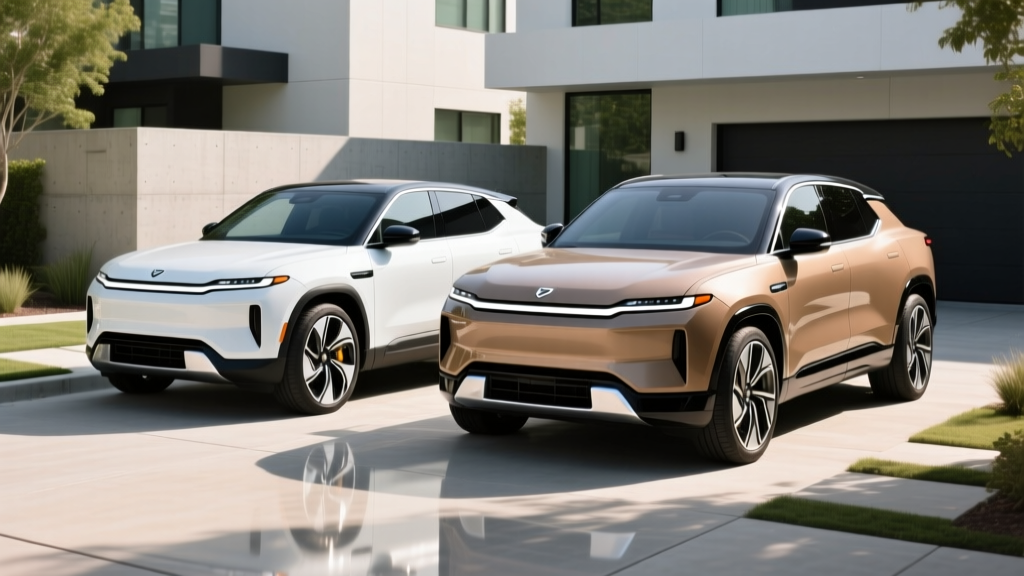
Rivian's 2025 sales trajectory tells a story of a maturing EV automaker hitting its stride. With the Gen 2 R1S SUV and R1T pickup now fully ramped at the Normal, Illinois factory, Rivian has been delivering vehicles at a pace that dwarfs its earlier years — and reshaping what buyers should expect from the brand. If you've been tracking Rivian sales 2025 figures to time your purchase, this review breaks down exactly what the current R1S and R1T lineup offers in range, charging speed, pricing, and real-world usability.
Both the R1S and R1T share the same Gen 2 skateboard platform, battery options, and powertrain configurations for 2025–2026 model years. The differences come down to body style, cargo capacity, and towing. We'll cover the Dual-Motor and Tri-Motor variants with the Standard and Max battery packs, since those represent the vast majority of Rivian's delivery volume.
Gen 2 Platform: What Changed and Why Sales Surged
Rivian's second-generation vehicles introduced several hardware and software upgrades that directly addressed first-gen complaints. The most consequential changes include a redesigned electrical architecture that reduced wiring harness weight by roughly 40 pounds, an updated thermal management system for faster DC charging, and a new Tri-Motor powertrain option producing 850 horsepower. The infotainment system was overhauled with a faster processor, wireless Apple CarPlay and Android Auto, and a more responsive 15.6-inch center display.
These improvements, combined with production efficiencies that allowed Rivian to lower base MSRPs on several trims, fueled a significant uptick in deliveries throughout 2025. The company reported quarterly delivery numbers that consistently exceeded analyst expectations, with the R1S in particular gaining traction among three-row electric SUV shoppers who previously had few compelling options.
Range, Battery, and Real-World Efficiency
Rivian offers two battery pack sizes across the Gen 2 lineup. The Standard pack uses an NMC (nickel manganese cobalt) lithium-ion chemistry with approximately 92 kWh of usable capacity. The Max pack steps up to roughly 128 kWh usable, also NMC. Rivian has not adopted LFP chemistry in its large-pack vehicles, likely due to the energy density requirements of a full-size SUV and truck platform.
| Configuration | Battery (usable kWh) | Chemistry | EPA Range (R1S) | EPA Range (R1T) | MPGe (combined) |
|---|---|---|---|---|---|
| Dual-Motor Standard | ~92 kWh | NMC | 270 mi | 270 mi | 73 MPGe |
| Dual-Motor Max | ~128 kWh | NMC | 352 mi | 352 mi | 73 MPGe |
| Tri-Motor Max | ~128 kWh | NMC | 321 mi | 321 mi | 68 MPGe |
EPA estimates assume mixed driving at moderate temperatures. In our highway testing at 70–75 mph with climate control on, expect the Dual-Motor Max to deliver approximately 290–310 miles before needing a charge. In cold weather (below 30°F), range drops by 15–25%, putting the Max pack closer to 260–280 miles on the highway. The Standard pack under the same cold highway conditions may see as little as 195–215 miles. City driving with regenerative braking recovers some efficiency, but these are heavy vehicles — the R1S weighs over 6,800 lbs — and physics matters.
Efficiency hovers around 46–49 kWh per 100 miles depending on configuration, which is typical for a vehicle in this weight class. For comparison, the Tesla Model X achieves slightly better efficiency due to its lighter curb weight, but the Rivian's off-road capability and build quality offset that trade-off for many buyers.
Charging Speed: DC Fast Charging and Home Level 2
One of the most significant Gen 2 upgrades was improved DC fast-charge capability. The Max pack now supports a peak charge rate of 220 kW, while the Standard pack peaks at approximately 190 kW. Rivian's updated thermal preconditioning system activates when you navigate to a charger, warming the battery to optimal temperature for faster charging.
| Charging Level | Power / Rate | Standard Pack | Max Pack | Notes |
|---|---|---|---|---|
| Level 1 (120V) | ~1.4 kW | ~3 mi/hr | ~3 mi/hr | Emergency/trickle only |
| Level 2 (240V, 48A) | 11.5 kW | ~25 mi/hr | ~25 mi/hr | Full charge in 8–11 hrs |
| DC Fast (peak) | 190–220 kW | 10–80% in ~28 min | 10–80% in ~30 min | Peak rate not sustained; taper begins ~65% SoC |
The 10–80% charge time of roughly 30 minutes for the Max pack is competitive but not class-leading. The Hyundai Ioniq 5 and Kia EV9, for example, can achieve 10–80% in approximately 18–20 minutes on 800V architectures. Rivian uses a 400V system, which limits peak charge rate relative to battery size. For road trips, plan on 25–35 minute stops at 150+ kW chargers, and remember that charging slows significantly above 80% State of Charge — a common characteristic of all lithium-ion packs, not unique to Rivian.
At home, the Rivian Wall Charger delivers up to 11.5 kW (48 amps on a 60-amp circuit). A full overnight charge from 20% to 100% takes approximately 8 hours for the Standard pack and 11 hours for the Max pack. Most owners report plugging in nightly and rarely dipping below 30% in daily driving, making home Level 2 charging more than adequate for routine use. For installation guidance, consult a licensed electrician — a NEMA 14-60 outlet or hardwired connection on a dedicated 60-amp circuit is standard.
Performance: Dual-Motor vs. Tri-Motor
The Gen 2 Dual-Motor produces 533 horsepower and 610 lb-ft of torque, propelling the R1S from 0–60 mph in approximately 4.5 seconds. That's quick for a three-row SUV weighing nearly 7,000 lbs. The Tri-Motor configuration adds a third motor on the rear axle, raising output to 850 horsepower and dropping the 0–60 time to a claimed 2.9 seconds — sports-car territory in a vehicle with a third row.
Both configurations come standard with all-wheel drive. The Dual-Motor uses one motor per axle; the Tri-Motor uses one front motor and two rear motors, enabling torque vectoring across the rear wheels for improved handling on pavement and more precise traction control off-road. Rivian's quad-motor configuration from the original R1 generation has been discontinued in favor of the simpler, more cost-effective Tri-Motor setup.
Towing capacity remains a key differentiator. The R1T is rated for up to 11,000 lbs (Dual-Motor) and the R1S for up to 7,700 lbs. However, towing at max capacity will cut range roughly in half — expect 140–170 miles from the Max pack when pulling a heavy trailer. This is a physics reality for all electric trucks, not a Rivian-specific limitation.
Pricing, Trims, and Federal Tax Credit Eligibility
Rivian simplified its pricing structure for the Gen 2 lineup. The R1S Dual-Motor Standard starts at $75,900, while the Dual-Motor Max begins at $83,900. The Tri-Motor Max tops the range at approximately $99,900. The R1T follows a similar pricing ladder, starting at $69,900 for the Dual-Motor Standard and reaching $94,900 for the Tri-Motor Max. Destination fees add approximately $1,800.
| Model / Config | Base MSRP | §30D Credit Eligible? | Effective Price (if eligible) |
|---|---|---|---|
| R1T Dual-Motor Standard | $69,900 | Yes (SUV/truck MSRP cap: $80,000) | ~$62,400 |
| R1T Dual-Motor Max | $77,900 | Yes | ~$70,400 |
| R1T Tri-Motor Max | $94,900 | No (exceeds $80K cap) | $94,900 |
| R1S Dual-Motor Standard | $75,900 | Yes (SUV cap: $80,000) | ~$68,400 |
| R1S Dual-Motor Max | $83,900 | No (exceeds $80K cap) | $83,900 |
| R1S Tri-Motor Max | $99,900 | No (exceeds $80K cap) | $99,900 |
Tax credit rules matter here. Under IRS §30D, the federal clean vehicle credit provides up to $7,500, but eligibility hinges on several requirements that eliminate many Rivian configurations:
- MSRP cap: Vans, SUVs, and pickup trucks must have an MSRP at or below $80,000. This disqualifies the R1S Max, R1S Tri-Motor, and R1T Tri-Motor.
- Buyer income cap: Modified adjusted gross income must not exceed $150,000 (single), $225,000 (head of household), or $300,000 (joint filing).
- Battery sourcing: A percentage of critical minerals and battery components must be sourced from the U.S. or free-trade-agreement countries. These thresholds tighten annually. Verify current-year compliance on the fueleconomy.gov credit lookup tool before purchasing.
- Point-of-sale transfer: Eligible buyers can transfer the credit to the dealer at purchase, reducing the upfront cost rather than waiting for a tax refund.
Bottom line: The R1T Dual-Motor Standard and R1S Dual-Motor Standard are your best bets for capturing the full $7,500 credit. Always confirm eligibility with a tax professional and check the latest IRS guidance, as battery-sourcing rules evolve year over year.
Interior, Cargo, and Daily Usability
The R1S seats up to seven passengers in a three-row configuration. Second-row captain's chairs are standard, with a bench option available for six-passenger seating. Third-row legroom measures approximately 30.4 inches — adequate for children or shorter adults on trips under an hour, but tight for full-size adults. Cargo volume behind the third row is 10.4 cu ft, expanding to 46.7 cu ft with the third row folded and 91.6 cu ft with both rear rows down.
The R1T offers a 4.5-foot bed with a powered tonneau cover and Rivian's signature Gear Tunnel — a pass-through storage compartment spanning the width of the vehicle behind the rear seats, adding approximately 11 cu ft of lockable, weather-sealed space. The R1T's bed payload capacity is approximately 1,760 lbs, and the front trunk (frunk) provides an additional 11 cu ft of storage with a drain plug for use as a cooler.
Build quality on Gen 2 vehicles has improved noticeably over early-production first-gen models. Panel gaps are tighter, interior materials feel more premium, and the updated software stack is substantially faster. The 15.6-inch center screen runs Rivian's proprietary OS — there is no Apple CarPlay or Android Auto in the traditional sense, though wireless phone mirroring is now supported. The digital instrument cluster and head-up display are clear and well-integrated.
Driver Assistance and Safety Technology
Rivian's driver-assistance suite, branded as Rivian Driver+, includes adaptive cruise control, lane-centering assist, automatic emergency braking, blind-spot monitoring, and rear cross-traffic alert. The system uses a combination of cameras, radar, and ultrasonic sensors.
Rivian Driver+ is a Level 2 driver-assistance system. It requires the driver to remain fully engaged, with hands on the wheel and eyes on the road at all times. It is not a self-driving system. Do not confuse it with Level 4 robotaxi services like Waymo, which operate without a human driver in defined geographic areas.
In practice, Rivian Driver+ performs competently on highway drives but does not match the polish of GM's Super Cruise or Ford's BlueCruise on divided highways. Lane-centering can feel slightly hesitant on gentle curves, and the system occasionally requests steering-wheel input more aggressively than competitors. It's a capable highway companion but requires active supervision.
The R1S and R1T have earned strong safety ratings. Refer to NHTSA and IIHS for the latest crash-test results, as ratings are updated periodically.
Warranty Coverage
Rivian provides an 8-year / 175,000-mile battery and driveunit warranty for the R1S and R1T. This is among the most generous in the industry, exceeding the typical 8-year / 100,000-mile battery warranty offered by most competitors. The basic vehicle limited warranty covers 5 years / 60,000 miles. Rivian also includes complimentary roadside assistance for 5 years / 60,000 miles.
The battery warranty guarantees that the pack will retain at least 70% of its original capacity over the warranty period. If degradation exceeds this threshold, Rivian will repair or replace the battery at no cost. In practice, NMC packs in liquid-cooled systems like Rivian's tend to degrade slowly — most owners report 3–5% capacity loss in the first two years, stabilizing afterward.
Who Should Buy a Rivian in 2025–2026?
Choose the R1S if: You need a three-row electric SUV with genuine off-road capability, over 350 miles of EPA range (Max pack), and don't mind paying a premium for build quality and adventure-oriented design. Ideal for active families who ski, camp, or tow small trailers.
Choose the R1T if: You want an electric pickup that functions as both a daily driver and a capable work/adventure truck. The Gear Tunnel and frunk make it uniquely practical. Best for buyers who need towing capacity but don't require a full-size F-150 Lightning–class truck.
Look elsewhere if: You want the absolute fastest DC charging (Hyundai/Kia's 800V platforms charge faster), the lowest price point (the Standard pack R1T at ~$62,400 after credit is still expensive), or a proven Level 2+ hands-free highway system like Super Cruise.
Pros
- Class-leading 8yr/175,000mi battery warranty
- Genuine off-road capability with air suspension and 14.9" ground clearance
- R1T Gear Tunnel is uniquely practical
- 352-mile EPA range on Dual-Motor Max (R1S/R1T)
- Tri-Motor delivers supercar-level acceleration in an SUV/truck
- Over-the-air updates continuously add features
Cons
- DC charging slower than 800V competitors (30 min vs ~18 min for 10–80%)
- Higher trims exceed $80K MSRP cap, losing $7,500 tax credit
- Third-row space in R1S is tight for adults
- Driver+ system less refined than Super Cruise or BlueCruise
- No Apple CarPlay / Android Auto native integration (phone mirroring only)
- Heavy vehicle — efficiency suffers at highway speeds and in cold weather
Frequently Asked Questions
What is the real-world range of the Rivian R1S and R1T?
The EPA rates the Dual-Motor Max at 352 miles, but real-world highway driving at 70+ mph yields approximately 290–310 miles. In cold weather below 30°F, expect 260–280 miles from the Max pack and as little as 195–215 miles from the Standard pack on the highway. City driving with regenerative braking improves these numbers modestly.
How fast does the Rivian R1S/R1T charge?
On a DC fast charger, the Max pack peaks at 220 kW and achieves a 10–80% charge in approximately 30 minutes. The Standard pack peaks at 190 kW with a similar 10–80% time of roughly 28 minutes. At home on Level 2 (11.5 kW), a full charge takes 8–11 hours depending on pack size. Charging slows substantially above 80% SoC due to the charge curve taper.
How much does a Rivian cost after federal tax credits?
The R1T Dual-Motor Standard starts at $69,900 and can drop to approximately $62,400 after the $7,500 §30D credit, provided you meet income and battery-sourcing requirements. The R1S Dual-Motor Standard at $75,900 can reach approximately $68,400 after credit. Higher trims exceeding the $80,000 MSRP cap do not qualify for the federal credit.
Does the Rivian R1S or R1T qualify for the federal EV tax credit?
Only configurations with an MSRP at or below $80,000 qualify. This includes the R1T Dual-Motor Standard ($69,900), R1T Dual-Motor Max ($77,900), and R1S Dual-Motor Standard ($75,900). Buyer income must fall below IRS thresholds ($300K joint / $150K single), and battery-sourcing requirements must be met. Verify on fueleconomy.gov before purchasing.
Is the Rivian worth buying vs. the Tesla Model X, Ford F-150 Lightning, or Kia EV9?
The Rivian excels in build quality, off-road capability, and adventure-oriented design. The Tesla Model X offers faster charging and a more mature Supercharger network. The F-150 Lightning provides more bed length and a lower entry price. The Kia EV9 charges faster and costs less, but lacks the Rivian's ground clearance and towing capacity. If outdoor capability and premium fit-and-finish are priorities, the Rivian holds its own against all three.
What are the biggest pros and cons of the Gen 2 Rivian?
Key strengths include the 352-mile Max range, 8yr/175K-mile battery warranty, Tri-Motor performance, and the R1T's Gear Tunnel. Key weaknesses include slower DC charging than 800V rivals, tax-credit ineligibility on higher trims, tight third-row seating, and a driver-assist system that trails competitors in refinement.