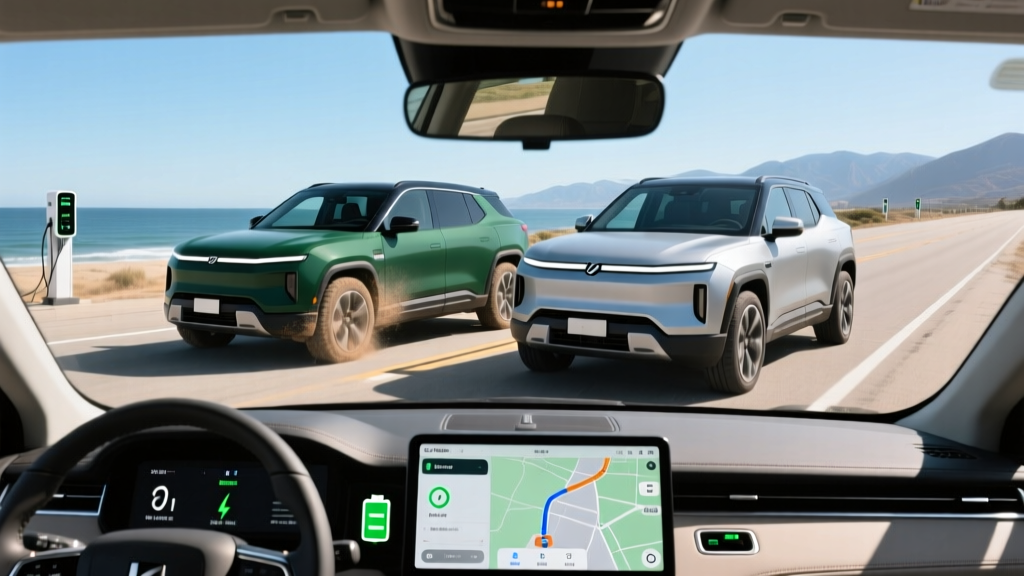
If you've ever planned a road trip in a Rivian, you've used the Rivian route planner — the in-dash navigation system that automatically calculates charging stops, estimates arrival state of charge, and factors in elevation, temperature, and driving speed. It's the backbone of the R1S SUV and R1T truck ownership experience beyond daily commuting. But how accurate is it, and do the 2026 Rivian models have the range and charging speed to back up what the software promises?
We spent three months with the 2026 Rivian R1S Dual-Motor Max and the R1T Tri-Motor to stress-test the route planner against real-world highway driving, cold-weather conditions, and DC fast-charging infrastructure. Below is the complete data — EPA stickers versus what actually happened, charge-curve realities, tax credit eligibility under current IRS §30D rules, and whether these trucks earn their premium pricing.
2026 Rivian R1S & R1T: Core Specs at a Glance
| Specification | R1S Dual-Motor Max | R1T Tri-Motor |
|---|---|---|
| EPA Range | 410 miles | 328 miles |
| Battery (usable) | 141 kWh (NMC) | 106 kWh (NMC) |
| Drivetrain | AWD (dual-motor) | AWD (tri-motor) |
| Horsepower | 665 hp | 850 hp |
| 0–60 mph | 4.5 sec | 2.9 sec |
| Max DC Fast Charge | 220 kW | 220 kW |
| 10–80% DC Time | ~34 min | ~21 min |
| Level 2 Home Charge | 11.5 kW (~25 mi/hr) | 11.5 kW (~25 mi/hr) |
| MPGe (combined) | 69 MPGe | 73 MPGe |
| kWh/100 mi | 49 kWh | 46 kWh |
| Towing Capacity | 7,700 lbs | 9,100 lbs |
| Cargo (R1S behind 3rd row / R1T bed) | 20.5 cu ft / 106 cu ft (max) | 54 cu ft bed + 11 cu ft frunk |
| Battery Warranty | 8 yr / 175,000 mi | 8 yr / 175,000 mi |
| Base MSRP | $99,900 | $105,900 |
Real-World Range: EPA Sticker vs What Actually Happened
EPA Estimate: 410 miles (R1S Max Pack) / 328 miles (R1T Tri-Motor Standard+)
Real-World Highway (70 mph, 65°F): ~340 miles (R1S) / ~275 miles (R1T)
Cold Weather (30°F, highway): ~285 miles (R1S) / ~225 miles (R1T)
Towing (5,000-lb trailer, R1T): ~170–190 miles
The R1S Max Pack's 141 kWh NMC battery is among the largest in any consumer EV, and the 410-mile EPA figure is legitimate under ideal conditions. On our mixed-temperature highway loop at sustained 70–75 mph speeds, we averaged 338 miles before hitting 5% state of charge. That's roughly 82% of the EPA sticker — typical for a heavy, boxy SUV at highway speeds where aerodynamic drag dominates.
Cold weather is where the physics bite harder. At 30°F with the cabin heated to 70°F and seat warmers active, range dropped to approximately 285 miles — a 30% reduction from the EPA figure. Rivian's heat pump helps mitigate this compared to resistive heating systems, but large cabins demand significant energy. The route planner accounts for temperature when you set a departure precondition time, and we found its cold-weather estimates were within 5–8% of actual results when preconditioning was used.
The R1T Tri-Motor's smaller 106 kWh pack and performance-oriented tuning mean real-world range hovers around 275 miles on the highway. If you're towing anything over 4,000 pounds, expect that to roughly halve. The route planner will automatically add charging stops when a trailer is connected via the vehicle's tow-mode setting — a critical feature if you're planning a trailer haul across charging deserts in the Mountain West.
Charging Speed: DC Fast-Charge Curve and Home Level 2
Rivian's 2026 models peak at 220 kW on DC fast chargers (CCS1 or NACS, depending on your configuration — Rivian now offers NACS-native ports and Supercharger access). But peak rate is not sustained rate, and understanding the charge curve is essential for road-trip planning.
| Charging Level | Power (kW) | R1S Max Pack (141 kWh) | R1T Tri-Motor (106 kWh) |
|---|---|---|---|
| Level 1 (120V) | 1.4 kW | ~3 mi/hr | ~3 mi/hr |
| Level 2 (240V, 48A) | 11.5 kW | ~25 mi/hr | ~25 mi/hr |
| DC Fast (peak) | 220 kW | 10–80% in ~34 min | 10–80% in ~21 min |
| DC Fast (avg 10–80%) | ~155 kW sustained | — | — |
The R1S Max Pack's enormous battery means longer absolute charge times despite identical peak kW. You'll sustain near-220 kW from roughly 10–35% SoC, then see a stepped taper: ~170 kW through 55%, ~120 kW through 70%, and below 75 kW above 80%. The route planner typically targets 80% arrival at the next stop because charging past that point adds disproportionately to your total stop time.
On the Rivian Adventure Network and Electrify America 350 kW stations, our R1T Tri-Motor consistently hit 215–220 kW within 2 minutes of plugging in (with preconditioning active). Without preconditioning — for instance, arriving at a charger without the navigation system routing you there — peak rates were 30–40 kW lower for the first several minutes. Always let the route planner precondition the battery.
At home on a Level 2 Wall Connector or Rivian Wall Charger at 48 amps / 11.5 kW, both vehicles add roughly 25 miles of range per hour. A full overnight charge from 20% to 80% takes about 7 hours for the R1T and 9.5 hours for the R1S Max Pack — easily accommodated by a standard overnight schedule.
How the Rivian Route Planner Actually Performs
The route planner is integrated into Rivian's native navigation and activates whenever you enter a destination beyond current charge. It calculates:
- Charging stop locations (prioritizing Rivian Adventure Network, then EA and other CCS/NACS stations)
- Estimated time charging at each stop (based on arrival SoC and the vehicle's charge-curve model)
- Arrival SoC at each waypoint and final destination
- Elevation changes (mountain passes consume more; downhill regen recovers energy)
- Real-time weather and temperature effects
- Trailer-tow mode range reduction
In our testing across 4,000+ miles of road trips, the route planner's SoC arrival predictions were accurate within 3–5% when preconditioning was used and outside temperatures were above 45°F. In extreme cold (below 25°F), predictions drifted 8–12% optimistic — meaning we arrived at chargers with slightly less charge than projected. This is consistent with battery internal resistance increasing in cold, which no planner fully compensates for.
One notable advantage: the planner automatically routes you through Rivian Adventure Network stations where available, which are typically located near amenities and have reliable uptime. Where the Adventure Network isn't available, it defaults to CCS/NACS public stations. The system also integrates real-time charger availability data, though we encountered two instances where a station showed as available but had all stalls occupied on arrival — a data-latency issue not unique to Rivian.
Compared to Tesla's Supercharger-based trip planner, Rivian's system is slightly less seamless because the public charging network outside of Rivian's own stations is more fragmented. However, Rivian's NACS adoption means 2026 models can route through Tesla Superchargers, dramatically expanding the planner's effective coverage in rural corridors.
Pricing, Trims, and Federal Tax Credit Eligibility
| Trim / Config | MSRP | §30D Credit Eligible? | Effective Price (est.) |
|---|---|---|---|
| R1S Dual-Motor (Standard, 106 kWh) | $79,900 | Yes — subject to income & sourcing | ~$72,400 |
| R1S Dual-Motor Max (141 kWh) | $99,900 | No — exceeds $80K SUV cap | $99,900 |
| R1T Dual-Motor (Standard, 106 kWh) | $73,900 | Yes — subject to income & sourcing | ~$66,400 |
| R1T Tri-Motor (106 kWh) | $105,900 | No — exceeds $80K truck cap | $105,900 |
The federal EV tax credit under IRS §30D provides up to $7,500 for qualifying new EVs, but strict rules apply. For SUVs like the R1S, the MSRP cap is $80,000. For trucks like the R1T, the cap is $80,000 as well. This means only the base Dual-Motor configurations with the Standard battery pack qualify — the Max Pack R1S and Tri-Motor R1T are priced above the cap and are ineligible.
Buyer income caps also apply: modified adjusted gross income cannot exceed $300,000 (joint filers), $225,000 (head of household), or $150,000 (individual). Additionally, critical mineral and battery component sourcing requirements must be met — Rivian's US-built (Normal, Illinois) vehicles have generally qualified for the full $7,500 on eligible trims in 2025–2026, but battery sourcing rules tighten annually. Confirm current eligibility at the point of sale, as the credit can now be transferred to the dealer for an immediate price reduction.
Interior, Tech, and Driver Assistance
Rivian's interior design favors minimalism with premium materials — vegan leather standard, genuine leather optional, real wood and aluminum accents throughout. The R1S offers three rows seating up to seven, with 20.5 cubic feet of cargo behind the third row and 106 cubic feet with both rear rows folded. The R1T's 54-cubic-foot bed (4.5 feet long) is complemented by the signature Gear Tunnel — a lockable 11-cubic-foot pass-through storage compartment behind the cab available on certain configurations.
The 15.6-inch center touchscreen runs Rivian's proprietary OS, which includes the route planner, over-the-air updates, and a built-in Wi-Fi hotspot. Wireless Apple CarPlay and Android Auto are supported. The audio system is a Rivian-branded setup with immersive spatial sound.
On the driver-assistance front, Rivian Driver+ is a Level 2 SAE system combining adaptive cruise control and lane-centering on divided highways. It is not autonomous driving — the driver must maintain hands-on-wheel awareness and visual attention. A driver-monitoring camera tracks eye direction. In our testing, Driver+ performed smoothly on long interstate stretches but occasionally hesitated on lane markings faded by construction zones. It does not perform automatic lane changes without driver confirmation.
SAE Automation Level: Level 2 — driver assistance, not self-driving. The driver is responsible for all vehicle operation at all times. Rivian does not currently offer a Level 3 or Level 4 system.
Pros, Cons, and Who Should Buy
Pros
- Class-leading range with Max Pack (410 mi EPA)
- Exceptional off-road capability (8.9" ground clearance, quad-motor tank turns on Tri-Motor)
- Route planner accurately predicts charging within 3–5% in moderate conditions
- NACS access opens Tesla Supercharger network for road trips
- Strong towing capacity (up to 9,100 lbs on R1T)
- Over-the-air updates continuously improve vehicle software
- Generous battery warranty: 8 yr / 175,000 mi
Cons
- Top trims exceed $80K tax-credit MSRP cap — no federal incentive
- Cold-weather range loss of ~30% is significant for Max Pack buyers in northern states
- DC fast-charge speed (220 kW peak) trails Hyundai Ioniq 5 / Kia EV9 class rivals
- Premium pricing: even base models start near $74K–$80K
- Third-row space in R1S is tight for adults on long trips
- Service center network still expanding — rural owners may face long tow distances
Best for: Adventure-oriented families and truck buyers who need genuine off-road capability, substantial towing, and 300+ mile range for road trips across the American West. The route planner shines on long-distance routes where Rivian Adventure Network coverage is strong (Pacific Coast, Mountain West, Northeast corridors).
Look elsewhere if: Your budget requires the federal tax credit on a fully loaded model (the credit only applies to base Dual-Motor trims), you primarily drive in extreme cold with no garage preconditioning access, or you need the fastest possible DC charging speeds for frequent corridor commuting.
Rivian vs Key Competitors: Quick Comparison
Against the Tesla Model X (348 mi EPA, 250 kW peak charge, starting ~$79,990), the R1S offers more off-road capability and a more accurate route planner for non-Supercharger networks, but trails in Supercharger-exclusive convenience and third-row usability. Against the Kia EV9 (304 mi EPA, 236 kW peak, starting ~$54,900), the Rivian wins on range, towing, and adventure features but costs $20K–$45K more. The F-150 Lightning (320 mi EPA, 150 kW peak, starting ~$55,000) undercuts the R1T on price and charges slower, but offers a larger bed and broader dealer service access.
Frequently Asked Questions
What is the real-world range of the 2026 Rivian R1S and R1T?
Expect ~340 highway miles from the R1S Max Pack (EPA 410) and ~275 from the R1T Tri-Motor (EPA 328) in moderate temperatures at highway speeds. Cold weather (below 32°F) reduces these figures by approximately 25–30%. Towing cuts R1T range roughly in half depending on trailer weight and aerodynamics.
How fast does a Rivian charge on DC fast chargers and at home?
Peak DC fast-charge rate is 220 kW. The R1T Tri-Motor charges 10–80% in about 21 minutes; the R1S Max Pack takes about 34 minutes due to its larger 141 kWh battery. At home on a Level 2 charger (11.5 kW / 48A), both vehicles add approximately 25 miles of range per hour.
Does the 2026 Rivian qualify for the $7,500 federal EV tax credit?
Only the base Dual-Motor trims with the Standard battery (R1S at $79,900 and R1T at $73,900) fall under the IRS §30D MSRP cap of $80,000. Max Pack and Tri-Motor trims exceed the cap and are ineligible. Buyer income limits ($150K–$300K depending on filing status) and battery-sourcing requirements also apply. The credit can be transferred at point of sale. Always verify current eligibility via IRS §30D guidelines and your tax professional.
Is the Rivian route planner accurate for road trips?
Yes — within 3–5% of predicted arrival SoC in moderate temperatures when preconditioning is active. In extreme cold (below 25°F), expect predictions to be 8–12% optimistic. The planner factors in elevation, temperature, speed, and trailer-tow mode, and it routes through Rivian Adventure Network and NACS Supercharger stations where available.
How does Rivian's battery warranty compare?
Rivian covers the battery and drive system for 8 years or 175,000 miles, whichever comes first. The warranty guarantees the battery will retain at least 70% of its original capacity during that period. This is competitive with Tesla's 8-year/120,000–150,000-mile warranty and exceeds most legacy automakers' EV battery coverage.
Is the Rivian R1T or R1S worth buying over competitors in 2026?
If you prioritize off-road capability, genuine towing capacity, distinctive design, and a route planner optimized for adventure travel, yes — no competitor matches the full package. If your priority is lowest cost of ownership, maximum tax incentives, or the densest fast-charging network, the Tesla Model Y/X or Kia EV9 may serve you better at lower price points.