Searches for a Rivian referral code usually mean one thing: a buyer is close to placing an order and wants to know if there's a discount, a perk, or a way to save on accessories. As of 2026, Rivian does not run a traditional owner-referral discount program the way Tesla once did. What you will find instead are occasional promotional referral links tied to gear-store credit, priority delivery windows, or limited-time events. Before you chase a code, it pays to understand what the vehicle actually delivers — and whether the R1S or R1T fits your garage, your budget, and your charging reality.
This profile focuses on the 2026 Rivian R1S Tri Motor (the three-row electric SUV) and the broader R1 platform, because that's what most referral-code searchers are evaluating. We'll cover EPA range, real-world efficiency, DC fast-charging curves, the updated §30D federal tax credit, and how the R1S stacks up against the Tesla Model X, BMW iX, and the Hyundai Ioniq 9.
Quick Verdict: Who the Rivian R1S Is Actually For
The R1S remains the best electric SUV for buyers who need genuine three-row usability, real towing capability (up to 7,700 lbs), and off-road chops — without stepping into a body-on-frame land yacht. It is not the cheapest path to 400 miles of range, and its premium price pushes it above the §30D MSRP cap for SUVs ($80,000). If you can charge at home and your typical trip is under 300 miles, the R1S is outstanding. If you're chasing maximum efficiency per dollar or need the lowest possible monthly payment, the Ioniq 9 or a used Model X may serve you better.
| Spec | Value |
|---|---|
| EPA Range (Max Pack) | 410 miles |
| Battery Capacity | ~141 kWh usable (Max Pack, NMC) |
| Drivetrain | Tri-Motor AWD |
| Horsepower | 850 hp |
| 0-60 mph | ~2.9 seconds |
| Max DC Fast Charge | 220 kW (peak) |
| 10-80% DC Charge Time | ~29 minutes |
| Level 2 Home Charging | 11.5 kW (~25 mi/hr) |
| EPA Efficiency | 73 MPGe / 46 kWh/100 mi |
| Towing Capacity | 7,700 lbs |
| Cargo (behind 3rd row) | 10.4 cu ft |
| Cargo (max, seats folded) | 91.6 cu ft |
| Base MSRP (Tri Motor Max) | $104,900 |
| Battery Warranty | 8 yr / 175,000 mi |
Range and Efficiency: EPA Sticker vs. Reality
The headline number is 410 miles on the EPA cycle for the R1S Tri Motor with the Max Pack. That's legitimate and places it among the longest-range three-row EVs on the market. But EPA tests include substantial city driving, where regenerative braking recovers energy and aerodynamic drag is lower. The R1S is a tall, heavy, boxy SUV — physics matters.
Real-World Range Expectations — R1S Tri Motor Max Pack
- City/suburban (55 mph avg): ~380-400 miles — close to EPA
- Highway (70-75 mph): ~290-330 miles — expect a 20-25% drop
- Cold weather (below 30°F, highway): ~240-280 miles — battery heating and cabin demand compound losses
- Towing (5,000-lb trailer): ~170-200 miles — plan charging accordingly
The R1S uses a heat pump for cabin and battery thermal management, which helps in cold weather compared to resistive heating. But at 6,900 lbs curb weight and a frontal area larger than most sedans, highway efficiency is roughly 46 kWh per 100 miles. That's higher than the BMW iX xDrive50 (~42 kWh/100 mi) and significantly thirstier than the Hyundai Ioniq 9 Long Range (~37 kWh/100 mi). For buyers in the Sun Belt doing mostly highway miles, budget for roughly 310 miles of usable range between charges.
According to fueleconomy.gov, the R1S Max Pack's combined MPGe is 73, which is respectable for a vehicle this size but trails lighter competitors. If you drive 15,000 miles per year at the U.S. average electricity cost of $0.16/kWh, expect roughly $1,100 in annual charging costs — about a third of what a comparable gas V8 SUV would consume in fuel.
Charging: DC Fast, Level 2, and the NACS Advantage
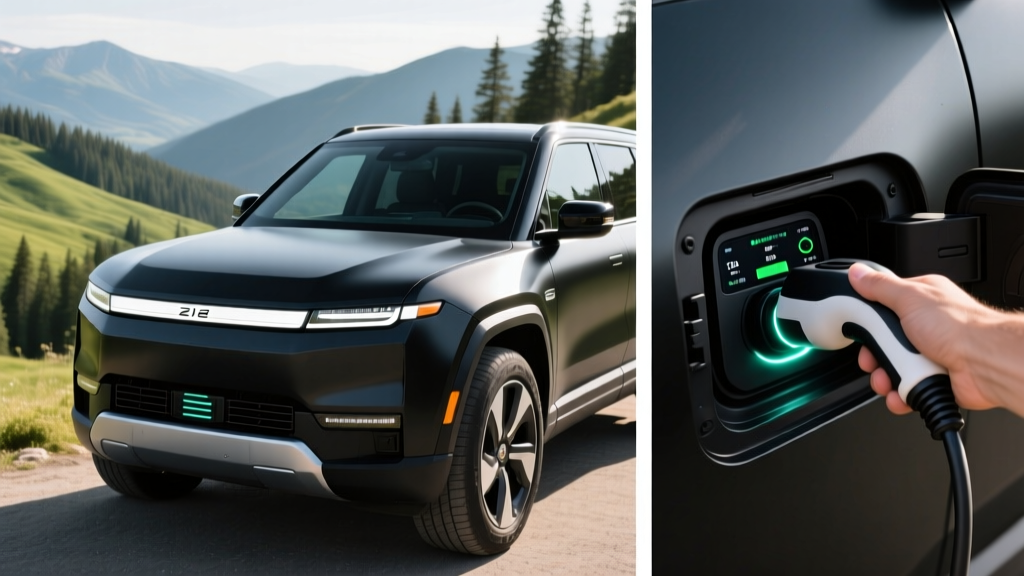
Rivian transitioned to the NACS (North American Charging Standard) port for all 2025+ models, and the 2026 R1S ships with a native NACS inlet — no adapter required for Tesla Superchargers. This is a major practical advantage over CCS-equipped competitors still reliant on adapter dongles at Supercharger stalls.
| Charging Level | Power | Miles Added per Hour | Notes |
|---|---|---|---|
| Level 1 (120V) | 1.4 kW | ~3 mi/hr | Emergency/trickle only |
| Level 2 (240V, 48A) | 11.5 kW | ~25 mi/hr | Full charge in ~14 hours |
| DC Fast (peak) | 220 kW | ~140 mi in 20 min | 10-80% in ~29 min |
| DC Fast (80-100%) | ~50-80 kW | — | Significant taper above 80% |
The 220 kW peak charge rate is competitive but not class-leading — the Hyundai Ioniq 9 and Kia EV9 hit 238 kW on 800V architectures, and the Porsche Macan EV peaks at 270 kW. The practical difference: the R1S takes roughly 29 minutes from 10-80%, while the Ioniq 9 does it in about 24 minutes. On a road trip with two DC stops, that's 10 minutes of your life back per day.
Where the R1S wins is network access. Rivian owners can use Tesla's Supercharger network (over 25,000 stalls in North America) natively, plus Electrify America, EVgo, and the Rivian Adventure Network at select trailheads and destinations. The Rivian app integrates route planning with charger preconditioning — the battery automatically heats or cools as you navigate to a DC station, which is critical for achieving peak charge rates in cold weather.
For home charging, a 48-amp Level 2 wall connector on a 60-amp circuit delivers 11.5 kW, replenishing the Max Pack in roughly 14 hours. Most owners charge overnight and rarely need the full 141 kWh in a single session. If your daily drive is under 60 miles, a 32-amp Level 2 unit (7.7 kW) is sufficient and may avoid a panel upgrade.
Performance and Drivetrain: Tri-Motor Muscle
The Tri Motor R1S pairs one motor on the front axle with two on the rear, producing 850 hp and a claimed 0-60 mph time of 2.9 seconds. That's supercar acceleration in a three-row SUV, and it never stops being amusing. The dual-motor variant (665 hp, 0-60 in 3.5 sec) is more than adequate for most buyers and saves roughly $8,000.
Rivian's quad-motor setup was retired after 2024 in favor of the tri-motor architecture, which reduces weight and complexity while maintaining torque-vectoring capability on the rear axle. The result is a tighter turning circle, better efficiency, and one fewer motor to service.
The air suspension offers 6.5 inches of ride-height adjustability, from a low "Park" mode for easy loading to a high "Off-Road" mode with 14.9 inches of ground clearance. For towing, the self-leveling suspension handles tongue weight well, and the integrated trailer brake controller is standard. Real-world towing of a 5,000-lb camper averages roughly 2.0-2.2 kWh per mile, which aligns with the 170-200 mile range estimate above.
Interior, Tech, and Driver Assistance
The R1S cabin seats up to seven (2-3-2 configuration) with vegan leather standard and available Nappa leather. Third-row legroom is 30.4 inches — tight for adults on long trips but fine for children. Cargo behind the third row is just 10.4 cubic feet, expanding to 91.6 cu ft with both rear rows folded. The front trunk (frunk) adds 11.0 cu ft of lockable, drainable storage — ideal for muddy gear or groceries.
The 15.6-inch center touchscreen runs Rivian's in-house OS, which is responsive and visually clean but lacks Apple CarPlay and Android Auto. This is a deliberate choice by Rivian and a dealbreaker for some buyers. Wireless phone charging, a 16-speaker Meridian audio system, and a panoramic glass roof are included on most trims.
Driver assistance is branded as Rivian Driver+, which combines adaptive cruise control, lane centering, and automatic lane changes on divided highways. This is an SAE Level 2 system — the driver must keep hands on the wheel and eyes on the road. It is competent but not class-leading; GM's Super Cruise and Ford's BlueCruise offer longer hands-free segments on mapped highways. Rivian has not announced a hands-free Level 3 or Level 4 system for the R1 platform as of early 2026.
Pricing, Trims, and the Federal Tax Credit Reality
The 2026 R1S lineup starts at $75,900 for the Dual Motor Standard pack (270-mile range) and climbs to $104,900 for the Tri Motor Max. Most buyers land on the Dual Motor Max at $89,900, which offers the best balance of range (390 mi EPA) and value.
| Trim | MSRP | §30D Credit Eligible? | Effective Price (if eligible) |
|---|---|---|---|
| Dual Motor Standard | $75,900 | Yes (if under $80k cap + income/sourcing rules) | ~$68,400 |
| Dual Motor Max | $89,900 | No (exceeds $80k SUV cap) | $89,900 |
| Tri Motor Max | $104,900 | No (exceeds $80k SUV cap) | $104,900 |
Under current IRS §30D rules, the federal EV tax credit is up to $7,500, but SUVs must have an MSRP at or below $80,000 to qualify. Only the base Dual Motor Standard R1S clears that bar — and only if the buyer meets income caps ($150,000 single / $300,000 joint AGI) and the vehicle's battery satisfies critical-mineral and component-sourcing requirements, which shift annually. The credit can now be transferred to the dealer at point of sale as an instant discount, but you must confirm eligibility at the time of purchase. Always verify current-year sourcing rules on the IRS site or with a tax professional before relying on the credit in your budget.
So, What About a Rivian Referral Code?
Here's the practical truth for 2026: Rivian does not maintain a permanent, publicly available referral code program that discounts the vehicle's purchase price. What you may encounter:
- Employee or partner referral links that provide a modest Rivian gear-store credit ($100-$250) applied after delivery.
- Limited-time promotional events (e.g., "Order by [date] and receive complimentary home charger installation" or priority build slots).
- Third-party affiliate links on blogs and YouTube channels that earn the creator a commission but provide no buyer discount.
If someone offers you a "Rivian referral code" promising $1,000 off the vehicle, be skeptical — it is almost certainly not legitimate. The most reliable way to save on a Rivian is to (1) order the Dual Motor Standard trim to stay under the §30D MSRP cap, (2) check your state's separate EV rebate programs (California, Colorado, and New York offer substantial add-ons), and (3) negotiate any demo or loaner vehicle inventory your local service center may have available.
R1S vs. the Competition: Is It Worth It?
The R1S competes in a narrow but growing segment. Here's how it compares to the most common cross-shops:
- Tesla Model X Long Range: $81,630, 348-mi range, falcon-wing doors, full Supercharger network, but aging interior and polarizing build quality. The Model X has more cargo room and better efficiency but less ground clearance and no real off-road pretense.
- BMW iX xDrive50: $87,250, 324-mi range, luxurious cabin, but only two rows and 4,850-lb towing. Better highway efficiency, worse practicality.
- Hyundai Ioniq 9 Long Range AWD: ~$63,000 est., 335-mi range, three rows, 800V charging (24 min 10-80%). Significantly cheaper, less powerful, less off-road capable.
The R1S wins if you need towing, off-road clearance, and a sense of adventure. It loses on pure efficiency, third-row space, and price. For a family that tows a camper to the mountains on weekends, the R1S is unmatched. For a suburban commuter who needs three rows for school drop-off, the Ioniq 9 saves $30,000 and charges faster.
Pros
- 410-mile EPA range (Max Pack) — longest in its class
- Native NACS port — full Supercharger access without adapter
- Genuine off-road capability with air suspension
- 7,700-lb towing with integrated brake controller
- Excellent build quality and thoughtful storage (drainable frunk)
Cons
- Only base trim qualifies for §30D tax credit
- No Apple CarPlay or Android Auto
- Highway efficiency trails lighter competitors
- Third row is tight for adults
- Driver+ is competent but not best-in-class
Warranty and Long-Term Ownership
Rivian covers the R1S with a 5-year/60,000-mile bumper-to-bumper warranty and an 8-year/175,000-mile battery and drive-unit warranty. The battery warranty guarantees at least 70% capacity retention over that period, which is in line with industry norms. Rivian uses NMC (nickel manganese cobalt) chemistry in the Max and Standard packs — NMC offers higher energy density than LFP but is more sensitive to sustained high state-of-charge. For maximum longevity, set your daily charge limit to 80-85% and only charge to 100% before long trips.
Service remains a pain point in some markets. Rivian operates roughly 60 service centers and relies on mobile service vans for routine work. If you live more than 100 miles from a service center, factor in potential travel time for warranty repairs. Rivian's mobile service handles tire rotations, software updates, and minor hardware swaps, but structural or high-voltage work requires a physical center.
Frequently Asked Questions
Does a Rivian referral code actually save me money on the vehicle?
Not directly. Rivian does not offer a purchase-price discount through referral codes in 2026. Referral links may provide gear-store credit or priority build slots, but the vehicle MSRP remains the same. Your best savings come from the §30D tax credit (if you order the base trim and meet income/sourcing rules) and state-level rebates.
What is the real-world highway range of the R1S?
Expect roughly 290-330 miles at 70-75 mph in moderate temperatures with the Max Pack. In cold weather (below 30°F), plan for 240-280 miles. The EPA 410-mile figure includes substantial city driving with regenerative braking.
How fast does the R1S charge at a DC fast charger?
The R1S peaks at 220 kW and charges from 10-80% in approximately 29 minutes. Above 80%, the charge rate tapers significantly to protect the battery — plan your road-trip stops around 10-80% windows rather than topping off to 100%.
Does the Rivian R1S qualify for the $7,500 federal tax credit?
Only the Dual Motor Standard trim ($75,900 MSRP) is potentially eligible, because §30D caps SUV MSRP at $80,000. You must also meet income limits ($300,000 joint / $150,000 single AGI) and the vehicle must satisfy battery critical-mineral and component-sourcing rules for the model year. Verify on IRS.gov before ordering.
Is the R1S better than the Tesla Model X for families?
It depends. The R1S offers more ground clearance, better towing, a more traditional SUV layout, and superior off-road capability. The Model X offers more cargo volume, faster efficiency, a larger service network, and (with FSD Supervised) a more advanced — though still Level 2 — driver-assist system. For active outdoor families, the R1S usually wins. For efficiency-focused commuters, the Model X or Ioniq 9 may be better.
Can I charge a Rivian at Tesla Superchargers?
Yes. All 2025 and newer Rivians ship with a native NACS port, meaning you can plug directly into any Tesla Supercharger stall without an adapter. Rivian's navigation system includes Supercharger locations and will precondition the battery for optimal charge speed on arrival.