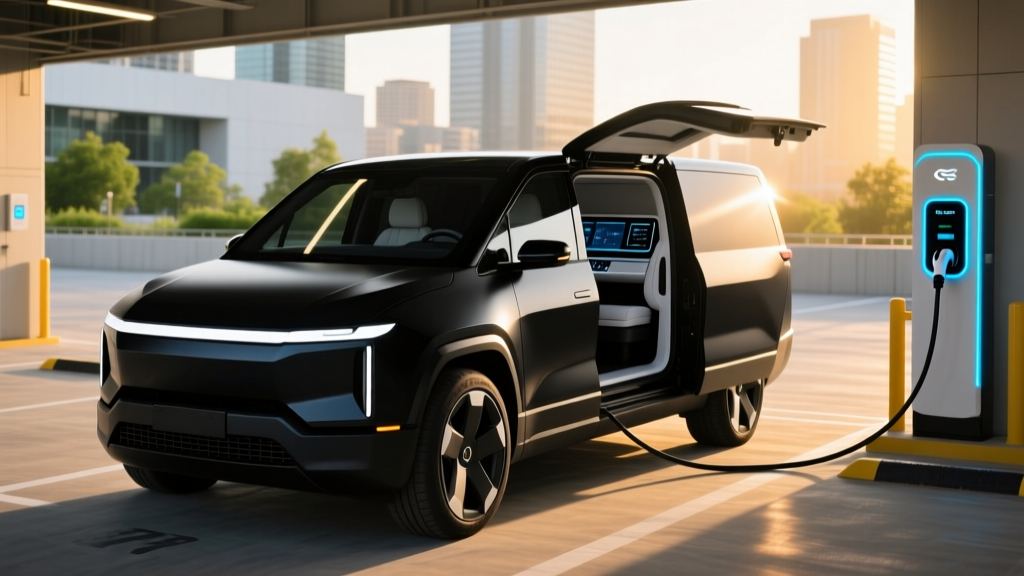
If you follow Rivian primarily through its R1S SUV and R1T pickup, you may have missed the vehicle that actually pays the bills: the Rivian RCV (Rivian Commercial Van). Built in Normal, Illinois, alongside the R1 fleet, the RCV is the backbone of Rivian's partnership with Amazon and a growing roster of commercial fleet operators. For 2026, Rivian has expanded the RCV lineup beyond its original EDV (Electric Delivery Van) configuration, offering new body lengths, updated battery options, and broader availability to small and mid-size fleets.
This profile covers everything a fleet buyer or EV-curious commercial operator needs to know — real-world range, charging infrastructure requirements, total cost of ownership, and whether the RCV earns its spot against competitors like the Ford E-Transit, BrightDrop Zevo, and Mercedes-Benz eSprinter.
Rivian RCV at a Glance: 2026 Specifications
| Spec | Value |
|---|---|
| EPA Estimated Range | 161 miles (EDV-700); 192 miles (EDV-900 with Max pack) |
| Battery Capacity (Usable) | ~89 kWh (Standard); ~122 kWh (Max) |
| Battery Chemistry | NMC (Nickel Manganese Cobalt) — cylindrical cells |
| Drivetrain | Single-motor FWD (fleet); Dual-motor AWD available |
| Horsepower | 275 hp (single motor); 500+ hp (dual motor) |
| 0–60 mph | ~7.5 sec (single motor); ~4.5 sec (dual motor, unloaded) |
| Max DC Fast Charge | ~150 kW peak |
| 10–80% DC Charge Time | ~35 minutes (Standard); ~48 minutes (Max) |
| Level 2 Charge Rate | 11.5 kW onboard charger (~25 mi/hr) |
| Cargo Volume (EDV-700) | ~420 cu ft |
| Cargo Volume (EDV-900) | ~560 cu ft |
| Payload Capacity | Up to ~2,735 lbs (varies by config) |
| Towing Capacity | Not rated for towing (commercial van) |
| MPGe (Combined) | ~1.8–2.0 kWh/mi (~1.7 MPGe equivalent) |
| Base MSRP (EDV-700) | ~$72,000 (fleet pricing varies by volume) |
| Base MSRP (EDV-900 Max) | ~$92,000+ |
| Battery/Powertrain Warranty | 8 years / 100,000 miles |
| Bumper-to-Bumper Warranty | 5 years / 60,000 miles |
Real-World Range: What Fleets Actually See
Range in a commercial van is less about road-trip anxiety and more about route predictability. The RCV's telematics system integrates with fleet management software to optimize routes based on remaining state of charge, terrain, and weather — a feature that matters far more than the raw EPA sticker. Rivian's regenerative braking is aggressive enough to enable near one-pedal driving in stop-and-go delivery patterns, which measurably improves efficiency in urban cores.
For context, the EPA's fueleconomy.gov database lists commercial EV vans with energy consumption measured in kWh per mile rather than traditional MPGe, since these vehicles operate on duty cycles far different from passenger cars. The RCV consumes approximately 1.8–2.0 kWh per mile depending on payload — competitive with the Ford E-Transit's ~2.0 kWh/mi but slightly higher than the BrightDrop Zevo 600's optimized efficiency.
Charging Speed and Infrastructure Requirements
Charging infrastructure is where the RCV either shines or stalls, depending entirely on a fleet's depot setup. Rivian equips the RCV with CCS1 DC fast-charge capability and an 11.5 kW Level 2 onboard charger.
| Charging Level | Power | Miles Added per Hour | Notes |
|---|---|---|---|
| Level 1 (120V) | ~1.4 kW | ~3–4 mi/hr | Emergency/trickle only; impractical for daily fleet ops |
| Level 2 (240V, 48A) | 11.5 kW | ~25 mi/hr | Full overnight charge in 8–10 hours; standard depot setup |
| DC Fast Charge | Up to ~150 kW peak | ~150+ mi/hr (at peak) | 10–80% in ~35 min (Std) / ~48 min (Max); tapers above 80% |
The DC fast-charge curve on the RCV peaks around 150 kW but does not sustain that rate. Expect peak speeds between 15–40% state of charge, with a noticeable taper above 60% and aggressive throttling above 80% to protect the NMC cells. For fleet operators relying on mid-shift top-ups, the 10–80% window is the practical charging envelope — roughly 35 minutes for the Standard pack at a capable 150 kW+ station.
Most fleet deployments rely on depot Level 2 charging overnight. At 11.5 kW, a fully depleted Standard-pack RCV reaches 100% in approximately 8 hours — fitting neatly within a single overnight shift window. Fleets installing Level 2 infrastructure should budget for commercial-grade 48A chargers (ChargePoint CPF50, Blink HQ 200, or similar) plus electrical panel upgrades. A 10-stall depot installation typically runs $80,000–$150,000 including trenching, conduit, chargers, and utility coordination.
For public DC fast charging, the RCV uses the CCS1 connector. As Rivian transitions its consumer vehicles to NACS (Tesla Supercharger access), the commercial van lineup has retained CCS1 for compatibility with established fleet charging networks like Electrify America and EVgo Commercial. Fleet buyers should verify connector requirements before committing to depot hardware.
Performance and Drivetrain
The RCV's single-motor front-wheel-drive configuration produces 275 horsepower and approximately 300 lb-ft of torque. That's adequate for urban and suburban delivery routes, where low-end torque matters more than highway passing power. The unloaded 0–60 mph time of roughly 7.5 seconds is brisk for a cargo van and makes merging onto highways stress-free even with a partial load.
The dual-motor AWD option (500+ hp) exists primarily for fleets operating in regions with snow, ice, or mountainous terrain. It transforms the RCV from a competent delivery van into something closer to a performance vehicle when unloaded — 0–60 in approximately 4.5 seconds — though that capability comes at the cost of efficiency and price. Most urban fleet operators will find single-motor FWD entirely sufficient.
Ride quality benefits from Rivian's skateboard platform, which positions the battery pack low in the chassis. The RCV handles better than any traditional body-on-frame commercial van, with minimal body roll through tight urban turns. The independent rear suspension is a notable advantage over the solid rear axles found in many competitors, particularly when the van is lightly loaded.
Cargo Space, Interior, and Standout Tech
The RCV comes in multiple body configurations, but the two primary offerings for 2026 are:
- EDV-700: ~420 cu ft of cargo volume, ~10 ft cargo length, suitable for last-mile parcel delivery
- EDV-900: ~560 cu ft of cargo volume, ~14 ft cargo length, designed for larger parcels and multi-stop routes
The driver's compartment is separated from the cargo area by a bulkhead with a pass-through door. The cab features a 15.6-inch central touchscreen running Rivian's proprietary fleet OS, which integrates route optimization, vehicle diagnostics, and telematics. A 12.3-inch digital instrument cluster replaces traditional gauges.
Standout tech features:
- Rivian Fleet Manager portal with real-time vehicle health, SoC monitoring, and route analytics
- Over-the-air (OTA) software updates for powertrain calibration, infotainment, and safety systems
- Highway Assist (SAE Level 2) — adaptive cruise control with lane centering for highway segments
- 360-degree camera system with curb-view for tight urban maneuvering
- Integrated tire pressure monitoring with per-wheel readouts in the dash
- Regenerative braking adjustable via steering wheel paddles
Notable drawbacks: The RCV's infotainment system, while functional, lacks the app ecosystem and polish of Rivian's consumer R1 vehicles. Third-party fleet management integration can require custom API work. The driver's seat, while comfortable for short shifts, lacks the lumbar adjustment range that full-day drivers want. And the RCV's height (over 10 ft for the EDV-900) excludes it from many parking garages and some drive-through facilities.
Pricing, Tax Credits, and Total Cost of Ownership
The 2026 Rivian RCV starts at approximately $72,000 for the EDV-700 with the Standard battery pack and single-motor FWD. The EDV-900 with the Max pack and dual-motor AWD can exceed $95,000 depending on upfitting and options. Fleet volume pricing is negotiated directly with Rivian's commercial division and can reduce per-unit cost significantly for orders of 10+ vehicles.
| Configuration | Base MSRP | Federal §30D Credit Potential | Effective Price (if eligible) |
|---|---|---|---|
| EDV-700 Standard (FWD) | ~$72,000 | Up to $7,500 | ~$64,500 |
| EDV-700 Max (FWD) | ~$82,000 | Up to $7,500 | ~$74,500 |
| EDV-900 Max (AWD) | ~$92,000+ | Up to $7,500 | ~$84,500+ |
Federal tax credit eligibility for the RCV follows IRS §30D rules, with critical caveats for commercial buyers:
- The $7,500 credit requires meeting both critical-mineral sourcing and battery-component manufacturing thresholds — Rivian has been progressively qualifying more of its supply chain, but eligibility should be verified at point of purchase via the IRS clean vehicle credit page.
- For business/fleet purchases, the commercial clean vehicle credit (§45W) may apply instead of §30D, offering up to $7,500 for vehicles under 14,000 lbs GVWR or up to $40,000 for heavier vehicles — consult a tax professional for your specific situation.
- There is no MSRP cap for the commercial credit (§45W), unlike the consumer §30D credit's $80,000 van/SUV cap.
- Income caps apply to §30D (consumer) but not to §45W (commercial).
Total cost of ownership is where the RCV makes its strongest case. Commercial electricity rates for depot charging average $0.12–$0.18/kWh nationally. At 1.9 kWh/mi and $0.15/kWh, the RCV costs approximately $0.29 per mile in energy — compared to $0.55–$0.70 per mile for a gasoline-powered Ford Transit at 15 mpg and $3.50–$4.50/gallon. Over 100,000 miles, that's a fuel savings of roughly $26,000–$41,000.
Maintenance savings compound the advantage: no oil changes, no transmission fluid, significantly reduced brake wear from regenerative braking, and fewer moving parts in the drivetrain. Fleet operators typically report 30–40% lower maintenance costs per mile compared to ICE equivalents.
Rivian RCV vs. Key Competitors
| Spec | Rivian RCV (EDV-700) | Ford E-Transit | BrightDrop Zevo 600 |
|---|---|---|---|
| EPA Range | 161 mi | 126 mi | ~250 mi (est.) |
| Battery (Usable) | ~89 kWh | 68 kWh | ~165 kWh |
| Max DC Charge | ~150 kW | ~115 kW | ~150 kW |
| Cargo Volume | ~420 cu ft | ~487 cu ft (high roof) | ~600 cu ft |
| Base Price | ~$72,000 | ~$55,000 | ~$95,000 (est.) |
| Dealer/Service Network | Limited (direct) | Extensive (Ford) | Limited (direct) |
- You prioritize range and battery capacity over maximum cargo volume
- Your routes involve varied terrain where the skateboard platform's handling pays off
- You value OTA updates and integrated fleet telematics
- You want dual-motor AWD for snow-belt operations
- Budget is the primary constraint (E-Transit undercuts by ~$17K)
- You need maximum cargo cube for bulky, lightweight freight (BrightDrop Zevo)
- Your fleet requires widespread dealer service access (Ford's network)
- Your routes are short and predictable, making range less critical
Who the Rivian RCV Suits Best
The RCV is purpose-built for last-mile and middle-mile delivery fleets operating predictable urban and suburban routes of 80–140 miles per day. It's ideal for:
- Parcel delivery fleets (Amazon DSPs, regional carriers) with depot-based overnight charging
- Service fleets (HVAC, plumbing, electrical) covering metro areas with return-to-base patterns
- Food and grocery delivery operations needing refrigerated upfit compatibility
- Municipal and campus fleets with fixed routes and on-site charging
It is not the right vehicle for long-haul routes exceeding 150 miles without mid-day charging opportunities, for operations requiring heavy towing, or for fleets without access to depot charging infrastructure. The RCV's value proposition depends entirely on the ability to charge at base overnight at commercial electricity rates.
Frequently Asked Questions
What is the real-world range of the Rivian RCV?
The EPA rates the EDV-700 at 161 miles and the EDV-900 Max at 192 miles. Real-world urban delivery routes typically yield 140–160 miles (Standard) and 170–190 miles (Max) in moderate weather. Highway driving and cold temperatures reduce range by 15–30%. Fleet telematics help predict remaining range accurately based on actual driving patterns.
How fast does the RCV charge at home and on DC fast chargers?
At a depot Level 2 charger (11.5 kW), the Standard pack charges fully overnight in about 8 hours, adding roughly 25 miles of range per hour. On a DC fast charger, the RCV peaks at ~150 kW and charges from 10–80% in approximately 35 minutes (Standard) or 48 minutes (Max). Charging speed tapers significantly above 80% SoC to protect battery health.
How much does the Rivian RCV cost after tax credits?
The EDV-700 starts around $72,000 before incentives. If eligible for the full $7,500 federal credit (either §30D for consumer purchases or §45W for commercial), the effective price drops to approximately $64,500. State and utility incentives can reduce cost further — check DSIRE (dsireusa.org) for local programs. Fleet volume pricing may provide additional discounts.
Does the Rivian RCV qualify for the federal EV tax credit?
Potentially yes, but eligibility depends on how you purchase. Consumer purchases may qualify under §30D (subject to income caps, battery-sourcing requirements, and MSRP limits). Commercial/fleet purchases may qualify under §45W, which has no MSRP cap and no income cap. Rivian's battery sourcing compliance changes over time — always verify current eligibility on irs.gov or consult a tax professional before purchasing.
Is the Rivian RCV worth buying vs. the Ford E-Transit or BrightDrop?
It depends on your priorities. The RCV offers more range than the E-Transit (161 vs. 126 miles EPA), a more sophisticated software platform, and available AWD — but costs roughly $17,000 more. Against the BrightDrop Zevo, the RCV is less expensive but offers less cargo volume and range. For fleets prioritizing range, handling, and software integration, the RCV is competitive. For budget-first buyers, the E-Transit's lower entry price and Ford dealer network are compelling.
What is the RCV's battery warranty?
Rivian covers the RCV's battery pack and powertrain for 8 years or 100,000 miles, whichever comes first. The bumper-to-bumper warranty is 5 years / 60,000 miles. The battery warranty guarantees a minimum capacity retention threshold (typically 70% of original capacity) — if the pack degrades below that threshold within the warranty period, Rivian will repair or replace it.