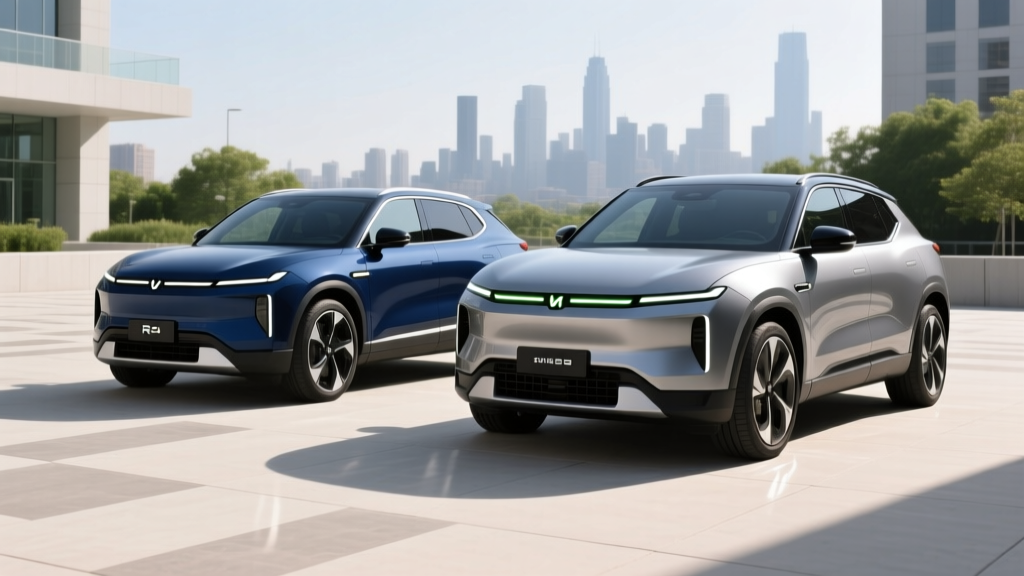
Rivian built its reputation on premium electric adventure vehicles — the R1T pickup and R1S SUV, both starting well above $70,000. That changes with the upcoming Rivian R4 (a compact crossover) and Rivian R5 (a subcompact SUV), two platforms designed to crack the mainstream market and compete directly with the Tesla Model Y, Volvo EX30, and Hyundai Ioniq 5. Together, they represent Rivian's bid to own the conversation around Rivian R4 R5 affordable EVs in a segment where every dollar and every mile of range matters.
Neither vehicle is on sale yet. The R4 is slated for production at Rivian's Normal, Illinois facility starting in early 2026, with the R5 following at the new Stanton, Georgia plant later in the year or early 2027. Everything below is based on Rivian's announced specifications, industry analysis, and comparable platform benchmarks. Final EPA certification and pricing may shift before customer deliveries begin.
Rivian R4 vs R5: What's the Difference?
Think of the R4 and R5 the way you'd think of a Toyota RAV4 versus a Corolla Cross — same brand DNA, different footprints. The R4 slots below the R1S as a compact two-row crossover aimed at small families and commuters. The R5 is even smaller, targeting urban buyers and first-time EV shoppers who want a premium badge without a premium price tag.
| Spec | Rivian R4 (Announced) | Rivian R5 (Announced) |
|---|---|---|
| Segment | Compact Crossover SUV | Subcompact SUV |
| Est. Starting MSRP | ~$40,000 | ~$35,000 (projected) |
| Est. EPA Range | Up to ~300+ mi (target) | Up to ~280+ mi (target) |
| Platform | Rivian Medium (new) | Rivian Medium (new) |
| Production Start | Early 2026 (Normal, IL) | Late 2026 / Early 2027 (Stanton, GA) |
| Drivetrain Options | Single-motor RWD / Dual-motor AWD | Single-motor RWD / Dual-motor AWD |
Both vehicles ride on Rivian's next-generation "Medium" platform, which the company has confirmed will use a more cost-effective structural approach than the R1's skateboard architecture. The key enabler for lower pricing is a combination of simplified manufacturing (fewer parts, more integrated casting), a smaller battery pack option, and a shift toward lithium iron phosphate (LFP) chemistry on base trims.
Battery, Range & Efficiency: What We Know
Rivian has not published final battery capacity figures, but the company has confirmed that the R4 and R5 platform will offer LFP (lithium iron phosphate) battery packs on base trims, with the option of higher-energy-density NMC (nickel manganese cobalt) packs on longer-range variants. This mirrors the strategy Tesla uses with the Model 3 and Model Y Standard Range.
LFP: Lower cost, longer cycle life (3,000+ cycles), can be charged to 100% daily without degradation concerns, but heavier and lower energy density. Expect slightly less range per kWh and reduced cold-weather performance.
NMC: Higher energy density (more range in a smaller pack), better cold-weather retention, but more expensive and benefits from staying between 20–80% SoC for daily use.
Based on the ~300-mile EPA range target for the R4 and competitive benchmarks (the Tesla Model Y Long Range achieves 310 miles on ~75 kWh usable), we estimate the R4 Long Range will carry a usable battery in the 72–82 kWh range, likely NMC. A base LFP variant with ~60–65 kWh usable could deliver roughly 240–260 miles EPA.
EPA Target (R4 Long Range): ~300+ miles
Highway driving (70–80 mph): Expect ~240–270 miles (aerodynamic drag reduces efficiency significantly above 65 mph)
Cold weather (below 32°F): Expect 20–30% range reduction, bringing effective range to ~210–240 miles
Combined real-world daily driving: Most owners will see 260–280 miles in moderate conditions
Efficiency targets are expected to land in the 110–120 MPGe combined range (roughly 28–30 kWh/100 mi), which would put the R4 in the same territory as the Hyundai Ioniq 5 and slightly behind the Tesla Model Y's class-leading efficiency. Rivian's boxy design language is great for interior space but creates aerodynamic drag that hurts highway efficiency — a trade-off the R1T and R1S already demonstrate.
Charging Speed: DC Fast Charging & Home Level 2
Charging speed is where affordable EVs often cut corners, and it will be a make-or-break spec for the R4 and R5. Rivian has confirmed that the Medium platform will support NACS (North American Charging Standard) natively — no adapter needed — giving these vehicles direct access to Tesla's Supercharger network, the most reliable DC fast-charging infrastructure in the U.S.
| Charging Level | Power / Rate | Estimated Time / Miles Added |
|---|---|---|
| Level 1 (120V household) | ~1.4 kW | ~3–4 miles per hour |
| Level 2 (240V home, 48A) | ~11.5 kW | ~30–35 miles per hour; full charge in ~7–8 hrs |
| DC Fast Charge (peak) | ~175–200 kW (est.) | 10–80% in ~25–30 min (est.) |
The estimated 175–200 kW peak DC charge rate would be competitive with the Hyundai Ioniq 5 (which peaks at ~240 kW on 800V architecture) but slightly behind. The real-world charging curve matters more than peak numbers — most vehicles sustain peak rate only briefly before tapering. A 10–80% time in the mid-to-high 20-minute range is adequate for road trips, though not class-leading.
Preconditioning note: Rivian's R1 vehicles already include battery preconditioning when navigating to a charger, and the R4/R5 are expected to carry this feature. Preconditioning warms the battery to optimal temperature before arrival at a DC fast charger, significantly improving charge speed — especially in cold weather. Always navigate to your charger rather than entering the address manually to ensure preconditioning activates.
Performance & Drivetrain
Rivian has built a reputation for quick, capable electric vehicles, and the R4 and R5 will offer multiple drivetrain configurations:
- Single-motor RWD: The base, most affordable configuration. Expect roughly 250–280 horsepower and a 0–60 mph time in the mid-6-second range. This is the efficiency-optimized variant and the one most likely to hit the lowest MSRP.
- Dual-motor AWD: Adds a front motor for all-wheel drive and a significant power bump — likely 350–400+ horsepower with a 0–60 mph time around 4.5–5.5 seconds. This is the variant adventure-oriented buyers will want, and it will carry a price premium of roughly $4,000–$5,000 over RWD.
Both configurations will use Rivian's in-house developed drive units. The dual-motor AWD system is expected to include Rivian's signature torque vectoring and multiple drive modes (All-Purpose, Sport, Snow, Off-Road), though ground clearance and approach/departure angles will be more modest than the R1T/R1S given the smaller platform.
Pricing, Trims & Federal Tax Credit Eligibility
Rivian CEO RJ Scaringe has publicly stated the company's goal of a starting MSRP around $40,000 for the R4, with the R5 positioned even lower. Here's how pricing is expected to stack up across trims:
| Trim | Est. MSRP | After §30D Credit (if eligible) |
|---|---|---|
| R4 Standard Range RWD (LFP) | ~$40,000 | ~$32,500 |
| R4 Long Range AWD (NMC) | ~$47,000–$49,000 | ~$39,500–$41,500 |
| R5 Base RWD (LFP) | ~$35,000 | ~$27,500 |
Federal tax credit (IRS §30D) eligibility is not guaranteed. Under current rules, a vehicle must satisfy all of the following to qualify for the full $7,500 credit (available as a point-of-sale rebate starting 2024):
- MSRP cap: SUVs/crossovers must have an MSRP at or below $80,000 (sedans: $55,000). Both the R4 and R5 should clear this easily.
- Buyer income cap: Modified adjusted gross income must not exceed $150,000 (single), $225,000 (head of household), or $300,000 (joint filers).
- Battery component sourcing: A percentage of battery components must be manufactured or assembled in North America (threshold increases annually through 2029).
- Critical minerals sourcing: A percentage of critical minerals must be sourced from the U.S. or free-trade-agreement partners (threshold also increases annually).
Rivian's use of LFP chemistry complicates the critical-minerals requirement, as much of the world's LFP supply chain is China-based. Rivian has indicated it is working to diversify sourcing, and the company's existing R1 vehicles have qualified for partial or full credits in recent years. Buyers should verify eligibility at the time of purchase via IRS.gov's clean vehicle credit page and consult a tax professional. Rules and thresholds change annually.
Interior, Cargo & Technology
Rivian's interior design language emphasizes minimalism, sustainability, and adventure-readiness. The R4 and R5 are expected to carry forward features like:
- Infotainment: A centrally mounted touchscreen (estimated 14–15 inches) running Rivian's in-house software, which has been well-reviewed on the R1 platform for its clean interface and over-the-air update capability.
- Digital instrument cluster: A compact driver display behind the steering wheel, consistent with Rivian's minimalist approach.
- Driver assistance: Rivian's Driver+ system (an SAE Level 2 hands-on system) will come standard, with adaptive cruise control, lane-keeping, and automatic emergency braking. Expect an available highway-assist feature similar to BlueCruise or Super Cruise, though not autonomous driving.
- Sustainable materials: Vegan leather, recycled fabrics, and natural-fiber composites — Rivian has made this a brand pillar.
Cargo and passenger space estimates based on the compact crossover segment:
- R4 cargo volume: ~25–30 cu ft behind second row, ~55–65 cu ft with seats folded (estimated)
- R5 cargo volume: ~18–22 cu ft behind second row, ~45–50 cu ft with seats folded (estimated)
- Both vehicles are expected to offer a front trunk (frunk), though smaller than the R1T's gear tunnel
- Rear legroom should be competitive with the Tesla Model Y (~38–40 inches for R4)
Notable drawback: Rivian's R1 vehicles have been criticized for limited phone-mount integration and the lack of Apple CarPlay/Android Auto (Rivian uses its own native navigation and media apps). Whether this continues on the R4/R5 platform is unconfirmed, but buyers who rely on phone projection should watch for this detail closely.
Warranty & Ownership Costs
Rivian currently offers the following warranty coverage on its R1 vehicles, and the R4/R5 are expected to match or slightly adjust these terms:
- Battery & drive unit: 8 years / 100,000 miles (whichever comes first), with a capacity retention threshold (typically 70% state of health)
- Vehicle limited warranty: 5 years / 60,000 miles bumper-to-bumper
- Roadside assistance: 5 years / unlimited miles
Insurance costs for Rivian vehicles have trended higher than segment averages, reflecting the brand's premium positioning and repair cost structure. The R4 and R5, with lower MSRPs and potentially more accessible parts, may see more moderate insurance premiums — but buyers should get quotes before purchasing.
Long-term ownership economics will depend heavily on home charging access. At the national average electricity rate of ~$0.16/kWh, charging an R4 with a 75 kWh battery from empty to full costs roughly $12.00 — compared to $45–$55 to fill a comparable gas crossover at $3.50/gallon. Over five years and 75,000 miles, that's a fuel savings of $4,000–$6,000 depending on local rates and driving patterns.
Rivian R4 R5 Affordable EVs vs. the Competition
The compact and subcompact EV crossover segment is crowded and getting more so. Here's how the R4 stacks up against confirmed competitors:
- NACS native — full Supercharger access from day one
- Strong adventure brand identity with genuine off-road DNA
- LFP option enables daily 100% charging without degradation worry
- Rivian's Driver+ and OTA software track record
- Potentially strong tax-credit-adjusted pricing
- Not yet available — delivery timelines may slip (as with R1)
- Rivian's production scaling track record is unproven at high volume
- Charging speed may lag 800V competitors (Ioniq 5, EV6)
- No Apple CarPlay/Android Auto (likely)
- Cold-weather range loss may be significant on LFP trims
Choose the Rivian R4 if: You want an adventure-capable compact EV with native Supercharger access, you value brand identity and build quality, and you can wait for 2026 production to stabilize.
Look elsewhere if: You need a vehicle today, you prioritize the fastest possible DC charging (consider Hyundai/Kia 800V platforms), or you require Apple CarPlay/Android Auto integration.
Frequently Asked Questions
What is the real-world range of the Rivian R4?
Rivian targets an EPA range of 300+ miles for the R4 Long Range variant. In real-world highway driving at 70–80 mph, expect roughly 240–270 miles. In cold weather (below freezing), plan for 20–30% range reduction, putting effective range around 210–240 miles. The base LFP Standard Range variant will likely deliver 240–260 miles EPA.
How fast does the Rivian R4 charge?
Estimated peak DC fast charging is 175–200 kW, with a 10–80% charge time of approximately 25–30 minutes. Home Level 2 charging at 11.5 kW (48-amp, 240V) adds roughly 30–35 miles of range per hour, fully charging the battery overnight in 7–8 hours. Native NACS compatibility means direct Tesla Supercharger access.
How much does the Rivian R4 cost after tax credits?
If the R4 qualifies for the full $7,500 federal §30D credit (subject to MSRP, income, and battery-sourcing requirements), the base Standard Range RWD model at ~$40,000 MSRP could cost as little as ~$32,500 after the point-of-sale rebate. Eligibility is not guaranteed and depends on your income, the vehicle's final battery sourcing, and current-year IRS thresholds.
Does the Rivian R4 qualify for the federal EV tax credit?
It's expected to, but not confirmed. The MSRP will fall under the $80,000 SUV cap. The critical-minerals and battery-component sourcing requirements are the main variables, especially for LFP trims where supply chains are heavily China-based. Check IRS.gov at the time of purchase for the definitive answer.
Is the Rivian R4 worth buying vs. a Tesla Model Y or Hyundai Ioniq 5?
The R4 offers a distinct value proposition: native Supercharger access (like Tesla), adventure-oriented design and capability (unlike either competitor), and Rivian's well-regarded software. However, the Model Y has a proven production and service track record, and the Ioniq 5 charges faster on 800V architecture. If you can wait for production to ramp and value the Rivian brand, the R4 is a strong contender. If you need a car now or prioritize charging speed, the incumbents remain excellent choices.
When can I buy the Rivian R4 or R5?
Rivian plans to begin R4 production in early 2026 at its Normal, Illinois facility. The R5 will follow at the Stanton, Georgia plant, likely in late 2026 or early 2027. Reservation holders will get priority. Rivian has not yet opened public reservations for all configurations — check rivian.com for the latest availability.