Quick Verdict: A Compact EV That Punches Above Its Weight
Rivian's R3 is the automaker's bid to crack the mainstream subcompact EV segment — a space dominated by the Volvo EX30, Hyundai Kona Electric, and Kia Niro EV. Announced in March 2024 alongside the larger R2, the R3 slots below it as a more affordable, city-friendly electric crossover built on Rivian's second-generation skateboard platform. With production slated for Rivian's Normal, Illinois facility starting in 2026, the R3 is not yet available for purchase — all specifications below are preliminary and based on manufacturer disclosures and industry analysis.
But the question buyers keep asking is practical: how big is it really? The Rivian R3 length, cargo capacity, and interior dimensions will determine whether it's a viable daily driver for small families or strictly an urban runabout. Here's what we know.
Rivian R3 Length, Dimensions & Exterior Packaging
Based on Rivian's published design renders and dimensional disclosures at the March 2024 reveal event, the R3 targets a footprint roughly comparable to the Subaru Crosstrek or Mazda CX-30 — small enough for tight city parking, large enough for weekend gear.
| Dimension | Rivian R3 (Est.) | Volvo EX30 | Hyundai Kona Electric |
|---|---|---|---|
| Length | ~170-175 inches | 166.7 in | 174.0 in |
| Width | ~74-76 inches | 72.3 in | 71.9 in |
| Wheelbase | ~107-110 inches | 103.5 in | 104.7 in |
| Ground Clearance | ~8.0-8.5 inches | 6.5 in | 6.7 in |
| Curb Weight (est.) | ~4,200-4,500 lbs | 3,955 lbs | 3,748 lbs |
The Rivian R3 length is expected to land between 170 and 175 inches — roughly matching the outgoing Kona Electric and significantly longer than the Volvo EX30. That extra length translates to two advantages: a longer wheelbase for better ride quality and rear-seat legroom, and more cargo volume behind the second row. Rivian has emphasized that the R3's flat-floor skateboard architecture maximizes interior space relative to its exterior envelope, a packaging benefit inherent to dedicated EV platforms.
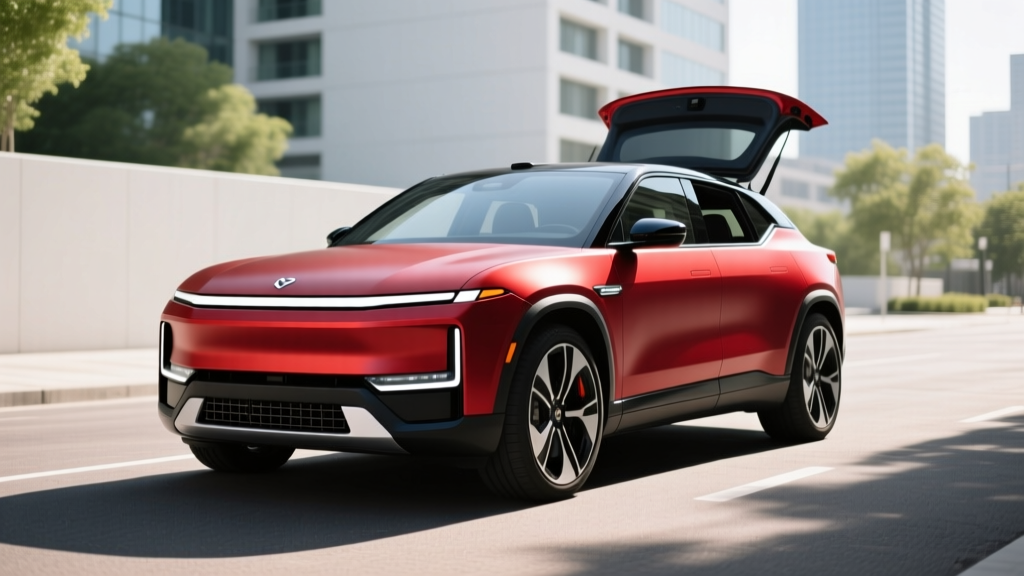
Notably, Rivian's design language carries over from the R1S and R2 — the signature stadium headlights, flat roofline, and squared-off rear hatch. The R3 is expected to offer a front trunk (frunk) for additional sealed storage, though capacity figures have not been confirmed.
Range, Battery & Real-World Efficiency
EPA estimated range (preliminary): ~250 miles (base) to ~330+ miles (extended pack, single motor).
Real-world expectation: Expect highway driving at 70+ mph to reduce range by 10-15% versus EPA estimates. In cold weather (below 32°F), range loss of 20-30% is typical for EVs without aggressive heat-pump preconditioning. A 330-mile EPA R3 could realistically deliver 250-280 miles on a winter highway trip.
Rivian has not published official EPA range or MPGe figures, as the R3 has not entered production. However, based on the efficiency of the R2 platform (which shares architecture) and competitive benchmarks, we project the R3 will achieve approximately 110-125 MPGe combined (roughly 27-30 kWh per 100 miles) for single-motor variants. Dual-motor AWD trims will likely drop to 100-110 MPGe.
For context, the 2025 Hyundai Kona Electric achieves 129 MPGe combined with its 64.8 kWh battery and 261-mile EPA range. The Rivian R3 will need to match or exceed this efficiency to compete, especially given its likely heavier curb weight from Rivian's emphasis on off-road capability and structural rigidity.
Charging Speed: DC Fast & Home Level 2
Charging infrastructure access remains the top concern for EV buyers, and the R3's charging architecture will be critical to its success. Rivian has confirmed the R3 will use the NACS (North American Charging Standard) connector natively, granting access to Tesla's Supercharger network — currently the most reliable DC fast-charging network in the U.S.
| Charging Level | Power / Rate | Estimated Speed |
|---|---|---|
| Level 1 (120V household) | ~1.4 kW | ~3-4 miles per hour |
| Level 2 (240V home/public) | ~11.5 kW (48A) | ~30-35 miles per hour |
| DC Fast Charge (peak) | ~175-200 kW (est.) | 10-80% in ~25-30 minutes |
Rivian's second-generation platform supports an 800-volt electrical architecture in higher trims, though the R3 base trims may use a 400V system to control costs. On a DC fast charger, expect peak charging rates of 175-200 kW for extended-pack models, with the charge curve tapering significantly above 80% state of charge. This means a 10-80% session should take approximately 25-30 minutes at a capable 250 kW Supercharger or Electrify America station, but charging from 80-100% could add another 15-20 minutes.
For home charging, a Level 2 wall connector on a 60-amp circuit (delivering 48 amps continuous) will fully replenish the R3's battery overnight — roughly 8-10 hours for a full charge depending on pack size. Most owners charging nightly from 20-80% will see a full top-up in 5-6 hours.
Performance: 0-60, Horsepower & Drivetrain
Rivian has confirmed the R3 will offer both single-motor rear-wheel-drive and dual-motor all-wheel-drive configurations. Based on platform capabilities and competitive positioning:
- Single Motor (RWD): Estimated 200-250 hp, 0-60 mph in ~7.0-7.5 seconds
- Dual Motor (AWD): Estimated 350-400 hp, 0-60 mph in ~4.5-5.5 seconds
- Performance variant (possible): Rivian has hinted at a potential tri-motor or performance-tuned dual-motor option, which could push 0-60 below 4 seconds
Rivian's torque-vectoring AWD system, first introduced on the R1T and R1S, is expected to carry over in simplified form for the R3. The system can independently control torque to each wheel, improving traction in snow, mud, and sand. Ground clearance of approximately 8.0-8.5 inches (estimated) would give the R3 genuine light-off-road capability unusual in the subcompact EV segment.
Towing capacity has not been disclosed, but given the R3's size and target market, expect a modest 1,500-2,500 lb rating — sufficient for a small utility trailer or a pair of dirt bikes, but not a camper.
Pricing, Trims & Federal Tax Credit Eligibility
Rivian CEO RJ Scaringe has stated the R3 will start at approximately $45,000, positioning it above the cheapest EVs on the market but below the R2 (expected ~$52,000+). Multiple trims are expected:
| Trim | Est. MSRP | §30D Credit Potential | Effective Price |
|---|---|---|---|
| Standard (RWD, base pack) | ~$45,000 | Up to $7,500 | ~$37,500 |
| Premium (AWD, base pack) | ~$50,000 | Up to $7,500 | ~$42,500 |
| Adventure (AWD, extended pack) | ~$55,000 | Up to $7,500 | ~$47,500 |
- MSRP cap: SUVs/crossovers must have an MSRP ≤ $80,000. All R3 trims should qualify.
- Buyer income cap: Modified AGI ≤ $150,000 (single), $225,000 (head of household), $300,000 (joint).
- Battery sourcing: The credit splits into two halves — $3,750 for critical minerals and $3,750 for battery component assembly, both with escalating domestic-content requirements through 2026. Full $7,500 eligibility depends on Rivian's supply chain at time of delivery.
- Point-of-sale transfer: Buyers can transfer the credit to the dealer at purchase, reducing the upfront cost rather than waiting for a tax refund.
Source: IRS.gov — Credits for New Clean Vehicles. Consult a tax professional for eligibility confirmation.
Interior Space, Cargo & Technology
Rivian has shown interior renders of the R3 featuring a minimalist dashboard dominated by a large central touchscreen (expected 15+ inches), a digital instrument cluster, and Rivian's signature use of sustainable materials including vegan leather and recycled textiles. The flat floor should provide generous rear-seat legroom for the segment — estimated at 36-38 inches — though official figures are pending.
Cargo capacity is a key differentiator. Given the Rivian R3 length of approximately 170-175 inches and its squared-off rear hatch, expect:
- Behind second row: ~22-26 cubic feet
- With rear seats folded: ~50-58 cubic feet
- Frunk (front trunk): ~3-5 cubic feet (estimated)
That cargo volume would slot the R3 between the Volvo EX30 (which is notably cargo-limited at 11.2 cu ft rear) and the Hyundai Kona Electric (25.8 cu ft rear). For buyers who need genuine utility in a small package, this is a meaningful advantage.
Driver Assistance & Software
The R3 will ship with Rivian's latest driver-assistance suite, expected to include:
- Adaptive cruise control with stop-and-go
- Lane centering and lane-keep assist
- Automatic emergency braking with pedestrian/cyclist detection
- Blind-spot monitoring with rear cross-traffic alert
- Rivian's Driver+ system (hands-on, eyes-on Level 2 driver assist per SAE classification — not self-driving)
Rivian's over-the-air (OTA) update capability is among the best in the industry, with regular feature additions and performance improvements delivered wirelessly. The R3 is expected to support phone-as-key, camp mode (climate control while parked), and Rivian's adventure-focused navigation with integrated trail guides.
Who the R3 Suits Best & Key Drawbacks
Pros
- NACS connector = native Supercharger access
- Estimated 250-330 mile range across trims
- Strong off-road capability for the segment (8+ in. ground clearance)
- Practical cargo space with frunk
- OTA updates and strong software ecosystem
- Likely qualifies for full $7,500 federal credit
Cons
- Not yet available — production starts 2026
- $45K+ base price exceeds budget EV segment
- Rivian's production ramp history (R1T delays, R2 timeline shifts)
- No official EPA or crash-test ratings yet
- Limited service center network vs. legacy brands
- Dual-motor trims may push past $55K
Best For
- Urban commuters who want Supercharger access for weekend road trips
- Outdoor enthusiasts needing light off-road capability in a small EV
- Small families wanting more cargo space than an EX30 but a smaller footprint than an R2
Consider Instead If
- You need a vehicle now — the Kona Electric, Niro EV, and EX30 are available today
- Your budget is strictly under $35K — look at the Chevy Equinox EV or used EV market
- You tow regularly — the R3's towing capacity will be limited
Frequently Asked Questions
What is the real-world range of the Rivian R3?
Based on preliminary estimates, the R3 should deliver 250-330 miles EPA depending on pack and drivetrain. Real-world highway range at 70+ mph will likely be 10-15% lower, and cold-weather range (below 32°F) may drop 20-30%. Expect 200-280 miles in mixed real-world conditions for most configurations.
How fast does the R3 charge at home and on the road?
On a Level 2 home charger (240V, 48A), expect roughly 30-35 miles of range added per hour — a full overnight charge. On DC fast charging, the R3 should peak at 175-200 kW and charge from 10-80% in approximately 25-30 minutes at a capable station.
How much does the Rivian R3 cost after tax credits?
The base R3 is estimated at ~$45,000 MSRP. If the full $7,500 federal §30D credit applies (subject to income, MSRP, and battery-sourcing requirements), the effective price drops to approximately $37,500. Point-of-sale transfer is available, reducing your upfront cost at the dealer.
Is the Rivian R3 worth buying vs. the Volvo EX30 or Hyundai Kona Electric?
The R3 offers advantages in ground clearance, native NACS/Supercharger access, and likely cargo space. However, the EX30 starts lower (~$36,000) and the Kona Electric is available now with proven EPA ratings. If you can wait for 2026 production and value off-road capability and Tesla charging access, the R3 is compelling. If you need an EV today, buy the Kona or EX30.
Does the Rivian R3 qualify for the federal EV tax credit?
All announced R3 trims fall well under the $80,000 SUV MSRP cap. Eligibility for the full $7,500 depends on your income (≤$150K single / ≤$300K joint), Rivian's battery sourcing compliance at time of delivery, and your tax liability. Consult IRS.gov and a tax professional before relying on the credit.
What is the Rivian R3 length and will it fit in a standard garage?
The Rivian R3 length is estimated at 170-175 inches (roughly 14.2-14.6 feet). A standard single-car garage is typically 20-24 feet deep, so the R3 will fit comfortably with room to spare. It is shorter than the Toyota RAV4 (180.9 in) and similar to the Mazda CX-30 (173.0 in).
Note: All specifications in this article are preliminary estimates based on Rivian disclosures and industry analysis as of 2026. Final EPA ratings, pricing, and availability will be confirmed closer to the R3's production start. Verify all details with Rivian.com and fueleconomy.gov before making a purchase decision.