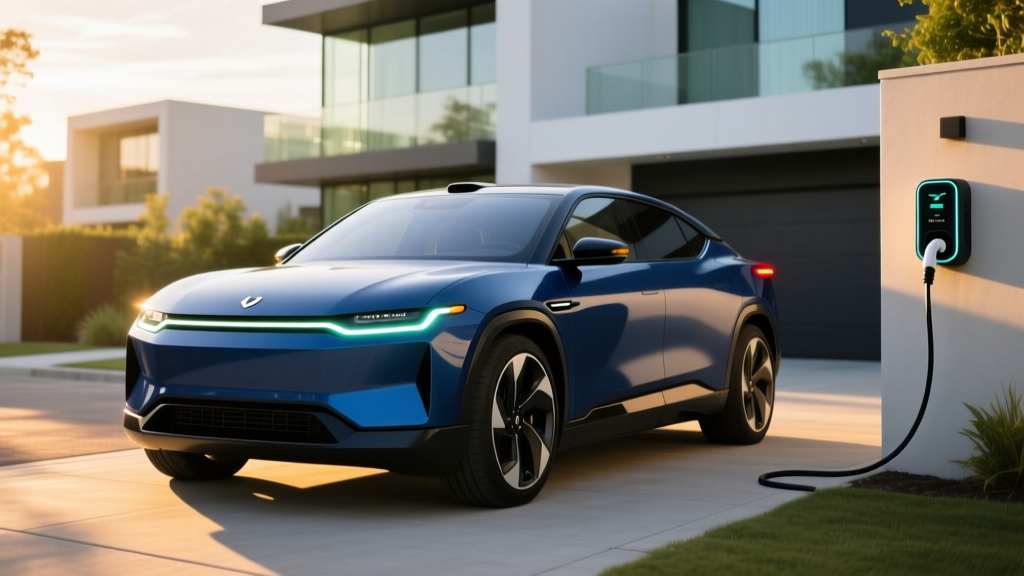
The Rivian R3 has been one of the most anticipated compact electric crossovers since its March 2024 reveal, promising to slot below the R1S and R1T with a more accessible price point. But the biggest question for prospective buyers remains: when can you actually buy one? Here's everything we know about the Rivian R3 launch date, projected specifications, and whether it's worth holding off on a competitor purchase to wait.
Rivian R3 Launch Date: Current Timeline
Rivian CEO RJ Scaringe confirmed the R3 will begin production at the company's Normal, Illinois facility in early 2026, with first customer deliveries expected in the first half of the year. This timeline positions the R3 against established compact EV crossovers like the Volvo EX30, Hyundai Kona Electric, and the upcoming next-generation Tesla Model Y refresh.
The R3 was originally teased alongside the larger R2 platform, but Rivian accelerated the R3 timeline to capture the sub-$45,000 electric crossover segment. Production will initially be limited as Rivian ramps its Georgia plant (destined for R2 production) and continues optimizing its Illinois assembly line. Expect initial allocation to favor reservation holders who placed deposits as early as 2024.
Projected Range, Battery & Efficiency
| Spec | Estimate |
|---|---|
| EPA Est. Range | ~300+ miles (target) |
| Battery Capacity | ~75-85 kWh usable (LFP expected for base) |
| Max DC Fast Charge | ~175-200 kW peak (projected) |
| 10-80% DC Charge | ~25-30 minutes (estimated) |
| Level 2 Home Charge | ~11.5 kW / ~30 mi/hr |
| 0-60 mph | ~5.5-6.5 sec (dual-motor AWD) |
| Horsepower | ~350-400 hp (dual-motor) |
| Drivetrain | Single-motor RWD / Dual-motor AWD |
| Base MSRP (est.) | $45,000 (target) |
The R3's efficiency will likely land between 3.0-3.5 kWh/mile (roughly 100-115 MPGe combined), competitive with the Hyundai Kona Electric's 129 MPGe and Volvo EX30's projected 110 MPGe. Rivian's thermal management system, proven in the R1S and R1T, should help mitigate cold-weather range loss better than some competitors.
Charging Speed & Home Setup
| Level | Power | Miles Added/Hour | Use Case |
|---|---|---|---|
| Level 1 (120V) | ~1.4 kW | ~4-5 mi/hr | Overnight trickle |
| Level 2 (240V) | ~11.5 kW | ~30 mi/hr | Daily home charging |
| DC Fast Charge | ~175-200 kW peak | ~600+ mi/hr (peak) | Road trips |
Rivian has not published official charge curve data, but based on the R1 platform's 200 kW peak capability and the R3's smaller battery, expect 10-80% charging in roughly 25-30 minutes at a compatible 350 kW DC fast charger. The charge curve will taper significantly above 80% state of charge — a 10-90% session could take 40-45 minutes. For road trips, plan stops around the 10-80% sweet spot to minimize dwell time.
At home, an 11.5 kW Level 2 wall connector (requiring a 60-amp dedicated circuit) will fully replenish the R3's battery in roughly 7-8 hours. Installation costs typically range from $800-$2,000 depending on panel capacity and conduit run length. If your home has a 100-amp electrical panel, a $1,500-$3,000 panel upgrade may be necessary.
Pricing, Trims & Federal Tax Credit Eligibility
| Trim | Est. MSRP | After §30D Credit |
|---|---|---|
| Base (RWD, LFP) | $45,000 | ~$37,500 (if eligible) |
| Adventure (AWD, NMC) | $52,000 | ~$44,500 (if eligible) |
| Performance (AWD, NMC) | $58,000 | ~$50,500 (if eligible) |
Interior, Cargo & Tech
The R3 is a compact crossover, roughly the size of a Subaru Crosstrek or Mazda CX-5, with seating for five. Expect cargo volume around 25-30 cubic feet behind the rear seats and 55-60 cubic feet with the rear seats folded — competitive for the segment but smaller than the R1S's 105 cu ft. Rear legroom should accommodate adults comfortably on shorter trips, though taller passengers may prefer the R1S for long hauls.
Tech features will mirror Rivian's current R1 platform: a 15.6-inch center touchscreen, digital instrument cluster, wireless Apple CarPlay/Android Auto, over-the-air updates, and Rivian's Driver+ assistance suite (adaptive cruise control, lane centering, automatic emergency braking). Driver+ is a Level 2 system — the driver must remain engaged and hands on or near the wheel. It is not autonomous driving.
A front trunk (frunk) is confirmed, adding roughly 8-10 cubic feet of secure, weatherproof storage — useful for groceries, charging cables, or gear you want separated from the cabin.
Who Should Wait for the Rivian R3?
- Commuters with home charging who want 300-mile range for occasional road trips
- Urban and suburban buyers who find the R1S too large for daily parking
- Adventure-oriented buyers who want Rivian's build quality and software at a lower price point
- Buyers who can wait until mid-2026 for delivery and want to maximize federal tax credit eligibility
- You need a vehicle in the next 3-6 months — the Hyundai Kona Electric, Volvo EX30, and Kia Niro EV are available now
- You regularly carry more than four adults or tow — the R1S or a three-row EV like the Kia EV9 is more practical
- You live in a charging desert with limited DC fast-charging infrastructure — a PHEV may be a safer bridge
Rivian R3 vs. Competitors
| Model | EPA Range | Base MSRP | Max DC kW |
|---|---|---|---|
| Rivian R3 (est.) | ~300 mi | $45,000 | ~200 kW |
| Volvo EX30 | 275 mi | $36,350 | 153 kW |
| Hyundai Kona Electric | 261 mi | $32,975 | 100 kW |
| Kia Niro EV | 239 mi | $39,600 | 77 kW |
The R3's projected range and charging speed would lead the segment, but at a higher entry price than the Kona Electric or EX30. The trade-off is Rivian's software experience, build quality, and adventure-oriented branding. If budget is the primary concern, the Kona Electric offers compelling value. If range and charging speed matter most, the R3 (or waiting for the Tesla Model Y refresh) may be worth the premium.
Warranty & Ownership Costs
Rivian's current warranty covers the battery and powertrain for 8 years or 175,000 miles (whichever comes first), with a capacity retention threshold of 70% over that period. The limited vehicle warranty is 5 years or 60,000 miles. Expect the R3 to follow this structure, though official terms will be confirmed at launch.
Insurance premiums for Rivian vehicles have historically been higher than segment averages due to repair costs and parts availability. Expect $2,200-$3,000 annually for the R3 depending on your location, driving record, and coverage level — roughly 15-25% more than a comparable Kona Electric or Niro EV.
Frequently Asked Questions
When will the Rivian R3 be available for purchase?
Production begins early 2026 at Rivian's Normal, Illinois facility, with first deliveries expected in the first half of 2026. Reservations are open now with a refundable deposit.
What is the real-world range of the Rivian R3?
Rivian targets 300+ miles EPA, but expect 260-280 miles in mixed highway driving and 220-240 miles in cold weather (below 32°F). Actual range depends on driving style, terrain, and climate control use.
How fast does the R3 charge at home and on the road?
At home on a Level 2 (240V, 48-amp) charger, expect ~30 miles of range added per hour, or a full charge in 7-8 hours. On a DC fast charger, expect 10-80% in roughly 25-30 minutes at a 350 kW station, tapering above 80%.
Does the Rivian R3 qualify for the $7,500 federal tax credit?
Likely yes for base and mid trims, provided the buyer meets income caps ($150K single / $300K joint AGI) and Rivian's battery sourcing complies with 2026 IRS critical mineral and component rules. Confirm eligibility at purchase via the IRS §30D guidelines.
Is the R3 worth waiting for vs. buying a Kona Electric or EX30 now?
If you need a vehicle immediately and prioritize budget, the Kona Electric ($32,975) or EX30 ($36,350) are strong choices available now. If you can wait until mid-2026 and want 300-mile range, faster charging, and Rivian's software platform, the R3 is worth the hold.
Will the R3 have a frunk and how much cargo space?
Yes, the R3 includes a front trunk (frunk) for secure storage. Total cargo volume is estimated at 25-30 cu ft behind the rear seats and 55-60 cu ft with seats folded — competitive for the compact crossover segment.