Rivian R3: A Compact EV SUV With Big Shoes to Fill
The Rivian R3 is the automaker's bid to crack the high-volume compact electric crossover segment — a space currently dominated by the Tesla Model Y, Hyundai Ioniq 5, and Volvo EX30. First revealed in March 2024 alongside the midsize R2, the R3 is slated for production in 2026 at Rivian's Normal, Illinois facility. While final EPA certification and pricing won't be locked until closer to launch, Rivian has shared enough engineering detail for a thorough preview of what buyers can expect — especially regarding the Rivian R3 interior, powertrain options, and charging architecture.
This preview synthesizes Rivian's announced specifications, platform details shared during the R2 reveal event, and industry-standard estimations to give prospective buyers a realistic picture. Where figures are preliminary, we flag them clearly.
Rivian R3 Interior: Dimensions, Layout, and Cargo
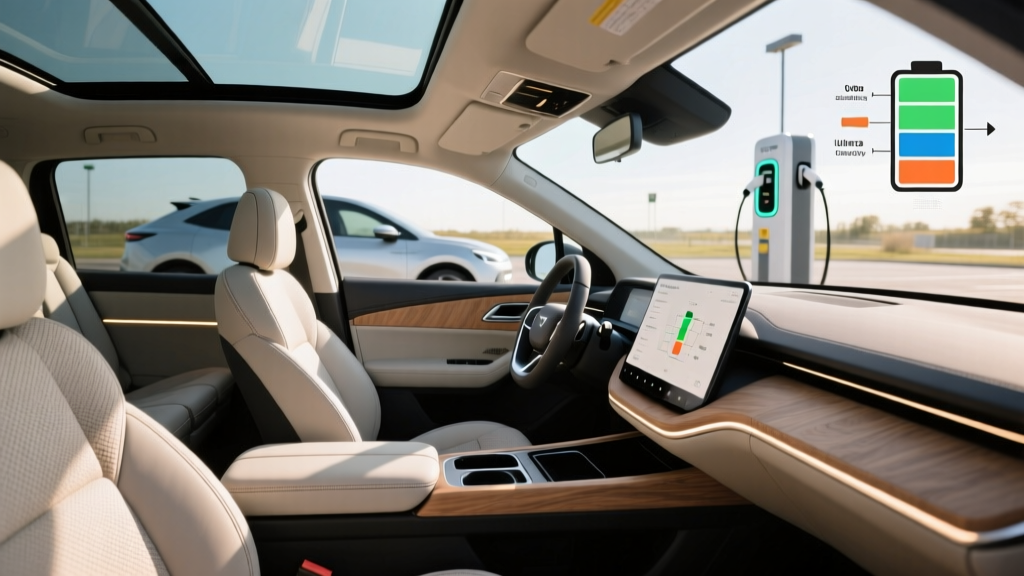
The Rivian R3 interior is designed around a sub-180-inch footprint — shorter than the R1S but taller and more spacious than a typical hatchback. Rivian has positioned the R3 as an "adventure-capable compact," which translates to a cabin that prioritizes vertical space, modular storage, and durable materials over luxury sedan opulence.
Cabin Layout and Seating
Expect a five-passenger, two-row configuration. Rivian's design language carries forward from the R1S and R2: a minimalist dashboard anchored by a central 15.4-inch landscape touchscreen, a compact digital instrument cluster, and a flat-bottom steering wheel. The center console features a pass-through storage area (a Rivian signature), and the rear seats are expected to fold nearly flat for cargo flexibility.
Cargo Volume and Dimensions (Estimated)
| Measurement | Estimated Spec |
|---|---|
| Rear cargo (seats up) | ~25 cu ft |
| Rear cargo (seats folded) | ~55 cu ft |
| Front trunk (frunk) | ~7 cu ft |
| Front legroom | ~41 in |
| Rear legroom | ~37 in |
| Front headroom | ~40 in |
| Rear headroom | ~38 in |
These figures position the R3 between the Hyundai Ioniq 5 (27.2 / 59.3 cu ft cargo) and the Volvo EX30 (11.2 / 32.4 cu ft) — closer to the Ioniq 5 in utility but in a smaller exterior package. The frunk adds weatherproof storage for charging cables or gear.
Materials and Durability
Rivian's adventure ethos means vegan leather upholstery with reinforced, wipe-clean surfaces on lower door panels and seatbacks. Expect available canvas-style seat inserts and rubberized floor mats as dealer accessories — similar to the R1S Adventure package. The Rivian R3 interior leans utilitarian-chic rather than plush, which suits the target buyer but may disappoint those cross-shopping the Genesis GV60 or Mercedes EQB.
Range, Battery, and Efficiency
The R3 will ride on a shorter-wheelbase variant of Rivian's new midsize platform (shared with the R2). This architecture supports both NMC (nickel manganese cobalt) and LFP (lithium iron phosphate) battery chemistries, though Rivian has not confirmed which will ship in the R3 at launch.
- Battery capacity: ~65–75 kWh usable (chemistry TBD; likely NMC for Long Range, LFP for Standard Range)
- EPA estimated range: ~270 mi (Standard Range) / ~315 mi (Long Range) — preliminary
- Efficiency: ~3.5–4.0 mi/kWh (~25–29 kWh/100 mi)
EPA estimates are measured under controlled conditions. In real-world highway driving at 70–75 mph, expect the Long Range R3 to deliver roughly 260–280 miles before needing a charge. In cold weather (below 30°F), range can drop 15–25%, bringing the Long Range down to approximately 235–265 miles. City driving with regenerative braking will push closer to or slightly above the EPA sticker. These estimates are based on platform efficiency data from the R2 and industry norms for compact crossovers in this weight class.
Rivian's thermal management system — a heat pump with liquid-cooled battery conditioning — should mitigate cold-weather losses compared to older EVs without heat pumps. Preconditioning the battery while plugged in (via the Rivian app or scheduled departure) will preserve range and optimize DC fast-charge speeds in winter.
Charging Speed: DC Fast, Level 2, and Home Setup
Charging speed is where the R3's new platform should shine. The R2/R3 architecture is confirmed to support NACS (North American Charging Standard) natively — meaning direct access to Tesla Supercharger stalls (now open to non-Tesla EVs) without an adapter.
| Charging Level | Power / Rate | Estimated Speed |
|---|---|---|
| Level 1 (120V household) | ~1.4 kW | ~3–4 mi/hr |
| Level 2 (240V home, 48A) | ~11.5 kW | ~30–34 mi/hr |
| DC Fast Charge (peak) | ~175–200 kW (est.) | 10–80% in ~25–30 min |
Understanding the Charge Curve
Peak DC fast-charge rates (the headline kW number) are only sustained at low states of charge — typically between 10–40% SoC. As the battery fills, the charge rate tapers to protect cell health. A "200 kW peak" does not mean 200 kW for the full session. Expect the R3 to hold above 150 kW through roughly 50% SoC, then taper progressively. This is standard for NMC lithium-ion packs and is managed by the vehicle's battery management system (BMS).
For home charging, a 48-amp Level 2 wall connector on a 60-amp circuit will add roughly 30–34 miles of range per hour — enough to fully replenish the R3 overnight. Installation costs for a Level 2 home charger typically range from $500 (simple outlet near panel) to $2,500+ (panel upgrade, long conduit runs). Always consult a licensed electrician for final specs.
Performance and Drivetrain
Rivian has historically offered dual-motor AWD as standard, but the R2/R3 platform introduces a single-motor rear-wheel-drive option to hit lower price points. Here's what to expect:
| Variant | Drivetrain | Est. Horsepower | Est. 0–60 mph |
|---|---|---|---|
| Standard Range RWD | Rear-wheel drive | ~280 hp | ~6.5 sec |
| Long Range AWD (Dual Motor) | All-wheel drive | ~450 hp | ~4.5 sec |
| Performance AWD (if offered) | All-wheel drive | ~550+ hp | ~3.5 sec |
The dual-motor AWD variant will likely feature Rivian's torque-vectoring system, which can independently distribute power front and rear for improved traction on loose surfaces — a meaningful advantage over competitors like the Ioniq 5 and Model Y in light off-road or snowy conditions. Ground clearance is expected around 7.5–8.0 inches, adequate for forest service roads and deep snow but not rock-crawling territory.
Pricing, Trims, and Federal Tax Credit Eligibility
Rivian CEO RJ Scaringe has stated the R3 will start "well under $40,000," with the base Standard Range RWD model targeting approximately $35,000–$38,000 MSRP before incentives. A Long Range AWD variant is expected in the $42,000–$46,000 range.
| Trim (Est.) | Est. MSRP | Potential §30D Credit | Est. Net Price |
|---|---|---|---|
| Standard Range RWD | $36,000 | Up to $7,500 | ~$28,500 |
| Long Range AWD | $44,000 | Up to $7,500 | ~$36,500 |
| Performance AWD | $50,000+ | Up to $7,500 | ~$42,500+ |
Federal Tax Credit Rules (§30D) — Key Caveats
The IRS §30D Clean Vehicle Credit offers up to $7,500, but eligibility is not automatic. Current requirements include:
- MSRP cap: SUVs must be under $80,000 — the R3 easily qualifies.
- Buyer income cap: Modified AGI must not exceed $150,000 (single) / $300,000 (joint).
- Battery sourcing: Critical minerals and battery components must meet phased-in domestic/free-trade-area sourcing thresholds. These thresholds tighten annually.
- Point-of-sale transfer: Buyers can transfer the credit to the dealer at purchase, reducing the out-of-pocket price directly.
Because battery-sourcing rules change yearly and depend on Rivian's supply chain at time of delivery, consult a tax professional and check the IRS's updated eligible-vehicle list closer to your purchase date. Rivian's U.S. manufacturing (Normal, IL) is an advantage for domestic-content requirements.
Tech, Driver Assists, and Standout Features
The R3 will inherit Rivian's latest software stack, which has matured significantly since the R1T/R1S launch. Key expected features:
- Infotainment: 15.4-inch center touchscreen with wireless Apple CarPlay and Android Auto, over-the-air updates, integrated trail maps and campsite database.
- Driver assistance: Rivian Driver+ (adaptive cruise, lane-centering, automatic emergency braking, blind-spot monitoring). This is an SAE Level 2 system — the driver must remain attentive and hands on or near the wheel at all times.
- Gear Tunnel (if offered): A transverse pass-through storage compartment behind the rear seats — a Rivian hallmark from the R1T, adapted for the R3's smaller footprint.
- Camp Mode & Pet Mode: Climate-control presets for overnight camping or leaving pets in the vehicle safely.
- V2L (Vehicle-to-Load): Expected 120V outlet capability for powering camp appliances or tools — confirm at launch.
Rivian Driver+ is a Level 2 advanced driver-assistance system. It is not autonomous or self-driving. The driver is legally and operationally responsible for steering, braking, and monitoring traffic at all times. Hands-off systems like GM's Super Cruise (on approved highways) offer more hands-free capability, but no consumer vehicle sold today is Level 4 or Level 5.
Warranty and Ownership Costs
Rivian's current warranty structure for the R1 series provides a strong baseline for what R3 buyers can expect:
- Battery & drive unit: 8 years / 100,000 miles (minimum 70% capacity retention)
- Limited vehicle warranty: 5 years / 60,000 miles
- Corrosion perforation: 5 years / unlimited miles
The 8-year/100,000-mile battery warranty is industry-standard and aligns with federal mandates for emissions-related components. Rivian's 70% capacity retention threshold is typical; some competitors (like Hyundai) warrant to 70% over 10 years/100,000 miles. Battery replacement cost for a ~70 kWh pack, if needed out of warranty, is estimated at $8,000–$12,000 based on current cell pricing trends — though most EV batteries retain well above 80% capacity at 150,000 miles with proper care.
Pros, Cons, and Who Should Buy
- NACS native — no adapter for Superchargers
- Strong estimated range (300+ mi Long Range)
- AWD with torque vectoring for real adventure use
- U.S.-built (Illinois) — strong tax-credit odds
- Practical Rivian R3 interior with frunk + flexible cargo
- OTA software updates and adventure-focused features
- Not yet available — production expected 2026
- Final EPA range and pricing unconfirmed
- Rivian's service center network still expanding
- Driver+ is Level 2 only (no hands-free highway mode yet)
- Compact rear seat may feel tight for tall passengers on long trips
- Insurance premiums for new EV models can run 15–25% above segment average
Who the Rivian R3 Suits Best
The R3 targets active singles, couples, and small families who want a compact EV that can handle weekend camping, ski trips, and daily commuting without the bulk (or price) of the R1S. If you need three rows, tow more than 3,500 lbs, or require a hands-free highway driving system, look at the R1S, Kia EV9, or GM Super Cruise-equipped vehicles instead. The R3 is ideal for buyers who value ground clearance, NACS Supercharger access, and a durable interior over luxury finishes.
Frequently Asked Questions
What is the real-world range of the Rivian R3?
Based on preliminary Long Range estimates of ~315 miles EPA, expect roughly 260–280 miles in real-world highway driving and 235–265 miles in cold weather (below 30°F). The Standard Range variant should deliver ~220–240 miles real-world. Final EPA certification will come closer to the 2026 production date.
How fast does the R3 charge at home and on the road?
At home on a 240V Level 2 charger (48A), the R3 should add approximately 30–34 miles of range per hour, achieving a full charge overnight. On DC fast chargers, the estimated peak rate of 175–200 kW should enable a 10–80% charge in roughly 25–30 minutes, with taper above 50% SoC as the BMS protects cell longevity.
How much will the Rivian R3 cost after tax credits?
The base Standard Range RWD model is estimated at ~$36,000 MSRP. If the full $7,500 §30D credit applies (subject to income, sourcing, and MSRP rules), the effective price could drop to approximately $28,500. The Long Range AWD at ~$44,000 could net to ~$36,500. Always verify eligibility with a tax professional and the IRS Clean Vehicle Credit page at time of purchase.
Does the Rivian R3 qualify for the federal EV tax credit?
Based on current rules, the R3 is a strong candidate: it will be assembled in the U.S. (Normal, IL), its MSRP will be well under the $80,000 SUV cap, and Rivian's North American supply chain positions it favorably for critical-mineral and battery-component sourcing thresholds. However, eligibility can change annually. Check fueleconomy.gov for the updated eligible-vehicle list before purchasing.
Is the R3 worth waiting for vs. competitors?
If you need an EV today, the Tesla Model Y, Hyundai Ioniq 5, and Kia EV6 are proven, available alternatives with established charging and service networks. The R3's advantages — native NACS, genuine adventure capability, Rivian's software ecosystem, and likely strong tax-credit eligibility — make it worth considering if your purchase timeline aligns with 2026 production. Reservation holders should watch for final spec and pricing announcements from Rivian.
What's the biggest unknown about the R3 right now?
Battery chemistry confirmation (LFP vs. NMC by trim), final EPA range certification, and exact DC fast-charge peak kW are the three biggest open questions. Rivian has historically been conservative with range estimates, often exceeding them in real-world use — but buyers should wait for official EPA numbers before making a final decision.