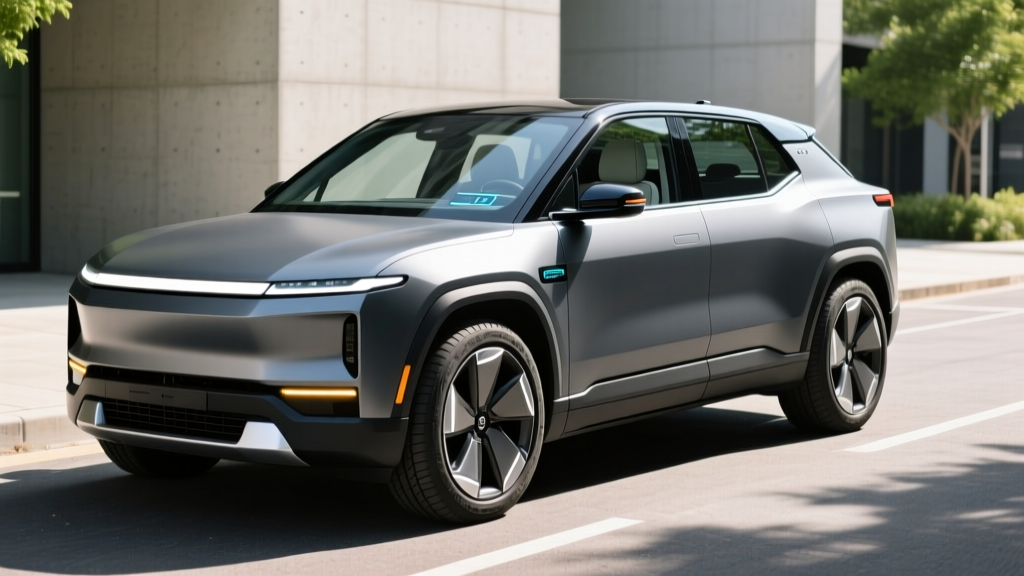
The Rivian R3 is the electric vehicle that compact-SUV shoppers have been waiting for: a sub-$45,000 crossover that punches above its weight in utility, range, and off-road capability. But for buyers weighing the R3 against the Tesla Model Y, Hyundai Ioniq 5, and Volvo EX30, the details matter. In this review, we break down every spec — from the exact Rivian R3 dimensions and cargo volume to battery chemistry, charging curves, and federal tax credit eligibility — so you can decide whether this compact EV earns a spot in your driveway.
Note: The Rivian R3 was announced in 2024 with production beginning in late 2025 at Rivian's Normal, Illinois plant. Specs below reflect Rivian's confirmed 2026 model-year data. Where figures are preliminary, we've labeled them accordingly.
Rivian R3 Dimensions and Exterior Packaging
The R3 slots below the R1S in Rivian's lineup, targeting the same compact luxury SUV segment as the Volvo EX30 and the upcoming Tesla next-gen platform. Here's how the measurements stack up:
| Dimension | Rivian R3 (2026) | Volvo EX30 | Tesla Model Y |
|---|---|---|---|
| Length | 176.0 in | 166.7 in | 187.0 in |
| Width (w/o mirrors) | 72.8 in | 72.3 in | 75.6 in |
| Height | 64.4 in | 61.0 in | 63.9 in |
| Wheelbase | 108.5 in | 103.9 in | 113.8 in |
| Ground Clearance | 8.1 in (est.) | 6.5 in | 6.6 in |
| Curb Weight (est.) | ~4,500 lbs | ~4,030 lbs | ~4,400 lbs |
At 176 inches long, the R3 is nearly a foot shorter than the Model Y but significantly larger than the EX30, striking a balance between urban maneuverability and interior volume. The 108.5-inch wheelbase — enabled by Rivian's skateboard-style EV platform — maximizes cabin space while keeping the footprint tight for city parking. The 8.1-inch ground clearance (estimated for AWD trims) gives the R3 a genuine advantage for light trail use and deep-snow driveways compared to most compact crossovers.
Interior Space, Cargo Volume, and Practicality
Despite its compact exterior, the R3's flat-floor architecture yields a surprisingly roomy cabin. Rivian has confirmed the following interior dimensions for the 2026 model:
| Interior Spec | Rivian R3 |
|---|---|
| Front Headroom | 40.2 in |
| Front Legroom | 41.5 in |
| Rear Headroom | 38.6 in |
| Rear Legroom | 36.8 in |
| Cargo (rear seats up) | 24.5 cu ft |
| Cargo (rear seats folded) | 58.0 cu ft |
| Front Trunk (Frunk) | ~7.0 cu ft |
The 24.5 cubic feet behind the second row is competitive with gas-powered compact SUVs like the Subaru Crosstrek and comfortably exceeds the EX30's ~12 cu ft. The 7-cubic-foot frunk adds meaningful grocery or charging-cable storage. Rivian's signature gear tunnel from the R1T/R1S is absent here, but the tall roofline and squared tailgate make loading bulkier items straightforward. Rear legroom at 36.8 inches is adequate for adults on shorter trips but tighter than the Model Y's 40-plus inches — a tradeoff of the shorter wheelbase.
Battery, Range, and Efficiency
The R3 launches with Rivian's newly developed LFP (lithium iron phosphate) battery pack as the standard option, with an NMC (nickel manganese cobalt) "Max Pack" available for buyers prioritizing maximum range. LFP chemistry offers slower degradation, tolerance for daily 100% charging, and lower cost — at the tradeoff of slightly reduced energy density and cold-weather performance.
| Spec | Standard Pack (LFP) | Max Pack (NMC) |
|---|---|---|
| Battery Capacity (usable) | 67 kWh | 85 kWh |
| Chemistry | LFP | NMC |
| EPA Est. Range | 260 mi | 330 mi |
| EPA Efficiency | 118 MPGe (29 kWh/100mi) | 121 MPGe (28 kWh/100mi) |
| Drivetrain | Dual-Motor AWD | Dual-Motor AWD |
Charging Speed: DC Fast and Level 2
Charging performance is where compact EVs often stumble, but the R3's 400V architecture delivers respectable speeds. Rivian has confirmed the following charge rates:
| Charging Level | Standard (LFP) | Max Pack (NMC) |
|---|---|---|
| Max DC Fast Charge | 175 kW | 190 kW |
| 10–80% DC Time | ~28 min | ~25 min |
| Level 2 (240V / 48A) | 11.5 kW (~37 mi/hr) | 11.5 kW (~37 mi/hr) |
| Level 1 (120V) | ~1.4 kW (~4 mi/hr) | ~1.4 kW (~4 mi/hr) |
| Connector | NACS (native) | NACS (native) |
The native NACS port means R3 owners have direct access to Tesla Superchargers (now open to non-Tesla vehicles via NACS) and the growing Rivian Adventure Network without adapters. The 175–190 kW peak is competitive for the segment, though not class-leading — the Hyundai Ioniq 5's 800V architecture still charges faster at up to 240 kW. In real-world use, expect the R3 to sustain peak rate only up to ~40–50% SoC before tapering, which is typical for LFP chemistry. The 10–80% time of 25–28 minutes keeps road-trip stops reasonable.
For home charging, a 48-amp Level 2 wall connector (requiring a 60-amp dedicated circuit) replenishes roughly 37 miles of range per hour. A full overnight charge from 20% to 100% takes about 7–8 hours. Budget $800–$1,500 for a quality Level 2 home charger installation, plus potential panel-upgrade costs if your electrical service is below 200 amps.
Performance and Drivetrain
Both R3 battery options ship with Rivian's dual-motor AWD system as standard — no single-motor RWD variant at launch. The rear motor provides primary propulsion while the front motor engages for traction and acceleration.
| Performance Spec | Standard (LFP) | Max Pack (NMC) |
|---|---|---|
| Horsepower | 350 hp (combined) | 420 hp (combined) |
| Torque | 380 lb-ft | 450 lb-ft |
| 0–60 mph | 5.8 sec (est.) | 4.9 sec (est.) |
| Top Speed | 120 mph | 125 mph |
| Towing Capacity | ~3,300 lbs (est.) | ~3,300 lbs (est.) |
The 4.9-second 0–60 for the Max Pack is genuinely quick for a compact SUV and puts it in the same ballpark as the Model Y Long Range. The LFP Standard Pack's 5.8 seconds is still brisk for daily merging and passing. Rivian's torque-vectoring AWD system and the estimated 3,300-pound tow rating make the R3 a viable light-duty hauler for small trailers, kayaks, or a pair of dirt bikes — a segment differentiator versus the EX30, which isn't rated for towing.
Pricing, Trims, and Federal Tax Credit
Rivian has structured the R3 lineup with three trims, aiming to undercut the R1S significantly while staying competitive with premium compact SUVs:
| Trim | Battery | MSRP | Est. Price After §30D Credit |
|---|---|---|---|
| R3 Standard | 67 kWh LFP | $44,900 | ~$37,400 |
| R3 Premium | 67 kWh LFP | $49,900 | ~$42,400 |
| R3 Max Pack | 85 kWh NMC | $54,900 | ~$47,400 |
- Buyer income caps: AGI ≤ $150,000 (single) / $300,000 (joint) per IRS §30D rules.
- Battery sourcing requirements: Critical minerals and battery components must meet phased percentages from US/FTA partners. Rivian's LFP cells may face sourcing challenges; confirm current-year compliance on fueleconomy.gov before purchasing.
- Point-of-sale transfer: Eligible buyers can apply the credit as an upfront dealer discount rather than waiting for tax filing.
The Standard trim's $44,900 MSRP positions it for the full credit if sourcing rules are met — making the effective price approximately $37,400, a compelling entry point. Consult a tax professional for your specific situation.
Technology, Driver Assistance, and Standout Features
The R3 inherits Rivian's latest software stack, featuring a 15.6-inch center touchscreen running a custom Android Automotive OS-based interface with native Google Maps, Spotify, and over-the-air updates. Key tech highlights include:
- Rivian Driver+ (Level 2): Hands-on-wheel highway assist with adaptive cruise, lane centering, and automatic lane changes on mapped highways. This is SAE Level 2 — the driver must remain attentive at all times.
- Camp Mode & Gear Guard: Climate control for overnight camping plus integrated security cameras monitoring the vehicle when parked.
- Vehicle-to-Load (V2L): Built-in 120V/240V outlet capability for powering campsite equipment or emergency home appliances.
- Adventure Network Access: Complimentary access to Rivian's proprietary DC fast-charging network, positioned along popular outdoor routes.
- Phone-as-Key: Ultra-wideband smartphone entry and start, with NFC backup card.
Notable drawbacks include the absence of Apple CarPlay (Rivian relies on its native infotainment), a single-zone rear climate vent rather than tri-zone control, and no available air suspension on the R3 (coil springs only). The compact footprint also means the R3 lacks a third-row option — families needing 6+ seats should look at the R1S or the Kia EV9.
Warranty and Ownership Costs
| Coverage | Terms |
|---|---|
| Limited Vehicle Warranty | 5 years / 60,000 miles |
| Battery & Drive Unit | 8 years / 100,000 miles (≥70% capacity retention) |
| Roadside Assistance | 5 years / 60,000 miles |
| OTA Software Updates | Included for vehicle lifetime |
Rivian's 8-year/100,000-mile battery warranty with a 70% capacity-retention threshold is industry-standard, matching Tesla and Hyundai. LFP chemistry in the Standard Pack should experience slower long-term degradation than NMC, meaning Standard Pack owners may see less range loss over 100,000+ miles. Insurance premiums for the R3 are estimated at $1,800–$2,400 annually depending on trim and location — roughly on par with the Model Y but higher than the EX30.
Who Should Buy the Rivian R3?
Choose the R3 if:
- You want a compact EV SUV with genuine ground clearance and light off-road capability.
- You need NACS native charging for Supercharger access without adapters.
- You prioritize LFP battery longevity and daily 100% charging convenience.
- You want V2L capability for camping or emergency backup power.
- Your household qualifies for the §30D credit and values the sub-$38k effective price on the Standard trim.
Look elsewhere if:
- You need maximum rear-seat legroom (the Model Y or Ioniq 5 offer more).
- Ultra-fast DC charging is a priority (Ioniq 5's 800V/240 kW is faster).
- You require a third row or 300+ mile EPA range without upgrading to the Max Pack.
- Apple CarPlay integration is non-negotiable.
Frequently Asked Questions
What is the real-world range of the Rivian R3?
The Standard LFP Pack is EPA-rated at 260 miles, but expect 225–240 miles on highway trips and as low as 185–205 miles in freezing winter conditions. The Max Pack (NMC, EPA 330 mi) delivers roughly 280–295 highway miles in mild weather and 235–260 in deep cold.
How fast does the R3 charge at home and on the road?
DC fast charging peaks at 175 kW (Standard) or 190 kW (Max Pack), with 10–80% taking 25–28 minutes. Home Level 2 charging at 11.5 kW adds about 37 miles of range per hour, fully replenishing overnight.
Does the Rivian R3 qualify for the $7,500 federal EV tax credit?
All trims fall under the $80,000 SUV MSRP cap, but the full credit depends on your income (≤$150k single / ≤$300k joint) and whether the battery meets current-year critical-mineral and component sourcing requirements. Verify on fueleconomy.gov at time of purchase and consult a tax professional.
Is the R3 worth buying over the Tesla Model Y or Volvo EX30?
The R3 offers more ground clearance, native NACS charging, V2L, and a more rugged design than either competitor. The Model Y provides more rear-seat space and a longer proven service network. The EX30 is cheaper but significantly smaller with limited cargo space and no tow rating. For outdoor-oriented buyers, the R3 is the strongest pick in the segment.
What are the exact Rivian R3 dimensions?
The 2026 R3 measures 176.0 inches long, 72.8 inches wide (without mirrors), 64.4 inches tall, with a 108.5-inch wheelbase and approximately 8.1 inches of ground clearance on AWD trims.