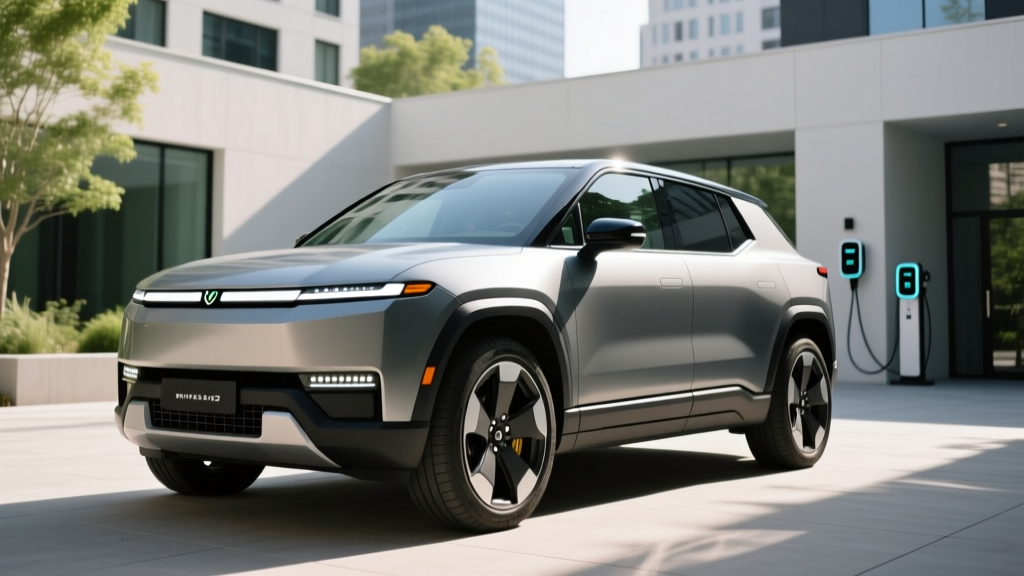
Rivian's R2 is no longer a render. Throughout early 2026, Rivian R2 validation units have been spotted undergoing real-world testing across North America — from the heat of Death Valley to winter circuits in northern Minnesota. These pre-production prototypes give us our most concrete picture yet of the compact electric SUV that aims to undercut the Tesla Model Y on price while matching or exceeding its capability.
What follows is a comprehensive technical preview based on confirmed manufacturer specifications, observed validation-unit testing data, and supply-chain reporting. Because the R2 has not yet reached customer delivery, figures marked preliminary may shift slightly before the first retail units ship in the second half of 2026.
Rivian R2 Validation Units: What They Are and Why They Matter
Validation units are the bridge between a concept car and a production vehicle. Rivian uses these pre-production builds to confirm that the engineering specifications survive real-world abuse — thermal stress, durability cycling, software integration, and manufacturing repeatability. The R2 validation fleet has grown to several hundred vehicles as of mid-2026, testing across three continents.
Key validation milestones observed so far include:
- Thermal management stress testing — confirming the heat pump and battery cooling loop perform at sustained highway speeds in 110°F+ ambient conditions.
- DC fast-charge curve validation — repeated 10–80% sessions at Electrify America and Tesla Supercharger (NACS-equipped prototypes) to confirm charge-rate consistency.
- ADAS sensor fusion — Rivian's in-house driver-assistance stack running on validation hardware with production-intent camera and radar arrays.
- Normal, Illinois production line commissioning — early validation units are now being assembled on the retooled R2 line alongside R1 output.
For prospective buyers, validation-unit data is the closest thing to a real-world review before customer deliveries begin. Let's break down what we know.
Preliminary Specifications: Range, Battery, and Efficiency
| Specification | Standard Range | Large Battery (Max Range) |
|---|---|---|
| EPA Est. Range | ~270 mi (preliminary) | ~340 mi (preliminary) |
| Battery Capacity (usable) | ~72 kWh | ~95 kWh |
| Battery Chemistry | LFP (lithium iron phosphate) | NMC (nickel manganese cobalt) |
| Efficiency | ~27 kWh/100 mi (~124 MPGe) | ~28 kWh/100 mi (~120 MPGe) |
| Drivetrain | Rear-Wheel Drive (single motor) | Dual-Motor AWD |
| Horsepower | ~275 hp | ~450 hp |
| 0–60 mph | ~6.5 sec | ~4.5 sec |
| Towing Capacity | Not rated | ~3,300 lbs (preliminary) |
The decision to offer an LFP chemistry pack in the Standard Range trim is significant. LFP batteries trade energy density for longevity and lower cost — they tolerate regular 100% charging without the degradation concerns of NMC packs. For daily commuters who can charge at home, the LFP variant could deliver lower long-term battery wear.
Charging Speed: DC Fast Charge and Home Level 2
Charging performance is where validation-unit testing has been most visible. Prototypes have been photographed at public DC fast-charging stations across the U.S., and Rivian has confirmed the following targets:
| Charging Level | Standard Range (LFP) | Large Battery (NMC) |
|---|---|---|
| Max DC Fast Charge Rate | ~175 kW peak | ~225 kW peak |
| 10–80% DC Fast Charge Time | ~28 min | ~24 min |
| Level 2 Home Charging (240V, 48A) | ~11.5 kW / ~30 mi/hr | ~11.5 kW / ~28 mi/hr |
| Level 2 Home Charging (240V, 32A) | ~7.7 kW / ~20 mi/hr | ~7.7 kW / ~19 mi/hr |
| Charge Port | NACS (native Tesla Supercharger access) | |
Rivian has committed to the NACS connector as standard on all R2 vehicles, meaning native access to the Tesla Supercharger network without an adapter. This is a critical advantage over CCS-equipped competitors still relying on adapters or third-party networks with spotty reliability.
Charging-curve reality check: The 225 kW peak on the Large Battery variant will not be sustained across the entire 10–80% window. Based on validation-unit observations and the behavior of similar NMC architectures, expect peak rates between 15–45% State of Charge, tapering to roughly 120 kW by 65% and further to ~60 kW approaching 80%. The 24-minute 10–80% claim assumes optimal battery preconditioning — which the R2's navigation system should trigger automatically when a charger is set as the destination.
For home charging, a 48-amp Level 2 wall connector on a 60-amp circuit will fully replenish the Large Battery pack in approximately 9–10 hours — practical for overnight charging. The Standard Range pack recovers in roughly 7 hours. Rivian has not yet announced whether it will bundle a mobile charger or offer a branded wall unit.
Pricing, Trims, and Federal Tax Credit Eligibility
The R2's pricing strategy is designed to undercut the Tesla Model Y and Hyundai Ioniq 5 at the entry point while offering a premium-adventure positioning.
| Trim | Est. Base MSRP | Est. After §30D Credit | Drivetrain |
|---|---|---|---|
| Standard Range RWD | ~$45,000 | ~$37,500* | Single Motor RWD |
| Large Battery AWD | ~$52,500 | ~$45,000* | Dual Motor AWD |
| Adventure (est.) | ~$57,000 | ~$49,500* | Dual Motor AWD |
*After-credit prices assume full $7,500 federal tax credit eligibility. Actual eligibility depends on multiple factors — see below.
- MSRP cap: SUVs must be priced at or below $80,000. All announced R2 trims clear this threshold.
- Buyer income cap: Adjusted gross income must not exceed $150,000 (single), $225,000 (head of household), or $300,000 (joint filers).
- Battery sourcing: A percentage of critical minerals and battery components must be sourced from the U.S. or free-trade-agreement partners. This threshold increases annually and is the most volatile eligibility factor for 2026.
- Point-of-sale transfer: Buyers can transfer the credit to the dealer at purchase, reducing the out-of-pocket price immediately rather than waiting for a tax refund.
- Assembly: Final assembly must occur in North America. The R2 is built in Normal, Illinois — this requirement is satisfied.
Source: IRS Clean Vehicle Credits. Eligibility rules are subject to change. Consult a tax professional before relying on credit availability.
The biggest uncertainty for R2 buyers is the critical-mineral and battery-component sourcing requirement. Rivian has been diversifying its supply chain — including a reported LFP cell supply agreement with a U.S.-allied manufacturer — but final §30D qualification for each trim will depend on the specific battery cell sourcing at time of delivery. Rivian has stated it expects the R2 to qualify for the full credit at launch, but buyers should verify eligibility via the fueleconomy.gov credit lookup tool once the R2 is officially listed.
Interior, Cargo, and Practicality
The R2 rides on a new, smaller platform than the R1S/R1T, but Rivian has emphasized interior volume as a competitive priority. Based on validation-unit observations and manufacturer disclosures:
- Seating: 5 passengers (2-row configuration standard)
- Rear legroom: ~38 inches (estimated, competitive with Model Y)
- Cargo behind rear seats: ~28–30 cu ft (estimated)
- Cargo with rear seats folded: ~65–70 cu ft (estimated)
- Front trunk (frunk): ~5–7 cu ft — confirmed on validation units, a differentiator vs. Model Y's sealed frunk area
- Roof rack capability: Confirmed — Rivian's adventure DNA carries over with factory roof-rail mounting points
- Ground clearance: ~8.0 inches (estimated, with available air suspension on higher trims)
The frunk is a notable practicality win. Validation units have shown a front trunk large enough for a charging cable kit, a small cooler, or a gym bag — the kind of everyday utility that distinguishes purpose-built EVs from converted ICE platforms.
Inside, expect Rivian's latest-generation infotainment running on a centrally mounted 15.4-inch touchscreen with a fully digital instrument cluster. Rivian has confirmed the R2 will use its in-house developed software stack (not Android Automotive), which should mean tighter integration with vehicle systems but potentially fewer third-party app options than competitors using Google Built-In.
Driver Assistance and Safety Technology
Rivian has been developing its driver-assistance suite internally, and validation units have been testing the production-intent sensor array:
- Camera array: 11 cameras (exterior surround-view + forward-facing perception)
- Radar: Forward-facing radar for adverse-weather object detection
- ADAS features at launch: Adaptive cruise control, lane centering, automatic emergency braking, blind-spot monitoring, rear cross-traffic alert
- Highway assist: Rivian's "Highway Assist" (hands-on, Level 2) expected at launch; hands-free highway driving anticipated as an over-the-air update post-launch
Rivian has not yet published NHTSA or IIHS crash-test results for the R2 — these typically arrive after production begins. The vehicle's architecture includes a rigid skateboard-style battery tray that contributes to a low center of gravity and strong structural rigidity, both favorable for crash performance.
Warranty and Ownership Costs
Rivian has indicated the R2 warranty will mirror or slightly improve upon the R1 program:
| Coverage | Term |
|---|---|
| Basic Vehicle (bumper-to-bumper) | 5 years / 60,000 miles |
| Battery & Drive Unit (powertrain) | 8 years / 120,000 miles |
| Battery Capacity Retention Guarantee | ≥70% capacity at 8 yr / 120,000 mi |
| Roadside Assistance | 5 years / 60,000 miles |
The 8-year/120,000-mile battery warranty with a 70% capacity retention floor is competitive with industry standards (Tesla offers 8 yr/120,000 mi at 70% for Model Y). For the LFP-equipped Standard Range variant, real-world degradation is expected to be notably lower — LFP cells routinely retain 85–90% capacity after 1,000+ equivalent full cycles, which translates to well over 200,000 miles of driving.
Insurance costs remain a question mark. The R1S and R1T have carried higher-than-average insurance premiums due to repair complexity and limited collision-shop familiarity. Rivian has been working to expand its certified repair network ahead of R2 volume production, but early adopters should budget for potentially elevated premiums in the first 12–18 months.
Competitive Positioning: R2 vs. the Compact EV SUV Field
Choose the Rivian R2 If:
- You want native NACS/Supercharger access without an adapter
- Adventure utility (frunk, roof rails, ground clearance) is a priority
- You prefer an LFP option for daily commuting longevity
- You value Rivian's software-first, OTA-improving approach
- You want a non-Tesla brand with strong outdoor lifestyle positioning
Consider a Competitor If:
- Tesla Model Y: You want the lowest price, most proven Supercharger integration, and available now
- Hyundai Ioniq 5: You want 800V ultra-fast charging (10–80% in ~18 min) and a proven platform
- Kia EV6: You prefer sportier driving dynamics and similar 800V charging
- Ford Mustang Mach-E: You want BlueCruise hands-free highway driving today
The R2's most direct rival is the Tesla Model Y. At a projected ~$45,000 starting MSRP, the R2 Standard Range undercuts the Model Y Long Range but sits above the Model Y RWD. The R2's frunk, expected off-road capability, and Rivian's brand cachet among outdoor enthusiasts are genuine differentiators. However, Tesla's manufacturing scale, established service network, and proven FSD Supervised software are formidable advantages.
Against the Hyundai Ioniq 5 and Kia EV6, the R2 trades 800V charging architecture (and its blistering ~18-minute 10–80% times) for NACS native compatibility and a more rugged vehicle persona. If DC fast-charge speed on non-Tesla networks is your top priority, the Korean platforms still hold the edge.
Frequently Asked Questions
When will the Rivian R2 actually be available to buy?
Rivian has targeted the first half of 2026 for production start, with customer deliveries expected to begin in the second half of 2026. Reservation holders will receive priority. As of this writing, the R2 is not yet available for retail purchase — all units on the road are validation or pre-production vehicles.
What is the real-world range of the Rivian R2?
Based on preliminary EPA targets, the Large Battery AWD variant aims for ~340 miles combined. Real-world highway driving at 70–75 mph in mild weather should yield 280–310 miles. In cold weather (below freezing), expect 230–270 miles. The Standard Range RWD model should deliver roughly 220–245 real-world highway miles in fair conditions.
How fast does the R2 charge at home and on the road?
At a DC fast charger, the Large Battery variant peaks at ~225 kW, achieving a 10–80% charge in approximately 24 minutes with preconditioning. The Standard Range LFP model peaks at ~175 kW, with a 10–80% time of ~28 minutes. At home on a 48-amp Level 2 charger, both variants add roughly 28–30 miles of range per hour of charging.
Does the Rivian R2 qualify for the $7,500 federal EV tax credit?
Rivian expects the R2 to qualify, and the vehicle meets the MSRP cap (under $80,000 for SUVs), North American assembly requirement (Normal, Illinois), and should meet buyer income thresholds for most reservation holders. However, the critical-mineral and battery-component sourcing requirements are the most uncertain factor and change annually. Verify eligibility on fueleconomy.gov closer to your delivery date and consult a tax professional.
Will the R2 have access to Tesla Superchargers?
Yes. The R2 will ship with a native NACS charge port, meaning it can plug directly into Tesla Superchargers without any adapter. This is one of the R2's strongest competitive advantages over CCS-equipped rivals.
Is the Rivian R2 self-driving?
No. The R2's driver-assistance system will be SAE Level 2 at launch, requiring full driver engagement at all times. Rivian has not announced any Level 3 or Level 4 autonomous capability for the R2.
What's the biggest risk of buying an R2 at launch?
Early-production vehicles from any manufacturer can have build-quality inconsistencies, software bugs, and limited service-center familiarity. Rivian's R1 launch had well-documented early issues that were largely resolved via OTA updates and service campaigns within 12–18 months. Buyers who can tolerate first-year refinement cycles will likely be rewarded; those who prefer a polished, high-volume product may want to wait for the 2027 model year.
This article will be updated as Rivian releases final production specifications and EPA certification data. Last updated: 2026.