First Look: Why the Rivian R2 Suspension Matters for Compact EV SUVs
When Rivian unveiled the R2 platform, the conversation quickly turned to one engineering choice: how would a smaller, lighter electric SUV replicate the composed ride quality that made the R1S and R1T benchmarks in their segments? The answer lies in a thoroughly reworked Rivian R2 suspension architecture that trades the R1's heavy-duty underpinnings for a more road-focused setup — without abandoning the off-road credibility the brand built on the Electric Adventure Vehicle platform.
The R2 arrives for the 2026 model year as Rivian's volume play, targeting buyers who want a practical compact electric SUV with genuine trail capability but don't need (or can't afford) the R1S's three-row footprint and $75,000+ starting price. Built at Rivian's new Georgia production facility alongside the updated R1 lineup, the R2 rides on a fresh skateboard chassis with a shorter wheelbase, lower curb weight, and a suspension tuned for the daily commute first, weekend overlanding second.
Below, we examine every dimension of the R2 — from its multilink rear suspension geometry to its battery chemistry, charging curve, and real-world range. If you're cross-shopping the Tesla Model Y, Hyundai Ioniq 5, or Ford Bronco Sport (for the off-road crowd), this profile gives you the exact numbers to decide.
Rivian R2 Suspension Architecture: What's Underneath
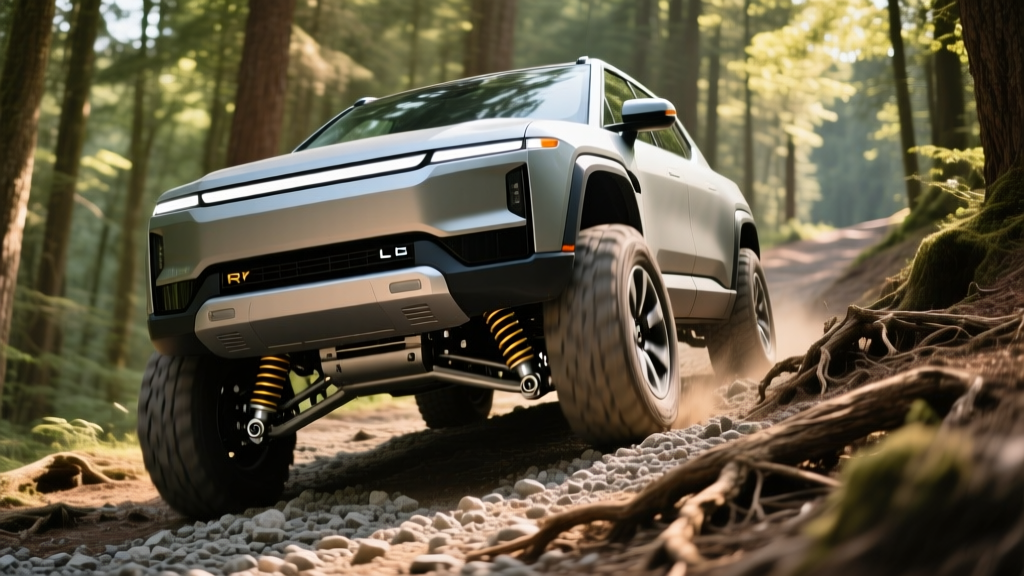
The Rivian R2 suspension uses a front double-wishbone and rear five-link multilink layout with passive steel-spring dampers on the base Adventure trim and an available adaptive air suspension on the Premium and Performance trims. This is a deliberate departure from the R1S/R1T, which use a fully independent double-wishbone setup at all four corners with standard air springs.
Why the change? Weight and cost. The R2 targets a curb weight under 4,800 lbs (compared to the R1S's ~6,900 lbs), which means less mass to control and less need for the expensive, complex hydraulic interconnected anti-roll system the R1 uses. The steel-spring base setup reduces unsprung weight, simplifies long-term maintenance, and keeps the entry price below $45,000.
Air Suspension vs. Steel Springs: Trim Breakdown
| Feature | Adventure (Base) | Premium | Performance |
|---|---|---|---|
| Front Suspension | Double-wishbone, steel coil | Double-wishbone, air spring | Double-wishbone, air spring |
| Rear Suspension | Five-link multilink, steel coil | Five-link multilink, air spring | Five-link multilink, air spring |
| Ground Clearance (max) | 8.4 in | 9.6 in (adjustable) | 9.6 in (adjustable) |
| Approach / Departure Angle | 24° / 27° | 28° / 31° | 28° / 31° |
| Wading Depth | 24 in | 30 in | 30 in |
| Adaptive Dampers | No | Yes | Yes (sport-tuned) |
The air suspension on Premium and Performance trims offers roughly 1.2 inches of adjustable ride height, selectable via the center touchscreen or automatically based on driving mode. In Highway mode, the R2 drops 0.6 inches for improved aerodynamics; in Off-Road mode, it rises to maximum clearance. The adaptive dampers on these trims read road inputs 500 times per second and adjust compression/rebound accordingly — a meaningful upgrade for broken pavement and washboard forest roads.
Off-Road Capability: Trail-Ready, Not Trail-Built
Rivian rates the R2 with air suspension for moderate off-road use — Class II trails, forest service roads, snow-covered passes — but it's not a dedicated rock crawler like a Wrangler 4xe or even the R1T with its quad-motor tank turns. The R2's off-road modes (Snow, Sand, Rock, Tow) remap throttle response, regenerative braking aggression, and traction control thresholds. The Performance trim adds an electronic limited-slip rear differential that can vector torque side-to-side, improving grip on loose surfaces without the complexity of locking differentials.
For most buyers, the steel-spring Adventure trim offers more than enough capability for dirt roads and campground access. If you plan to tackle technical terrain regularly, the Premium's air suspension and extra ground clearance justify the trim upgrade.
Range, Battery & Efficiency: The Numbers That Matter
The 2026 Rivian R2 is offered with two battery packs, both using NMC (nickel manganese cobalt) chemistry supplied by Samsung SDI. Rivian has not announced an LFP option for the R2 at launch, though the company has signaled LFP adoption for a future base variant to hit a lower price point.
The R2 Standard's EPA-estimated range is 270 miles; the Extended Range is rated at 330 miles. In real-world highway driving at 70-75 mph with climate control on, expect approximately 240-255 miles from the Standard pack and 295-315 miles from the Extended. In cold weather (below 32°F), reduce those figures by 15-25% depending on cabin heat usage — the R2 uses a resistive PTC heater on base trims, while Premium/Performance include a heat pump that cuts cold-weather range loss to roughly 10-15%.
| Spec | Standard Range | Extended Range |
|---|---|---|
| Usable Battery Capacity | 72 kWh (NMC) | 92 kWh (NMC) |
| EPA Estimated Range | 270 mi | 330 mi |
| Real-World Highway (70 mph) | ~240-255 mi | ~295-315 mi |
| Cold-Weather Range (20°F, heat pump) | ~230 mi | ~280 mi |
| Combined MPGe | 112 MPGe | 109 MPGe |
| Efficiency (kWh/100 mi) | 30 kWh/100 mi | 31 kWh/100 mi |
The R2's efficiency is competitive with the segment but not class-leading. The Tesla Model Y Long Range achieves roughly 28 kWh/100 mi thanks to superior aerodynamics (0.23 Cd vs. the R2's boxier 0.30 Cd). However, the R2's taller ride height and more upright greenhouse are trade-offs for the cargo volume and ground clearance that define its use case.
Charging Speed: DC Fast, Level 2 & Connector Details
The R2 comes equipped with the NACS (North American Charging Standard) connector natively — no adapter needed for Tesla Superchargers. This is a significant advantage over CCS-equipped competitors that still require adapters for Supercharger access.
| Charging Method | Max Power | Speed / Time |
|---|---|---|
| DC Fast Charge (Peak) | 220 kW (Std) / 250 kW (Ext) | 10-80% in ~22 min (Ext) / ~24 min (Std) |
| DC Fast Charge (Sustained avg) | ~170 kW | 80-100% adds ~18 min (taper) |
| Level 2 (240V, 48A) | 11.5 kW | ~30 mi/hr of range added |
| Level 2 (240V, 32A) | 7.7 kW | ~20 mi/hr of range added |
| Level 1 (120V, 12A) | 1.4 kW | ~3.5 mi/hr of range added |
The R2's charge curve is typical of NMC packs: it hits peak kW between 10-30% state of charge, then tapers progressively. Above 80%, charging slows dramatically to protect cell longevity — plan for an extra 15-20 minutes if you need a full charge at a DC station. For road trips, the 10-80% window is what matters, and the R2's ~22-minute window is solid but not best-in-class. The Hyundai Ioniq 5's 800V architecture still holds the edge at roughly 18 minutes 10-80%.
Home Charging Setup
Rivian recommends a 48-amp hardwired Level 2 wall connector for optimal home charging. At 11.5 kW, the Extended Range pack charges from 10% to 100% in approximately 7.5 hours — ideal for overnight replenishment. The Rivian Wall Connector (sold separately, ~$500) includes Wi-Fi scheduling and integrates with the Rivian app for off-peak charging optimization. Installation typically costs $500-$1,500 depending on panel proximity and whether a 200-amp service upgrade is needed. Always consult a licensed electrician for final installation specifications.
Performance & Drivetrain: Dual-Motor AWD Standard
Every 2026 Rivian R2 ships with a dual-motor all-wheel-drive powertrain — there is no single-motor RWD variant at launch. The front motor is a permanent-magnet synchronous unit; the rear is a higher-output variant. Combined output varies by trim:
| Spec | Adventure / Premium | Performance |
|---|---|---|
| Horsepower | 402 hp | 485 hp |
| Torque | 445 lb-ft | 520 lb-ft |
| 0-60 mph | 4.8 seconds | 3.9 seconds |
| Top Speed | 120 mph | 130 mph |
| Towing Capacity | 3,300 lbs | 3,300 lbs |
The Performance trim's 3.9-second 0-60 time puts it in hot-hatch territory and makes highway merging effortless. More importantly for daily driving, the dual-motor setup provides instant torque to the axle with grip, which translates to confident acceleration in rain and snow. The Rivian R2 suspension tuning on the Performance trim firms up the dampers noticeably in Sport mode, reducing body roll in corners at the cost of some low-speed ride compliance over sharp bumps.
Towing and Payload
The 3,300-lb tow rating is adequate for a small utility trailer, a pair of dirt bikes, or a lightweight pop-up camper — but it won't pull a 5,000-lb travel trailer. Towing mode adjusts the regenerative braking curve and limits top speed to 65 mph. Expect a 35-45% range reduction when towing near max capacity, consistent with most compact EV SUVs.
Interior, Cargo & Technology
The R2's cabin is a study in durable minimalism — think Scandinavian design meets Patagonia materials. The dashboard is dominated by a 15.4-inch center touchscreen running Rivian's latest software (Rivian OS 4.0), with a 10.2-inch digital instrument cluster behind the wheel. Physical buttons are limited to steering wheel controls, hazard lights, and a row of shortcut toggles below the screen.
Cargo and Passenger Dimensions
| Dimension | Measurement |
|---|---|
| Front Legroom | 41.8 in |
| Rear Legroom | 37.6 in |
| Front Headroom | 40.2 in |
| Rear Headroom | 38.9 in |
| Cargo (behind rear seats) | 32.1 cu ft |
| Cargo (rear seats folded) | 68.4 cu ft |
| Frunk (front trunk) | 11.2 cu ft |
The 32.1 cu ft rear cargo area edges out the Tesla Model Y (30.2 cu ft) and is competitive with the Hyundai Ioniq 5 (32.5 cu ft). The 11.2 cu ft frunk is one of the largest in the segment — large enough for a full-size backpack, charging cables, and a small cooler. Rivian includes a built-in gear tunnel pass-through behind the rear seats for longer items like skis or fishing rods, though it doesn't match the R1T's full-width gear tunnel.
Driver Assistance and Infotainment
The R2 comes standard with Rivian Driver+, a Level 2 driver-assistance suite that includes adaptive cruise control, lane-centering steering, automatic emergency braking, blind-spot monitoring, and rear cross-traffic alert. An available Highway Assist package adds hands-on-wheel lane-centering on divided highways with automatic lane changes when the turn signal is engaged. Per SAE definitions, this is a Level 2 system — the driver must remain engaged and keep hands on the wheel at all times. It is not autonomous or self-driving.
The infotainment system supports wireless Apple CarPlay and Android Auto, over-the-air updates, and a built-in trip planner that factors in elevation, weather, and charger availability. The R2 also features Rivian's Camp Mode, which maintains cabin climate and powers accessories via the 120V bed outlet (available on Premium/Performance) while parked — useful for car camping and tailgating.
Pricing, Trims & Federal Tax Credit Eligibility
| Trim | Battery | Base MSRP | Est. After §30D Credit |
|---|---|---|---|
| Adventure (Standard) | 72 kWh | $44,900 | ~$37,400* |
| Adventure (Extended) | 92 kWh | $49,900 | ~$42,400* |
| Premium (Extended) | 92 kWh | $54,900 | ~$47,400* |
| Performance (Extended) | 92 kWh | $59,900 | ~$52,400* |
*Estimated pricing assumes full $7,500 federal tax credit eligibility. Actual credit amount depends on IRS §30D requirements including buyer income limits, battery component sourcing, and critical mineral content. The R2's MSRP falls under the $80,000 SUV cap. Consult IRS.gov §30D guidelines and a tax professional before purchase. Point-of-sale transfer is available through participating dealers.
Does the Rivian R2 Qualify for the Full $7,500 Credit?
Based on current 2026 IRS rules, the R2 is positioned to qualify for at least a partial credit. The MSRP on all trims falls well below the $80,000 SUV cap. Buyer income limits apply ($150,000 single / $300,000 joint for modified AGI). The critical variable is battery sourcing: Rivian's Samsung SDI cells must meet the escalating critical-mineral and battery-component requirements under the Inflation Reduction Act. Rivian has stated it expects the R2 Extended Range to qualify for the full $7,500 at launch, but final certification depends on the supply chain at time of delivery. Always verify current eligibility on fueleconomy.gov before committing to a purchase.
Pros, Cons & Who Should Buy the R2
- Standard dual-motor AWD with strong off-road modes
- NACS connector native — full Supercharger access
- Class-leading frunk volume (11.2 cu ft)
- Air suspension available with 9.6 in ground clearance
- Heat pump on Premium/Performance trims
- 8-year/100,000-mile battery & powertrain warranty
- No single-motor RWD option for lower price/longer range
- Base trim uses PTC heater — more cold-weather range loss
- 3,300-lb tow rating lags R1T and some gas competitors
- 22-min 10-80% DC charge trails Ioniq 5's 800V system
- LFP battery option not yet available
- Georgia production ramp-up may delay early deliveries
Who the R2 Is For
Commuters with weekend ambitions: If your week involves a 30-50 mile round-trip commute and your weekends involve forest service roads, ski areas, or trailheads, the R2's combination of daily efficiency and genuine off-road modes is hard to beat in this price range.
Young families: Two car seats fit comfortably in the rear with usable cargo space remaining. The frunk absorbs stroller accessories and charging gear.
Not ideal for: High-mileage road trippers who prioritize maximum range and minimum charging stops (consider the Model Y Long Range or a PHEV). Buyers who need to tow more than 3,000 lbs regularly. Those in states without robust NACS/Supercharger coverage who need CCS flexibility.
How the R2 Stacks Up Against Competitors
| Spec | 2026 Rivian R2 (Ext.) | 2026 Tesla Model Y LR | 2026 Hyundai Ioniq 5 LR AWD |
|---|---|---|---|
| EPA Range | 330 mi | 340 mi | 290 mi |
| Battery (usable) | 92 kWh (NMC) | 82 kWh (NMC) | 84 kWh (NMC) |
| 0-60 mph | 4.8 sec | 4.8 sec | 5.1 sec |
| DC Fast Charge 10-80% | ~22 min | ~25 min | ~18 min |
| Ground Clearance | 9.6 in (air) | 6.6 in | 6.1 in |
| Cargo (rear seats up) | 32.1 cu ft | 30.2 cu ft | 32.5 cu ft |
| Base MSRP (AWD) | $49,900 | $48,990 | $50,100 |
| Native Connector | NACS | NACS | CCS (NACS adapter avail.) |
The R2's key differentiator is ground clearance and off-road capability. No competitor in this segment offers 9.6 inches of adjustable clearance with dedicated off-road drive modes. If your use case is strictly pavement and efficiency, the Model Y's lower price, longer range, and Supercharger ecosystem still make it the rational pick. If you value DC charging speed above all, the Ioniq 5's 800V architecture remains the segment benchmark. But if you want an EV that can genuinely handle unpaved adventures without compromise, the Rivian R2 suspension and chassis package has no direct rival at this price point.
Warranty & Ownership Costs
Rivian covers the R2 with:
- Battery & Powertrain: 8 years / 100,000 miles (whichever comes first), with a minimum 70% capacity retention threshold
- Vehicle (bumper-to-bumper): 5 years / 60,000 miles
- Corrosion: 5 years / unlimited miles
- Roadside Assistance: 5 years / 60,000 miles
The battery warranty is competitive with the industry standard (Tesla: 8yr/120,000mi; Hyundai: 10yr/100,000mi). Rivian's 70% retention threshold is standard — if your battery drops below 70% of original capacity within the warranty period, Rivian will repair or replace it. Real-world NMC degradation data from the R1 fleet suggests roughly 5-8% capacity loss over the first 100,000 miles under normal usage patterns.
Frequently Asked Questions
What is the real-world range of the Rivian R2?
The EPA rates the R2 Extended Range at 330 miles. In real-world highway driving at 70-75 mph, expect 295-315 miles. In cold weather (below freezing), a heat-pump-equipped R2 will deliver roughly 280 miles; base trims with PTC heaters may see 230-240 miles.
How fast does the R2 charge at home and on the road?
On a 48-amp Level 2 home charger, the R2 adds about 30 miles of range per hour (11.5 kW). On a DC fast charger, it peaks at 250 kW and charges from 10-80% in approximately 22 minutes, then tapers significantly above 80%.
Does the Rivian R2 qualify for the $7,500 federal EV tax credit?
The R2's MSRP is under the $80,000 SUV cap, and Rivian expects Extended Range variants to meet battery-sourcing requirements for the full credit. However, buyer income limits ($150K single / $300K joint) and final IRS certification of battery components apply. Verify at fueleconomy.gov before purchasing.
Is the Rivian R2 suspension good for off-roading?
Yes, within its class. With available air suspension, the R2 offers 9.6 inches of ground clearance, dedicated Snow/Sand/Rock modes, and up to 30 inches of wading depth. It handles moderate trails confidently but is not designed for extreme rock crawling like a dedicated off-roader.
What's the biggest drawback of the R2?
The 3,300-lb towing capacity is modest for an SUV positioned as adventure-ready, and the lack of an LFP battery option means higher upfront battery cost and a recommendation to avoid routine 100% charges for longevity. Early production from the new Georgia plant may also face ramp-up delays.
How does the Rivian R2 compare to the Tesla Model Y for families?
The R2 offers slightly more rear cargo space, a significantly larger frunk, standard AWD, and far better ground clearance for outdoor activities. The Model Y wins on efficiency, range per dollar, and Supercharger network maturity. For families who camp, ski, or hike regularly, the R2 is the more capable tool. For pure commuting efficiency, the Model Y still leads.