Rivian R2 Screen-Only Controls: Why This Interior Choice Matters
The upcoming Rivian R2 is poised to be one of the most important EVs of the decade, promising a more affordable entry into the brand's lineup. But alongside the excitement about its size and price, one design decision has generated intense debate among EV enthusiasts: the Rivian R2 screen-only controls. Following the minimalist interior philosophy pioneered by Tesla and adopted by several new EV startups, Rivian appears to be consolidating nearly all vehicle functions — climate, mirrors, glovebox, drive modes — into a central touchscreen interface, eliminating traditional physical buttons and knobs.
For buyers researching the R2 ahead of its expected mid-2026 production start, understanding how this screen-centric approach impacts daily usability is just as important as evaluating range and charging specs. Below, we break down everything confirmed or strongly indicated about the R2's interior tech, then cover the hard numbers on battery, charging, performance, and pricing that matter for your purchase decision.
The Rivian R2 is an announced vehicle expected to enter production in mid-2026 at Rivian's Normal, Illinois facility. Specs cited below reflect Rivian's published targets and industry reporting as of early 2026. Final EPA certification, pricing, and feature availability may differ at launch. We will update this review once production vehicles are tested.
How the R2's Screen-Only Interface Works
Rivian's existing R1S and R1T vehicles already lean heavily on a 15.6-inch center display, but they retain a modest bank of physical controls — a rotary drive-mode selector, steering-wheel buttons, and a small lower screen for climate shortcuts. The R2 is expected to push further toward full screen integration, driven by both cost-reduction targets and a design philosophy that favors software-defined flexibility.
Based on Rivian's public presentations, patent filings, and supply-chain reporting, the R2's cockpit is expected to include:
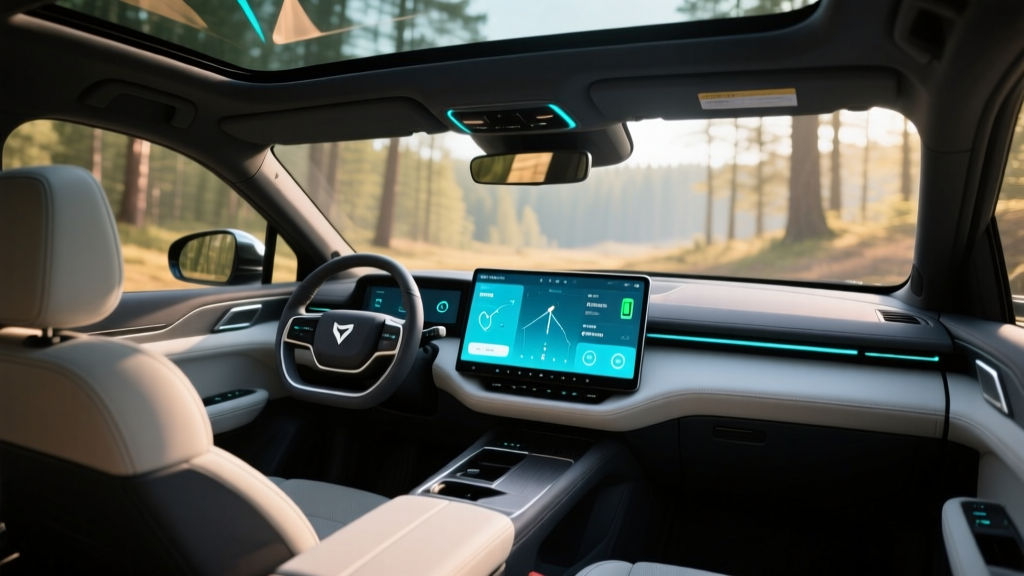
- A single large central touchscreen (estimated 15-16 inches) handling navigation, media, climate, vehicle settings, and drive-mode selection
- A compact driver display or head-up display for speed, range, and ADAS information — reducing the need to look away from the road for core driving data
- Steering-wheel touch controls for volume, media skip, and voice assistant activation
- Steering-column stalks for turn signals, wipers, and drive-mode (Park/Reverse/Neutral/Drive) — functions that are safety-critical and likely to retain physical actuation
The elimination of physical HVAC knobs, seat-heater buttons, and mirror-adjustment switches is where the Rivian R2 screen-only controls draw the most scrutiny. In Rivian's current software, adjusting cabin temperature requires tapping the center screen or using voice commands. Mirror adjustment is buried in a settings menu. For a vehicle positioned as a family-friendly daily driver, this friction is a legitimate concern — especially for a passenger trying to adjust the temperature while the driver focuses on traffic.
Real-World Usability: What Owners of Screen-Only EVs Report
The R2 won't be the first EV to go buttonless. Tesla's Model 3 and Model Y have operated with screen-only climate and mirror controls since 2017 and 2020 respectively, and the Tesla Model 3 Highland refresh even removed turn-signal stalks. Owner sentiment is split:
- Adaptation period: Most owners report adjusting within 2-4 weeks, relying on muscle memory for screen zones and voice commands for climate
- Glove frustration: Winter driving with gloves makes touchscreen operation significantly harder — a real issue for buyers in northern climates
- Passenger friction: Front-seat passengers unfamiliar with the interface often struggle to adjust climate or seat heaters without driver assistance
- Distraction risk: NHTSA research has consistently shown that visual-manual tasks on touchscreens increase eyes-off-road time compared to physical knobs, though voice-command mitigation helps
Rivian's software team has a strong reputation for UX polish — the R1's interface is widely regarded as more intuitive than Tesla's. If the R2 inherits this design discipline, screen-only controls may prove less aggravating than competitors' implementations. But the fundamental trade-off remains: software flexibility comes at the cost of tactile immediacy.
Rivian R2 Spec Table: Range, Battery, Charging, and Performance
| Specification | Rivian R2 (Expected / Target) |
|---|---|
| EPA Estimated Range | ~330 miles (Standard Battery, targeted) |
| Real-World Range Note | Expect ~270-290 mi highway; ~230-260 mi in cold weather (below 32°F) |
| Battery Capacity | ~85-92 kWh usable (Standard); larger pack option expected |
| Battery Chemistry | LFP (Standard Battery); NMC expected for Max Range variant |
| Max DC Fast Charge Rate | ~200-250 kW (targeted) |
| 10-80% DC Charge Time | ~25-30 minutes (estimated, dependent on charger capacity) |
| Level 2 Home Charging | ~11.5 kW onboard charger; ~30-35 mi/hr added |
| 0-60 mph | ~4.5 sec (Dual-Motor AWD); ~3.0 sec (Tri-Motor, targeted) |
| Horsepower | ~450 hp (Dual-Motor); ~600+ hp (Tri-Motor) |
| Drivetrain | RWD (base), Dual-Motor AWD, Tri-Motor AWD |
| Efficiency | ~110-120 MPGe combined (estimated, pending EPA cert) |
| Towing Capacity | ~4,500-5,000 lbs (targeted, Dual-Motor) |
Rivian targets approximately 330 miles of EPA-estimated range for the R2 Standard Battery. In practice, plan for ~270-290 miles on sustained highway driving at 70-80 mph, and ~230-260 miles in winter conditions (below freezing with cabin heat active). The LFP chemistry in the standard pack offers excellent cycle life but slightly lower energy density than NMC — the trade-off is longevity and the ability to charge to 100% daily without degradation concerns. If you regularly drive 200+ miles between charging stops in cold climates, the Max Range NMC variant will be worth the premium.
Charging Speed and Home Setup: What to Expect
Rivian has confirmed that the R2 will support DC fast charging at rates competitive with the segment — likely in the 200-250 kW peak range. While this doesn't match the 350 kW peaks of Hyundai-Kia's E-GMP platform vehicles, it aligns with real-world charging infrastructure: the majority of Electrify America and EVgo stations deliver 150-180 kW reliably, and sustained charge rates matter more than peak numbers.
At a 250 kW peak, the R2 should add roughly 150-180 miles of range in 15 minutes under ideal conditions. The charge curve will taper significantly above 80% state of charge — a universal lithium-ion behavior driven by cell-protection protocols. For road trips, plan your stops around 10-80% charges to minimize time at the charger.
| Charging Level | Power (kW) | Miles Added per Hour | Typical Use Case |
|---|---|---|---|
| Level 1 (120V household) | ~1.4 kW | ~4-5 mi/hr | Emergency / overnight trickle |
| Level 2 (240V home) | ~11.5 kW | ~30-35 mi/hr | Daily home charging, full overnight fill |
| DC Fast Charge | ~200-250 kW peak | ~600-900 mi/hr (peak) | Road-trip stops; 10-80% in ~25-30 min |
For home charging, a Level 2 wall connector on a 48-amp circuit (hardwired, 60-amp breaker) will replenish the R2's standard battery from empty in roughly 8-9 hours. Most owners who plug in nightly will never need the full capacity — a typical 40-mile daily commute requires only about 1.5 hours of Level 2 charging.
Pricing, Trims, and Federal Tax Credit Eligibility
Rivian has positioned the R2 as its volume vehicle, with a starting price designed to undercut the R1S/R1T significantly and compete directly with the Tesla Model Y, Ford Mustang Mach-E, and upcoming Hyundai Ioniq 5 SUV variants.
| Trim / Configuration | Expected Base MSRP | Est. After §30D Credit* |
|---|---|---|
| R2 Standard (RWD, Standard Battery) | ~$45,000 | ~$37,500 (if eligible) |
| R2 Dual-Motor AWD (Standard Battery) | ~$52,000 | ~$44,500 (if eligible) |
| R2 Dual-Motor AWD (Max Range) | ~$58,000 | ~$50,500 (if eligible) |
| R2 Tri-Motor Performance | ~$65,000+ | ~$57,500+ (if eligible) |
*Federal tax credit estimates assume full $7,500 eligibility under IRS §30D rules. Eligibility depends on buyer income caps ($150K single / $300K joint MAGI), vehicle MSRP caps ($80K for SUVs), battery critical-mineral sourcing, and North American final assembly. The R2 is assembled in Normal, Illinois, satisfying the assembly requirement. Battery-sourcing compliance is expected but subject to Rivian's supply-chain certification at launch. Consult a tax professional for your specific situation.
As of 2026, the §30D credit can be transferred to the dealer at point of sale, reducing your purchase price directly rather than requiring you to claim it on your tax return. This is a significant cash-flow advantage for buyers who don't want to wait until April of the following year for the benefit.
Cargo, Passenger Space, and Daily Practicality
The R2 is smaller than the three-row R1S, positioned as a compact-to-midsize crossover closer in footprint to the Tesla Model Y or Volvo EX40. Based on Rivian's published dimensions and segment positioning:
- Rear cargo volume: ~28-32 cu ft behind second row; ~60-65 cu ft with rear seats folded (estimated)
- Front trunk (frunk): ~8-10 cu ft — Rivian has made the frunk a signature feature, and the R2 is expected to continue this
- Rear legroom: ~38-40 inches (estimated), adequate for adults on longer trips
- Seating: 5-passenger, two-row configuration
The screen-only control layout has a direct impact on practicality: without physical buttons, there's more flexibility for Rivian to reconfigure interior surfaces and storage via software updates, but it also means that simple actions — opening the glovebox, defogging the windshield, adjusting side mirrors — all require navigating menus or issuing voice commands. For families with young children, the speed of physical controls for climate and window defrost can matter when seconds count.
Driver Assistance and Safety Technology
Rivian's Driver+ system is expected to carry over to the R2 with enhancements. This is a Level 2 SAE driver-assist system — meaning the driver must remain fully engaged, hands on or near the wheel, and eyes on the road at all times. It is not autonomous driving.
- Adaptive cruise control with stop-and-go
- Lane-centering assist on divided highways
- Automatic emergency braking with pedestrian and cyclist detection
- Blind-spot monitoring with rear cross-traffic alert
- Expected: Hands-free highway driving on mapped roads (similar to Ford BlueCruise or GM Super Cruise), though Rivian has not confirmed timeline
Rivian Driver+ is an SAE Level 2 system. You are the driver at all times. You must monitor traffic, keep your hands available, and be prepared to take over instantly. Do not confuse marketing terms like "enhanced highway assist" with Level 4 autonomous capability. Only services like Waymo operate at Level 4, and those are geofenced ride-hail services — not consumer vehicles.
Warranty Coverage
Rivian's current warranty structure for the R1 series provides a useful baseline for R2 expectations:
- Battery & drive unit: 8 years / 175,000 miles (Rivian has been more generous than the industry-standard 8/100,000)
- Limited vehicle warranty: 5 years / 60,000 miles
- Corrosion warranty: Expected to carry over at similar terms
The LFP chemistry in the standard R2 battery is expected to deliver superior long-term capacity retention compared to NMC — typically 85-90% state of health after 1,000+ full charge cycles, versus 80-85% for NMC at equivalent cycle counts. For owners planning to keep the R2 past 100,000 miles, the LFP pack offers meaningful peace of mind.
Pros and Cons: Rivian R2 Screen-Only Controls and Overall Package
✅ Pros
- Competitive ~330 mi EPA range target in a sub-$50K package
- LFP battery option enables daily 100% charging with minimal degradation
- Strong expected DC fast-charge speed (200-250 kW peak)
- Rivian's software UX is among the best in the EV industry
- Frunk + rear cargo versatility for outdoor and family use
- North American assembly supports §30D tax credit eligibility
- Over-the-air updates can refine screen-only interface post-purchase
❌ Cons
- Screen-only controls add friction for climate, mirrors, and glovebox
- Touchscreen reliance problematic with gloves in cold weather
- No physical HVAC knobs — a dealbreaker for some buyers
- Mid-2026 production start means a wait for early reservation holders
- Real-world range will fall short of EPA, especially in winter
- Tax credit eligibility depends on evolving battery-sourcing rules
- No third row — families needing 7 seats must look at R1S or competitors
Who the Rivian R2 Suits Best
🎯 Choose the Rivian R2 If:
- You want a US-built compact EV SUV with strong range and outdoor versatility
- You're comfortable with touchscreen-dominant interfaces and voice commands
- You value a frunk and flexible cargo for camping, gear, or groceries
- You plan to charge at home nightly and need only occasional DC fast charging
- You want LFP battery longevity for 10+ year ownership
Look Elsewhere If:
- You strongly prefer physical knobs and buttons for climate and vehicle controls
- You need a third row for carpool or large family duty
- You live in a charging desert and need 350+ miles of real-world range
- You want to buy immediately rather than wait for 2026 production ramp
Frequently Asked Questions
What is the real-world range of the Rivian R2?
Rivian targets ~330 miles EPA for the standard battery. In real-world conditions, expect approximately 270-290 miles on the highway at 70-80 mph, and 230-260 miles in freezing temperatures with cabin heating active. The Max Range variant should extend these figures by roughly 15-20%.
How fast does the Rivian R2 charge at home and on the road?
On a Level 2 home charger (240V, ~11.5 kW), the R2 adds approximately 30-35 miles of range per hour, fully replenishing overnight. On DC fast chargers, the expected 200-250 kW peak rate delivers a 10-80% charge in roughly 25-30 minutes under good conditions.
How much does the Rivian R2 cost after the federal tax credit?
The base R2 is expected to start around $45,000. If you qualify for the full $7,500 §30D credit (subject to income caps of $150K single/$300K joint, MSRP under $80K for SUVs, and battery-sourcing compliance), the effective price drops to approximately $37,500. The credit can now be applied at point of sale as of 2024 rules continuing into 2026.
Does the Rivian R2 qualify for the federal EV tax credit?
The R2 is assembled in Normal, Illinois, meeting the North American final-assembly requirement. Full §30D eligibility depends on battery critical-mineral sourcing and buyer income, both of which are expected to be satisfied but must be confirmed at the time of purchase. Check the latest guidance at IRS.gov and verify with your tax professional.
Is the Rivian R2 worth buying over the Tesla Model Y or other competitors?
The R2 competes on range, build quality, outdoor versatility, and software UX. If screen-only controls are a concern, the Hyundai Ioniq 5 and Kia EV6 retain more physical buttons. If you want the most mature charging network, Tesla's Supercharger ecosystem remains unmatched — though Rivian owners now have Supercharger access via adapter. The R2's LFP battery option and frunk give it unique advantages for long-term owners and outdoor enthusiasts.
Are screen-only controls safe while driving?
NHTSA research indicates that touchscreen-based adjustments generally require more eyes-off-road time than physical controls. Rivian mitigates this with voice commands, steering-wheel shortcuts, and a driver-focused display for critical information. However, passengers may find screen-only climate and mirror adjustments less intuitive than physical knobs, especially during the first weeks of ownership.
What is the Rivian R2's towing capacity?
Rivian targets approximately 4,500-5,000 pounds of towing capacity for the Dual-Motor AWD variant. This is competitive with the Tesla Model Y (~3,500 lbs) and suitable for small boat trailers, bike racks, or light utility trailers. Towing will reduce range by 30-50% depending on trailer weight and aerodynamics.