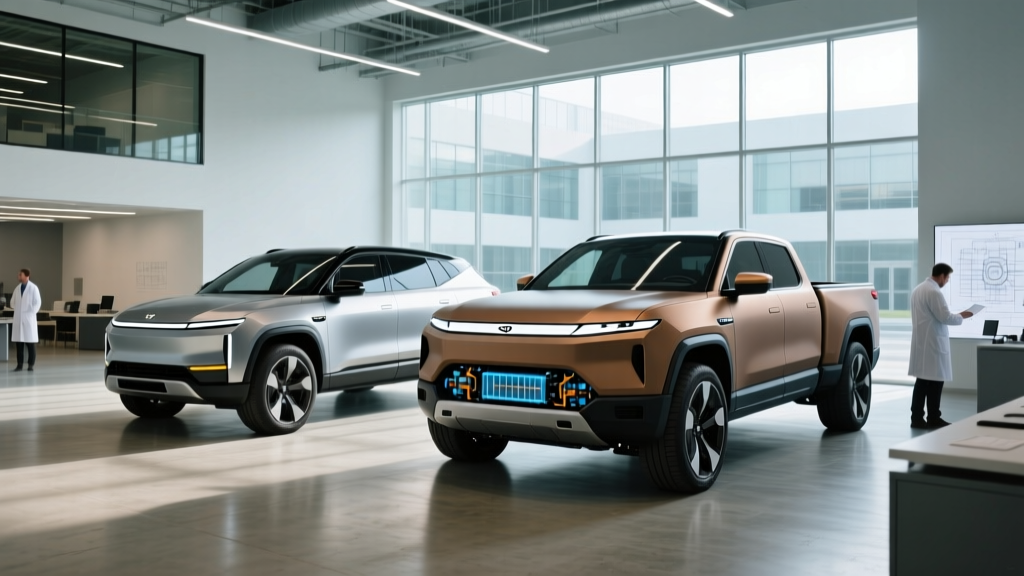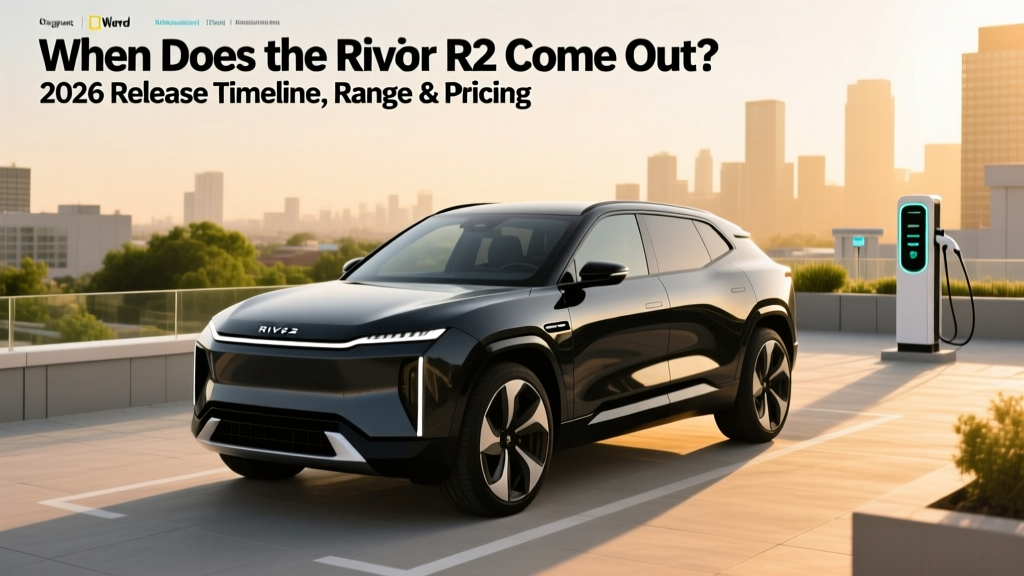
The Rivian R2 is the most anticipated compact electric SUV since the Tesla Model Y reshaped the segment. Smaller and more affordable than the R1S, the R2 targets mainstream buyers who want genuine off-road capability, a usable frunk, and a sub-$50,000 price tag. But anticipation only matters if you can actually buy one — so let's get straight to the question everyone is asking.
When Does the Rivian R2 Come Out?
Rivian CEO RJ Scaringe confirmed at the March 2024 R2 reveal that production is targeted for the first half of 2026, with initial units built at Rivian's existing Normal, Illinois facility. A purpose-built production line in Stanton, Georgia — originally slated to come online alongside the Illinois launch — has been pushed back as Rivian focuses capital on near-term profitability. Deliveries to reservation holders are expected to begin in mid-2026, with broader retail availability following in late 2026 or early 2027 depending on ramp speed.
If you're on the reservation list (a $100 refundable deposit secures your place), expect Rivian to open configuration in early 2026, likely Q1. If you're not on the list, plan for a wait — Rivian's R1T and R1S launches showed that early production slots fill quickly, and the R2's lower price point will drive significantly higher demand.
Rivian R2 Preliminary Specifications (2026 Model Year)
| Spec | Estimated / Announced |
|---|---|
| Body Style | 5-passenger compact SUV |
| Drivetrain | RWD (base), Dual-Motor AWD, Performance AWD |
| Battery Capacity | ~75–85 kWh usable (chemistry TBD — likely NMC for Standard, LFP for future base trim) |
| EPA Range (AWD Standard) | ~300+ miles (Rivian target, not yet EPA-certified) |
| Max DC Fast Charge | ~200–250 kW (estimated, 800V architecture) |
| 10–80% DC Charge Time | ~20–25 minutes (estimated) |
| Level 2 Home Charging | ~11.5 kW (~35–40 mi/hr) |
| 0–60 mph (Dual-Motor) | ~4.5 seconds (estimated) |
| Horsepower (Dual-Motor) | ~400–500 hp (estimated) |
| Towing Capacity | ~4,000 lbs (estimated) |
| Cargo Volume (behind 2nd row) | ~30–35 cu ft (estimated, plus front trunk) |
| Base MSRP | $45,000 (before incentives) |
| Battery/Powertrain Warranty | 8 years / 100,000 miles (expected, matching R1S) |
Note: All specs above are preliminary and based on Rivian's announced targets as of 2024–2025. Final EPA certification, battery chemistry confirmation, and pricing will be published closer to the production start date. We will update this article as official figures are released.
Range and Efficiency: What to Expect in the Real World
Real-World Expectation: ~240–270 miles highway; ~200–230 miles in cold weather (below 32°F); ~280–300 miles city/mixed driving in mild conditions
Rivian has targeted a 300+ mile EPA range for the dual-motor AWD variant with the Standard battery pack. This is a credible target given the R2's smaller, lighter platform compared to the R1S (which achieves up to 410 miles with the Max pack on fueleconomy.gov). The R2's aerodynamic profile — lower and sleeker than the boxy R1S — should help highway efficiency.
However, real-world range for any compact SUV with AWD and a ~80 kWh pack typically falls 10–20% below the EPA sticker on sustained highway trips at 70+ mph. In freezing temperatures, expect an additional 15–25% reduction due to cabin heating demands and reduced battery efficiency, even with a heat pump (which Rivian has confirmed the R2 will include). If your daily commute is under 80 miles round-trip, even winter range will be a non-issue. If you regularly drive 250+ miles between charges, plan your stops accordingly.
Efficiency should land in the range of 100–115 MPGe combined (roughly 29–34 kWh/100 mi), competitive with the Tesla Model Y Long Range (122 MPGe) and slightly behind the Hyundai Ioniq 5 (114 MPGe) due to the R2's expected higher weight and off-road-oriented tires.
Charging Speed: DC Fast Charging and Home Setup
Rivian has confirmed the R2 will use a native NACS charge port, meaning direct access to Tesla's Supercharger network — currently the largest and most reliable DC fast-charging network in North America — without an adapter. This is a significant practical advantage over CCS-equipped competitors that still rely on adapters for Supercharger access.
| Charging Level | Power / Rate | Speed (Miles Added) | Notes |
|---|---|---|---|
| Level 1 (120V household) | ~1.4 kW | ~4–5 mi/hr | Emergency/trickle only |
| Level 2 (240V, 48A home charger) | ~11.5 kW | ~35–40 mi/hr | Full charge overnight (~8–9 hrs) |
| DC Fast Charge (peak) | ~200–250 kW | ~150+ mi in 15 min | 10–80% in ~20–25 min; tapers above 80% |
The R2's expected 800V-class electrical architecture should enable a strong charge curve — meaning sustained charging rates closer to peak for longer, rather than a sharp taper after 50% State of Charge (SoC). Rivian's R1 vehicles already demonstrate solid charge-curve management, and the R2 should improve on this with newer cell chemistry and thermal management.
For home charging, a 48-amp Level 2 wall connector on a 60-amp circuit will add roughly 35–40 miles of range per hour. Most owners charging overnight from 20% to 80% will wake up to a full battery. Installation costs for a Level 2 home charger typically range from $500 to $2,000 depending on your electrical panel's capacity and the run length from panel to garage — factor in a potential $1,500–$3,000 panel upgrade if you're running a 200-amp service that's near capacity.
Performance, Drivetrain, and Capability
Rivian has confirmed three drivetrain configurations for the R2:
- Single-Motor RWD: The volume play. Lowest price, longest range, adequate for most commuters. Expected ~250–300 hp.
- Dual-Motor AWD: Two independent motors (one per axle) delivering ~400–500 hp and a 0–60 mph time in the mid-4-second range. This is the sweet spot for most buyers who want all-weather confidence and brisk acceleration.
- Performance AWD: A higher-output dual-motor setup (potentially tri-motor if Rivian carries over its R1 tri-motor tech) targeting sub-4-second 0–60 times. Expect this on higher trims at launch or shortly after.
Rivian's torque-vectoring AWD system — which can independently control power to each wheel — is a hallmark of the brand and will carry over to the R2. This gives the R2 legitimate off-road chops (rock crawling, snow, sand) that most compact electric SUVs simply don't offer. Ground clearance is expected around 8.5–9.5 inches, and Rivian has teased approach/departure angles competitive with the Subaru Outback Wilderness.
Towing capacity is targeted at approximately 4,000 pounds — enough for a small boat, utility trailer, or a pair of dirt bikes, but not a large travel trailer. This is a realistic number for the segment and aligns with the Tesla Model Y's 3,500-pound rating.
Pricing, Trims, and Federal Tax Credit Eligibility
Rivian has stated a starting MSRP of $45,000 for the R2. Based on Rivian's current R1 trim strategy and industry pricing trends, here's a reasonable projection for the launch lineup:
| Trim / Configuration | Estimated MSRP | After Potential §30D Credit |
|---|---|---|
| Standard RWD | $45,000 | ~$37,500 (if eligible) |
| Standard AWD (Dual-Motor) | $50,000–$52,500 | ~$42,500–$45,000 |
| Adventure AWD | $55,000–$58,000 | ~$47,500–$50,500 |
| Performance AWD | $60,000+ | ~$52,500+ |
Does the Rivian R2 Qualify for the Federal EV Tax Credit?
The R2 has a strong path to qualifying for the up to $7,500 federal tax credit under IRS §30D, but eligibility is not guaranteed for every buyer or every build configuration. Here's what determines it:
- MSRP Cap: SUVs must have an MSRP at or below $80,000. All announced R2 trims clear this threshold comfortably.
- Buyer Income Cap: Modified adjusted gross income (MAGI) must not exceed $150,000 (single), $225,000 (head of household), or $300,000 (married filing jointly). Check your prior-year tax return.
- Battery Component & Critical Mineral Sourcing: As of 2025, the credit is split into two $3,750 halves — one for battery components manufactured or assembled in North America, and one for critical minerals sourced from the U.S. or free-trade-agreement partners. Rivian assembles its vehicles in Illinois, but cell sourcing (likely Samsung SDI or another partner) will determine the critical-minerals half. Final credit amount ($0, $3,750, or $7,500) depends on the specific battery pack in your build.
- Point-of-Sale Transfer: As of 2024, buyers can transfer the credit to the dealer at purchase, reducing the out-of-pocket price immediately rather than waiting for a tax refund. Rivian is expected to support this.
For the most current eligibility rules, consult IRS.gov's clean vehicle credits page and verify your specific configuration before ordering. Tax rules change, and this information reflects 2025–2026 guidance — always confirm with a tax professional.
Interior, Cargo, and Technology
The R2's interior represents a deliberate step toward mainstream practicality compared to the R1S. Key features based on Rivian's reveal and subsequent previews:
- Seating: 5 passengers (no third row — that's the R1S's job). Rear legroom is expected around 38–40 inches, competitive with the Model Y and Ioniq 5.
- Cargo: Approximately 30–35 cubic feet behind the second row, with a flat load floor. The rear seats are expected to fold flat for longer items.
- Front Trunk (Frunk): Rivian has confirmed a "gear tunnel" is not coming to the R2 (that's an R1-exclusive feature), but a usable frunk for charging cables, groceries, or a backpack is expected — likely 5–8 cubic feet.
- Infotainment: A landscape-oriented touchscreen (estimated 14–15 inches) running Rivian's in-house OS, which has earned praise for its clean interface, built-in route planning with charging stops, and over-the-air update capability.
- Driver Assistance: Rivian's Driver+ system (highway assist with lane centering and adaptive cruise) will be standard. This is an SAE Level 2 system — it assists with steering and speed but requires the driver to remain fully engaged and supervising at all times. It is not self-driving.
- Unique Features: Rivian has highlighted a "camp kitchen" accessory option, integrated gear guards (built-in tie-downs and storage dividers), and a removable Bluetooth speaker. The brand's adventure-oriented DNA is clearly present.
How the R2 Compares to Key Competitors
The R2 enters one of the most competitive segments in the EV market. Here's how it stacks up against its most likely rivals:
| Attribute | Rivian R2 AWD (est.) | Tesla Model Y LR AWD | Hyundai Ioniq 5 AWD | Ford Mustang Mach-E ER AWD |
|---|---|---|---|---|
| Starting Price (AWD) | ~$50,000 | $48,090 | $50,600 | $51,875 |
| EPA Range | ~300+ mi | 308 mi | 290 mi | 290 mi |
| Max DC Charge | ~200–250 kW | 250 kW | 240 kW | 150 kW |
| 0–60 mph | ~4.5 sec | 4.8 sec | 5.0 sec | 5.1 sec |
| NACS Native Port | Yes | Yes | No (adapter req.) | No (adapter req.) |
| Off-Road Capability | High | Low | Low | Moderate (Rally trim) |
| Towing | ~4,000 lbs | 3,500 lbs | 2,300 lbs | 2,200 lbs |
The R2's differentiators are clear: best-in-class off-road capability, a native NACS port for seamless Supercharger access, and Rivian's adventure-oriented brand identity. Where it may trail the Model Y is in charging infrastructure maturity (Rivian's own Adventure Network is still small), software ecosystem polish, and potentially rear-seat space. Against the Ioniq 5 and Mach-E, the R2 offers more range and towing, but likely at a slight price premium for equivalent trims.
Pros
- Native NACS port — direct Tesla Supercharger access
- Genuine off-road capability rare in the segment
- Strong estimated range (~300+ mi) and competitive charging speed
- Rivian's proven build quality and OTA improvement track record
- Distinctive design that stands out from the crossover crowd
- Sub-$50K starting price opens up to a broad buyer pool
Cons
- Not yet available — 2026 production start means a long wait
- Specs are preliminary; final range, pricing, and credit eligibility unconfirmed
- Rivian's service center network is still expanding (coverage gaps in some states)
- No third row — families needing 7 seats still need the R1S
- Reservation backlog may mean 12–18 month delivery wait even after production starts
- Adventure Network (Rivian's own chargers) remains limited vs. Superchargers
Who Should Buy the Rivian R2 — And Who Should Look Elsewhere?
- You want an electric SUV that can actually handle trails, snow, and rough roads — not just pavement
- You need native Supercharger access without fumbling with adapters
- You value distinctive design and don't want another white crossover that blends into the parking lot
- Your household is 1–4 people and you don't need a third row
- You're willing to reserve now and wait into 2026–2027 for delivery
- You need a vehicle now — the Model Y, Ioniq 5, and Mach-E are available today
- You need 7-passenger seating (consider the R1S, Kia EV9, or a PHEV like the Grand Cherokee 4xe)
- You live in a region with no nearby Rivian service center and no mobile-service coverage
- Your budget is firmly under $40,000 — the R2 won't reach that price point at launch
Frequently Asked Questions
When can I actually buy the Rivian R2?
Production is targeted for the first half of 2026 at Rivian's Normal, Illinois plant. Reservation holders will likely configure and receive vehicles starting mid-2026. Walk-in retail availability without a reservation will depend on production ramp speed — realistically late 2026 or early 2027.
What is the real-world range of the Rivian R2?
Rivian targets 300+ miles EPA for the AWD Standard Battery. In real-world highway driving at 70 mph, expect roughly 240–270 miles. In freezing weather, that drops to approximately 200–230 miles. City and mixed driving in mild conditions should closely match the EPA figure.
How fast does the R2 charge at home and on the road?
At home on a 48-amp Level 2 charger, the R2 should add ~35–40 miles of range per hour, fully recharging overnight. On DC fast chargers, Rivian estimates 200–250 kW peak, achieving a 10–80% charge in approximately 20–25 minutes. The native NACS port means direct Supercharger compatibility.
How much will the Rivian R2 cost after tax credits?
The base RWD starts at $45,000. If you qualify for the full $7,500 §30D federal credit (income, MSRP, and battery sourcing requirements all met), the effective price drops to ~$37,500. The dual-motor AWD at ~$50,000–$52,500 would drop to ~$42,500–$45,000. State incentives may stack on top — check IRS.gov and your state's energy office for current rules.
Does the Rivian R2 qualify for the $7,500 federal EV tax credit?
It has a strong path to full or partial eligibility. The MSRP is well under the $80,000 SUV cap, and Rivian's Illinois assembly satisfies North American final assembly. The variable is battery cell and critical-mineral sourcing, which determines whether you receive $3,750 or $7,500. Buyer income limits also apply ($150K single / $300K married filing jointly). Confirm your eligibility with a tax professional before ordering.
Is the Rivian R2 worth waiting for vs. buying a Tesla Model Y or Hyundai Ioniq 5 now?
If you need a vehicle immediately, the Model Y and Ioniq 5 are excellent, proven options available today with strong range, fast charging, and broad service networks. If you can wait and you prioritize off-road capability, adventure-oriented features, and a more distinctive design, the R2 is worth the patience. The R2's native NACS port also future-proofs your charging options. Just be realistic about the timeline — "first half of 2026" production start means many buyers won't take delivery until late 2026 or 2027.
Will the R2 have a gear tunnel like the R1T and R1S?
No. Rivian has confirmed the R2 will not include the cross-vehicle gear tunnel. It will have a front trunk (frunk) and standard rear cargo area. The gear tunnel is exclusive to the R1 platform due to its larger dimensions.
What battery chemistry will the R2 use?
Rivian has not officially confirmed the R2's cell chemistry. Industry analysts expect NMC (nickel manganese cobalt) for the Standard and larger packs due to its higher energy density, which is critical for hitting 300+ miles in a compact SUV. A future base RWD trim could potentially use LFP (lithium iron phosphate) for lower cost and longer cycle life, though at the expense of some range and cold-weather performance. We'll update when Rivian confirms.
This article reflects information available as of early 2026 based on Rivian's official announcements and industry analysis. Final specifications, pricing, and tax credit eligibility are subject to change. Always verify with Rivian.com and the IRS before making a purchase decision.