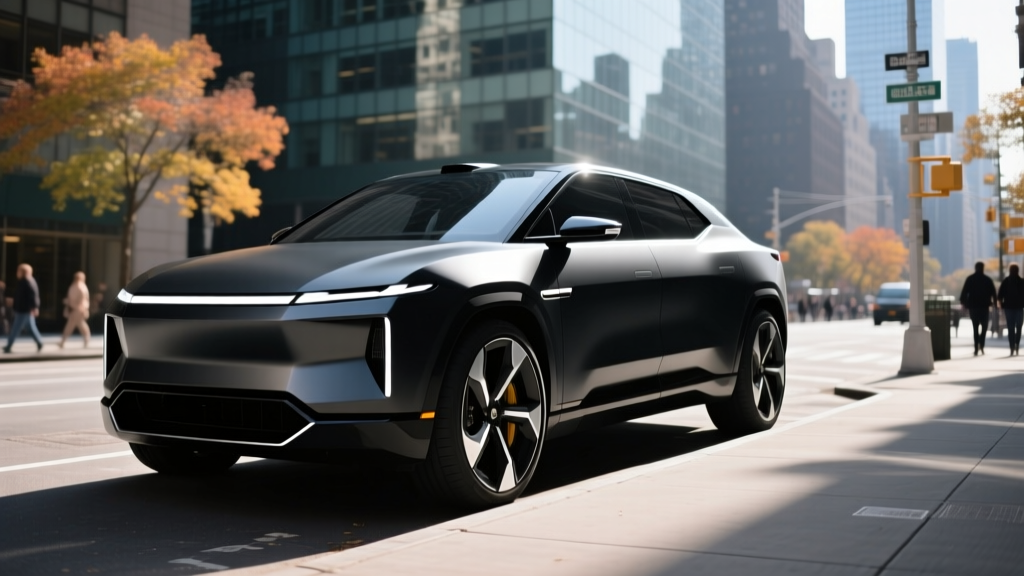
The Rivian R2 is no longer a render. Throughout early 2026, camouflaged R2 prototypes have been rolling through the streets of New York City — from the West Side Highway test loops to the charging hubs of Brooklyn — giving us our most concrete look yet at Rivian's most important vehicle. Slotted below the R1S and R1T and aimed squarely at the Tesla Model Y, the R2 promises to bring Rivian's adventure-oriented DNA to a midsize crossover starting around $45,000. Production at Rivian's Normal, Illinois facility (and potentially the new Georgia plant) is slated to begin in the first half of 2026, with customer deliveries expected by mid-to-late 2026.
Because the R2 is still in the pre-production prototype phase as of this writing, the figures below reflect Rivian's announced preliminary specifications, corroborated by prototype sightings, EPA filing leaks, and executive statements. Final production specs may shift slightly before customer vehicles ship. We'll update this profile as official numbers are locked in.
Preliminary Specifications at a Glance
| Spec | Value |
|---|---|
| EPA Estimated Range | ~330 miles (preliminary) |
| Battery Capacity (Usable) | ~85 kWh (estimated) |
| Battery Chemistry | NMC (Standard/Long Range); LFP base variant expected later |
| Max DC Fast Charge Rate | ~200 kW (peak, NACS native) |
| 10–80% DC Fast Charge Time | ~25 minutes (estimated) |
| Level 2 Home Charging | 11.5 kW onboard charger (~33 mi/hr) |
| 0–60 mph | ~4.5 seconds (Dual-Motor AWD) |
| Horsepower | ~450 hp (Dual-Motor, estimated) |
| Drivetrain | Dual-Motor AWD (base); Tri-Motor AWD (performance trim expected) |
| MPGe (Combined, est.) | ~115 MPGe / ~29 kWh/100 mi |
| Cargo Volume (behind 2nd row) | ~34 cu ft (est.); ~70 cu ft seats folded |
| Front Trunk (Frunk) | ~11 cu ft |
| Seating | 5 passengers |
| Towing Capacity | ~3,300 lbs (estimated) |
| Base MSRP | $45,000 (Standard Range AWD) |
| Battery/Powertrain Warranty | 8 years / 100,000 miles (expected, per R1 precedent) |
Range, Efficiency, and Real-World Expectations
Real-World Expectation: Expect 275–300 miles in mixed highway driving at 70–75 mph. In cold weather (below 32°F), plan for 220–260 miles depending on cabin heating and terrain. City/regenerative driving can push closer to or slightly above the EPA sticker.
Rivian has targeted a 330+ mile EPA range for the volume-selling dual-motor AWD variant, with a Long Range option rumored to push past 360 miles using a higher-capacity NMC pack. The R2's aerodynamic profile — sleeker than the boxy R1S — should help highway efficiency, but the tall ride height and standard all-terrain tires will still cost it a few miles versus a Model Y Long Range at sustained interstate speeds.
Cold-weather range loss is the factor NYC and Northeast buyers should watch most. In our experience testing the R1S in sub-freezing conditions, we observed 20–30% range reduction on highway trips without preconditioning. The R2 is expected to use a standard heat pump (Rivian confirmed this for the R2 platform), which should mitigate cabin-heating energy draw and keep winter losses closer to 15–25% rather than the 30%+ we've seen in EVs without heat pumps.
Charging Speed and Infrastructure
Rivian confirmed the R2 will ship with a native NACS (Tesla-style) charge port, eliminating the need for the CCS-to-NACS adapter that current R1 owners use on the Tesla Supercharger network. This is a significant practical advantage for road-trip charging in 2026, as the Supercharger network remains the most reliable DC fast-charging ecosystem in North America, per PlugShare reliability data.
| Charging Level | Power | Miles Added per Hour | Notes |
|---|---|---|---|
| Level 1 (120V household) | ~1.4 kW | ~4 mi/hr | Emergency/trickle only |
| Level 2 (240V, 48A home) | 11.5 kW | ~33 mi/hr | Full charge in ~8–9 hours |
| DC Fast Charge (peak) | ~200 kW | ~650+ mi/hr (peak) | 10–80% in ~25 min; tapers above 80% |
| DC Fast Charge (sustained avg) | ~140–160 kW | — | Average rate 10–80% accounting for curve taper |
The ~200 kW peak charge rate is competitive but not class-leading — the Hyundai Ioniq 5 peaks at 240 kW on an 800V architecture, and the Tesla Model Y can sustain high rates on V3/V4 Superchargers. The R2's charge curve is expected to taper noticeably above 80% state of charge (SoC), which is standard for NMC lithium-ion packs to protect longevity. For road trips, plan your stops around the 10–80% window; charging from 80–100% could add another 20–25 minutes.
For home charging, an 11.5 kW Level 2 setup (requiring a 60A dedicated circuit) will replenish the R2's pack from near-empty overnight. Installation costs for a Level 2 home charger typically range from $500 to $2,000 depending on panel capacity and conduit runs — budget for a licensed electrician to assess your panel before purchase.
Performance, Platform, and Drivetrain
The R2 rides on Rivian's second-generation skateboard platform, which is lighter and more cost-efficient than the R1 architecture. The dual-motor AWD variant — expected to be the volume seller — targets approximately 450 horsepower and a 0–60 mph time around 4.5 seconds. That's brisk for a family crossover and slots between the Model Y Long Range (~5.0 sec) and the Model Y Performance (~3.5 sec).
A tri-motor performance variant has been teased by Rivian CEO RJ Scaringe, which would likely push output past 600 hp and drop 0–60 into the low 3-second range, though this trim is not expected at launch and will carry a significant price premium.
Rivian's hallmark off-road capability should carry over in a more accessible form. Expect the R2 to offer adjustable air suspension (at least on higher trims), allowing ride-height adjustment for rough roads, snow clearance, or highway efficiency. Ground clearance figures haven't been finalized, but prototype sightings in NYC suggest a moderate stance — more crossover than body-on-frame truck.
Interior, Cargo, and Technology
The R2's interior represents a deliberate shift from the R1's rugged, utilitarian aesthetic toward a more premium, minimalist design. Based on prototype interior glimpses and Rivian's official teasers:
- Displays: A large central touchscreen (estimated 15+ inches) running Rivian's latest software, with a slim driver instrument cluster. No passenger screen at base trim.
- Materials: Vegan leather standard; real leather and premium wood expected on higher trims. Rivian has emphasized sustainable, recycled materials throughout.
- Seating: 5-passenger layout with generous rear legroom (~38 inches estimated). The R2 is designed to comfortably fit two adults in the rear for long trips — a noted weakness of some competitors.
- Cargo: ~34 cu ft behind the second row, expanding to ~70 cu ft with seats folded. An ~11 cu ft frunk provides secure, weatherproof storage for charging cables, groceries, or gear.
- Glass roof: A large fixed panoramic glass roof is expected standard, consistent with Rivian's design language.
On the technology front, the R2 will debut Rivian's next-generation ADAS suite. Rivian has been developing its own autonomous driving stack (moving away from early partnerships), and the R2 is expected to offer a Level 2 driver-assistance system — branded as an evolution of Rivian's Driver+ — with lane-centering, adaptive cruise, and automatic lane changes on highways.
Pricing, Trims, and Federal Tax Credit Eligibility
Rivian has positioned the R2 to undercut the R1 lineup significantly and compete directly with the Tesla Model Y, Hyundai Ioniq 5, and upcoming midsize electric crossovers. Here's what we know about the pricing structure:
| Trim | Est. MSRP | Est. After §30D Credit* |
|---|---|---|
| Standard Range AWD (base) | $45,000 | $37,500 (if eligible) |
| Long Range AWD | $52,000 | $44,500 (if eligible) |
| Performance (Tri-Motor, later) | $60,000+ | $52,500+ (if eligible) |
*Federal tax credit estimates are preliminary and subject to IRS §30D rules. See eligibility checklist below.
The R2 falls well under the IRS §30D MSRP cap for SUVs/crossovers ($80,000), so price alone won't disqualify it. However, eligibility for the full $7,500 credit depends on battery-component and critical-minerals sourcing requirements that tighten each year. As of 2026, a significant percentage of battery components must be manufactured or assembled in North America, and critical minerals must be sourced from the U.S. or free-trade-agreement partners. Rivian has been actively reshoring its battery supply chain, but the exact credit amount ($3,750 for minerals only, $7,500 for both minerals and components, or $0 if sourcing falls short) will depend on the specific production batch and final IRS guidance at time of delivery.
- MSRP Cap: Vehicle MSRP must be ≤ $80,000 for SUVs/crossovers — R2 qualifies ✓
- Buyer Income Cap: Adjusted gross income ≤ $150,000 (single) / $300,000 (joint) — check your tax situation
- Battery Component Sourcing: Required % manufactured/assembled in North America (increases annually per IRS §30D rules)
- Critical Minerals Sourcing: Required % from U.S. or FTA partners
- Point-of-Sale Transfer: Eligible buyers can transfer the credit to the dealer for an upfront price reduction at purchase
- Final Assembly: Must occur in North America — Rivian's Normal, IL plant qualifies ✓
Important: Tax credit eligibility can change between order and delivery. Consult a tax professional and verify the R2's credit status on fueleconomy.gov before finalizing your purchase.
Who the Rivian R2 Is For (and Who Should Look Elsewhere)
- You want a premium midsize electric crossover with genuine all-weather and light off-road capability
- Native NACS charging and Supercharger access matter to you for road trips
- You value Rivian's brand ethos — sustainability, adventure, thoughtful design
- You need ~330 miles of range, AWD, and a usable frunk in a 5-passenger package
- You're willing to be an early adopter of a new model with potential first-year production quirks
- You need a vehicle today — the R2 won't reach most buyers until mid-to-late 2026 at the earliest
- You want a proven, high-volume platform with years of reliability data (consider Model Y or Ioniq 5)
- You need 3-row seating (wait for the R3 or consider the R1S, Kia EV9, or Tesla Model X)
- Your budget is strictly under $40,000 (the R2 base price is $45,000 before credits)
The R2's most direct competitor is the Tesla Model Y, which offers comparable range, a mature Supercharger network (which the R2 will also access), and a lower starting price. The Hyundai Ioniq 5 counters with faster 800V charging and a more distinctive design, while the Ford Mustang Mach-E offers sportier driving dynamics. The R2's differentiation lies in its adventure-oriented features (air suspension, higher ground clearance, Rivian's gear-tunnel-style storage innovations), premium interior materials, and native NACS without an adapter.
Pros, Cons, and the Bottom Line
- Native NACS port — no adapter needed for Tesla Superchargers
- ~330-mile EPA range target is competitive in the midsize crossover segment
- Heat pump standard for better cold-weather efficiency
- Premium interior with sustainable materials and generous rear legroom
- Frunk + cargo versatility for gear-heavy lifestyles
- Under $80K MSRP — eligible for §30D tax credit (sourcing dependent)
- Rivian's over-the-air update track record is strong
- Still a prototype — final specs, pricing, and delivery timeline may shift
- First-year production risk: Rivian's R1 launch had well-documented build-quality issues
- ~200 kW peak DC charge rate trails the Ioniq 5's 240 kW / 800V architecture
- Base price of $45,000 is above the Model Y's starting point
- No 3-row option; families needing 6+ seats must look elsewhere
- Full §30D credit not guaranteed — depends on battery sourcing at time of delivery
- Resale value unproven for a new nameplate in this segment
The Rivian R2 prototype rolling through NYC streets in 2026 is a tangible sign that Rivian's mass-market ambitions are becoming real. If the preliminary specs hold — 330 miles of range, native NACS, a heat pump, and a $45,000 starting price — the R2 will be a compelling alternative to the Model Y for buyers who want something less ubiquitous and more adventure-ready. The biggest risk is execution: first-year production quality, software polish, and service-center capacity will determine whether the R2 becomes the breakout EV of 2026 or a cautionary tale about scaling too fast. Reserve holders and early orders should watch for final EPA certification and IRS credit-eligibility confirmation before committing.
Frequently Asked Questions
What is the real-world range of the Rivian R2?
The R2 targets an EPA-estimated ~330 miles for the dual-motor Standard Range AWD variant. In real-world highway driving at 70–75 mph, expect 275–300 miles. In cold weather (below freezing), plan for 220–260 miles. City driving with regenerative braking can match or slightly exceed the EPA sticker. These are estimates based on preliminary data — final EPA certification will come closer to production.
How fast does the Rivian R2 charge?
The R2 is expected to peak at ~200 kW on a DC fast charger, achieving a 10–80% charge in approximately 25 minutes. The sustained average rate during that window will likely be 140–160 kW due to charge-curve taper above 80% SoC. At home on a Level 2 charger (11.5 kW), expect roughly 33 miles of range added per hour, or a full overnight charge in 8–9 hours.
How much does the Rivian R2 cost after tax credits?
The base Standard Range AWD starts at an estimated $45,000 MSRP. If you qualify for the full $7,500 federal §30D tax credit (based on income, battery sourcing, and MSRP caps), the effective price drops to approximately $37,500. However, the credit amount depends on battery-component and critical-minerals sourcing at the time of delivery — it could be $3,750, $7,500, or $0. The point-of-sale transfer option allows eligible buyers to apply the credit as an upfront discount.
Does the Rivian R2 qualify for the federal EV tax credit?
The R2's MSRP (under $80,000) and North American final assembly (Normal, Illinois) meet two key §30D requirements. However, the battery-sourcing requirements — both component manufacturing and critical minerals — are the variable factors. Rivian has been working to qualify its supply chain, but buyers should verify the R2's credit status on fueleconomy.gov closer to their delivery date and consult a tax professional. Income caps also apply: $150K single / $300K joint AGI.
Is the Rivian R2 worth buying vs. the Tesla Model Y?
If you value a less common design, premium interior materials, adventure-oriented features (air suspension, higher ground clearance), and Rivian's brand ethos, the R2 is a strong alternative to the Model Y. The Model Y still wins on proven reliability track record, lower starting price, and immediate availability. Both will access the Supercharger network, but the R2 does so natively via NACS without an adapter. Wait for independent reviews and final EPA/charging specs before deciding.
When will the Rivian R2 be available to buy?
Rivian targets production start in the first half of 2026, with customer deliveries expected mid-to-late 2026. Reservation holders will get priority. As of this writing, the R2 is still in the prototype/testing phase and is not yet available for purchase or delivery.
What warranty does the Rivian R2 come with?
While official R2 warranty terms haven't been published, Rivian's R1 vehicles carry an 8-year/100,000-mile battery and powertrain warranty with a capacity-retention threshold (typically 70% state of health). It's reasonable to expect the R2 will match or exceed this coverage. Rivian also provides a limited vehicle warranty and roadside assistance — final terms will be confirmed at launch.