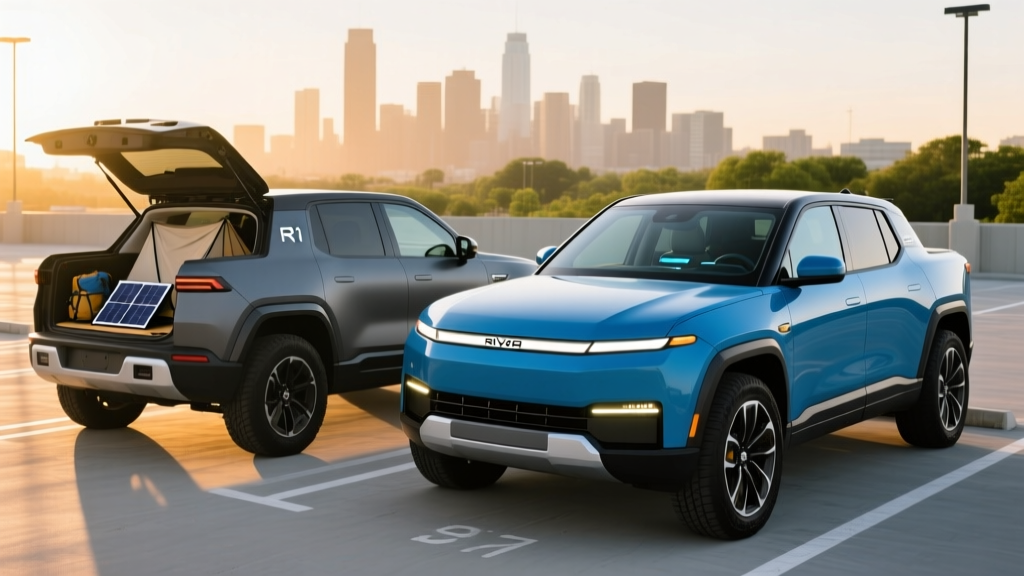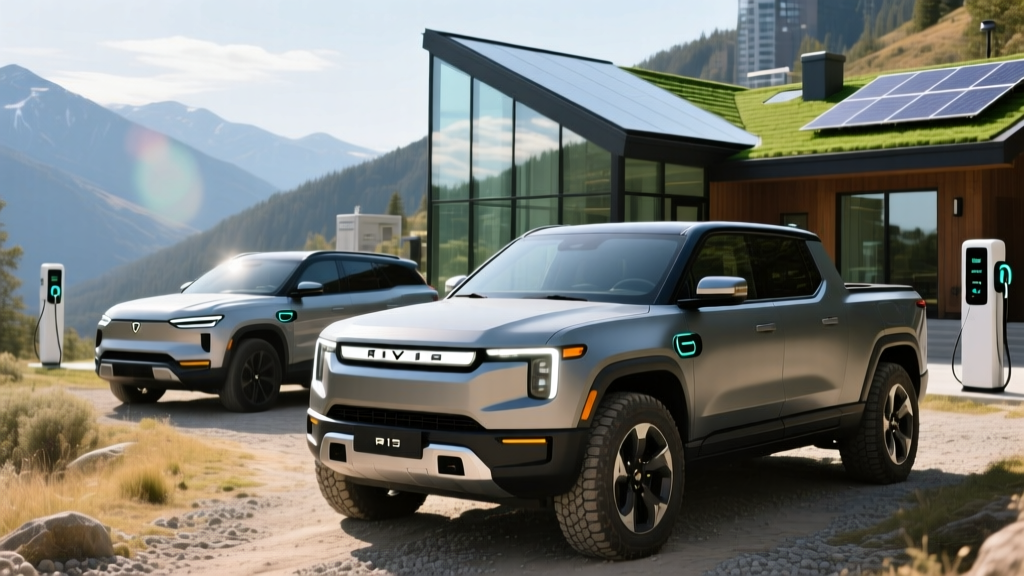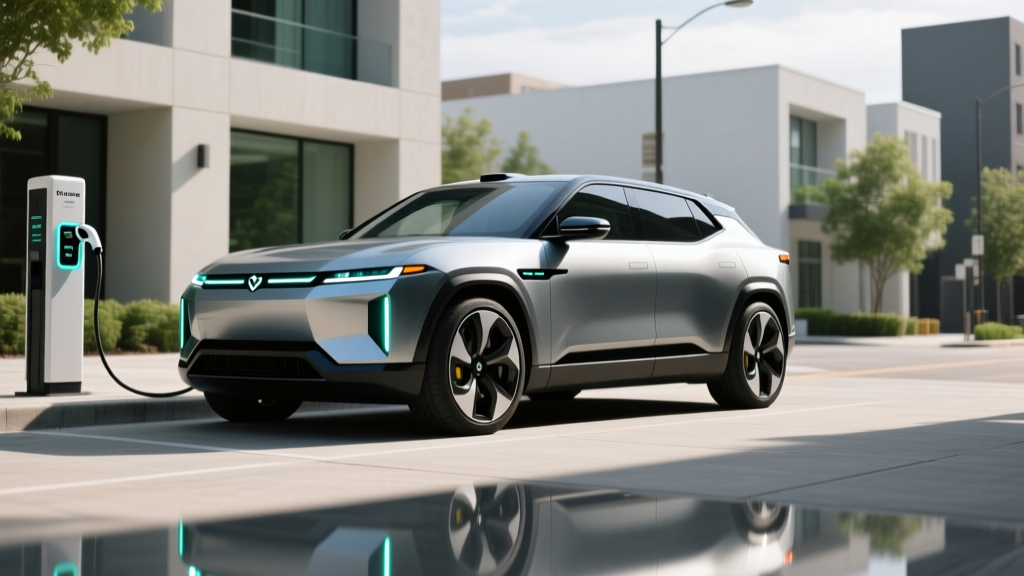
The Rivian R2 is no longer a concept relegated to auto-show floors. After years of anticipation, the compact electric SUV is officially entering production in the first half of 2026 at Rivian's Normal, Illinois facility — with a brand-new Georgia plant slated to follow for higher-volume output. For buyers who've held deposits since 2022, the wait is nearly over. For new shoppers, the R2 represents Rivian's bid to compete directly with the Tesla Model Y, Ford Mustang Mach-E, and Hyundai Ioniq 5 in the mainstream electric SUV segment.
This profile breaks down every confirmed and preliminary spec we have on the 2026 Rivian R2, from battery chemistry and charging architecture to real-world range expectations and federal tax credit eligibility. Because the vehicle is just beginning deliveries, some figures remain manufacturer estimates pending final EPA certification.
What Is the Rivian R2 Production Status in 2026?
Rivian confirmed that R2 production commenced at its existing Normal, Illinois factory in early 2026, with first customer deliveries targeted for mid-2026. The company retooled a portion of the plant originally used for R1S and R1T assembly, adding a new mid-size vehicle platform line. The purpose-built Stanton, Georgia facility — announced in 2022 with $5 billion in planned investment — is expected to begin R2 production at scale later, potentially by late 2026 or 2027, dramatically increasing annual output capacity.
Reservation holders who placed $100 deposits have been receiving configuration invitations in waves, prioritized by deposit date and trim selection. Rivian has stated it will produce both dual-motor AWD and single-motor RWD variants from the start, though initial batches are weighted toward higher-trim AWD configurations — a pattern consistent with the R1S/R1T launch strategy.
- Early 2026: R2 production begins at Normal, IL facility
- Mid-2026: First customer deliveries (reservation holders)
- Late 2026–2027: Stanton, GA plant ramps for volume production
- Target annual capacity: 155,000+ units (combined IL + GA)
Range, Battery, and Efficiency: What to Expect
The R2 rides on Rivian's new mid-size platform, which uses a structural battery pack integrated into the vehicle floor. Rivian has targeted an EPA-estimated range of approximately 330 miles for the dual-motor AWD variant with the larger battery option. The single-motor RWD version is expected to achieve slightly higher range due to reduced drivetrain losses, though official EPA figures for that variant have not yet been published.
The 330-mile EPA estimate assumes a mix of city and highway driving at moderate temperatures. In real-world conditions:
- Highway-only (70–75 mph): Expect ~270–290 miles due to aerodynamic drag at sustained speed
- Cold weather (below 32°F): Range can drop 20–30%, yielding ~230–265 miles without preconditioning
- City/regenerative driving: You may match or slightly exceed the EPA figure thanks to regen braking recovery
The R2 is expected to include a heat pump for improved cold-weather efficiency, which should mitigate some winter range loss compared to resistive heating systems.
Rivian has not officially disclosed the exact usable battery capacity, but industry reporting and supply-chain analysis point to a ~85 kWh usable pack for the standard-range variant and a larger ~105 kWh usable pack for the extended-range option. The chemistry is expected to be NMC (nickel manganese cobalt) for the extended-range pack, prioritizing energy density, while Rivian has signaled it will offer an LFP (lithium iron phosphate) option on base trims in the future for buyers who prioritize longevity and lower cost over maximum range.
| Specification | Standard Range (Est.) | Extended Range (Est.) |
|---|---|---|
| Usable Battery Capacity | ~85 kWh | ~105 kWh |
| Chemistry | LFP (planned) | NMC |
| EPA Range (AWD) | ~275 mi | ~330 mi |
| Efficiency (est.) | ~30 kWh/100 mi | ~32 kWh/100 mi |
| MPGe (est. combined) | ~112 MPGe | ~105 MPGe |
Note: MPGe (miles per gallon equivalent) translates electrical energy into a gasoline-equivalent figure using the conversion factor of 33.7 kWh = 1 gallon. Lower kWh/100mi means better efficiency. Heavier extended-range pack slightly reduces MPGe despite more total range.
Charging Speed: DC Fast Charge and Home Level 2
One of the R2's most significant upgrades over the first-generation R1 platform is its adoption of the NACS (North American Charging Standard) connector natively — the same connector used by Tesla. This means R2 owners will have direct access to Tesla's Supercharger network (now open to non-Tesla EVs via NACS) without an adapter, which is the largest and most reliable DC fast-charging network in North America.
Rivian has targeted a peak DC fast-charge rate of approximately 200 kW for the R2. On a capable 250+ kW charger, the R2 should achieve a 10–80% charge in roughly 25–28 minutes. As with all EVs, the charge curve tapers significantly above 80% to protect battery health — expect 80–100% to take an additional 15–20 minutes. For road-trip planning, the 10–80% window is what matters.
| Charging Level | Power | Speed / Time | Connector |
|---|---|---|---|
| Level 1 (120V household) | ~1.4 kW | ~3–4 mi/hr | NACS |
| Level 2 (240V home) | ~11.5 kW (48A) | ~30–34 mi/hr; full charge ~9–10 hr | NACS |
| DC Fast Charge | Peak ~200 kW | 10–80% in ~25–28 min | NACS |
Understanding kW vs. kWh: kW (kilowatts) measures the rate of power delivery — like water flow from a hose. kWh (kilowatt-hours) measures total energy stored in the battery — like the size of the tank. A 200 kW charger fills the battery fast, but the battery's kWh capacity determines how far you can drive.
For home charging, Rivian is expected to offer a Wall Connector-style unit capable of 11.5 kW on a 48-amp circuit, which requires a 60-amp dedicated breaker. Most R2 owners who install a Level 2 home charger will wake up to a full battery every morning — the single biggest convenience advantage of EV ownership. Installation costs for a 240V/60A circuit typically range from $800 to $2,500 depending on panel proximity and local permitting. Always consult a licensed electrician for final specs.
Performance: 0–60, Horsepower, and Drivetrain
The R2 is positioned as a compact adventure SUV, and Rivian is offering it in both rear-wheel-drive and dual-motor all-wheel-drive configurations.
| Variant | Drivetrain | Horsepower | 0–60 mph | Towing (est.) |
|---|---|---|---|---|
| Single Motor | RWD | ~330 hp | ~6.0 sec | ~3,300 lb |
| Dual Motor | AWD | ~500 hp | ~4.5 sec | ~3,500 lb |
| Performance (Dual Motor) | AWD | ~600 hp | ~3.5 sec | ~3,500 lb |
The dual-motor AWD variant uses independent front and rear electric motors, giving it precise torque vectoring and genuine off-road capability — a Rivian hallmark. The R2 is expected to offer multiple drive modes (All-Purpose, Sport, Snow, Off-Road, Tow) and retain a wading depth suitable for stream crossings, though it will be slightly less capable than the body-on-frame R1T/R1S in extreme rock-crawling scenarios.
Pricing, Trims, and Federal Tax Credit Eligibility
Rivian has targeted a starting MSRP of approximately $45,000 for the base single-motor RWD R2, with dual-motor AWD variants starting around $52,000–$55,000 and fully loaded configurations reaching the low $60,000s. These prices position the R2 aggressively against the Tesla Model Y (starting ~$44,990) and well below the R1S (starting ~$75,900).
| Trim / Config | Est. MSRP | Max §30D Credit | Effective Price |
|---|---|---|---|
| Base RWD (Standard Range) | ~$45,000 | Up to $7,500* | ~$37,500 |
| Dual Motor AWD (Std Range) | ~$52,000 | Up to $7,500* | ~$44,500 |
| Dual Motor AWD (Ext Range) | ~$58,000 | Up to $7,500* | ~$50,500 |
*Federal tax credit eligibility under IRS §30D depends on multiple requirements that change annually. For 2026:
- MSRP cap: SUVs must be ≤$80,000 — the R2 qualifies on all trims
- Buyer income cap: AGI ≤$150,000 (single), ≤$225,000 (head of household), ≤$300,000 (joint)
- Battery sourcing: Critical minerals and battery components must meet escalating domestic/free-trade-agreement thresholds — Rivian's supply chain compliance varies by build date
- Point-of-sale transfer: Eligible buyers can apply the credit as an instant dealer discount at purchase, reducing out-of-pocket cost immediately
- FIN requirement: The vehicle must have a valid battery certification from the manufacturer filed with the IRS
Always verify current eligibility with a tax professional and the DOE/FuelEconomy.gov tax credit lookup before purchasing. Credit amounts may be $3,750 or $7,500 depending on whether the vehicle meets one or both sourcing thresholds.
Interior, Cargo, and Technology
The R2 is a compact two-row SUV, smaller than the three-row R1S but designed to maximize interior volume within its footprint. Rivian has emphasized a flat floor (thanks to the skateboard-style battery architecture), generous glass area, and a minimalist dashboard dominated by a large central touchscreen.
Expected interior dimensions place the R2 in line with competitors:
- Cargo volume (rear seats up): ~28–32 cu ft
- Cargo volume (rear seats folded): ~65–70 cu ft
- Front trunk (frunk): ~8–10 cu ft — sealed and drainable, useful for wet gear
- Rear legroom: ~38–40 inches
- Seating: 5 passengers
On the technology front, the R2 debuts Rivian's next-generation software stack with over-the-air update capability, a redesigned infotainment interface, and enhanced driver-assistance features. The R2 will ship with Rivian's Driver+ system — a SAE Level 2 hands-on driver-assistance suite offering adaptive cruise control, lane centering, and automatic lane changes on divided highways. This is not autonomous driving; the driver must remain attentive and keep hands on the wheel at all times.
Rivian Driver+ is an SAE Level 2 system. It assists with steering and speed but requires continuous driver supervision. It does not make the R2 a self-driving vehicle. Only Level 4 robotaxi services (e.g., Waymo in designated geofenced areas) operate without a human driver. Never disengage attention while using Level 2 features.
Additional expected tech features include:
- 15.6-inch center touchscreen with wireless Apple CarPlay and Android Auto
- Digital instrument cluster and available head-up display
- Vehicle-to-load (V2L) capability — power camping gear or tools from the battery
- Rivian's Camp Kitchen and gear tunnel accessories (optional, carryover from R1 platform thinking)
- Phone-as-key with Bluetooth LE and UWB
- Multi-zone climate control with heat pump
Warranty Coverage
Rivian has not yet published the final R2 warranty booklet, but based on the R1S/R1T precedent and industry norms, buyers should expect:
- Battery & drive unit: 8 years / 100,000 miles (minimum per EPA/CARB norms; Rivian's R1 warranty is 8 yr / 175,000 mi for the battery)
- Battery capacity retention: Typically warranted at ≥70% of original capacity over the warranty period
- Vehicle limited warranty: 5 years / 60,000 miles (bumper-to-bumper)
- Roadside assistance: 5 years / unlimited miles
The battery warranty is one of the most important ownership factors for EV buyers. A 70% capacity retention threshold means that if the battery degrades below 70% of its original kWh within the warranty window, Rivian will repair or replace it at no cost. Most modern NMC and LFP packs degrade only 8–12% over the first 100,000 miles under normal use, based on data from the broader EV fleet.
Who Should Buy the Rivian R2?
Choose the R2 if:
- You want genuine off-road capability in a compact EV (trail modes, ground clearance, AWD torque vectoring)
- You value NACS native charging and direct Supercharger access without adapters
- You need a frunk plus generous cargo space for outdoor gear, groceries, or family hauling
- You want a more distinctive design than the ubiquitous Model Y
- You're a current Rivian reservation holder ready to configure
Look elsewhere if:
- You need three rows of seating (consider the R1S, Kia EV9, or Tesla Model X)
- You want the longest possible range — the Hyundai Ioniq 5 and Tesla Model Y Long Range may edge out the R2 on efficiency
- You need immediate delivery — early R2 production slots will be limited and prioritized to reservation holders
- You prioritize the lowest possible price — the Chevy Equinox EV starts significantly lower
The R2 is best suited for active-lifestyle families and outdoor enthusiasts who want a capable, adventure-oriented compact SUV with real off-road chops and the convenience of home charging. It's also a strong pick for daily commuters who want a premium interior and strong tech stack without stepping up to the R1S's price and size. For road trips, the 330-mile range and Supercharger access make it a credible long-distance vehicle, though you'll want to plan charging stops around the 10–80% fast-charge sweet spot.
Rivian R2 vs. Key Competitors
| Spec | Rivian R2 (AWD) | Tesla Model Y LR | Ford Mach-E ER AWD | Hyundai Ioniq 5 LR AWD |
|---|---|---|---|---|
| EPA Range | ~330 mi | 320 mi | 312 mi | 290 mi |
| Starting MSRP (AWD) | ~$52,000 | ~$48,990 | ~$51,995 | ~$50,100 |
| Peak DC Charge | ~200 kW | 250 kW | 150 kW | 240 kW |
| 10–80% DC Time | ~25–28 min | ~20 min | ~38 min | ~18 min |
| Connector | NACS | NACS | CCS (NACS adapter avail.) | CCS (NACS adapter avail.) |
| Off-Road Capability | Strong | Limited | Moderate | Limited |
Frequently Asked Questions
Can I buy a Rivian R2 right now?
As of mid-2026, the R2 is in early production and first deliveries are reaching reservation holders. Walk-in purchases are unlikely until production ramps significantly, likely late 2026 or into 2027. Placing a reservation on Rivian's website is the best path to securing an early build slot.
What is the real-world range of the Rivian R2?
The EPA-estimated range is approximately 330 miles for the extended-range AWD variant. Real-world highway driving at 70–75 mph will yield roughly 270–290 miles, and cold-weather driving below freezing can reduce range by 20–30% to around 230–265 miles. Preconditioning the battery before driving and using the heat pump will help mitigate losses.
How fast does the R2 charge at home and on the road?
At home on a 240V Level 2 charger (11.5 kW), the R2 gains approximately 30–34 miles of range per hour, fully charging overnight in 9–10 hours. On a DC fast charger, it peaks at approximately 200 kW, reaching 10–80% in about 25–28 minutes. Charging slows above 80% to protect battery longevity.
Does the Rivian R2 qualify for the $7,500 federal tax credit?
The R2's MSRP falls well under the $80,000 SUV cap, so it clears the price requirement. However, full §30D credit eligibility depends on your income (AGI caps apply), the battery's critical-mineral and component sourcing (which may vary by production batch), and Rivian's certification filings with the IRS. The credit can be transferred at point of sale as an instant discount. Always confirm with a tax professional and check the latest data at fueleconomy.gov.
Is the R2 worth buying over a Tesla Model Y?
It depends on your priorities. The Model Y offers slightly faster DC charging (250 kW peak), a more mature Supercharger ecosystem, and a lower starting price for AWD. The R2 counters with genuine off-road capability, a more distinctive design, a drainable frunk, V2L capability, and a more premium interior feel. If adventure use and design differentiation matter, the R2 is compelling. If you want the most proven, lowest-friction EV ownership experience, the Model Y remains the default.
What are the biggest pros and cons of the Rivian R2?
- Native NACS connector — direct Supercharger access
- ~330 mi EPA range (extended-range AWD)
- Genuine off-road capability for a compact EV SUV
- Drainable frunk and generous cargo versatility
- V2L capability for camping and worksite use
- Distinctive design in a segment dominated by one model
- Early production — limited availability, potential build-quality variability
- DC charge speed (~200 kW) trails Hyundai Ioniq 5 and Tesla Model Y
- Rivian's service center network is still expanding
- No third-row option for larger families
- Final EPA and pricing figures not yet confirmed for all trims
- Reservation-to-delivery wait may extend into 2027 for new orders
Will Rivian offer an LFP battery option on the R2?
Rivian has indicated that an LFP battery option is planned for base trims, which would offer lower cost, longer cycle life, and the ability to regularly charge to 100% without degradation concerns — at the trade-off of slightly lower energy density and reduced cold-weather performance. Availability timing for the LFP variant has not been confirmed.