If you've been searching for Rivian R2 pictures and concrete specifications, the wait for visual details is largely over — but the wait for actual delivery is still ongoing. Rivian's compact electric SUV, officially unveiled in early 2024 and slated for production beginning in the first half of 2026, represents the brand's bid to crack the mainstream EV market with a smaller, more affordable platform. Here at AutoEdgeView, we've compiled every confirmed and estimated spec, analyzed the real-world implications, and gathered the latest imagery details so you can evaluate the R2 before reservations convert to orders.
Important disclosure: The 2026 Rivian R2 is an announced, pre-production vehicle. Specifications below reflect Rivian's published estimates and industry analysis as of early 2026. Final EPA certification, pricing, and tax credit eligibility will be confirmed closer to delivery. We will update this profile as official data becomes available.
Design and Exterior: What the Latest Rivian R2 Pictures Reveal
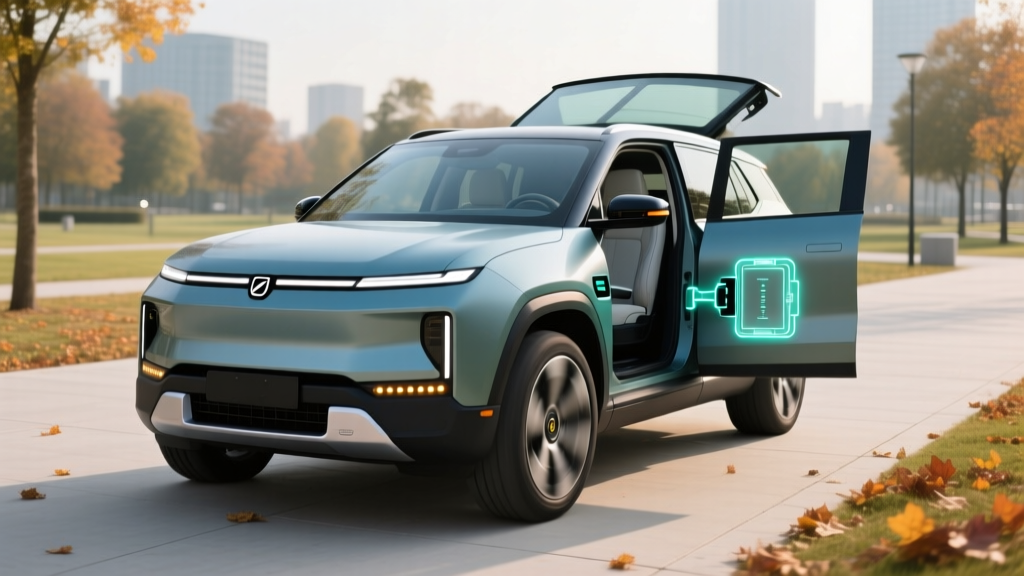
The R2 carries forward Rivian's signature design language — upright stance, oval LED headlights with animated light signatures, and a flat, skateboard-platform floor — but shrinks it to a footprint closer to the Tesla Model Y and Hyundai Ioniq 5. From available imagery and Rivian's official reveal materials, several design details stand out:
- Dimensions: Approximately 183 inches long, 76 inches wide, and 66 inches tall — roughly 10 inches shorter than the R1S.
- Wheel options: 19-inch aero wheels (range-optimized) and available 21-inch all-terrain wheels.
- Gear tunnel: The R2 drops the R1's signature transverse gear tunnel to reduce cost and complexity, but retains a front trunk (frunk).
- Roof: Available panoramic glass roof with electrochromic dimming; optional crossbar-ready roof rails for cargo boxes and bike racks.
- Lighting: Full LED exterior lighting with Rivian's animated welcome/lock sequences.
The overall aesthetic is purposefully rugged without the exaggerated cladding of some competitors. Rivian's design chief Jeff Hammoud has described the R2 as "approachable adventure" — a vehicle that looks ready for a trail without looking out of place at a suburban school drop-off.
Spec Table: 2026 Rivian R2 at a Glance
| Specification | Estimated / Confirmed Value |
|---|---|
| EPA Range (est.) | 300–330 miles (Dual-Motor, Standard battery) |
| Battery Capacity (usable) | ~75 kWh (Standard) / ~100 kWh (Max, est.) |
| Battery Chemistry | NMC (nickel manganese cobalt) — LFP variant under evaluation |
| Max DC Fast Charge | ~200 kW peak (est.) |
| 10–80% DC Charge Time | ~28–32 minutes (est.) |
| Level 2 Home Charging | 11.5 kW (~30–33 miles/hr) |
| 0–60 mph (Dual-Motor) | ~4.5 seconds (est.) |
| Horsepower (Dual-Motor) | ~400 hp (est.) |
| Drivetrain | RWD (base) / Dual-Motor AWD |
| MPGe (est.) | ~105–115 MPGe combined |
| Cargo Volume (est.) | ~30 cu ft (rear seats up) / ~65 cu ft (folded) |
| Frunk Volume (est.) | ~5–7 cu ft |
| Base MSRP | $45,000 (RWD, Standard battery) |
| Dual-Motor AWD MSRP (est.) | ~$50,000–$52,500 |
| Battery Warranty | 8 years / 100,000 miles (expected, per Rivian precedent) |
| Production Start | First half of 2026 (Normal, IL plant) |
Range and Efficiency: Real-World Expectations vs. the Sticker
EPA Estimated: 300–330 miles (Dual-Motor, Standard battery)
Real-World Highway (70 mph): ~240–270 miles
Cold Weather (below 30°F): ~200–230 miles
City / Moderate Climate: ~280–310 miles
Rivian targets an EPA-estimated 300 to 330 miles for the dual-motor R2 equipped with the standard battery pack. That's competitive with the Model Y Long Range (320 miles EPA) and the Ioniq 5 Long Range (303 miles EPA). But as any experienced EV owner knows, the EPA number is a best-case blended figure.
On sustained highway driving at 70+ mph, expect to lose roughly 15–20% from the EPA sticker due to aerodynamic drag — the R2's upright SUV profile doesn't slice through air like a sedan. In freezing temperatures, battery chemistry limitations and cabin heating draw can knock range down 25–35%, even with a heat pump (which Rivian has confirmed the R2 platform will include).
Efficiency is projected around 105–115 MPGe combined, translating to roughly 29–32 kWh per 100 miles. That's in line with compact electric SUVs in this weight class, though the R2's adventure-ready weight and tire options may push real-world consumption toward the higher end of that range, especially on all-terrain rubber.
Charging Speed: DC Fast Charging and Home Setup
Charging speed is where the R2 needs to compete with the best in class. Based on Rivian's 800-volt-derived architecture announcements and the R1 platform's evolution, here's what we project:
| Charging Level | Power / Rate | Estimated Speed |
|---|---|---|
| Level 1 (120V household) | ~1.4 kW | ~3–4 miles per hour |
| Level 2 (240V home, 48A) | 11.5 kW | ~30–33 miles per hour |
| DC Fast Charge (peak) | ~200 kW | 10–80% in ~28–32 min |
| DC Fast Charge (sustained avg) | ~140–160 kW | Avg ~180 miles added in 20 min |
The ~200 kW peak DC fast-charge rate puts the R2 behind the Hyundai/Kia E-GMP platform (which peaks at 240+ kW on 350 kW chargers) but on par with most mainstream competitors. The critical detail is the charge curve — peak kW is only sustained at low states of charge. Expect the R2 to taper significantly above 80% SoC, as all lithium-ion packs do to protect cell longevity. For road trips, plan your stops around 10–80% charges, which should take roughly half an hour at a functioning 150+ kW station.
At home, the 11.5 kW Level 2 rate means a full overnight charge from 10–90% in roughly 7–8 hours on a 48-amp hardwired unit. You'll need a NEMA 14-50 outlet or a dedicated hardwired circuit installed by a licensed electrician — budget $800–$2,000 for installation depending on your panel capacity and run distance.
Connector note: Rivian has confirmed adoption of the NACS (North American Charging Standard) connector on future vehicles. The R2 is expected to ship with a native NACS port, granting access to Tesla Supercharger stations — a significant advantage for road-trip charging reliability over CCS-only vehicles.
Performance and Drivetrain
Rivian plans to offer the R2 in multiple drivetrain configurations:
- RWD (Single Motor): The base model, expected around 300 hp and a 0–60 mph time in the low 6-second range. This is the $45,000 entry point.
- Dual-Motor AWD: Two motors (one front, one rear) producing an estimated 400 hp and a 0–60 mph time around 4.5 seconds. This is the volume configuration for buyers in snow-belt states and those planning light off-road use.
- Performance variant (unconfirmed): Rivian has hinted at a potential tri-motor or performance-tuned dual-motor variant, but specs and availability are not confirmed for launch.
Rivian's torque-vectoring AWD system on the R1 platform has been praised for its responsiveness on loose surfaces, and the R2 is expected to inherit a simplified version of this capability. Ground clearance figures haven't been published, but expect approximately 8.0–8.5 inches — adequate for fire roads and snowy driveways, if not hardcore rock crawling.
Pricing, Trims, and Federal Tax Credit Eligibility
| Trim / Config | Est. MSRP | Est. After §30D Credit |
|---|---|---|
| RWD Standard Battery | $45,000 | ~$37,500 (if eligible) |
| Dual-Motor AWD Standard | ~$50,000–$52,500 | ~$42,500–$45,000 |
| Dual-Motor Max Battery | ~$57,000–$60,000 | ~$49,500–$52,500 |
The headline $45,000 starting price positions the R2 aggressively against the Model Y (starting ~$44,990 in 2026), but most buyers will likely opt for dual-motor AWD, pushing the transaction price into the low-to-mid $50,000 range before incentives.
Federal §30D Tax Credit Eligibility: The R2 is expected to qualify for up to $7,500 under the IRS clean vehicle credit, but eligibility depends on several factors that shift regularly:
- MSRP cap: SUVs must be under $80,000 MSRP — the R2 clears this easily.
- Buyer income cap: Modified AGI must not exceed $150,000 (single) / $300,000 (joint). Check your tax situation with a professional.
- Battery sourcing: Critical minerals and battery components must meet escalating domestic-content thresholds. Rivian has been actively reshoring its supply chain, but exact credit amounts ($3,750 vs. $7,500) depend on the specific battery pack's compliance at time of delivery.
- Point-of-sale transfer: As of 2024, buyers can transfer the credit to the dealer for an immediate price reduction at purchase, rather than waiting to claim it on their tax return.
Always verify current eligibility on fueleconomy.gov and consult a tax professional before making a purchase decision based on credit assumptions.
Interior, Tech, and Cargo Space
The R2's interior represents a deliberate simplification from the R1. Rivian has moved to a single large central touchscreen (estimated 15 inches) with minimal physical buttons, a digital instrument cluster, and a head-up display. Key interior details from Rivian's reveal and subsequent updates:
- Seating: 5-passenger capacity (no third row, unlike the R1S). Vegan leather standard; premium textile and Nappa leather options.
- Cargo (rear seats up): ~30 cubic feet — competitive with the Model Y (~30 cu ft) and larger than the Ioniq 5 (~27 cu ft).
- Cargo (rear seats folded): ~65 cubic feet, with a flat load floor.
- Frunk: ~5–7 cubic feet — useful for charging cables, groceries, or a small cooler.
- Towing: Estimated 3,300–4,400 lbs max (unconfirmed; Rivian has not published a final figure).
On the tech front, the R2 will run Rivian's next-generation software stack, including:
- Over-the-air updates for performance, features, and UI.
- Rivian's Driver+ ADAS suite — adaptive cruise, lane centering, and automated lane changes. This is an SAE Level 2 driver-assistance system requiring continuous driver supervision, not a self-driving system.
- Native navigation with real-time charging route planning and battery preconditioning for DC fast charging.
- Integrated camp mode, pet mode, and the Rivian gear-shop ecosystem.
Rivian Driver+ is an SAE Level 2 system. The driver must remain alert, keep hands on or near the wheel, and be prepared to take over at any moment. It does not make the R2 a self-driving vehicle.
Warranty and Ownership
Rivian has not published final R2 warranty terms, but based on the R1 platform precedent, expect:
- Battery pack: 8 years / 100,000 miles (minimum 70% capacity retention)
- Powertrain (motors, reducers): 8 years / 100,000 miles
- Vehicle (bumper-to-bumper): 5 years / 60,000 miles
- Roadside assistance: 5 years / unlimited miles
One ownership variable to watch: Rivian's service network is still expanding. As of early 2026, Rivian operates roughly 50+ service centers nationwide, supplemented by mobile service vans. If you live outside a major metro area, confirm service accessibility before ordering.
Pros and Cons
- Adventure-capable AWD in a compact, daily-drivable size
- NACS native charging — Supercharger network access
- Projected 300+ mile EPA range
- Strong cargo capacity for the class (~30 cu ft)
- $45,000 starting MSRP undercuts most AWD electric SUVs
- Rivian's OTA software and community ecosystem
- Pre-production — no EPA-certified figures or test drives yet
- Peak DC charge rate (~200 kW) trails Hyundai/Kia E-GMP
- Service network still growing — may be sparse in rural areas
- No third-row option (families needing 7 seats should look at R1S)
- Tax credit eligibility dependent on evolving battery-sourcing rules
- Reservation-to-delivery timeline uncertain
Is the Rivian R2 Worth Waiting For?
The R2 targets a specific buyer: someone who wants a compact electric SUV with genuine all-weather and light-trail capability, values access to the Supercharger network, and prefers Rivian's software and community over Tesla's ecosystem. If that's you, the R2 is arguably the most compelling vehicle in the upcoming 2026 lineup.
However, if you need a vehicle now, the Model Y, Ioniq 5, and Ford Mustang Mach-E are all available, well-reviewed, and tax-credit-eligible today. The R2's biggest risk is production timing — Rivian's Normal, Illinois factory must scale a new platform while continuing to build R1 vehicles and EDV delivery vans for Amazon.
Reserve the R2 if: You can wait until mid-to-late 2026, want NACS + AWD in a compact SUV, and value Rivian's adventure-oriented brand.
Buy now if: You need a vehicle within 3–6 months, want proven reliability data, or live far from a Rivian service center.
Frequently Asked Questions
What is the real-world range of the Rivian R2?
Rivian targets 300–330 miles EPA for the dual-motor standard battery. In real-world highway driving at 70 mph, expect roughly 240–270 miles. In cold weather below 30°F, plan for 200–230 miles. These are estimates until EPA certification is finalized.
How fast does the R2 charge at home and on the road?
At home on a 48-amp Level 2 charger (11.5 kW), the R2 should add roughly 30–33 miles of range per hour, fully charging overnight. On DC fast chargers, the estimated 200 kW peak should deliver a 10–80% charge in about 28–32 minutes, though sustained rates will average lower due to charge-curve tapering.
Does the Rivian R2 qualify for the $7,500 federal EV tax credit?
The R2 is expected to qualify, but final eligibility depends on IRS §30D rules at time of delivery — including buyer income caps ($150K single / $300K joint), the $80K SUV MSRP cap (which the R2 clears), and battery critical-mineral sourcing thresholds. Always verify on fueleconomy.gov and consult a tax professional.
When can I actually buy the Rivian R2?
Production is scheduled to begin in the first half of 2026 at Rivian's Normal, Illinois facility. Reservation holders will receive delivery windows based on configuration and order date. Walk-up orders without a reservation will depend on production capacity.
Is the R2 better than the Tesla Model Y?
The R2 offers more adventure-oriented capability (AWD tuning, roof rails, rugged design) and Rivian's community-driven ownership experience. The Model Y has a proven production track record, broader service infrastructure, and years of efficiency optimization. The R2 is unproven but potentially more compelling for outdoor-oriented buyers; the Model Y is the safer, known quantity.
What connector does the R2 use?
The R2 is expected to feature a native NACS (Tesla-style) charging port, granting direct access to Tesla Supercharger stations without an adapter — a significant advantage for road-trip charging convenience.