The Rivian R2 is the most anticipated compact electric SUV since the Tesla Model Y reshaped the segment. Slated for production at Rivian's Normal, Illinois plant starting in the first half of 2026, the R2 promises to bring the brand's adventure-oriented DNA to a more accessible price point. But with competition from the Tesla Model Y, Hyundai Ioniq 5, and Ford Mustang Mach-E intensifying, buyers need hard numbers — not hype — before placing a reservation.
This preview breaks down everything confirmed and estimated about the 2026 Rivian R2: the interior layout and cargo dimensions, battery specs and projected range, charging speeds, performance figures, pricing, and federal tax credit eligibility. Where Rivian has published official data, we cite it directly. Where figures remain preliminary, we flag them clearly and benchmark against segment rivals.
Rivian R2 Interior: Space, Materials, and the 5-Person Layout
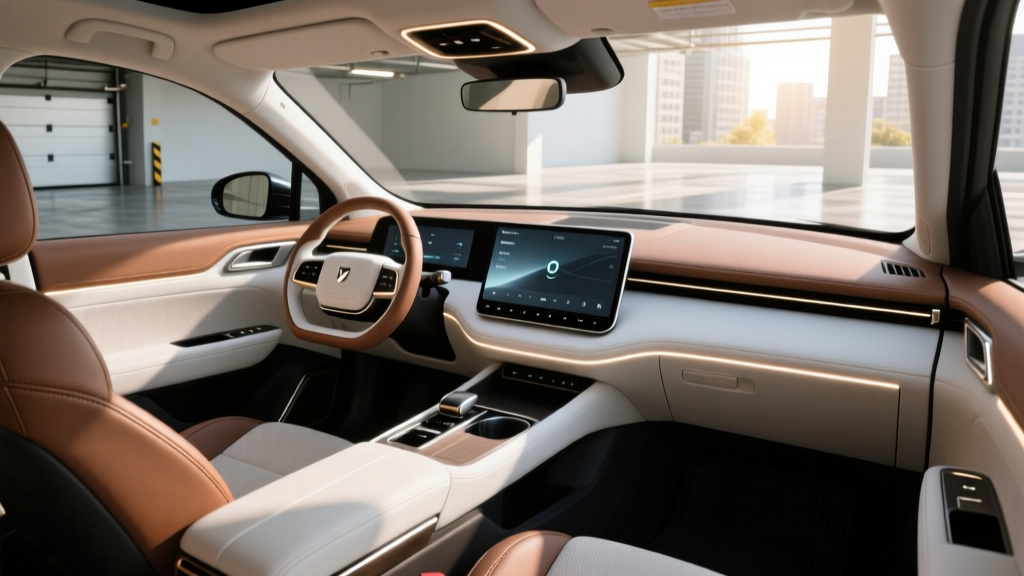
The Rivian R2 interior marks a deliberate step down from the R1S's premium, body-on-frame architecture to a unibody platform optimized for volume manufacturing and cost efficiency. Yet the design language carries forward: a minimalist dashboard dominated by a central touchscreen, a compact digital instrument cluster, and Rivian's signature use of durable, vegan materials.
Rivian has confirmed the R2 seats five passengers across two rows — a notable decision given that some competitors (the Kia EV9, for instance) offer three-row layouts in this price band. The five-seat configuration allows for a more generous second-row legroom envelope and a larger cargo area behind the rear seats.
Estimated Interior and Cargo Dimensions
| Dimension | Rivian R2 (Est.) | Tesla Model Y | Hyundai Ioniq 5 |
|---|---|---|---|
| Seating Capacity | 5 | 5 (optional 7) | 5 |
| Front Headroom | ~40.5 in | 41.0 in | 39.8 in |
| Rear Legroom | ~38.0 in | 41.6 in | 39.4 in |
| Cargo Behind 2nd Row | ~32 cu ft | 30.2 cu ft | 27.2 cu ft |
| Cargo Total (Seats Folded) | ~68 cu ft | 72.1 cu ft | 59.3 cu ft |
| Frunk Volume | ~8 cu ft | 4.1 cu ft | 2.1 cu ft |
Rivian has historically prioritized frunk space as a differentiator — the R1T's front trunk is large enough for a full-size cooler. The R2's estimated 8 cu ft frunk continues this trend and provides secure, weatherproof storage for charging cables, groceries, or gear that doesn't belong in the main cabin.
The center console design borrows from the R1 family: a large, flat surface with wireless charging pads, USB-C ports front and rear, and modular storage. Rivian's design chief Jeff Hammoud has emphasized that the R2 interior uses "honest materials" — recycled textiles, microfiber suede accents, and plant-based leather alternatives rather than traditional hides. Expect available Napa-style synthetic leather on higher trims.
Range, Battery, and Efficiency: What We Know
Rivian has targeted a maximum EPA-estimated range of 330+ miles for the R2's largest battery configuration. The company has not yet published the exact usable battery capacity in kWh, but industry reporting and supply-chain analysis point to a pack in the 85–95 kWh range, likely using NMC (nickel manganese cobalt) chemistry for energy-density optimization on the long-range variant.
A Standard-range R2 is also expected, potentially using a smaller NMC pack or, speculatively, an LFP (lithium iron phosphate) battery for cost reduction. LFP cells are heavier and less energy-dense but offer longer cycle life, lower degradation, and reduced reliance on cobalt and nickel — a trade-off Rivian may exploit for a sub-$45,000 entry point.
EPA Estimate: ~330 miles (Long Range AWD, projected)
Highway Driving (75 mph, 70°F): Expect ~265–285 miles — aerodynamic drag hits boxy SUV profiles hard at sustained highway speeds.
Cold Weather (20°F, cabin heat on): Expect ~215–240 miles — a 25–35% reduction is typical for EVs without aggressive heat-pump preconditioning.
Mixed Commuting (city + suburban): ~300–320 miles is realistic, as regenerative braking recovers energy in stop-and-go traffic.
Bottom line: plan road trips around ~250 miles of usable range per charge leg for a comfortable buffer. The 330-mile EPA figure is best-case, low-speed, temperate-weather driving.
Efficiency Estimates
For a compact electric SUV with AWD and roughly 90 kWh of usable battery, expect an efficiency rating near 105–112 MPGe combined (roughly 30–32 kWh/100 miles). That's competitive with the Tesla Model Y Long Range AWD (122 MPGe per fueleconomy.gov) but trails the Hyundai Ioniq 5 AWD (110 MPGe) by a small margin. The R2's more upright, adventure-oriented styling will likely impose a slight aerodynamic penalty compared to sleeker crossovers.
Charging Speed: DC Fast Charge and Home Level 2
Charging speed is where the R2 needs to deliver to compete. Rivian has confirmed the R2 will support DC fast charging at up to ~175 kW peak and will come equipped with the NACS (North American Charging Standard) port from launch — granting native access to Tesla's Supercharger network, which now numbers over 25,000 stalls across North America.
| Charging Level | Power / Rate | Estimated Speed | Connector |
|---|---|---|---|
| Level 1 (120V household) | ~1.4 kW | ~3–4 mi/hr | NACS (J1772 adapter) |
| Level 2 (240V home, 48A) | ~11.5 kW | ~30–35 mi/hr | NACS |
| DC Fast Charge (peak) | ~175 kW | 10–80% in ~25–28 min | NACS |
| DC Fast Charge (sustained avg.) | ~120–130 kW | ~200+ mi in 30 min | NACS |
Charging-curve reality: The 175 kW peak is typically available only between roughly 10–35% State of Charge (SoC). Above 50%, the charge rate tapers to protect battery longevity, dropping to ~80 kW by 70% and ~40 kW above 85%. This is standard behavior for all modern lithium-ion EV batteries — peak kW is a headline number, not a sustained rate. Plan fast-charge stops around the 10–80% window for the fastest sessions.
At home, a Level 2 wall connector on a 60-amp circuit (48 amps continuous) will deliver roughly 11.5 kW, replenishing the R2's full battery in about 8–9 hours. Most owners will plug in overnight and wake to a full charge daily. Installation cost for a home Level 2 setup typically runs $800–$2,000 including the charger ($400–$700), electrician labor ($300–$1,000), and permitting ($50–$300), though homes needing a 200-amp panel upgrade should budget an additional $1,500–$3,000.
Performance: Dual-Motor AWD and 0–60 Times
Rivian's engineering DNA is performance-forward — the R1T dual-motor does 0–60 in roughly 3.0 seconds. The R2, being lighter and more compact, should deliver brisk acceleration even in base form.
| Configuration | Drivetrain | Horsepower (Est.) | 0–60 mph (Est.) | Towing (Est.) |
|---|---|---|---|---|
| Standard Range | Single-motor RWD | ~280 hp | ~6.5 sec | ~3,000 lb |
| Long Range | Dual-motor AWD | ~450 hp | ~4.5 sec | ~3,500 lb |
| Performance / Tri-Motor | Tri-motor AWD | ~600+ hp | ~3.0 sec | ~4,000 lb |
Rivian has confirmed the R2 will offer a single-motor rear-wheel-drive variant — a first for the brand — aimed at maximizing range and minimizing cost for commuters who don't need AWD traction. The dual-motor AWD configuration will be the volume seller, providing all-weather capability and the torque-vectoring feel that Rivian owners expect.
Towing capacity, while lower than the R1T's 11,000-pound rating, should be competitive with the segment. A ~3,500-pound tow rating covers light trailers, small boats, and bike racks — adequate for the weekend-adventure use case the R2 targets.
Pricing, Trims, and Federal Tax Credit Eligibility
Rivian CEO RJ Scaringe has repeatedly stated a target starting price of approximately $45,000 for the base R2, with higher trims climbing toward $55,000–$60,000. These are pre-destination, pre-options figures.
| Trim | Est. MSRP | §30D Credit | Effective Price |
|---|---|---|---|
| Standard Range RWD | ~$45,000 | Up to $7,500* | ~$37,500 |
| Long Range AWD | ~$52,000 | Up to $7,500* | ~$44,500 |
| Performance AWD | ~$58,000 | Up to $7,500* | ~$50,500 |
*Federal tax credit caveats (IRS §30D, 2026 rules):
- MSRP Cap: SUVs must have an MSRP at or below $80,000 — all R2 trims clear this threshold.
- Buyer Income Cap: Modified adjusted gross income must not exceed $150,000 (single), $225,000 (head of household), or $300,000 (joint filers).
- Battery Sourcing: To qualify for the full $7,500, the battery must meet critical-minerals and battery-component sourcing requirements set by the IRS under the Inflation Reduction Act. If the R2's cells contain components from a "foreign entity of concern" (FEOC), the credit could be reduced to $3,750 or eliminated entirely. Rivian has not yet published full battery-sourcing details for the R2.
- Point-of-Sale Transfer: As of 2024, buyers can transfer the credit to the dealer at purchase, reducing the out-of-pocket price immediately rather than waiting for a tax refund. This applies to 2026 purchases as well.
The critical-minerals requirement is the biggest variable. Rivian sources cells from multiple suppliers and has been working to secure IRA-compliant supply chains. Buyers should verify R2 credit eligibility on the fueleconomy.gov tax credit tracker once the EPA certifies the vehicle, and consult a tax professional for personal eligibility.
Driver Assistance, Tech, and Software
The R2 will ship with Rivian's latest ADAS (advanced driver-assistance system) suite, building on the Rivian Driver+ platform currently available on the R1S and R1T. Expect:
- Adaptive cruise control with stop-and-go
- Lane-centering assist with hands-on-wheel monitoring
- Automatic emergency braking with pedestrian and cyclist detection
- Blind-spot monitoring with rear cross-traffic alert
- Available highway assist (hands-on, SAE Level 2) on mapped divided highways
Rivian Driver+ is an SAE Level 2 driver-assistance system. The driver must remain attentive, keep hands on or near the steering wheel, and be prepared to take over at any moment. This is not autonomous or "self-driving" capability. Only Level 4 systems (like Waymo's driverless robotaxi) operate without a human driver in the loop.
The infotainment system will run on a central touchscreen estimated at 14–15 inches, with wireless Apple CarPlay and Android Auto, over-the-air (OTA) software updates, and integrated navigation with real-time charging-station routing. Rivian's software stack has been well-received for responsiveness and regular OTA improvements — a competitive advantage over legacy automakers still struggling with connected-car platforms.
One standout feature to watch: Rivian has teased a "camp mode" and integrated gear-management system for the R2, extending the adventure-lifestyle positioning from the R1 lineup. Details remain under wraps, but expect built-in tie-down points, accessory power outlets (potentially V2L — vehicle-to-load), and software modes optimized for tailgating and car camping.
Pros and Cons: An Honest Assessment
Pros
- NACS port from day one — native Supercharger access without adapters
- Generous frunk and cargo space for a compact SUV
- Strong projected range (~330 mi) competitive with Model Y and Ioniq 5
- Rivian's proven build quality and OTA software track record
- Likely qualifies for full $7,500 §30D credit (MSRP well under $80K cap)
- Available single-motor RWD for cost/range optimization
- Durable, sustainable interior materials
Cons
- Not yet in production — deliveries expected mid-2026 at earliest
- Charging speed (~175 kW peak) trails Hyundai Ioniq 5's 800V / ~240 kW architecture
- Rivian's service-center network is still growing; rural owners may face longer service trips
- Battery-sourcing details for §30D credit not yet confirmed
- No three-row option; families needing 7 seats must look elsewhere
- Base price ($45K) is competitive but not class-leading vs. Ioniq 5 ($42K)
Who Should Buy the Rivian R2?
Choose the Rivian R2 if:
- You want a compact electric SUV with genuine outdoor/adventure capability and don't need three rows
- Native Tesla Supercharger access (NACS) is a priority for road-trip charging reliability
- You value frunk space, sustainable materials, and Rivian's software-driven ownership experience
- Your household income qualifies for the §30D credit, bringing the effective price near $37,500–$44,500
Look elsewhere if:
- You need the fastest possible DC charging — the Hyundai Ioniq 5 / Kia EV6 (800V, ~240 kW) charge 10–80% in ~18 minutes
- You need a third row for child seats or frequent 6+ passengers — consider the Kia EV9
- You want to take delivery now rather than waiting for mid-2026 production
- You live far from a Rivian service center and prefer the dealer-network density of Ford or Hyundai
Warranty and Long-Term Ownership
Rivian's current warranty structure for the R1S/R1T provides a strong baseline for what R2 buyers should expect:
| Coverage | Terms |
|---|---|
| Basic Vehicle | 5 years / 60,000 miles |
| Battery & Drive Units | 8 years / 100,000 miles (est. 70% minimum retention) |
| Corrosion Perforation | 5 years / unlimited miles |
| Roadside Assistance | 5 years / 60,000 miles |
The 8-year / 100,000-mile battery warranty is an industry-standard floor set partly by EPA and CARB requirements. Rivian has historically committed to a 70% capacity-retention threshold during the warranty period, meaning the battery should retain at least 70% of its original kWh capacity through 100,000 miles. Real-world degradation data from R1 owners suggests NMC packs lose roughly 5–8% capacity over the first 50,000 miles before stabilizing — a trajectory that keeps most vehicles well within warranty bounds.
Long-term battery replacement cost remains a concern for all EV buyers. For a ~90 kWh NMC pack, out-of-warranty replacement could cost $12,000–$18,000 at current cell prices, though costs are trending downward year over year as battery manufacturing scales.
Frequently Asked Questions
What is the real-world range of the Rivian R2?
Rivian targets an EPA-estimated 330+ miles for the Long Range AWD variant. In real-world highway driving at 75 mph, expect roughly 265–285 miles. In cold weather (below freezing), plan for 215–240 miles. City and suburban driving with regenerative braking will yield results closer to the EPA sticker — around 300–320 miles.
How fast does the Rivian R2 charge?
The R2 is expected to support up to ~175 kW peak DC fast charging via its native NACS port, achieving a 10–80% charge in approximately 25–28 minutes. At home on a Level 2 (240V, 48A) charger, expect ~11.5 kW and a full overnight charge in 8–9 hours. The 175 kW peak tapers significantly above 50% SoC — this is normal lithium-ion charge-curve behavior.
How much does the Rivian R2 cost after tax credits?
The base Standard Range RWD is targeted at ~$45,000 MSRP. If you qualify for the full $7,500 federal §30D tax credit (income under caps, battery sourcing compliant), the effective price drops to ~$37,500. Long Range AWD at ~$52,000 would come to ~$44,500 after credit. Eligibility depends on your income, the R2's battery-sourcing compliance, and the MSRP cap — verify at purchase time.
Is the Rivian R2 worth buying vs. the Tesla Model Y or Hyundai Ioniq 5?
The R2 competes on adventure-oriented design, frunk space, native Supercharger access, and Rivian's strong software and community. The Model Y wins on charging speed (V4 Supercharger stalls), Supercharger network density, and proven long-term reliability data. The Ioniq 5 wins on DC fast-charge speed (800V architecture, 10–80% in ~18 min) and current availability. If you can wait for 2026 production and want a distinctive, outdoor-focused EV, the R2 is compelling. If you need a car now or prioritize the fastest possible road-trip charging, the Ioniq 5 or Model Y may serve you better today.
Does the Rivian R2 qualify for the federal EV tax credit?
It is expected to, but full eligibility depends on battery-component and critical-minerals sourcing at the time of production. The R2's MSRP (all trims well under $80,000) clears the SUV price cap. Your personal eligibility depends on income (≤$150K single / ≤$300K joint). Check fueleconomy.gov and consult a tax professional before relying on the credit for budgeting.
When will the Rivian R2 be available?
Rivian plans to begin R2 production at its Normal, Illinois facility in the first half of 2026. Reservations are open with a refundable deposit. Early reservation holders will likely receive deliveries mid-to-late 2026, with broader availability scaling into 2027.