Rivian R2 Interior Photos: What the New Compact Electric SUV Reveals
If you've been searching for Rivian R2 interior photos, you're not alone — the compact electric SUV is one of the most anticipated EV launches in recent memory. Rivian has released a steady stream of cabin teasers and design renders, and the picture they paint is a smaller, more affordable sibling of the R1S that keeps the brand's adventure-first ethos intact. Below, we break down every detail we can confirm (and what remains preliminary) about the R2's interior layout, materials, tech stack, and the hard specs buyers care about most: range, charging speed, price, and tax-credit eligibility.
A critical note up front: as of the 2026 model year, the Rivian R2 is an announced/preliminary vehicle. Production at Rivian's new Georgia plant is targeted for 2026, and final EPA certification, pricing, and trim content may shift before customer deliveries begin. We'll flag estimated figures clearly.
Inside the Cabin: Layout, Materials, and Seating
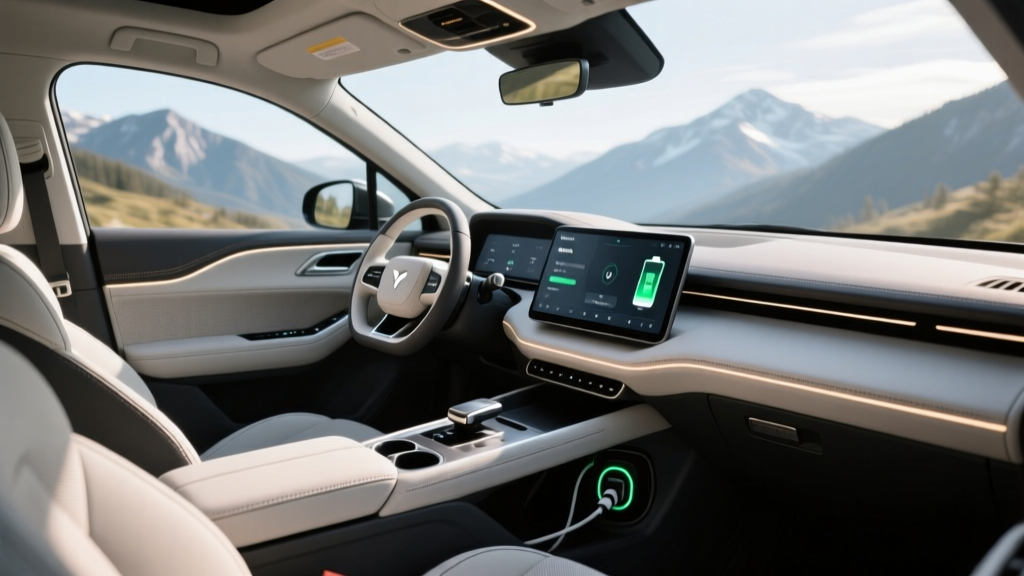
The R2 interior photos released by Rivian show a clean, horizontal dashboard dominated by a single glass panel that combines the digital instrument cluster and central infotainment touchscreen — a layout similar to the refreshed R1S but simplified for cost efficiency. The steering wheel is flat-bottomed, and Rivian has moved most secondary controls (climate, drive modes) into the touchscreen or steering-wheel toggles, eliminating the stacked button rows found in some competitors.
- Seating: Five passengers across two rows. Front seats are heavily bolstered with available vegan leather and recycled-fabric inserts; rear bench offers a 60/40 split fold.
- Cargo volume: Approximately 28 cu ft behind the rear seats and up to ~65 cu ft with the rear row folded (Rivian preliminary). A front trunk (frunk) adds roughly 10-12 cu ft of sealed, drainable storage — a signature Rivian feature carried over from the R1T/R1S.
- Legroom: Rivian targets ~41 inches of front legroom and ~38 inches rear, competitive with the Tesla Model Y and Hyundai Ioniq 5.
- Materials: Rivian continues its commitment to animal-free interiors — microfiber suede, recycled PET fabrics, and natural-fiber composites replace traditional leather and wood.
One of the most interesting interior details in the R2 photos is the modular center console, which Rivian says will support removable accessories (camping tables, gear dividers) via integrated mounting rails — a nod to the overlanding crowd that has driven so much R1T loyalty.
Spec Table: Rivian R2 Preliminary Specs at a Glance
| Spec | Value (Preliminary) |
|---|---|
| EPA-estimated range | ~300+ miles (Standard Battery); ~340 miles (Large Battery, est.) |
| Battery capacity (usable) | ~85 kWh (Standard); ~106 kWh (Large) |
| Battery chemistry | NMC (nickel-manganese-cobalt) for Large; LFP likely for Standard |
| Max DC fast-charge rate | ~200 kW peak |
| 10-80% DC fast-charge time | ~25-30 minutes (est.) |
| Level 2 home charging | 11.5 kW onboard (~33 miles/hour at 240V) |
| 0-60 mph (Dual-Motor AWD) | ~5.0 seconds |
| Horsepower (Dual-Motor) | ~450 hp |
| Drivetrain | RWD base / Dual-Motor AWD available |
| Towing capacity | ~3,500 lbs (est.) |
| Base MSRP | ~$45,000 (Standard Battery RWD) |
| Battery warranty | 8 years / 100,000 miles (expected) |
Real-World Range: What to Actually Expect
EPA sticker: ~300 miles (Standard Battery) / ~340 miles (Large Battery, est.)
Real-world highway (70 mph): Expect roughly 250-280 miles on the Standard pack and 290-320 on the Large pack. Aerodynamic drag at highway speeds cuts into efficiency more than city/regen-heavy driving.
Cold-weather (below 32°F): Plan for a 20-30% range reduction, putting the Standard pack closer to 210-240 miles in deep winter. Battery preconditioning helps but doesn't eliminate the physics of cold lithium-ion chemistry.
Rivian's thermal-management system includes a heat pump (standard), which improves cold-weather efficiency compared to resistive cabin heaters. But no EV is immune to winter losses — buyers in northern climates should size their battery for worst-case days, not best-case EPA numbers.
Charging Speed: DC Fast and Home Level 2
| Charging Level | Power | Speed |
|---|---|---|
| Level 1 (120V household) | ~1.4 kW | ~4 miles/hour |
| Level 2 (240V home/work) | 11.5 kW | ~33 miles/hour |
| DC Fast Charge | ~200 kW peak | 10-80% in ~25-30 min |
A few nuances matter here. First, the ~200 kW peak charge rate is just that — a peak. As with all EVs, the charge curve tapers significantly above 80% state of charge (SoC) to protect battery longevity. Sustained rates from 10-60% will hover closer to 150-170 kW before tapering. Second, Rivian uses the NACS (Tesla-style) connector on the R2, giving it native access to the Tesla Supercharger network — currently the largest and most reliable DC fast-charging network in the U.S.
For home charging, an 11.5 kW onboard charger is generous — it means a full overnight replenishment on a 48-amp Level 2 wall connector. Budget roughly $800-$1,500 for a professional Level 2 home installation (equipment + electrician + permit), depending on panel proximity and whether a 200-amp service upgrade is needed.
Pricing, Trims, and Federal Tax Credit Eligibility
Rivian has positioned the R2 to undercut the R1S significantly and compete directly with the Tesla Model Y, Hyundai Ioniq 5, and Ford Mustang Mach-E. Preliminary pricing:
- Standard Battery RWD: ~$45,000 MSRP
- Standard Battery Dual-Motor AWD: ~$49,000 MSRP
- Large Battery Dual-Motor AWD: ~$55,000 MSRP
Under IRS §30D rules, the R2 should qualify as an SUV for the federal clean-vehicle credit (SUV MSRP cap: $80,000). However, eligibility for the full $7,500 credit depends on several moving targets:
- Buyer income caps: $150,000 single / $225,000 head of household / $300,000 joint MAGI
- Battery sourcing: Critical-mineral and battery-component requirements phase in more strictly each year — Rivian's supply chain will need to meet the thresholds in effect at time of delivery.
- Point-of-sale transfer: Buyers can elect to transfer the credit to the dealer at purchase, reducing the out-of-pocket price immediately rather than waiting for tax filing.
- Domestic assembly: The R2 will be built at Rivian's new Georgia plant, satisfying the North American final-assembly requirement.
| Trim | MSRP (est.) | After potential $7,500 credit |
|---|---|---|
| Standard RWD | $45,000 | $37,500 |
| Standard AWD | $49,000 | $41,500 |
| Large AWD | $55,000 | $47,500 |
Eligibility varies. Confirm sourcing rules and income caps at IRS.gov and verify final assembly via the DOE VIN-lookup tool before purchase.
Performance, Efficiency, and Drivetrain
Rivian is offering the R2 in both rear-wheel-drive (base) and dual-motor all-wheel-drive configurations. The dual-motor AWD variant targets ~450 hp and a 0-60 mph time around 5.0 seconds — brisk but not supercar territory, which is appropriate for a family-oriented compact SUV. The RWD base model will be slightly slower but more efficient, likely pushing past 3.0 mi/kWh on the highway.
Efficiency targets are roughly 110-120 MPGe combined (EPA preliminary), translating to approximately 28-32 kWh per 100 miles. That's competitive with the Model Y Long Range and slightly behind the Ioniq 5's class-leading efficiency — but Rivian trades some efficiency for off-road capability, higher ground clearance, and the adventure-oriented hardware that defines the brand.
Rivian's driver-assist suite, branded Rivian Autonomy, is a Level 2 SAE system (hands-on, eyes-on) offering adaptive cruise, lane-centering, and automated lane changes on mapped highways. It is not a self-driving system — the driver remains responsible at all times, consistent with every consumer ADAS on the market today.
Warranty and Ownership Considerations
Rivian is expected to carry over its R1-series warranty structure to the R2:
- Battery & drivetrain: 8 years / 100,000 miles (with a capacity-retention threshold, typically 70%)
- Bumper-to-bumper: 5 years / 60,000 miles
- Roadside assistance: Included for the basic warranty period
One ownership factor to watch: Rivian's service network is still growing. Unlike legacy OEMs with thousands of dealerships, Rivian relies on a mix of mobile service vans and dedicated service centers. Rural buyers should confirm coverage in their area before committing.
Pros and Cons
Pros
- Native NACS connector — full Supercharger access
- Frunk + modular center console for gear-heavy lifestyles
- Heat pump standard for better winter efficiency
- Strong off-road capability for the segment
- Aggressive pricing with tax-credit potential
Cons
- Production timeline uncertain — deliveries may slip
- Service network still maturing vs legacy brands
- Tax-credit eligibility hinges on evolving sourcing rules
- Rear-seat legroom tighter than some crossovers
- Efficiency slightly behind segment leaders
Who the Rivian R2 Suits Best
The R2 is engineered for active-lifestyle buyers who want EV economics without giving up weekend capability. Think: ski-trip families, climbers who need gear storage, dog owners who want a drainable frunk for muddy equipment. It's less ideal for buyers whose top priority is maximum efficiency or the lowest possible purchase price — the Hyundai Ioniq 5 and base Tesla Model Y undercut it on both fronts. But for buyers who value build quality, adventure features, and NACS Supercharger access in a compact SUV footprint, the R2 sits in a lane of its own.
FAQ
What is the real-world range of the Rivian R2?
Expect roughly 250-280 highway miles on the Standard Battery and 290-320 on the Large Battery, with 20-30% losses in cold weather. EPA estimates are ~300 and ~340 miles respectively, but real-world driving — especially at 70+ mph or in winter — reduces those figures.
How fast does the R2 charge at home and on the road?
At home on a 240V Level 2 charger (11.5 kW), the R2 adds roughly 33 miles per hour — enough for a full overnight charge. On DC fast chargers, it peaks around 200 kW and should hit 10-80% in about 25-30 minutes, with tapering above 80%.
How much does the R2 cost after tax credits?
The base Standard Battery RWD starts around $45,000 MSRP. If you qualify for the full $7,500 §30D credit (income, sourcing, and assembly rules apply), the effective price drops to roughly $37,500. Confirm eligibility on IRS.gov before purchase.
Is the R2 worth buying vs the Tesla Model Y or Hyundai Ioniq 5?
Choose the R2 if you prioritize off-road capability, frunk storage, NACS Supercharger access, and adventure-oriented design. Choose the Model Y for efficiency and charging infrastructure, or the Ioniq 5 for value and interior space. The R2's differentiator is lifestyle, not pure spec-sheet dominance.
Does the Rivian R2 qualify for the federal EV tax credit?
It should — the R2 will be assembled in Georgia (North American final-assembly requirement met) and is priced well under the $80,000 SUV MSRP cap. However, the full $7,500 credit depends on battery-sourcing and critical-mineral thresholds that tighten yearly, plus buyer income caps. Always verify on IRS.gov before committing.
When can I actually buy the Rivian R2?
Rivian targets production start at its Georgia plant in 2026, with deliveries following later that year or into 2027. Reservations are open, but firm delivery dates are not yet confirmed. Treat all current specs and pricing as preliminary until EPA certification and MSRP are finalized.