The Rivian R2 is the automaker's play for mainstream EV buyers — a compact electric SUV sitting below the R1S and R1T in both size and price. First announced in early 2024 with production targeted for the first half of 2026 at Rivian's new Georgia facility (alongside continued Normal, Illinois output), the R2 has generated enormous reservation interest. But interest doesn't equal ownership readiness. Here, we go deep on the Rivian R2 inside and out — the battery chemistry, charging curve realities, real-world range expectations, and tax-credit math that actually determine whether this EV fits your life.
Note: The Rivian R2 is in pre-production as of early 2026, with first customer deliveries expected mid-2026. Specifications below reflect Rivian's latest published figures and industry analysis. Final EPA certification and MSRP by trim may shift before deliveries begin. We will update this profile as confirmed data arrives.
Rivian R2 Core Specifications at a Glance
| Attribute | R2 Standard (Dual-Motor AWD) | R2 Max Battery (Dual-Motor AWD) |
|---|---|---|
| EPA Range (est.) | ~275 miles | ~330+ miles |
| Battery Capacity (usable) | ~70 kWh | ~85 kWh |
| Battery Chemistry | LFP (Lithium Iron Phosphate) | LFP |
| Drivetrain | Dual-Motor AWD | Dual-Motor AWD |
| Horsepower | ~450 hp (est.) | ~450 hp (est.) |
| 0–60 mph | ~4.5 sec (est.) | ~4.5 sec (est.) |
| Max DC Fast Charge | ~200 kW (peak) | ~200+ kW (peak) |
| 10–80% DC Charge Time | ~25 min (est.) | ~30 min (est.) |
| Level 2 Home Charge Rate | 11.5 kW (~37 mi/hr) | 11.5 kW (~37 mi/hr) |
| Charging Port | NACS (native Tesla Supercharger access) | NACS |
| Towing Capacity | ~3,300 lbs (est.) | ~3,300 lbs (est.) |
| Base MSRP (est.) | ~$45,000 | ~$52,000 |
| Battery/Powertrain Warranty | 8 yr / 100,000 mi (est.) | 8 yr / 100,000 mi (est.) |
Real-World Range: What the EPA Sticker Doesn't Tell You
Real-World Expectation: Plan for ~270–295 miles on a road trip in the Max Battery variant at sustained 70–80 mph highway speeds. In cold weather (below 30°F), expect a 15–25% reduction — potentially dropping to ~250–260 miles usable range. City driving with regenerative braking will push closer to or slightly above the EPA sticker.
Rivian's targeted 330+ mile figure for the Max Battery R2 would place it competitively against the Tesla Model Y Long Range (EPA 320 mi) and well ahead of most compact EV SUVs. But the EPA's test cycles include a mix of city and highway driving with moderate climate loads — conditions that rarely match a 400-mile interstate haul.
Two factors will shape your actual experience. First, the R2's boxy, adventure-oriented design trades some aerodynamic efficiency for interior volume and ground clearance. That means highway range will taper more than in a sleeker sedan like the Hyundai Ioniq 6. Second, LFP chemistry — while excellent for longevity and cost — has slightly lower energy density than NMC, which is partly why the Max Battery pack is ~85 kWh rather than smaller. Rivian's heat pump (expected as standard) will help mitigate cold-weather losses compared to resistive heating, but physics still applies: sub-freezing temperatures reduce battery throughput and increase cabin energy demands.
For daily commuting under 60 miles round-trip, even the Standard Battery R2 will require charging only twice a week on a home Level 2 setup. Road trippers should plan around ~250-mile realistic legs between DC fast-charge stops to maintain a comfortable buffer.
Battery Chemistry and Longevity: Why LFP Matters Here
Rivian has confirmed the R2 will use LFP (lithium iron phosphate) battery cells, likely sourced to comply with IRA critical-mineral requirements for federal tax-credit eligibility. This is a significant choice with real ownership implications.
| Factor | LFP (Rivian R2) | NMC (Common in R1S/R1T, Performance EVs) |
|---|---|---|
| Energy Density | Lower (heavier pack for same kWh) | Higher (lighter, more compact) |
| Cycle Life | 3,000+ cycles to 80% SoH | 1,000–2,000 cycles to 80% SoH |
| Recommended Daily SoC | 100% OK — charge to full daily | 80% preferred for daily; 100% for trips only |
| Cold-Weather Performance | Slightly reduced low-temp throughput | Better cold performance |
| Cost per kWh | Lower (enables lower MSRP) | Higher |
| Thermal Stability | Excellent — lower runaway risk | Good but requires more management |
The practical takeaway: LFP is ideal for the R2's target buyer who wants a durable, lower-cost daily driver. You can charge to 100% every night without the degradation anxiety that NMC owners manage. Over 150,000+ miles, LFP packs typically show slower capacity fade. The trade-off is a slightly heavier vehicle and marginally less range per kWh of battery — a compromise Rivian has accepted to hit the ~$45,000 starting price.
Rivian's battery warranty is expected to follow the industry-standard 8 years / 100,000 miles with a capacity retention threshold of 70% — matching the R1 series and most competitors. This is the minimum required by the IRS for §30D tax-credit eligibility as well.
Charging Speed: DC Fast, Home Level 2, and the NACS Advantage
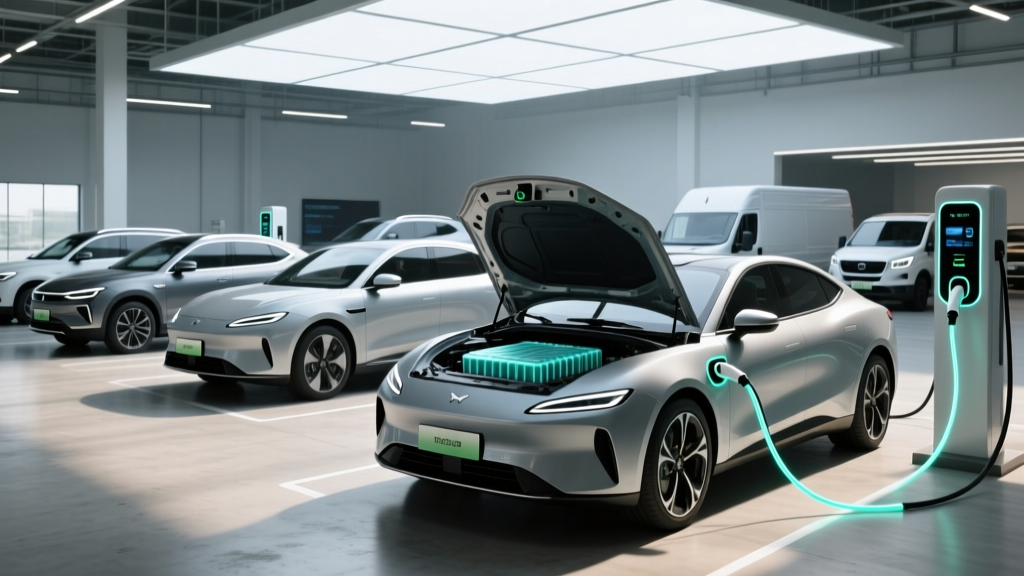
The R2 will ship with a native NACS (North American Charging Standard) port, meaning direct access to Tesla's Supercharger network — currently the most reliable and expansive DC fast-charging infrastructure in North America. No adapter required, no CCS compatibility headaches.
| Charging Level | Power / Rate | Miles Added per Hour | Typical Use Case |
|---|---|---|---|
| Level 1 (120V household) | ~1.4 kW | ~4–5 mi/hr | Emergency / overnight trickle |
| Level 2 (240V home, 48A) | 11.5 kW | ~37 mi/hr | Daily home charging — full charge in ~8–9 hrs (Max Battery) |
| DC Fast Charge (peak) | ~200+ kW | ~600+ mi/hr (at peak) | Road trips — 10–80% in ~25–30 min |
Understanding the charge curve is essential. The R2's peak ~200+ kW rate applies only at low state-of-charge (roughly 10–30% SoC) with a preconditioned battery. As the pack fills, charge speed tapers — typically dropping to ~100 kW by 60% SoC and ~50 kW or less above 85%. This is normal for all lithium-ion packs and protects cell health, but it means the last 20% takes nearly as long as the first 50%. Plan your road-trip stops around 10–80% charges for the best time efficiency.
For home charging, a 48-amp Level 2 wall connector on a 60-amp circuit will replenish the Max Battery R2 from empty to full overnight (~8–9 hours). Most owners who plug in nightly will never wake up to anything less than a full battery. Installation costs for a Level 2 home setup typically range from $500–$2,000 depending on panel proximity and whether your electrical panel needs a 200-amp upgrade.
Preconditioning tip: When navigating to a Supercharger or DC fast station via the R2's built-in nav, the thermal management system will warm the battery to optimal charging temperature before you arrive. Skipping this — for example, by using a third-party app to route to a charger — can reduce peak charge rates by 30–50% in cold weather.
Performance and Drivetrain: Dual-Motor AWD Standard
Rivian has built its reputation on capable, adventure-ready electric drivetrains, and the R2 is expected to continue that tradition with standard dual-motor all-wheel drive across all trims. Unlike the R1T and R1S, which offer dual-, tri-, and quad-motor configurations, the R2 simplifies the lineup — a decision that reduces manufacturing complexity and keeps pricing accessible.
Estimated output sits around 450 horsepower with a 0–60 mph time near 4.5 seconds. That's brisk enough for confident highway merging and passing, though not in the supercar territory of a quad-motor R1T (0–60 in ~2.5 sec). For context, the Tesla Model Y Long Range AWD hits 60 mph in ~4.8 seconds, so the R2 should be competitive.
Rivian's torque-vectoring AWD system — which can independently control front and rear motor output — should provide confident traction in snow, rain, and light off-road conditions. Ground clearance is expected around 8.0–8.5 inches, adequate for fire roads and campsite access but not rock-crawling territory. Towing capacity is projected at roughly 3,300 pounds, enough for a small camping trailer or a pair of jet skis but below the R1T's 11,000-pound rating.
Interior, Cargo, and Tech: What You Get Inside the R2
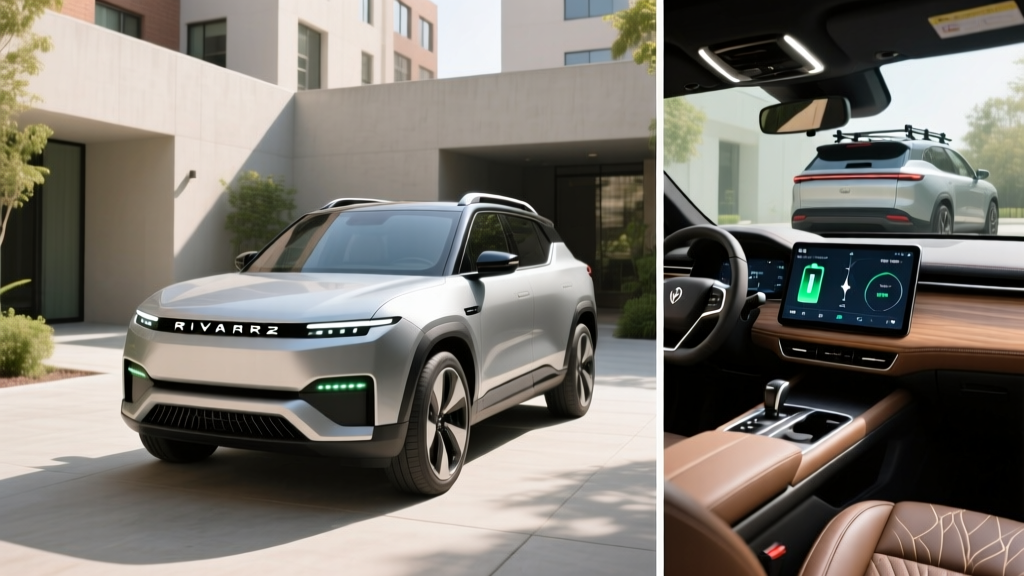
The R2's interior design follows Rivian's established philosophy: clean, minimal, with a large central touchscreen and a focus on durable, sustainable materials. The compact SUV footprint (roughly 185–190 inches long, placing it between a Tesla Model Y and a Hyundai Ioniq 5 in overall size) means interior space is a key question.
Estimated cargo volume: ~25–28 cu ft behind the second row, expanding to ~60–65 cu ft with the rear seats folded. A front trunk (frunk) is confirmed, likely offering 8–12 cu ft of additional sealed storage — a practical advantage for muddy gear or charging cables. Rivian's signature Gear Tunnel (available on the R1T) is not expected on the R2 due to its unibody SUV architecture.
Passenger space: Expect ~40 inches of front legroom and ~37–38 inches of rear legroom — competitive with the Model Y but slightly tighter than the Hyundai Ioniq 5's generous 39.4 inches rear. Headroom should be ample thanks to the R2's taller roofline.
Tech highlights:
- Large central infotainment display (~15.6 inches) running Rivian's proprietary OS with OTA updates
- Digital driver display and available heads-up display
- Rivian's driver-assistance suite (adaptive cruise, lane-centering, automatic emergency braking) — expected to be SAE Level 2, meaning the driver must remain engaged at all times
- Native NACS integration with Supercharger routing and preconditioning built into navigation
- Vehicle-to-load (V2L) capability for powering campsite equipment or emergency home backup
- Over-the-air software updates for performance, range optimization, and feature additions
Notable drawbacks: Rivian's infotainment system, while improving, has drawn criticism from R1 owners for occasional sluggishness and limited third-party app integration compared to Tesla's ecosystem. The R2's smaller footprint also means less cargo volume than the three-row R1S. And the R2 will not offer the quad-motor or tri-motor powertrain options that some performance-oriented buyers want.
Pricing, Trims, and Federal Tax Credit Eligibility
The R2's headline price is its most important competitive weapon. Rivian has targeted a starting MSRP of approximately $45,000 for the Standard Battery AWD, with the Max Battery variant expected around $52,000. A single-speed, potentially RWD-only base variant has been hinted at for a future model year that could dip below $40,000, but is not expected at launch.
| Trim | Est. Base MSRP | §30D Federal Credit (max) | Est. Effective Price |
|---|---|---|---|
| R2 Standard Battery AWD | ~$45,000 | Up to $7,500 | ~$37,500 |
| R2 Max Battery AWD | ~$52,000 | Up to $7,500 | ~$44,500 |
| R2 Adventure / Premium (est.) | ~$55,000–$58,000 | Up to $7,500 | ~$47,500–$50,500 |
However, federal §30D tax-credit eligibility is not automatic. The IRS rules impose several requirements that buyers must verify:
- MSRP Cap: SUVs must have an MSRP at or below $80,000. The R2 clears this easily.
- Buyer Income Cap: Modified adjusted gross income must not exceed $150,000 (single), $225,000 (head of household), or $300,000 (joint). Check your tax situation before assuming eligibility.
- Battery Sourcing: A percentage of critical minerals and battery components must be sourced from the U.S. or free-trade-agreement countries. These thresholds increase annually. Rivian's LFP cell sourcing — potentially from U.S.-based or FTA-partner manufacturing — will determine whether the full $7,500 is available or only the $3,750 partial credit.
- Point-of-Sale Transfer: As of 2024, buyers can transfer the credit to the dealer at purchase, reducing the upfront price rather than waiting for a tax refund. This is available for the R2 if eligible.
- Final Assembly: Must occur in North America. Rivian's Georgia and Illinois plants satisfy this.
Critical caveat: LFP cells have historically been sourced from China, which is not an FTA country. If Rivian's cell supplier has not shifted sufficient production to qualifying jurisdictions by your delivery date, the R2 may qualify for only $3,750 or potentially zero credit. Consult a tax professional and check the DOE/FuelEconomy.gov credit tracker at the time of purchase for the latest eligibility status.
Rivian R2 vs. the Competition: Is It Worth Buying?
The R2 enters one of the most competitive segments in the EV market. Here's how it stacks up on paper against the key rivals it will face in 2026:
| Spec | Rivian R2 Max Battery AWD | Tesla Model Y LR AWD | Hyundai Ioniq 5 LR AWD |
|---|---|---|---|
| EPA Range | ~330 mi | ~320 mi | ~290 mi |
| Battery (usable) | ~85 kWh (LFP) | ~75 kWh (NMC) | ~77.4 kWh (NMC) |
| 0–60 mph | ~4.5 sec | ~4.8 sec | ~4.5 sec |
| Max DC Charge | ~200 kW | ~250 kW | ~240 kW |
| 10–80% Time | ~30 min | ~22 min | ~18 min |
| Cargo (behind 2nd row) | ~25–28 cu ft | ~30 cu ft | ~27 cu ft |
| Base MSRP | ~$52,000 | ~$48,000 | ~$50,000 |
| Charging Standard | NACS (native) | NACS (native) | CCS (adapter for NACS) |
- You want an adventure-oriented compact SUV with rugged styling, V2L capability, and available off-road modes
- LFP battery longevity and daily 100% charging convenience matter to you
- You value Rivian's brand, community, and OTA-driven ownership experience
- You want native NACS/Supercharger access without an adapter
- Charging speed and Supercharger network maturity are your top priorities
- You want the lowest starting price and maximum cargo space in the segment
- Software ecosystem and Autopilot/FSD feature availability matter most
- Fastest 10–80% DC charging times (800V architecture) are essential for your road-trip habits
- You prefer a more car-like ride and rear-seat spaciousness over SUV ruggedness
- You want a proven platform with strong IIHS safety ratings and wide dealer availability
Pros, Cons, and the Bottom Line
- 330+ mile targeted range (Max Battery) is segment-competitive
- LFP battery allows daily 100% charging with minimal degradation concern
- Native NACS port — seamless Supercharger access from day one
- Rivian's adventure DNA: V2L, solid ground clearance, durable interior
- Sub-$45K starting price (Standard Battery) before potential tax credit
- Standard dual-motor AWD across trims — no FWD penalty model
- Strong OTA update pipeline and brand community
- DC fast-charge speed (~200 kW peak) trails 800V competitors like Ioniq 5 (~240 kW)
- Pre-production — final EPA numbers, pricing, and tax-credit eligibility unconfirmed
- Georgia plant ramp-up risk: early production delays are possible (R1T/R1S launch precedent)
- Cargo space likely trails Model Y by ~2–5 cu ft
- LFP cold-weather performance may slightly reduce winter range vs. NMC rivals
- Rivian's service-center footprint is still growing — coverage varies by region
- No tri-motor or performance variant at launch
The R2 is the EV that Rivian needs to succeed — and that a large segment of buyers have been waiting for. A 330-mile, AWD, NACS-equipped compact SUV at ~$45,000 checks nearly every box for the mainstream EV-curious shopper. The LFP battery is a smart long-term ownership play, and the Supercharger network access removes one of the biggest public-charging friction points.
The risks are real, though. Production ramp-ups are notoriously difficult, and Rivian's history with R1T/R1S delivery delays should temper expectations for on-time arrival. DC fast-charge speeds, while adequate, won't match the 800V architecture of Hyundai/Kia rivals. And the tax-credit question remains unresolved until battery-sourcing details are finalized.
If your timeline is flexible and you're willing to be an early adopter of a new model from a young automaker, the R2 is one of the most compelling EVs on the horizon. If you need a vehicle today, the Model Y and Ioniq 5 remain excellent, proven choices — and you'll have final EPA data and confirmed pricing to make a confident decision now.
Frequently Asked Questions
What is the real-world range of the Rivian R2?
The R2 Max Battery AWD targets an EPA-estimated ~330 miles. In real-world highway driving at 70–80 mph, expect ~270–295 miles. In cold weather (below 30°F), range may drop to ~250–260 miles. The Standard Battery variant (~275 mi EPA) will deliver roughly 220–240 miles in real-world highway conditions.
How fast does the Rivian R2 charge?
On DC fast charging, the R2 is expected to peak at ~200+ kW, achieving a 10–80% charge in approximately 25–30 minutes. At home on a 48-amp Level 2 charger (11.5 kW), expect roughly 37 miles of range added per hour, with a full charge of the Max Battery taking about 8–9 hours.
How much does the Rivian R2 cost after federal tax credits?
The Standard Battery R2 is expected to start around $45,000, potentially dropping to ~$37,500 if the full $7,500 §30D credit applies. The Max Battery variant at ~$52,000 could net to ~$44,500. However, credit eligibility depends on battery-sourcing rules, buyer income, and MSRP caps — verify with a tax professional before purchase.
Does the Rivian R2 qualify for the $7,500 federal EV tax credit?
It may, but eligibility is not guaranteed. The R2's MSRP is well below the $80,000 SUV cap, and final assembly will be in the U.S. The critical variable is battery-component and critical-mineral sourcing under §30D rules. LFP cells sourced from non-FTA countries could reduce or eliminate the credit. Check fueleconomy.gov at time of purchase for the latest status.
Is the Rivian R2 worth buying over the Tesla Model Y?
The R2 offers a more adventure-oriented design, LFP battery longevity, and a differentiated ownership experience. The Model Y currently offers faster DC charging, a more mature Supercharger network, greater cargo space, and proven production scale. If you prioritize rugged capability and brand identity, the R2 is compelling. If you want the safest bet with the widest charging infrastructure today, the Model Y still holds an edge — though the gap is narrowing as both use NACS.
When will the Rivian R2 be available to buy?
Rivian targets production start in the first half of 2026, with customer deliveries expected mid-to-late 2026. Reservation holders will receive priority. Walk-up orders without a reservation may face significant wait times depending on initial production capacity at the Georgia facility.
What warranty does the Rivian R2 include?
Rivian is expected to offer an 8-year / 100,000-mile battery and powertrain warranty for the R2, consistent with the R1 series and industry norms. The basic vehicle warranty is anticipated at 5 years / 60,000 miles. Final terms will be confirmed at launch.