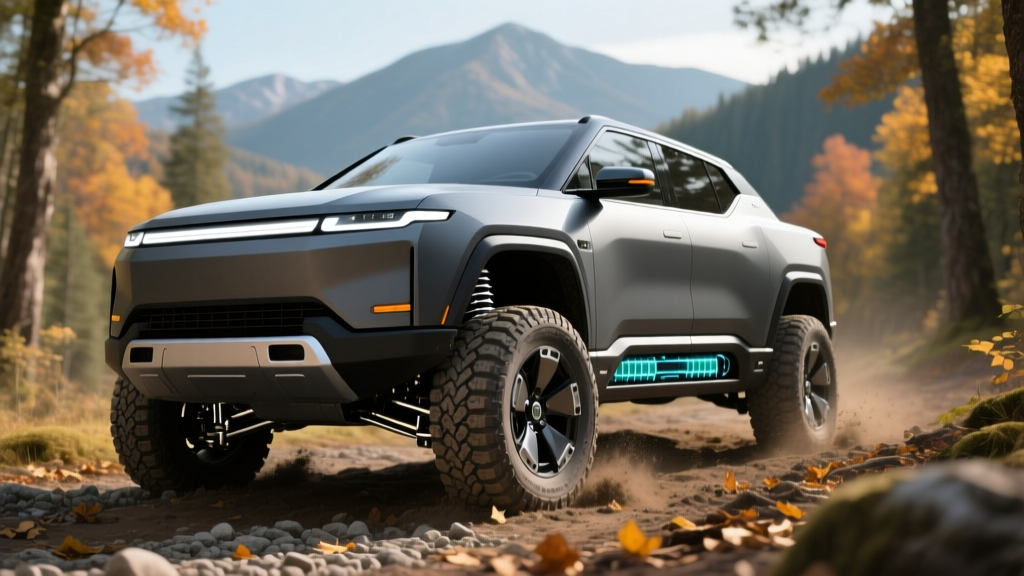
The compact electric SUV segment has been dominated by crossovers built for pavement. The 2026 Rivian R2 aims to change that formula by pairing everyday usability with genuine off-road chops — a smaller, more affordable sibling to the R1S that doesn't sacrifice the adventure DNA Rivian built its brand on. With a starting MSRP near $45,000 and a targeted EPA range of up to 330 miles, the R2 is positioned to capture buyers who want electric efficiency without giving up weekend trail capability.
But the spec that has off-road enthusiasts and overlanders paying closest attention is the Rivian R2 ground clearance. At an estimated 8.5 inches in standard ride height, it sits notably higher than most electric crossovers in its class — and Rivian has confirmed that an available adaptive air suspension will allow drivers to raise or lower the vehicle depending on terrain. Let's break down everything we know about the 2026 R2's specifications, from battery chemistry to charging speed to real-world usability.
2026 Rivian R2 Quick Specs
| Specification | Detail |
|---|---|
| EPA Est. Range | Up to 330 mi (Dual-Motor, Large Pack) |
| Battery Capacity | ~90 kWh usable (Large Pack, NMC); ~72 kWh (Standard, LFP expected) |
| Max DC Fast Charge | ~200 kW peak |
| 10–80% DC Charge Time | ~25–28 minutes (estimated) |
| Level 2 Home Charging | 11.5 kW onboard charger (~30 mi/hr) |
| 0–60 mph | ~4.5 sec (Dual-Motor AWD) |
| Horsepower | ~450 hp (Dual-Motor) |
| Drivetrain | RWD (base) / Dual-Motor AWD / Tri-Motor (performance) |
| Ground Clearance | ~8.5 in (standard); adjustable w/ air suspension |
| Starting MSRP | $45,000 (RWD Standard Pack) |
| Battery Warranty | 8 years / 100,000 miles |
Ground Clearance and Off-Road Capability
The headline feature for adventure-oriented buyers is the Rivian R2 ground clearance. At approximately 8.5 inches in its standard configuration, the R2 clears more obstacles than competitors like the Tesla Model Y (6.6 inches) or the Hyundai Ioniq 5 (6.0 inches). For context, the larger R1S offers up to 14.9 inches of ground clearance in its maximum off-road setting via its air suspension — and Rivian has indicated the R2 will offer a similar, though slightly scaled-down, adaptive air suspension option.
With the available air suspension, expect the R2 to raise approximately 1.5–2 inches above standard height for trail use, potentially reaching 10+ inches of clearance when needed. The system will also lower the vehicle at highway speeds for improved aerodynamic efficiency and make loading cargo or strapping on roof gear easier at a standstill.
Rivian's R1T and R1S have earned strong reputations on trails like the Rubicon, and the R2 is engineered with similar approach, departure, and breakover angles in mind — though its shorter wheelbase (compared to the R1S) should actually benefit breakover geometry. Expect skid plate protection for the battery pack and underbody components, a feature Rivian has standardized across its adventure-oriented vehicles.
Real-World Range Expectations
EPA Estimate: Up to 330 miles (Dual-Motor, Large Pack)
Real-World Highway (70+ mph): Expect ~265–290 miles. Aerodynamic drag hits boxy SUV shapes hard at sustained highway speeds.
Cold Weather (below 32°F): Plan for 20–30% reduction, yielding roughly 230–265 miles. Battery chemistry and cabin heating both contribute to winter range loss.
Off-Road/Low-Speed Trail Use: Range impact is minimal at low speeds, but terrain mode and frequent elevation changes will increase consumption modestly.
Battery, Chemistry, and Efficiency
Rivian has confirmed that the R2 will use a new, more compact battery pack architecture designed specifically for the R2/R3 platform. The Large Pack variant is expected to use NMC (nickel manganese cobalt) chemistry with approximately 90 kWh of usable capacity, prioritizing energy density for maximum range. A Standard Pack, likely using LFP (lithium iron phosphate) chemistry at around 72 kWh usable, should offer a lower-cost entry point with the trade-off of reduced range but superior cycle life and the ability to charge to 100% regularly without degradation concerns.
The LFP vs. NMC trade-off matters for ownership planning: NMC delivers higher energy density (more range per pound) but benefits from staying between 20–80% for daily use, while LFP sacrifices some range for longevity and daily 100% charging convenience. If your commute is short and you prioritize battery longevity, the LFP Standard Pack may be the smarter long-haul choice.
Efficiency targets land in the neighborhood of 110–115 MPGe combined (roughly 29–31 kWh per 100 miles), competitive with the dual-motor versions of the Ford Mustang Mach-E and slightly behind the more aerodynamic Tesla Model Y. The R2's boxier, upright design prioritizes interior volume and visibility over slippery aero — a deliberate trade-off Rivian's buyers have historically embraced.
Charging Speed: DC Fast and Home Level 2
The R2 will charge via the NACS (North American Charging Standard) connector natively, giving it direct access to Tesla's Supercharger network — the most reliable and expansive DC fast-charging infrastructure in North America. No adapter is required.
2026 Rivian R2 Charging Speeds
| Charging Level | Power | Speed / Notes |
|---|---|---|
| Level 1 (120V household) | ~1.4 kW | ~3–4 miles per hour |
| Level 2 (240V home/public) | 11.5 kW (onboard charger max) | ~30 miles per hour; full charge in ~8–9 hours |
| DC Fast Charge (NACS) | ~200 kW peak | 10–80% in ~25–28 minutes; tapers significantly above 80% |
A critical note on DC fast charging: the ~200 kW peak rate is not sustained across the entire session. Like all modern EVs, the R2's charge curve will taper as the battery fills — expect peak speeds between 10–40% State of Charge, with a significant step-down above 60% and another above 80%. This is standard battery management behavior to protect cell health. A typical 10–80% session at a 250 kW Supercharger or Electrify America station should complete in roughly 25–28 minutes under ideal thermal conditions.
For home charging, Rivian's 11.5 kW onboard charger is competitive with the segment. On a 48-amp Level 2 circuit (60-amp breaker), you'll recover roughly 30 miles of range per hour of charging — enough to replenish a full day's driving overnight. Installation costs for a home Level 2 setup typically range from $800 to $2,500 depending on your electrical panel's capacity and the run distance from panel to charger location. A 200-amp panel is generally sufficient; older homes with 100-amp service may require a panel upgrade ($1,500–$3,000).
Performance and Drivetrain Options
The 2026 R2 will launch with multiple drivetrain configurations, mirroring Rivian's approach with the R1 lineup:
- RWD (Rear-Wheel Drive): Single-motor, base configuration. Expected 0–60 mph in approximately 6.0 seconds. Lowest MSRP, longest range variant due to reduced weight and drivetrain losses.
- Dual-Motor AWD: Two motors (front and rear), approximately 450 hp. Expected 0–60 mph in ~4.5 seconds. The sweet spot for most buyers — all-weather traction, strong acceleration, and competitive range.
- Tri-Motor (Performance): Three motors, potentially exceeding 600 hp. Expected 0–60 mph under 3.5 seconds. Top-tier trim with maximum towing and off-road capability.
Rivian's torque vectoring system on multi-motor configurations allows precise power distribution to individual wheels — a significant advantage on loose surfaces like gravel, sand, or snow. The R1T has demonstrated this system's capability on challenging off-road courses, and the R2 will inherit a version of the same architecture scaled for its lighter, shorter platform.
Towing capacity is expected to land around 4,500–5,000 pounds for dual-motor variants — adequate for small campers, jet skis, or a utility trailer, though below the R1T's 11,000-pound rating. Remember that towing at capacity will cut range roughly in half; plan charging stops accordingly.
Interior, Cargo, and Technology
The R2 sits on a dedicated EV platform with a flat floor and no transmission tunnel, which translates to generous interior volume for a compact SUV. Expect the following dimensions (estimated based on Rivian's published exterior proportions and platform details):
- Cargo Volume (rear seats up): ~30–33 cubic feet
- Cargo Volume (rear seats folded): ~65–70 cubic feet
- Front Trunk (Frunk): ~10–12 cubic feet — a lockable, weather-sealed compartment ideal for charging cables, groceries, or gear you want separated from the main cabin
- Rear Legroom: ~38 inches — competitive with the Model Y and sufficient for adult passengers on longer trips
The infotainment system will run Rivian's proprietary software on a large central touchscreen (expected 15+ inches), with over-the-air update capability for continuous feature improvements. Rivian has historically avoided Apple CarPlay and Android Auto in favor of deep native integration — a decision that draws mixed reactions. Native navigation includes integrated route planning with automatic charging stop suggestions, factoring in terrain, weather, and elevation changes for accurate range prediction.
Driver assistance will be powered by Rivian's in-house Driver+ system, an SAE Level 2 platform offering adaptive cruise control, lane centering, and automatic lane changes on divided highways. This is a hands-on, eyes-on system — not self-driving. The driver must remain engaged and responsible for vehicle operation at all times. Expect a camera-based monitoring system to verify driver attention.
Pros
- Class-leading ground clearance (~8.5 in standard; adjustable with air suspension)
- Native NACS connector — direct Tesla Supercharger access, no adapter needed
- Genuine off-road capability with torque vectoring and skid plate protection
- Spacious cargo area with useful frunk for a compact SUV footprint
- Competitive starting price ($45,000) with available federal tax credit
- Over-the-air updates and Rivian's strong software track record
Cons
- Boxy design sacrifices some highway efficiency vs. sleeker rivals
- No Apple CarPlay / Android Auto — native-only infotainment
- Range drops significantly when towing at capacity
- Production ramp-up risk — Rivian's Normal, IL factory must scale significantly
- Top trims (Tri-Motor, Large Pack, Air Suspension) will push price well above $55,000
Pricing, Trims, and Federal Tax Credit Eligibility
The 2026 Rivian R2 is positioned as a more accessible entry into the Rivian ecosystem. Here's how pricing breaks down across expected trims:
Estimated Pricing by Trim
| Trim | Est. MSRP | Est. After Federal Credit* |
|---|---|---|
| RWD Standard Pack | $45,000 | ~$37,500 |
| Dual-Motor Standard Pack | $50,000 | ~$42,500 |
| Dual-Motor Large Pack | $55,000 | ~$47,500 |
| Tri-Motor Large Pack | $60,000+ | ~$52,500+ |
*Federal tax credit estimates assume full eligibility under IRS §30D rules. Actual credit depends on battery sourcing, buyer income, and MSRP caps. See eligibility details below.
The federal EV tax credit under IRS §30D can provide up to $7,500 for qualifying new EVs. However, eligibility is not automatic — it depends on several requirements:
- MSRP Cap: SUVs must have an MSRP at or below $80,000. All R2 trims should clear this threshold.
- Buyer Income Cap: Modified adjusted gross income must not exceed $150,000 (single), $225,000 (head of household), or $300,000 (joint filers).
- Battery Sourcing: The credit is split into two halves — $3,750 for meeting critical minerals requirements and $3,750 for meeting battery component sourcing requirements. These thresholds tighten annually. Rivian has been actively reshoring its supply chain, but exact credit amounts for the R2 will depend on the cell supplier and mineral sourcing at time of delivery.
- Point-of-Sale Transfer: As of 2024, buyers can transfer the credit to the dealer at purchase, receiving it as an immediate price reduction rather than waiting to claim it on their tax return. This is expected to remain available for 2026 purchases.
Always verify current eligibility on the fueleconomy.gov tax credit database before purchasing, as battery sourcing compliance can change between model years and production batches. Consult a tax professional for your specific situation.
How the R2 Compares to Key Competitors
The R2 enters a compact electric SUV segment that has grown crowded. Here's how it stacks up against the most relevant alternatives:
| Feature | Rivian R2 (Dual-Motor) | Tesla Model Y LR AWD | Ford Mustang Mach-E ER AWD | Hyundai Ioniq 5 AWD |
|---|---|---|---|---|
| EPA Range | ~330 mi | 311 mi | 290 mi | 290 mi |
| Ground Clearance | ~8.5 in | 6.6 in | 5.7 in | 6.0 in |
| 0–60 mph | ~4.5 sec | 4.8 sec | 5.1 sec | 5.2 sec |
| Max DC Charge | ~200 kW | 250 kW | 150 kW | 235 kW |
| Starting MSRP | ~$50,000 | ~$48,990 | ~$49,995 | ~$50,100 |
| Off-Road Capability | Strong | Limited | Limited | Limited |
| Connector | NACS (native) | NACS (native) | CCS1 | CCS1 (NACS adapter avail.) |
The R2's clearest differentiator is off-road capability and ground clearance. No competitor in this segment offers anything close to 8.5 inches of standard clearance or an adjustable air suspension for trail use. If your weekends involve forest roads, ski trips over unplowed passes, or overlanding, the R2 occupies a lane that's essentially empty in the compact electric SUV class.
For pure on-road efficiency and charging speed, the Tesla Model Y Long Range still holds advantages — its Supercharger network integration (now shared with the R2 via NACS), slightly faster peak charging, and superior aerodynamic efficiency make it the more pragmatic highway commuter. The Ioniq 5's 800V architecture delivers faster 10–80% charge times, though its CCS1 connector requires an adapter for NACS stations.
Who Should Buy the 2026 Rivian R2?
The R2 is best suited for buyers who:
- Want a compact electric SUV that can genuinely handle off-road trails, not just gravel driveways
- Need a vehicle that serves as a daily commuter Monday through Friday and an adventure rig on weekends
- Value a frunk and flexible cargo layout for gear-heavy lifestyles (camping, skiing, climbing, biking)
- Want direct access to the Tesla Supercharger network without carrying an adapter
- Are willing to pay a modest premium over a Model Y for capability, design, and brand identity
It's less ideal for buyers who prioritize maximum highway efficiency, need the absolute fastest charging times, or prefer Apple CarPlay integration. Budget-conscious shoppers may also find that desirable options (air suspension, Large Pack, Tri-Motor) push the R2 well beyond its $45,000 headline price.
Frequently Asked Questions
What is the real-world range of the Rivian R2?
The EPA estimates up to 330 miles for the Dual-Motor Large Pack configuration. In real-world highway driving at 70+ mph, expect approximately 265–290 miles. In cold weather (below freezing), plan for 230–265 miles. Off-road use at low speeds has minimal range impact, but climbing steep grades will increase consumption.
How fast does the R2 charge at home and on the road?
On a Level 2 home charger (240V, 48A), the R2's 11.5 kW onboard charger adds roughly 30 miles of range per hour — a full overnight charge covers most daily needs. On a DC fast charger, the R2 peaks at approximately 200 kW, completing a 10–80% session in roughly 25–28 minutes under ideal conditions. Charging slows significantly above 80% to protect battery health.
How much does the R2 cost after the federal tax credit?
The base RWD Standard Pack starts at an estimated $45,000 MSRP. If you qualify for the full $7,500 federal credit under IRS §30D (subject to income caps, MSRP limits, and battery sourcing requirements), the effective price drops to approximately $37,500. The credit can be transferred at the point of sale as an immediate price reduction. Higher trims will cost more, but all should remain under the $80,000 SUV MSRP cap.
Does the Rivian R2 qualify for the federal EV tax credit?
It is expected to qualify, but eligibility depends on several factors: buyer income (under $150K single / $300K joint), MSRP (under $80K for SUVs — all R2 trims should meet this), and battery component/critical mineral sourcing requirements that tighten annually. Verify current eligibility at fueleconomy.gov before purchase, as sourcing compliance can vary by production batch.
Is the Rivian R2 worth buying over the Tesla Model Y?
If you need genuine off-road capability, higher ground clearance, and a more adventure-oriented design, the R2 has no direct rival in its segment. If your priorities are maximum charging speed, proven long-term reliability data, and the lowest possible highway energy consumption, the Model Y remains a strong choice. Both use NACS natively and access the same Supercharger network, so charging infrastructure is no longer a differentiator.
What is the Rivian R2's ground clearance?
The 2026 Rivian R2 offers approximately 8.5 inches of ground clearance in its standard ride height. With the available adaptive air suspension, the vehicle can raise an additional 1.5–2 inches for off-road use, potentially exceeding 10 inches. It can also lower for easier loading and improved highway aerodynamics.
What is the battery warranty on the R2?
Rivian is expected to offer an 8-year / 100,000-mile battery and powertrain warranty on the R2, consistent with the R1 lineup and the industry standard for EV battery coverage. This warranty typically guarantees a minimum capacity retention threshold (often 70%) over the coverage period.