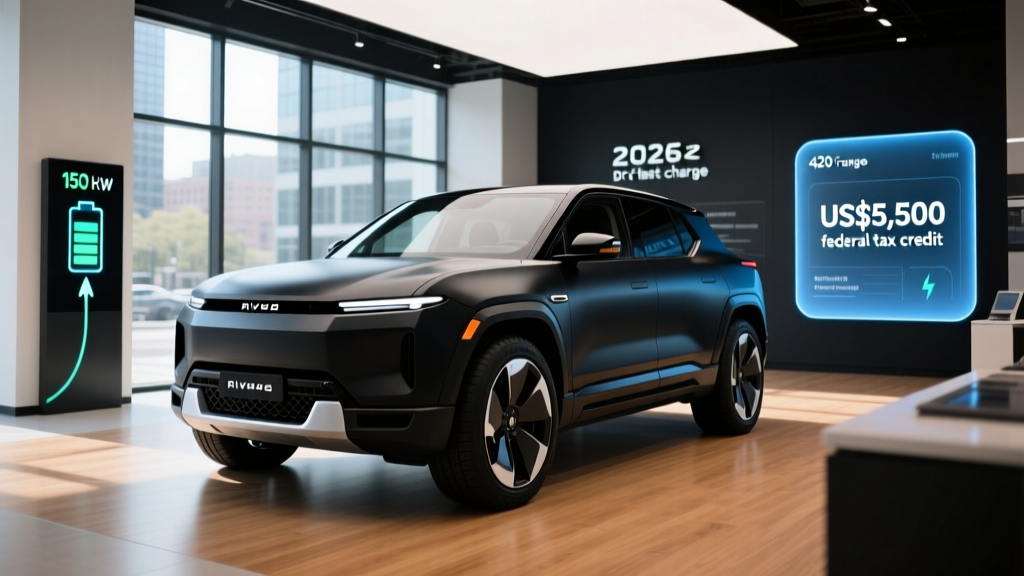
The Rivian R2 arrives in the first half of 2026 as the automaker's long-awaited midsize electric SUV, positioned squarely against the Tesla Model Y, Hyundai Ioniq 5, and Ford Mustang Mach-E. Built at Rivian's new production lines in Normal, Illinois, the R2 promises to bring the brand's adventure-oriented DNA to a more accessible price point. But the headline question for most buyers is straightforward: what does the Rivian R2 cost once you factor in real-world range, charging infrastructure, and federal incentives?
Below, we break down every dollar, kilowatt-hour, and mile — using the latest preliminary specifications Rivian has published and cross-referencing IRS rules for the 2026 tax year. Because the R2 is just beginning deliveries, some figures remain manufacturer estimates and are marked accordingly.
Rivian R2 Price, Trims, and Tax Credit Eligibility
Rivian has confirmed three trim levels for the R2 at launch, with a more affordable variant expected to follow within 12–18 months of production start:
| Trim | Drivetrain | Base MSRP | Est. Destination | As-Tested Target |
|---|---|---|---|---|
| R2 Standard (AWD) | Dual-Motor AWD | $45,000 | $1,800 | ~$47,000 |
| R2 Adventure (AWD) | Dual-Motor AWD | $50,000 | $1,800 | ~$55,000 |
| R2 Performance (AWD) | Tri-Motor AWD | $55,000 | $1,800 | ~$62,000 |
The base AWD model at $45,000 is Rivian's strategic play to undercut the Tesla Model Y Long Range while offering comparable interior volume. The tri-motor Performance variant pushes toward the $60,000 mark with options, competing with higher-trim Model Y Performance and the Porsche Macan EV's entry point.
Federal §30D Tax Credit: What R2 Buyers Need to Know
The IRS §30D clean vehicle credit remains the single biggest variable in the R2's effective cost. Here's the eligibility checklist as of the 2026 tax year:
- MSRP Cap: SUVs must not exceed $80,000 MSRP — all R2 trims clear this threshold comfortably.
- Buyer Income Cap: Modified AGI must not exceed $150,000 (single), $225,000 (head of household), or $300,000 (joint filers).
- Battery Sourcing: A percentage of critical minerals and battery components must be sourced from the U.S. or free-trade-agreement countries. This requirement tightens annually and is the most common disqualifier.
- Point-of-Sale Transfer: Eligible buyers can transfer the credit to the dealer at purchase, reducing the out-of-pocket price immediately rather than waiting for tax filing.
- Assembly: The R2 is assembled in Normal, Illinois — satisfying the North American final assembly requirement.
| Trim | MSRP + Dest. | Max §30D Credit | Effective Cost (if eligible) |
|---|---|---|---|
| Standard AWD | $46,800 | $7,500 | ~$39,300 |
| Adventure AWD | $51,800 | $7,500 | ~$44,300 |
| Performance AWD | $56,800 | $7,500 | ~$49,300 |
Critical caveat: The full $7,500 credit requires meeting both the critical-minerals and battery-component thresholds. If Rivian's supply chain only partially qualifies, buyers may receive $3,750 instead. Rivian has not publicly confirmed the exact credit tier for early-production R2 units. Always verify current eligibility on fueleconomy.gov before purchasing, as sourcing compliance can change with model year and production batch.
Range, Battery, and Real-World Efficiency
The R2 rides on Rivian's new midsize platform with a structural battery pack. Rivian has confirmed the pack will use a mix of cell chemistries depending on trim, with the Standard trim expected to use LFP (lithium iron phosphate) cells for cost and longevity, while Adventure and Performance trims use higher-energy-density NMC (nickel manganese cobalt) chemistry.
| Spec | Standard AWD | Adventure AWD | Performance AWD |
|---|---|---|---|
| Battery Capacity (usable) | ~75 kWh | ~85 kWh | ~85 kWh |
| Chemistry | LFP | NMC | NMC |
| EPA Est. Range | ~300 mi | ~330 mi | ~310 mi |
| Efficiency (est.) | ~25 kWh/100mi | ~26 kWh/100mi | ~27 kWh/100mi |
| MPGe (est. combined) | ~135 MPGe | ~130 MPGe | ~125 MPGe |
The EPA sticker may say 300–330 miles, but plan for less in practice. In highway driving at 70–75 mph, expect roughly 250–280 miles from the Standard AWD and 275–300 miles from the Adventure. In freezing temperatures (below 30°F), range can drop 20–30% due to battery resistance and cabin heating — meaning a 300-mile EPA rating may yield 210–240 miles on a cold winter road trip. The LFP pack in the Standard trim is less energy-dense but can be charged to 100% daily without the degradation concerns that come with NMC, partially offsetting the smaller capacity.
Charging Speed: DC Fast Charge and Home Level 2
Rivian has engineered the R2 on an 800-volt architecture (up from the R1's 400V), enabling significantly faster DC fast charging. This is one of the R2's most consequential upgrades for road-trip practicality.
| Charging Level | Connector | Max Rate | Speed / Time |
|---|---|---|---|
| Level 1 (120V) | NACS | ~1.4 kW | ~4 mi/hr |
| Level 2 (240V, 48A) | NACS | 11.5 kW | ~35 mi/hr |
| DC Fast Charge | NACS | ~300 kW (peak) | 10–80% in ~20 min (est.) |
Rivian uses the NACS (North American Charging Standard) connector natively, meaning R2 owners will have seamless access to the Tesla Supercharger network — now the largest and most reliable DC fast-charging network in North America. No adapter is required.
Understanding the charge curve: The "300 kW peak" figure is the maximum rate the R2 can accept under ideal conditions (low state of charge, preconditioned battery, warm ambient temperature). In practice, the charge rate tapers significantly above 80% state of charge to protect the battery. A typical 10–80% session at a 350 kW Supercharger or Electrify America station will average roughly 180–220 kW sustained. Charging from 80–100% can add another 15–20 minutes — plan accordingly on road trips and aim to charge to 80% and go.
For home charging, a 48-amp Level 2 wall connector on a 240V/60A circuit will fully replenish the Standard trim's 75 kWh pack in roughly 7 hours — easily an overnight charge. Expect to pay $500–$1,500 for a quality Level 2 home charger installation depending on your electrical panel's capacity and the run length from panel to garage. If your home has a 100A panel, a $1,500–$3,000 panel upgrade to 200A may be necessary to support simultaneous EV charging and household loads.
Performance, Drivetrain, and Capability
Rivian built its reputation on dual-motor AWD performance, and the R2 carries that forward with available tri-motor configurations:
| Spec | Standard AWD | Adventure AWD | Performance AWD |
|---|---|---|---|
| Drivetrain | Dual-Motor AWD | Dual-Motor AWD | Tri-Motor AWD |
| Horsepower | ~450 hp | ~500 hp | ~600+ hp |
| 0–60 mph | ~4.5 sec | ~4.0 sec | ~3.0 sec |
| Towing Capacity | ~3,500 lbs | ~4,500 lbs | ~4,500 lbs |
| Ground Clearance | ~7.5 in | ~8.5 in | ~8.5 in |
The dual-motor AWD system provides independent torque vectoring front and rear, giving the R2 legitimate light-off-road capability — a differentiator against the unibody Model Y. The Adventure trim adds Rivian's adaptive air suspension for adjustable ride height, while the tri-motor Performance variant adds a rear-axle dual-motor setup for the kind of acceleration that will embarrass most sports cars at a stoplight.
Towing is rated at up to 4,500 pounds on Adventure and Performance trims — enough for a small camper trailer or a pair of jet skis, but below the R1S's 7,700-pound rating. Towing will slash range by roughly 35–50%, so plan charging stops accordingly when hauling.
Interior Space, Cargo, and Technology
The R2 is sized between the Tesla Model Y and the Hyundai Ioniq 5 in footprint, but Rivian's skateboard platform maximizes interior volume:
- Passenger volume: ~106 cu ft (est.) — seating five adults comfortably
- Rear legroom: ~38 inches (est.), competitive with Model Y's ~37 inches
- Cargo behind 2nd row: ~32 cu ft (est.)
- Cargo with 2nd row folded: ~72 cu ft (est.)
- Front trunk (frunk): ~10 cu ft — a Rivian signature feature absent from the Model Y
The R2's frunk is lockable, drained, and large enough for groceries, a gym bag, or charging cables — a practical advantage Rivian owners consistently praise. The interior design language borrows from the R1 with a minimalist center console, a large portrait-oriented infotainment screen (~15.3 inches), and sustainable materials including vegan leather and recycled textiles.
Driver Assistance and Software
Rivian's driver-assistance suite, branded Rivian Driver+, is a Level 2 system under the SAE J3016 framework. This means it provides combined steering and speed automation on highways, but the driver must remain fully engaged, with hands on or near the wheel and eyes on the road at all times. It is not self-driving. Rivian has not announced a Level 3 or Level 4 system for the R2.
Rivian Driver+ includes adaptive cruise control, lane-centering assist, automated lane changes, and traffic-jam assist. Over-the-air updates have historically added features post-launch — Rivian's software team is one of the brand's strongest assets. The R2 will ship with a next-generation sensor suite including higher-resolution cameras and enhanced radar, but Rivian has notably avoided lidar, relying instead on a vision-and-radar approach similar to Tesla's.
Warranty Coverage and Long-Term Ownership
| Coverage Area | Term |
|---|---|
| Limited Vehicle Warranty | 5 years / 60,000 miles |
| Battery & Drive Unit (Powertrain) | 8 years / 120,000 miles |
| Battery Capacity Retention | ≥70% of original capacity during warranty period |
| Corrosion Perforation | 5 years / unlimited miles |
Rivian's 8-year/120,000-mile battery warranty aligns with industry norms (Tesla offers 8 years/120,000 miles on the Model Y; Hyundai offers 10 years/100,000 miles). The 70% capacity-retention threshold means Rivian will replace or repair the battery if it degrades below that level within the warranty window. For the LFP-equipped Standard trim, real-world degradation is expected to be minimal — LFP cells routinely demonstrate 2,000+ full charge cycles before significant capacity loss, translating to 300,000+ miles in most driving patterns.
NMC batteries in the Adventure and Performance trims degrade somewhat faster, especially if routinely charged to 100% or exposed to sustained high temperatures. Best practice: charge NMC to 80–90% for daily use and reserve 100% charges for road trips.
Who the Rivian R2 Is For — And Who Should Look Elsewhere
- You want an AWD electric SUV with genuine light-off-road capability and a frunk
- You value access to the Tesla Supercharger network via native NACS
- You need a compact-to-midsize SUV for a family of four with room for gear
- You want Rivian's software and OTA update track record at a lower price than the R1
- 800V fast charging is a priority for frequent road trips
- You need maximum range above all else — the Hyundai Ioniq 5 and Tesla Model Y offer comparable or slightly higher EPA figures
- You're on a strict sub-$40,000 budget (even after tax credits, the R2 starts near $39,300)
- You need three rows of seating — the R1S or Kia EV9 are better fits
- You require heavy towing (5,000+ lbs) — the R1 or a PHEV truck is more capable
- You want immediate availability — early R2 deliveries may involve waitlists and reservation prioritization
How the R2 Stacks Up Against Key Competitors
| Spec | Rivian R2 Standard | Tesla Model Y LR | Hyundai Ioniq 5 LR AWD | Ford Mustang Mach-E ER AWD |
|---|---|---|---|---|
| Base MSRP | $45,000 | $44,990 | $47,400 | $48,995 |
| EPA Range | ~300 mi | 320 mi | 290 mi | 290 mi |
| Battery (usable) | ~75 kWh | ~75 kWh | 77.4 kWh | 91 kWh |
| Peak DC Charge | ~300 kW | ~250 kW | ~240 kW | ~150 kW |
| 0–60 mph | ~4.5 sec | 4.8 sec | 5.1 sec | 5.1 sec |
| Native NACS | Yes | Yes | No (CCS1) | No (CCS1) |
| Frunk | Yes (~10 cu ft) | No | Small (~0.85 cu ft) | Yes (~4.7 cu ft) |
The R2's primary advantage over the Model Y is its frunk, higher ground clearance, more adventurous design, and 800V charging architecture. The Model Y counters with a slightly longer EPA range, a more mature Supercharger network experience, and immediate availability. The Ioniq 5 and Mach-E compete on value but lack native NACS and the R2's off-road capability. As more competitors adopt NACS adapters, the charging-access advantage narrows — but native integration remains simpler.
Frequently Asked Questions
What is the real-world range of the Rivian R2?
The EPA-estimated range is approximately 300 miles for the Standard AWD and 330 miles for the Adventure AWD. In real-world highway driving at 70+ mph, expect 250–280 miles (Standard) and 275–300 miles (Adventure). In cold weather below freezing, reduce those numbers by 20–30%. The LFP battery in the Standard trim can be charged to 100% daily without degradation concerns, which partially offsets the lower EPA figure.
How fast does the Rivian R2 charge?
On a DC fast charger, the R2 peaks at approximately 300 kW thanks to its 800V architecture, reaching 10–80% in roughly 20 minutes under ideal conditions. At home on a 240V Level 2 charger (11.5 kW / 48 amps), a full charge takes about 7 hours for the Standard trim. Level 1 trickle charging on a standard 120V outlet adds roughly 4 miles per hour — useful for overnight top-ups but not practical as a primary charging strategy.
How much does the Rivian R2 cost after tax credits?
If you qualify for the full $7,500 federal §30D tax credit, the R2 Standard AWD drops from $46,800 (including destination) to approximately $39,300. Eligibility depends on your income (under $150K single / $300K joint), the battery's critical-mineral and component sourcing, and the vehicle's MSRP (all R2 trims are under the $80,000 SUV cap). The credit can be transferred to the dealer at point of sale, reducing your upfront payment. State incentives may stack on top — check your state's energy office for details.
Does the Rivian R2 qualify for the federal EV tax credit?
The R2 is expected to qualify, but the exact credit amount ($3,750 or $7,500) depends on battery-sourcing compliance at the time of purchase. Rivian assembles the R2 in Illinois, meeting the North American assembly requirement, and all trims fall under the $80,000 MSRP cap. The binding factor is whether Rivian's cell suppliers meet the critical-minerals and battery-component thresholds set by the IRS under §30D. Verify current eligibility on fueleconomy.gov before finalizing your order.
Is the Rivian R2 worth buying over a Tesla Model Y?
It depends on your priorities. The R2 offers a frunk, higher ground clearance, 800V fast charging, a more distinctive design, and Rivian's strong software-update track record. The Model Y offers slightly more EPA range, immediate availability, and the lowest operating cost in its segment. If off-road capability, cargo flexibility, and brand differentiation matter to you, the R2 is a compelling alternative. If you want the safest bet with the most charging infrastructure today, the Model Y remains the default.
What are the biggest pros and cons of the Rivian R2?
- 800V architecture with ~300 kW peak DC charging
- Native NACS — no adapter needed for Superchargers
- Lockable, drained frunk (~10 cu ft)
- Legitimate light-off-road capability with AWD
- Competitive pricing at $45,000 base
- LFP option for daily 100% charging without degradation
- Real-world range falls short of EPA estimates, especially in cold
- Early production may face build-quality learning curves
- Tax credit amount uncertain pending battery-sourcing verification
- Tri-motor Performance pushes price toward $60K+
- Reservation waitlists may delay delivery for months
- No third-row seating option
Note: The Rivian R2 is in early production as of 2026. Specifications cited above are based on Rivian's published preliminary data and may be revised as EPA certification testing is finalized. Always confirm final specs with Rivian or your dealer before purchase.