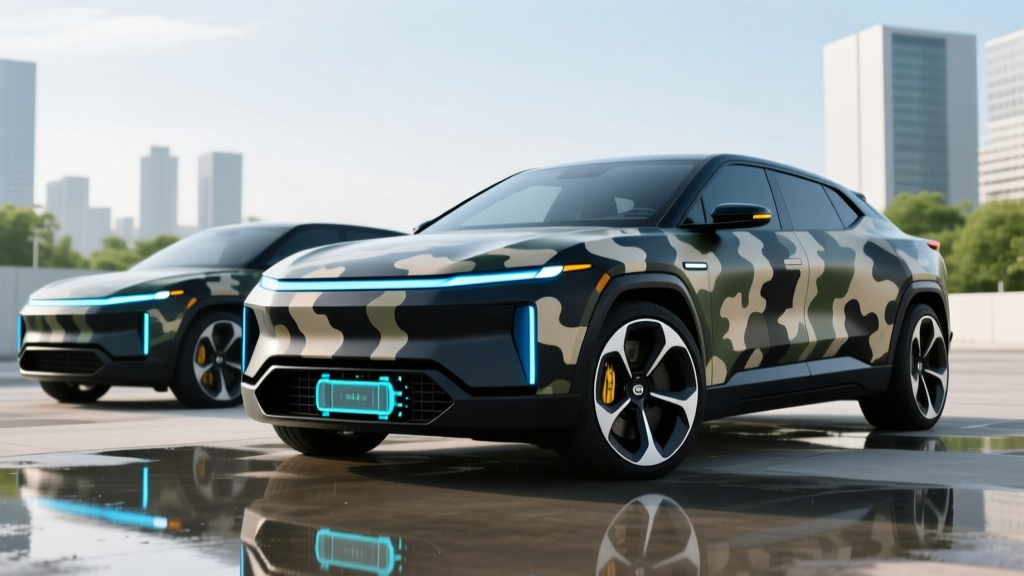
If you've been scrolling EV forums or automotive spy-shot galleries in recent months, you've almost certainly seen them: heavily wrapped Rivian R2 camouflage prototypes carving through desert heat, Arctic cold, and urban traffic. The compact electric SUV is Rivian's most consequential launch yet — a vehicle designed to bring the brand's adventure-oriented DNA to a price point that undercuts the R1S by roughly $30,000. With production targeted for the first half of 2026 at Rivian's Normal, Illinois facility, the R2 is moving from camouflaged mule to showroom reality.
Here's everything the prototype sightings, official teasers, and supply-chain reporting tell us about the Rivian R2's expected specs — and what matters most if you're considering one.
What Rivian R2 Camouflage Prototypes Tell Us About Design and Platform
The camouflage-wrapped test mules spotted in Death Valley, northern Sweden, and around Rivian's Normal, Illinois headquarters share unmistakable family DNA with the R1S and R1T. However, the R2 rides on an entirely new, ground-up mid-size platform that is shorter in wheelbase and overall length than the R1. The prototypes reveal a slightly more upright greenhouse, a shorter front overhang (no engine bay to accommodate), and what appears to be a single-motor rear-drive layout on base variants alongside dual-motor all-wheel-drive configurations on higher trims.
Notable design cues visible through the wrap include:
- Rivian's signature stadium-shaped headlights, scaled down for the smaller fascia
- A simplified front trunk (frunk) with a shallower opening than the R1T/R1S
- A flatter roofline optimized for aerodynamic efficiency over rugged approach angles
- Rear door handles that appear flush-mounted to reduce drag
- A rear hatch with a wider, more practical cargo opening than the R1S
Rivian CEO RJ Scaringe has confirmed the R2 will be built on a new architecture that uses large single-piece aluminum castings for the front and rear underbody — a manufacturing approach similar to Tesla's gigacasting that reduces part count, weight, and assembly time. This is critical for hitting the R2's aggressive price target.
Estimated Battery, Range, and Efficiency
The R2 is expected to launch with two battery options, drawing heavily on lessons learned from Rivian's transition to LFP (lithium iron phosphate) chemistry on the R1's Standard Pack.
| Spec | Standard Pack (Est.) | Large Pack (Est.) |
|---|---|---|
| Usable Capacity | ~72 kWh | ~95 kWh |
| Chemistry | LFP (prismatic) | NMC (nickel manganese cobalt) |
| EPA Est. Range | ~270 mi | ~330 mi |
| Est. Efficiency | ~27 kWh/100 mi | ~29 kWh/100 mi |
| Est. MPGe (Combined) | ~125 MPGe | ~116 MPGe |
Real-World Range Expectations: The EPA sticker is only part of the story. Based on the R1S's real-world behavior and the R2's smaller frontal area, expect approximately 290–310 miles on the highway at 70 mph with the Large Pack in mild weather. In sub-freezing temperatures (20°F and below), plan for a 20–30% range reduction, bringing the Large Pack down to roughly 230–260 miles of usable range. The LFP Standard Pack will see less cold-weather degradation percentage-wise but starts from a lower baseline, so winter highway range may dip to 190–210 miles.
The LFP chemistry choice for the Standard Pack is significant. LFP cells are heavier and less energy-dense than NMC, but they tolerate repeated charging to 100% without accelerated degradation, have a longer cycle life, and use no cobalt or nickel — reducing both cost and supply-chain risk. For daily commuting, the LFP pack is arguably the smarter long-term ownership choice.
Charging Speed: DC Fast Charging and Home Level 2
Charging speed is where the R2 needs to be competitive, and the prototypes have been spotted at Rivian's growing network of in-house chargers as well as third-party stations. Here's what we expect based on Rivian's current R1 charging architecture and the new platform's 800V-capable electrical system:
| Charging Level | Max Power | Speed / Notes |
|---|---|---|
| Level 1 (120V household) | ~1.4 kW | ~4–5 miles per hour |
| Level 2 (240V home, 48A) | ~11.5 kW | ~32–38 miles per hour; full charge in ~8–9 hrs |
| DC Fast Charge (CCS/NACS) | Peak ~220 kW (Large Pack) | 10–80% in approximately 22–25 minutes |
| DC Fast Charge (Standard/LFP) | Peak ~175 kW | 10–80% in approximately 25–28 minutes |
Charging curve reality check: As with all EVs, the R2 will not sustain its peak kW rate for the entire session. Expect peak charge rates in the 10–40% state-of-charge window, with a progressive taper beginning around 60% SoC and a significant slowdown above 80%. This is normal battery management behavior — not a flaw — but it means a "10–80%" time is the most honest metric for trip planning.
Rivian has adopted the NACS (North American Charging Standard) connector — the Tesla-designed plug now being standardized across the industry — as the native port on the R2. This means direct, adapter-free access to Tesla's Supercharger network, which remains the most reliable public DC fast-charging infrastructure in the U.S. This is a major practical advantage for road-trippers compared to CCS-only vehicles still relying on Electrify America or third-party networks.
Performance: Motors, 0-60, and Drivetrain
Rivian has built its reputation on dual-motor and quad-motor performance, and the R2 continues that tradition — albeit at a more accessible tier.
| Configuration | Drivetrain | Est. Horsepower | Est. 0-60 mph |
|---|---|---|---|
| Single Motor | RWD | ~275 hp | ~6.5 sec |
| Dual Motor | AWD | ~450 hp | ~4.5 sec |
| Dual Motor Performance (est.) | AWD | ~550 hp | ~3.5 sec |
The single-motor RWD variant is the volume play — it's the cheapest to produce, the most efficient, and more than adequate for the vast majority of buyers. The dual-motor AWD is the sweet spot for anyone who encounters snow, gravel, or wants to tow. Rivian has confirmed the R2 will offer a towing capacity of approximately 3,500–4,000 lbs with the AWD configuration, which is competitive with the Hyundai Ioniq 5 and significantly better than many compact crossovers.
Interior Space, Cargo, and Practicality
The R2's dimensions place it in the compact-to-midsize crossover segment — think Tesla Model Y territory, but with Rivian's trademark outdoor utility.
| Dimension | Estimated Spec |
|---|---|
| Seating Capacity | 5 passengers |
| Front Legroom | ~41 inches |
| Rear Legroom | ~37 inches |
| Cargo Behind Rear Seats | ~28–32 cu ft |
| Cargo (Rear Seats Folded) | ~65–72 cu ft |
| Frunk Volume | ~8–10 cu ft |
The frunk is smaller than the R1T's massive 11-cu-ft front trunk but still large enough for a charging cable bag, a small cooler, or a week's worth of groceries. Rivian has also teased integrated camping and adventure features — likely including built-in air compressor access, rooftop tent wiring pre-provisions, and the brand's signature Gear Tunnel-style storage solutions adapted for the smaller platform.
Pricing, Trims, and Federal Tax Credit Eligibility
This is the question driving the most search traffic around the R2. Rivian has targeted a starting price of approximately $45,000 for the single-motor Standard Pack — a number that, if achieved, positions the R2 directly against the Tesla Model Y, Hyundai Ioniq 5, and Kia EV6 while undercutting the R1S by a wide margin.
| Trim (Estimated) | Base MSRP | After §30D Credit (if eligible) |
|---|---|---|
| Single Motor / Standard Pack (LFP) | ~$45,000 | ~$37,500 |
| Dual Motor AWD / Standard Pack | ~$50,000 | ~$42,500 |
| Dual Motor AWD / Large Pack (NMC) | ~$55,000 | ~$47,500 |
| Dual Motor Performance / Large Pack | ~$60,000 | ~$52,500 |
Federal Tax Credit (§30D) Eligibility — Key Caveats: The up-to-$7,500 federal EV tax credit is not automatic. Under current IRS rules, the R2 must meet several requirements:
- MSRP Cap: The vehicle must have an MSRP at or below $80,000 for SUVs (the R2 easily clears this).
- Buyer Income Cap: Modified adjusted gross income must not exceed $150,000 (single), $225,000 (head of household), or $300,000 (joint filers).
- Battery Sourcing: A percentage of critical minerals and battery components must be sourced from the U.S. or free-trade-agreement countries. This threshold increases annually. The LFP Standard Pack may face challenges here depending on cell sourcing (many LFP cells originate from China), while the NMC Large Pack using North American-sourced materials is more likely to qualify for the full amount.
- Point-of-Sale Transfer: Buyers can now transfer the credit to the dealer at purchase, reducing the out-of-pocket price immediately rather than waiting for a tax refund.
Always verify current eligibility on IRS.gov before purchasing, as sourcing rules tighten each model year. Consult a tax professional for your specific situation.
Warranty, Safety, and Driver Assistance
Rivian currently provides an 8-year / 175,000-mile battery and drive unit warranty on the R1 platform — among the most generous in the industry. The R2 is expected to carry similar coverage, though the exact mileage threshold may adjust given the vehicle's lower price positioning. A reasonable expectation is 8 years / 100,000–150,000 miles on the battery and drive unit, with a 4-year / 50,000-mile bumper-to-bumper warranty.
The battery warranty guarantees that the pack will retain a minimum percentage of its original capacity (typically 70%) over the warranty period. Rivian's over-the-air update capability means battery management algorithms can be refined post-purchase to optimize longevity.
Driver Assistance — SAE Level 2: The R2 will ship with Rivian's driver-assistance suite (the successor to the current Driver+ system). This includes adaptive cruise control, lane-centering, automatic emergency braking, and likely a highway hands-on-assist feature. This is SAE Level 2 automation — the driver must remain attentive, hands engaged or eyes monitored, at all times. This is not self-driving. No production consumer vehicle currently sold in the U.S. is self-driving.
Pros, Cons, and Who the R2 Is For
Pros
- Native NACS connector — direct Supercharger access, no adapter needed
- LFP option for daily drivers who charge to 100% regularly without degradation worry
- Competitive starting price (~$45K) with available federal tax credit
- Rivian's adventure ecosystem: camping integrations, tow rating, over-the-air updates
- 800V architecture for competitive DC fast-charge speeds
- U.S.-built (Normal, Illinois) — supports domestic manufacturing and may aid credit eligibility
Cons
- Not yet available — production targeted for H1 2026; early buyers face potential ramp-up delays
- Rivian's service center network is still expanding — coverage in rural areas may lag
- LFP Standard Pack may not qualify for full §30D credit due to critical-mineral sourcing rules
- Smaller frunk and cargo area than the R1S/R1T
- Performance trim pricing pushes into R1S territory, blurring the value proposition
Who Should Buy the Rivian R2?
- Choose the R2 if: You want a compact electric SUV with genuine outdoor utility, native Supercharger access, and a price point that makes EV ownership realistic — without stepping up to a full-size R1S.
- Look elsewhere if: You need three rows of seating (consider the R1S or Kia EV9), you require maximum towing (the R1T handles 7,700+ lbs), or you want to take delivery tomorrow rather than wait for a 2026 production slot.
Frequently Asked Questions
What is the real-world range of the Rivian R2?
Based on estimated EPA figures and real-world adjustments, expect approximately 290–310 highway miles from the Large Pack (NMC) in mild weather, dropping to 230–260 miles in sub-freezing conditions. The LFP Standard Pack should deliver roughly 240–250 real-world highway miles, with less cold-weather percentage loss.
How fast does the Rivian R2 charge?
The Large Pack is expected to peak at ~220 kW on DC fast chargers, achieving a 10–80% charge in approximately 22–25 minutes. Home Level 2 charging at 11.5 kW adds roughly 32–38 miles per hour, fully replenishing the battery overnight.
How much does the Rivian R2 cost after tax credits?
If the base single-motor model starts at ~$45,000 and you qualify for the full $7,500 §30D federal credit (meeting income, MSRP, and sourcing requirements), the effective price drops to approximately $37,500. However, battery-sourcing rules may limit the credit on certain trims — verify on IRS.gov before committing.
Is the Rivian R2 worth buying vs. the Tesla Model Y or Hyundai Ioniq 5?
The R2 competes directly with both. It offers more adventure-oriented features and native NACS/Supercharger access (an advantage over the Ioniq 5, which also now uses NACS). The Model Y has a proven track record and wider Supercharger availability today. The R2's advantage will be its Rivian ecosystem, potential LFP option, and American manufacturing — but early-production risk is real. Wait for initial reviews if reliability is a top priority.
Does the Rivian R2 qualify for the federal EV tax credit?
It likely qualifies for some or all of the $7,500 credit, but this depends on the specific battery pack (LFP vs. NMC), your income, and the current year's critical-mineral sourcing thresholds. The NMC Large Pack has a stronger chance of full eligibility. Always confirm via IRS.gov and consult a tax professional.
When will the Rivian R2 be available to order?
Rivian has targeted production start for the first half of 2026. Reservation holders will likely get first access, with general availability following later in the year. Check Rivian.com for the latest timeline updates.