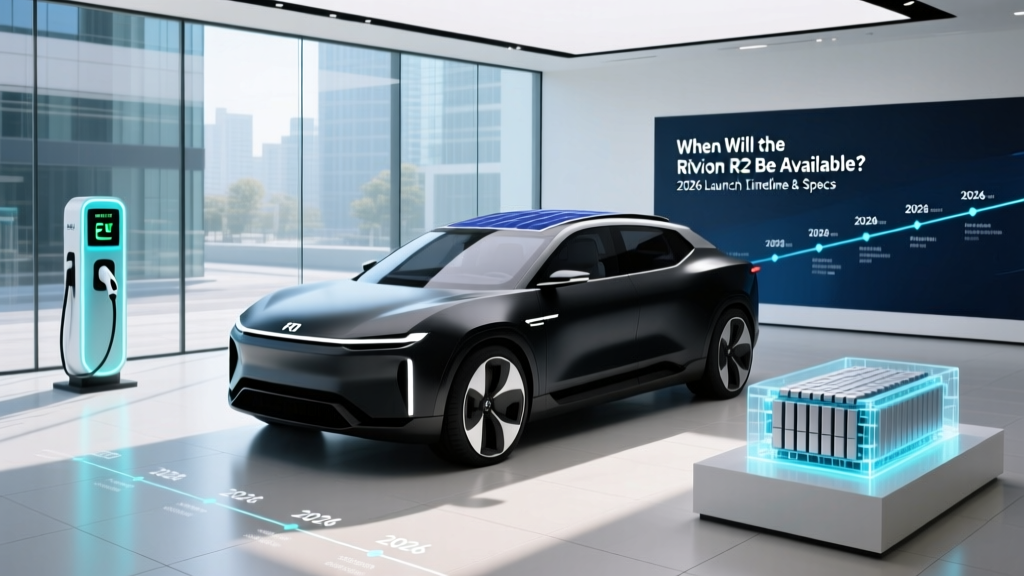
The Rivian R2 is the most anticipated mainstream electric SUV since the Tesla Model Y reshaped the segment. Designed to slot below the R1S in both size and price, the R2 promises to bring Rivian's adventure-oriented engineering to a much broader audience. But for the thousands of reservation holders and curious shoppers asking when will the Rivian R2 be available, the answer involves a multi-phase production rollout that stretches across 2026 and into 2027.
Here's everything we know about the Rivian R2's release schedule, preliminary specifications, pricing, and whether it will qualify for the federal EV tax credit — all framed from our current vantage point in 2026.
Rivian R2 Production Timeline: When Can You Actually Get One?
Rivian has confirmed that R2 production will begin at its Normal, Illinois assembly plant in the first half of 2026, with the earliest customer deliveries targeted for mid-to-late 2026. The company initially explored building a brand-new factory in Georgia, but pivoted in early 2024 to leverage existing Illinois capacity — a decision that accelerated the timeline by roughly a year and reduced capital expenditure by an estimated $2.25 billion.
Here's how the rollout is expected to unfold:
- Q1–Q2 2026: Pilot production and validation vehicles at the Normal plant. New assembly line tooling, including a mega-casting system for the underbody, comes online.
- Q2–Q3 2026: Initial production begins, prioritizing reservation holders who placed deposits (typically $1,000 refundable). Early builds are expected to be higher-trim Dual-Motor configurations.
- Q4 2026–Q1 2027: Broader delivery ramp, including the base single-motor RWD variant at the lowest advertised MSRP.
- Mid-2027 onward: The planned Georgia plant is expected to come online for R2 production, substantially increasing annual output toward Rivian's long-term target of 200,000+ R2 units per year.
If you haven't placed a reservation yet, expect your delivery window to fall in late 2026 or early 2027 at the earliest — and potentially later if you select the base trim or a high-demand configuration. Rivian's R1T and R1S launches demonstrated that initial demand can outstrip production capacity for several quarters.
Estimated Specs: Range, Battery, and Powertrain
Because the R2 has not yet entered full customer production, the figures below are based on Rivian's announced targets, supply-chain reporting, and engineering disclosures. Final EPA-certified numbers may differ at launch.
| Specification | Rivian R2 (Preliminary) |
|---|---|
| EPA Range (est.) | ~330 miles (Dual-Motor, Standard battery) |
| Battery Capacity | ~75–85 kWh usable (estimated) |
| Battery Chemistry | LFP (Lithium Iron Phosphate) for Standard; NMC for Max Range |
| Drivetrain | Single-Motor RWD (base) / Dual-Motor AWD |
| Horsepower | ~275 hp (RWD) / ~450 hp (Dual-Motor AWD) |
| 0–60 mph | ~6.5 sec (RWD) / ~4.5 sec (Dual-Motor) |
| Max DC Fast Charge | ~200 kW (estimated peak) |
| 10–80% DC Fast Charge | ~25–30 minutes (estimated) |
| Level 2 Home Charging | ~11.5 kW / ~30–35 miles per hour |
| Towing Capacity | ~3,300 lbs (estimated) |
| Charging Port | NACS (native Tesla Supercharger access) |
Real-World Range: What to Expect Beyond the EPA Sticker
EPA Estimated Range: ~330 miles (Dual-Motor, standard battery pack)
Real-World Expectation: Plan for approximately 260–290 miles in mixed highway driving at 70–75 mph. In cold weather (below 32°F), expect a further 15–25% reduction, bringing effective range down to roughly 210–250 miles depending on cabin heating demand and terrain.
Rivian's R1S and R1T have historically landed close to their EPA estimates in city and mixed driving but fall short on sustained highway runs — a pattern common to boxy, adventure-oriented SUVs with higher drag coefficients. The R2's more compact, slightly more aerodynamic profile may improve highway efficiency, but it's still a tall crossover. LFP chemistry in the standard pack also means slightly lower energy density than NMC, though LFP offers superior longevity and can be charged to 100% daily without degradation concerns — a significant practical advantage for commuters.
For context, in our experience with similar-class EVs, a ~330-mile EPA rating typically translates to needing a charge stop every 230–260 miles on a road trip when you factor in an 80% fast-charging ceiling and a comfort buffer.
Charging Speed: DC Fast, Home, and NACS Access
Rivian has confirmed that the R2 will ship with a native NACS charge port, meaning direct access to Tesla's Supercharger network — currently the most reliable and expansive DC fast-charging infrastructure in the U.S. — without an adapter.
| Charging Level | Power (kW) | Speed (Miles of Range Added) |
|---|---|---|
| Level 1 (120V household) | ~1.4 kW | ~4–5 miles per hour |
| Level 2 (240V home/public) | ~11.5 kW | ~30–35 miles per hour |
| DC Fast Charge (peak) | ~200 kW | ~10–80% in ~25–30 min |
A critical nuance: the ~200 kW peak rate applies only in the 10–40% state-of-charge window. As with all modern EVs, the charge curve tapers significantly above 60% SoC, and you'll see rates drop to 80–100 kW in the 60–80% range. This is a battery-protection feature, not a defect. For road trips, plan your stops around 10–80% charges (~25 minutes) rather than attempting to fill to 100% at a DC station, which can add 20+ minutes for the final 20%.
At home on a Level 2 wall connector, the R2 should recover a full battery overnight (~8–9 hours from near-empty). Most daily commuters driving 30–50 miles will need only 1.5–2 hours of Level 2 charging per day — easily handled by plugging in each evening.
Pricing, Trims, and Federal Tax Credit Eligibility
Rivian has targeted a starting MSRP of approximately $45,000 for the base single-motor RWD R2, making it competitive with the Tesla Model Y, Hyundai Ioniq 5, and upcoming mid-size electric crossovers. Higher trims with dual-motor AWD and the larger NMC battery pack are expected to push into the $52,000–$58,000 range.
| Trim / Configuration | Est. MSRP | Est. After §30D Credit |
|---|---|---|
| R2 Standard (RWD, LFP) | ~$45,000 | ~$37,500 (if eligible) |
| R2 Dual-Motor AWD (LFP) | ~$50,000 | ~$42,500 (if eligible) |
| R2 Dual-Motor Max Range (NMC) | ~$55,000–$58,000 | ~$47,500–$50,500 (if eligible) |
Does the Rivian R2 Qualify for the $7,500 Federal Tax Credit?
This is one of the most important questions for prospective buyers, and the answer depends on several factors governed by IRS §30D rules for new clean vehicles:
- MSRP Cap: SUVs must have an MSRP at or below $80,000. All announced R2 trims clear this threshold easily.
- Buyer Income Cap: Modified adjusted gross income must not exceed $150,000 (single), $225,000 (head of household), or $300,000 (joint filers).
- Battery Sourcing Requirements: The credit is split into two halves — $3,750 for critical minerals and $3,750 for battery component assembly, both with escalating domestic-content thresholds that tighten each year. As of 2026, the sourcing requirements are stringent. Rivian's LFP cells are expected to be sourced from suppliers with significant Chinese supply-chain involvement, which could disqualify the standard-range R2 from the full $7,500 — potentially limiting it to $3,750 or zero depending on final supplier certifications.
- FEOC Restriction: Vehicles with battery components from a Foreign Entity of Concern (primarily Chinese companies) are disqualified entirely. This is the highest-risk factor for the LFP-equipped R2.
- Point-of-Sale Transfer: If eligible, the credit can be transferred to the dealer at purchase, reducing your out-of-pocket cost immediately rather than waiting for a tax refund.
Bottom line: The R2's price and buyer demographics align well with §30D eligibility, but the battery-sourcing and FEOC rules create genuine uncertainty — especially for the LFP trims. Rivian has not yet published final battery supplier certifications. We recommend consulting fueleconomy.gov closer to launch for the official eligibility determination, and speaking with a tax professional before making purchase decisions based on the credit.
Interior, Cargo, and Technology
The R2 is positioned as a compact-to-mid-size electric SUV — think slightly smaller than the R1S but larger than a Hyundai Ioniq 5. Rivian has confirmed a focus on practical family utility:
- Cargo Volume: Estimated at ~28–32 cu ft behind the second row, with a front trunk (frunk) adding approximately 10–12 cu ft — a Rivian signature feature.
- Seating: Five passengers across two rows. Rivian has emphasized generous rear-seat legroom (~38 inches estimated) and a flat floor thanks to the skateboard platform.
- Infotainment: A centrally mounted touchscreen (estimated 14–15 inches) running Rivian's proprietary operating system, with wireless Apple CarPlay and Android Auto expected.
- Driver Assistance: Rivian's in-house Driver+ suite will be standard, offering adaptive cruise control, lane-centering, and hands-on highway assist. This is an SAE Level 2 system — the driver must remain engaged and attentive at all times. It is not autonomous driving.
- Unique Features: Rivian's signature gear tunnel (if adapted for the smaller platform), integrated air compressor, and camp kitchen accessory compatibility are under consideration but not confirmed for R2.
Driver Assist Limitation: Rivian Driver+ is an SAE Level 2 system. It does not replace the driver. You must keep your hands on the wheel (or demonstrate attentiveness) and remain prepared to take over at any moment. Do not confuse this with Level 4 autonomous services like Waymo.
Pros and Cons: An Honest Assessment
Pros
- Native NACS port = direct Supercharger access at launch
- LFP battery option enables daily 100% charging with minimal degradation
- Estimated ~$45K starting price undercuts R1S significantly
- Rivian's proven build quality and adventure-gear integration
- Frunk + competitive cargo space for the class
- OTA software updates and growing service network
Cons
- 2026 availability means limited early production — expect wait times
- LFP battery sourcing may jeopardize full $7,500 tax credit
- ~200 kW peak DC charging is adequate but trails Hyundai/Kia's 800V architecture (~240–350 kW)
- Base RWD trim may not launch until late 2026 or early 2027
- Rivian's service center network is still expanding — rural owners may face longer service trips
- Final EPA ratings and pricing not yet certified
Who Should Buy the Rivian R2 — and Who Should Look Elsewhere?
Choose the Rivian R2 if:
- You want a compact electric SUV with genuine outdoor/adventure capability and Supercharger access
- You value LFP battery longevity and plan to own the vehicle 8+ years
- You're willing to wait for production ramp and potentially accept a higher-trim initial build
- You need a frunk and flexible cargo solutions for gear, pets, or camping equipment
Look at competitors if:
- You need a vehicle now — the Tesla Model Y, Hyundai Ioniq 5, and Ford Mustang Mach-E are available today
- Maximum DC charging speed is your top priority — Hyundai/Kia's E-GMP platform charges faster
- You want three-row seating — the R2 is strictly a two-row, five-passenger SUV
- You need maximum towing — the R1S or Ford F-150 Lightning offer substantially higher tow ratings
Warranty and Long-Term Ownership
Rivian is expected to match or exceed its current R1S/R1T warranty structure for the R2:
- Battery & Drive Unit: 8 years / 175,000 miles (estimated, based on R1 coverage)
- Limited Vehicle Warranty: 5 years / 60,000 miles
- Battery Degradation Threshold: Typically 70% capacity retention over the warranty period — meaning Rivian will repair or replace the pack if it degrades below 70% of original capacity within the warranty window.
The LFP battery in the standard R2 is a particular longevity advantage. LFP cells typically demonstrate slower degradation curves than NMC, often retaining 90%+ capacity after 1,000+ charge cycles. For an owner driving 12,000 miles per year, that translates to well over a decade of practical use before meaningful range loss. According to NHTSA and industry data, modern EV battery packs are outlasting their original warranty periods in the vast majority of cases.
Frequently Asked Questions
When will the Rivian R2 be available for delivery?
Initial customer deliveries are targeted for mid-to-late 2026 for reservation holders. Broader availability, including the base RWD trim, is expected in late 2026 through early 2027. The Georgia plant coming online in mid-2027 should significantly increase production volume.
What is the real-world range of the Rivian R2?
With an estimated EPA rating of ~330 miles, expect approximately 260–290 miles in real-world highway driving and 210–250 miles in cold weather. City and mixed driving should come closer to the EPA figure, especially with regenerative braking recapturing energy in stop-and-go traffic.
How fast does the Rivian R2 charge?
On a DC fast charger, the R2 is estimated to peak at ~200 kW, achieving a 10–80% charge in roughly 25–30 minutes. At home on a Level 2 (240V) charger at 11.5 kW, you'll add approximately 30–35 miles of range per hour, enough for a full overnight charge.
How much does the Rivian R2 cost after tax credits?
The base RWD R2 is targeted at ~$45,000 MSRP. If it qualifies for the full $7,500 federal tax credit under IRS §30D, the effective price drops to ~$37,500. However, battery sourcing rules — particularly for LFP cells — create uncertainty about full credit eligibility. Final determination will come closer to launch.
Is the Rivian R2 worth buying vs. the Tesla Model Y or Hyundai Ioniq 5?
The R2 differentiates with native NACS Supercharger access, a frunk, adventure-oriented design, and LFP battery longevity. The Model Y offers a more mature Supercharger-integrated ecosystem and immediate availability. The Ioniq 5 charges faster on DC (800V architecture) and is available now. If you can wait and value Rivian's build quality and outdoor utility, the R2 is a compelling option. If you need a car today, the alternatives are strong.
Does the Rivian R2 qualify for the federal EV tax credit?
It depends. All announced R2 trims fall under the $80,000 MSRP cap for SUVs. Buyer income limits apply ($150K single / $300K joint). The biggest variable is battery sourcing: LFP cells may not meet 2026 critical-mineral and FEOC requirements for the full $7,500. Check fueleconomy.gov closer to launch for the official determination.
Can I reserve a Rivian R2 now?
Yes. Rivian has been accepting refundable $1,000 reservations since the R2's announcement. Placing a reservation now is the best way to secure an earlier delivery window, though Rivian has not published exact reservation-to-delivery timelines.