The Short Answer: Is the Rivian R2 Actually Amphibious?
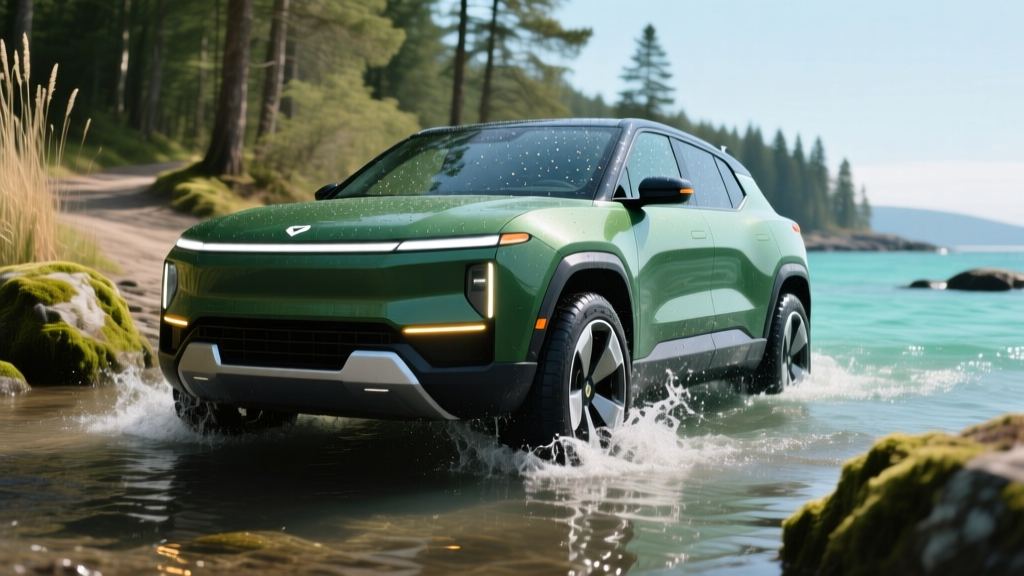
Let's clear the air immediately: the Rivian R2 is not an amphibious vehicle, and Rivian has never marketed it as one. Searches for "Rivian R2 series amphibious capabilities" appear to stem from speculative renders, internet memes, and confusion with Rivian's well-documented water-wading ability on the R1S and R1T. No production EV from any mainstream automaker is amphibious, and the physics of combining a high-voltage traction battery, sealed power electronics, and buoyant cabin architecture with water propulsion make such a vehicle extraordinarily unlikely for consumer sale.
What the R2 does offer — based on Rivian's announced 2026 production specifications — is a compact electric SUV platform with legitimate light-off-road credentials, competitive range, and a starting price that undercuts the R1 lineup dramatically. Below, we break down every confirmed and estimated spec for the 2026 Rivian R2, address the water-wading question with real engineering context, and evaluate whether it earns a spot on your shortlist.
Spec Snapshot: 2026 Rivian R2 (Preliminary)
| Attribute | Estimated / Announced Value |
|---|---|
| EPA Range (est.) | ~330 miles (Large Pack, RWD) |
| Battery Capacity (usable) | ~85 kWh (Large), ~65 kWh (Standard) |
| Battery Chemistry | NMC (Large); LFP expected for Standard (unconfirmed) |
| Max DC Fast Charge | ~225 kW (peak) |
| 10–80% DC Charge Time | ~24–28 minutes (est.) |
| Level 2 Home Charge Rate | 11.5 kW (~37 miles/hr added) |
| 0–60 mph | ~3.0 sec (Dual-Motor Performance); ~5.5 sec (RWD) |
| Drivetrain Options | RWD single-motor, AWD dual-motor, AWD tri-motor (Performance) |
| Base MSRP | ~$45,000 (Standard RWD); ~$52,500 (Large AWD) |
| Federal §30D Credit | Up to $7,500 (subject to sourcing/income/MSRP caps) |
| Battery Warranty | 8 years / 120,000 miles (expected, based on R1 precedent) |
Sources: Rivian press announcements, rivian.com, and fueleconomy.gov (pending EPA listing).
Water Wading vs. Amphibious: The Engineering Reality
The R1S and R1T are rated for approximately 3 feet (36 inches) of water wading, thanks to sealed battery enclosures, waterproofed power electronics, and elevated air intake routing. Rivian has suggested the R2 will inherit a version of this capability, likely in the 24–30 inch range given its shorter ground clearance and smaller platform.
Wading and amphibious travel are fundamentally different engineering problems:
- Wading means the vehicle's wheels remain on the ground; the battery pack and cabin are sealed against ingress; and water depth stays below critical electronics.
- Amphibious operation requires the vehicle to float (positive buoyancy), propel itself through water (propeller or waterjet), and steer independently of the wheels — adding hundreds of pounds of hardware, compromising crash structure, and creating regulatory nightmares under both NHTSA and US Coast Guard jurisdiction.
No production passenger EV meets amphibious standards. Vehicles like the Gibbs Aquada and WaterCar Panther exist as low-volume specialty builds, not as daily-driver SUVs. If amphibious capability is a genuine use case for you, a dedicated amphibious ATV (e.g., Argo, RIB with trailer) remains the practical solution.
Range, Efficiency, and Real-World Expectations
Rivian's announced target of ~330 miles EPA for the Large Pack RWD R2 would place it among the most efficient compact electric SUVs in its class. However, EPA stickers don't tell the full story.
Efficiency is projected in the 105–115 MPGe combined range (~29–32 kWh/100 mi), competitive with the Tesla Model Y and Hyundai Ioniq 5 but slightly lower than the aerodynamically optimized Tesla due to the R2's boxier, off-road-oriented silhouette.
Charging Speed and Infrastructure
Rivian has committed to NACS (Tesla-style) as the native charge port on the R2, granting direct access to the Supercharger network without adapters — a significant practical advantage over CCS-equipped competitors still relying on Magic Dock or third-party adapters.
| Charging Level | Power | Speed / Notes |
|---|---|---|
| Level 1 (120V) | ~1.4 kW | ~4–5 miles/hr (overnight trickle) |
| Level 2 (240V, 48A) | 11.5 kW | ~37 miles/hr (full charge in ~9 hrs) |
| DC Fast Charge | ~225 kW peak | 10–80% in ~24–28 min; tapers above 80% |
A note on the charge curve: peak 225 kW is sustained only between roughly 10% and 40% State of Charge. Expect tapering to ~150 kW through the 60% mark and ~80 kW above 80%. This is standard behavior for NMC packs with active thermal management and means a 10–80% session at a 250 kW Supercharger or Electrify America stall will take roughly 25 minutes in moderate ambient temperatures. Preconditioning the battery via the nav-routed preconditioning feature is essential in cold weather to hit these numbers.
Performance and Drivetrain Options
Rivian's tri-motor Performance variant targets a sub-3.0-second 0–60 mph time with an estimated 800+ horsepower — putting it in supercar territory from a compact SUV. The more volume-oriented dual-motor AWD is expected around 500 hp and 4.5 seconds, while the base RWD single-motor aims for ~275 hp and a ~5.5-second sprint, which is adequate for merging and passing but deliberately less aggressive than the R1 lineup.
Ground clearance is estimated at ~8.5 inches (vs. 14.9 inches on the R1S at max air suspension), with approach/departure angles tuned for trail use but not rock-crawling. Rivian's quad-motor tank-turn feature is not expected on the R2.
Pricing, Trims, and Federal Tax Credit Eligibility
The R2's sub-$45,000 entry point is the headline, but real-world transaction prices will vary with options and credit eligibility.
| Trim (est.) | MSRP | After Max §30D Credit |
|---|---|---|
| Standard RWD | ~$45,000 | ~$37,500 |
| Standard AWD | ~$49,500 | ~$42,000 |
| Large AWD | ~$52,500 | ~$45,000 |
| Performance Tri-Motor | ~$62,000+ | ~$54,500+ |
The IRS §30D Clean Vehicle Credit offers up to $7,500, but eligibility is not automatic. As of 2026, the following constraints apply:
- MSRP cap: SUVs must sticker at $80,000 or below — all R2 trims clear this.
- Buyer income cap: MAGI ≤ $150k single / $300k joint.
- Battery sourcing: Critical minerals and battery components must meet escalating domestic/free-trade thresholds; Rivian's supply chain compliance is expected but not guaranteed on every trim.
- Point-of-sale transfer: Eligible buyers can apply the credit at purchase, reducing out-of-pocket cost immediately.
Always verify current-year rules at IRS.gov and consult a tax professional before relying on credit eligibility.
Interior, Cargo, and Technology
The R2 rides on a shorter wheelbase than the R1S, so third-row seating is not offered. Expect two rows for five passengers with approximately 39 inches of rear legroom and ~30 cu ft of cargo space behind the second row, expanding to ~65 cu ft with seats folded. A modest front trunk (frunk) adds roughly 4–6 cu ft of sealed storage.
Tech highlights include Rivian's proprietary infotainment stack (15.6-inch center display expected), over-the-air updates, Rivian Driver+ (a Level 2 hands-on ADAS, not autonomous), integrated camp kitchen accessory compatibility, and a gear tunnel option inherited from the R1 platform philosophy.
Pros, Cons, and the Verdict
- Sub-$45k entry price (before credits)
- Native NACS = direct Supercharger access
- Legitimate light-off-road capability
- Competitive 330-mi range target
- Rivian's OTA-driven feature pipeline
- 2026 production ramp risks (Rivian's historical pain point)
- No third row; smaller cargo than R1S
- Not amphibious, despite internet chatter
- Final EPA/§30D sourcing TBD at launch
- Tri-motor Performance trim pushes past $60k
Frequently Asked Questions
Is the Rivian R2 amphibious or able to float?
No. The R2 is not amphibious and cannot propel itself through water. It may offer 24–30 inches of water-wading capability consistent with sealed EV powertrain architecture, but this is not equivalent to floating or waterborne travel.
What is the real-world range of the Rivian R2?
With the Large Pack RWD, expect ~260–290 miles at highway speeds in moderate temperatures, dropping to 200–240 miles in deep winter. AWD trims reduce range by roughly 8–15%.
How fast does the R2 charge at home and on the road?
Level 2 home charging at 11.5 kW adds ~37 miles per hour; a full charge takes ~9 hours. DC fast charging peaks at ~225 kW, reaching 10–80% in approximately 24–28 minutes on a 250 kW+ station.
Does the Rivian R2 qualify for the $7,500 federal tax credit?
The R2's MSRP clears the $80,000 SUV cap, but final eligibility depends on buyer income (≤$300k joint), battery sourcing compliance under current IRS rules, and point-of-sale transfer availability. Verify at IRS.gov.
Is the R2 worth buying over the Tesla Model Y or Hyundai Ioniq 5?
If you value off-road capability, native NACS, and Rivian's adventure-oriented brand, yes — but expect longer delivery waits and less mature service infrastructure than Tesla. If you prioritize lowest cost of ownership and widest charging access today, the Model Y remains the default. The Ioniq 5 wins on interior space and 800V charging architecture.
When can I actually buy the Rivian R2?
Rivian targets first-half 2026 production at its Normal, Illinois plant. Reservations opened in 2024; delivery timelines depend on trim and configuration priority.