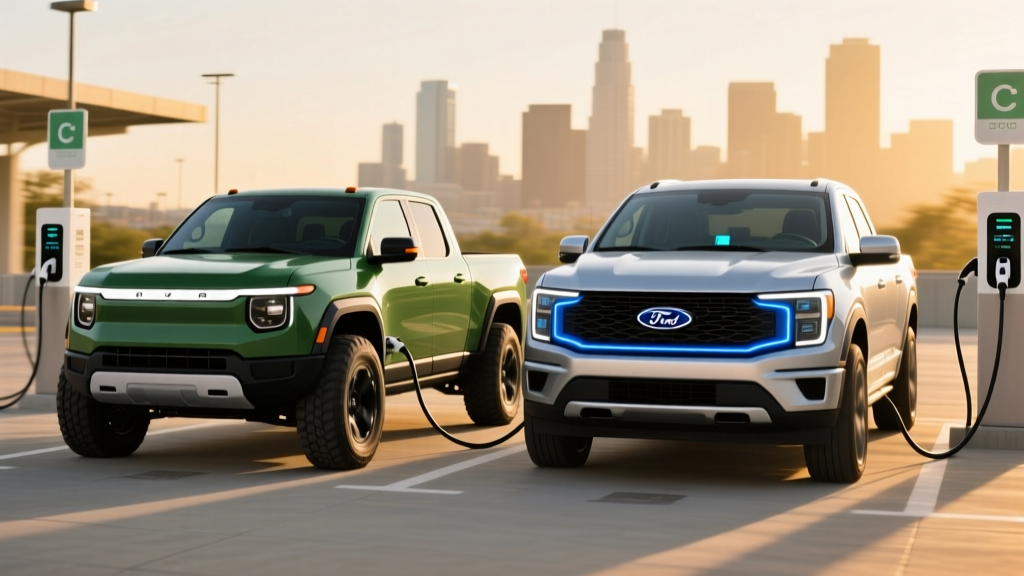
The 2026 Electric Truck Showdown: Rivian R1T or Ford F-150 Lightning?
If you're cross-shopping the Rivian R1T and Ford F-150 Lightning, you're choosing between two fundamentally different philosophies of electric trucks. The R1T is a premium, tech-forward adventure vehicle built on a bespoke skateboard platform. The Lightning is a full-size workhorse that electrifies America's best-selling nameplate while keeping conventional truck DNA intact. Both are compelling, but their strengths serve very different buyers.
This comparison uses current 2026 model-year specifications, EPA data, and IRS §30D federal tax credit rules to give you exact numbers — not marketing fluff — so you can decide which electric truck earns your driveway.
Range, Battery, and Real-World Efficiency
The Rivian R1T Dual-Motor with the Standard battery pack carries a 93.5 kWh usable NMC (nickel manganese cobalt) lithium-ion pack and achieves an EPA-estimated 330 miles on the Max pack variant (149 kWh). The Standard pack variant is EPA-rated at approximately 270 miles. The Ford F-150 Lightning with the Extended Range battery uses a 131 kWh usable NMC pack and achieves an EPA-estimated 320 miles.
Rivian R1T (Standard, 270 mi EPA): Expect 230–250 miles in mixed highway driving at 70+ mph. In freezing temperatures (below 32°F), plan for 185–210 miles due to cabin heating demands and battery chemistry resistance. The R1T's boxy aerodynamics penalize highway efficiency more than city driving.
Ford F-150 Lightning (Extended Range, 320 mi EPA): Highway cruising yields roughly 265–285 miles. Cold weather drops that to 215–240 miles. The Lightning's larger frontal area and heavier curb weight (roughly 6,500 lbs) mean efficiency suffers noticeably when towing or hauling near payload capacity.
Both trucks use liquid thermal management systems with heat pumps, which mitigate cold-weather losses compared to older EV architectures — but physics still applies.
| Specification | Rivian R1T Dual-Motor (Std) | Rivian R1T (Max Pack) | Ford F-150 Lightning (Ext Range) |
|---|---|---|---|
| EPA Range | 270 mi | 330 mi | 320 mi |
| Battery (usable) | 93.5 kWh NMC | 149 kWh NMC | 131 kWh NMC |
| Efficiency | 42 kWh/100 mi | 48 kWh/100 mi | 48 kWh/100 mi |
| MPGe (combined) | 70 MPGe | 65 MPGe | 66 MPGe |
| Drivetrain | Dual-Motor AWD | Dual-Motor AWD | Dual-Motor AWD |
| Horsepower | 533 hp | 533 hp | 580 hp |
| 0–60 mph | 4.5 sec | 4.5 sec | 3.8 sec |
| Max Tow Capacity | 11,000 lbs | 11,000 lbs | 10,000 lbs |
| Payload | 1,760 lbs | 1,760 lbs | 2,235 lbs |
| Bed Length | 4'6" (54") | 4'6" (54") | 5'6" (66") |
Charging Speed: DC Fast Charging and Home Level 2
Charging speed separates trucks you can road-trip from trucks you dread taking beyond your commute. Here's exactly what each delivers at the plug.
| Charging Metric | Rivian R1T (Std Pack) | Rivian R1T (Max Pack) | Ford F-150 Lightning |
|---|---|---|---|
| Max DC Fast Charge | 220 kW (peak) | 220 kW (peak) | 150 kW (peak) |
| 10–80% DC Time | ~28 min | ~42 min | ~41 min |
| Sustained DC Rate (10–50%) | ~180–200 kW | ~160–180 kW | ~120–140 kW |
| Level 2 Home (kW) | 11.5 kW (48A) | 11.5 kW (48A) | 19.2 kW (80A) / 11.3 kW (48A) |
| Level 2 Miles/Hour | ~25 mi/hr | ~25 mi/hr | ~30 mi/hr (80A) |
| Connector | NACS (native) | NACS (native) | CCS1 (adapter for NACS) |
Charging curve reality: The R1T's peak 220 kW is impressive, but like all EVs, it doesn't sustain that rate. Expect 180–200 kW through the 10–50% state of charge window, then a taper to roughly 80–100 kW from 50–80%. The Lightning's 150 kW peak is lower, but its larger 131 kWh pack means those kW fill more actual miles per minute at the lower end of the curve.
For home charging, Ford offers an available 80-amp Charge Station Pro that delivers up to 19.2 kW — significantly faster than Rivian's 11.5 kW onboard charger. With the 80A station, the Lightning adds roughly 30 miles of range per hour of charging, meaning a full overnight session (10 hours) easily replenishes the entire battery. The R1T adds about 25 miles per hour on Level 2, which is adequate for daily commuting but means a depleted Max Pack takes roughly 13 hours for a full charge.
Performance, Capability, and Drivetrain
Both trucks use dual-motor all-wheel-drive layouts, but the execution differs. The F-150 Lightning's 580 horsepower and 3.8-second 0–60 time make it the quicker truck off the line — genuinely startling acceleration for a 6,500-pound vehicle. The R1T Dual-Motor produces 533 hp and hits 60 mph in 4.5 seconds, which is still sports-sedan quick.
Where the R1T separates itself is off-road capability. Rivian's quad-motor option (available on higher trims) provides individual wheel torque vectoring, and even the dual-motor models feature an adjustable air suspension with up to 14.4 inches of ground clearance, a wade depth of over 3 feet, and dedicated off-road drive modes. The Lightning is no slouch with available 4x4 modes, but it's built on Ford's body-on-frame F-150 architecture and rides more like a traditional truck — which is either a pro or a con depending on your expectations.
Towing favors the R1T at 11,000 lbs maximum versus the Lightning's 10,000 lbs. However, towing range penalty is severe for both: expect to lose 40–50% of your EPA range when pulling a 5,000+ lb trailer at highway speeds. This is physics, not a defect — aerodynamic drag from a trailer dominates energy consumption. Plan charging stops accordingly.
Pricing, Trim Levels, and Federal Tax Credit Eligibility
| Model / Trim | Base MSRP | Federal Credit (§30D) | Effective Price (if eligible) |
|---|---|---|---|
| Rivian R1T Dual-Motor (Standard) | $69,900 | $0–$7,500* | $62,400–$69,900 |
| Rivian R1T Dual-Motor (Max Pack) | $83,900 | $0–$7,500* | $76,400–$83,900 |
| Rivian R1T Tri-Motor | $99,900 | $0 (exceeds MSRP cap) | $99,900 |
| Ford F-150 Lightning XLT (Std Range) | $54,995 | $0–$7,500* | $47,495–$54,995 |
| Ford F-150 Lightning Lariat (Ext Range) | $71,990 | $0–$7,500* | $64,490–$71,990 |
| Ford F-150 Lightning Platinum (Ext Range) | $84,990 | $0–$7,500* | $77,490–$84,990 |
*Federal §30D tax credit caveats (2026 rules): The up-to-$7,500 credit splits into two halves — $3,750 for critical minerals sourcing and $3,750 for battery component sourcing, both of which have phase-in thresholds that tighten yearly. Additionally:
- MSRP cap: Pickup trucks must have an MSRP at or below $80,000 to qualify. The R1T Tri-Motor at $99,900 is ineligible. The Lightning Platinum at $84,990 is also ineligible.
- Income cap: Modified adjusted gross income must not exceed $150,000 (single), $225,000 (head of household), or $300,000 (joint filers).
- Point-of-sale transfer: As of 2024, eligible buyers can transfer the credit to the dealer at purchase, reducing the purchase price directly rather than waiting for tax filing.
- Foreign entity of concern (FEOC): Battery components from FEOC entities disqualify the vehicle — check IRS.gov's clean vehicle credit page for the latest eligible VIN list, as sourcing requirements change.
The Lightning's lower starting price gives it a decisive affordability advantage. An XLT Standard Range at roughly $55K before credit is a compelling entry point into electric truck ownership that the R1T simply cannot match.
Cargo, Interior Space, and Practicality
This is where the F-150 Lightning's full-size truck architecture asserts itself. The Lightning offers a 5.5-foot bed (66 inches) with a conventional tailgate, plus the massive 14.1 cubic-foot Mega Power Frunk — a lockable, drainable front trunk with 400 lbs of payload capacity and built-in power outlets. Total front trunk and bed storage is best-in-class for electric trucks.
The R1T's 4.5-foot bed (54 inches) is notably shorter, which limits what you can haul — standard 4×8 sheets of plywood won't fit flat. However, Rivian counters with the innovative Gear Tunnel, a pass-through storage compartment behind the cab that holds long items like skis, snowboards, or camping gear (roughly 11 cubic feet). Combined with a smaller front trunk (11 cu ft), the R1T offers creative storage, but it's optimized for adventure gear, not job-site materials.
Interior passenger space tells a similar story:
- F-150 Lightning: SuperCrew cab seats five comfortably with 43.9 inches of rear legroom. The flat floor (no transmission tunnel) makes the middle rear seat genuinely usable.
- Rivian R1T: Seats five with 38.2 inches of rear legroom — adequate for adults on short trips but tighter than the Lightning for long highway stretches. The R1T cabin is more driver-focused and materials quality is noticeably premium (vegan leather, real wood, aluminum).
Tech, Driver Assistance, and Standout Features
Rivian R1T tech highlights:
- 15.6-inch center touchscreen with Rivian's proprietary OS — responsive, regularly updated OTA
- Rivian Driver+ (SAE Level 2): adaptive cruise + lane centering on highways; requires hands on wheel
- Camp Kitchen accessory (slide-out kitchen for Gear Tunnel)
- Embedded 4G LTE Wi-Fi, integrated air compressor
- Vehicle-to-load (V2L) capability — power devices from the truck's battery
Ford F-150 Lightning tech highlights:
- Available 15.5-inch portrait touchscreen with SYNC 4A
- Ford BlueCruise (SAE Level 2): hands-free driving on pre-mapped divided highways — eyes monitored by driver-facing camera
- Pro Power Onboard: up to 9.6 kW of exportable power from the bed and frunk outlets — can run job-site tools, tailgate setups, or serve as home backup power during outages
- Intelligent Backup Power (with Ford Charge Station Pro): automatic home backup power, feeding your house during grid outages via a bi-directional charger and home integration system
- Over-the-air updates via Ford Power-Up platform
The Lightning's Pro Power Onboard and home backup capability are arguably the most practical differentiators in this comparison. A fully charged Lightning can power an average home for up to three days during an outage — a feature that has real-world value beyond daily driving.
Warranty and Long-Term Ownership
| Coverage Area | Rivian R1T | Ford F-150 Lightning |
|---|---|---|
| Basic Vehicle | 5 yr / 60,000 mi | 3 yr / 36,000 mi |
| Battery Pack | 8 yr / 175,000 mi | 8 yr / 100,000 mi |
| Drivetrain / Powertrain | 8 yr / 175,000 mi | 8 yr / 100,000 mi |
| Battery Capacity Retention | ≥70% over warranty period | ≥70% over warranty period |
Rivian's 8-year/175,000-mile battery warranty is among the most generous in the industry, providing 75% more mileage coverage than Ford's 100,000-mile threshold. For high-mileage drivers or those planning long-term ownership, this is meaningful. Both manufacturers guarantee at least 70% battery capacity retention over the warranty period — if degradation exceeds 30%, the manufacturer must repair or replace the pack.
Pros and Cons at a Glance
- Best-in-class off-road capability with air suspension and 14.4" ground clearance
- 220 kW DC fast charging (faster than Lightning)
- 11,000-lb towing capacity
- 8 yr / 175,000 mi battery warranty
- Premium interior materials and fit-finish
- NACS connector native (full Supercharger + Rivian Adventure Network access)
- High starting price ($69,900+)
- Short 4.5-foot bed limits utility
- Tighter rear-seat legroom (38.2")
- No home backup power capability
- 11.5 kW Level 2 onboard charger (slower home charging)
- Significantly lower starting price ($54,995)
- Full-size 5.5-foot bed and massive 14.1 cu ft frunk
- Pro Power Onboard (9.6 kW) + Intelligent Backup Power for home
- Available 80A / 19.2 kW Level 2 home charging
- BlueCruise hands-free highway driving
- Familiar F-150 service network nationwide
- Lower DC fast-charge peak (150 kW vs 220 kW)
- Shorter battery warranty mileage (100K vs 175K)
- Less off-road focused; conventional truck ride quality
- CCS1 connector (needs adapter for Tesla Superchargers)
- Heavy curb weight impacts efficiency under load
Who Should Buy Which Truck?
- You prioritize off-road adventure capability and premium build quality
- You want the fastest DC charging available in an electric truck
- Your budget supports a $70K+ starting price and you value the longer battery warranty
- You need NACS-native Supercharger access without adapters
- You haul adventure gear (Gear Tunnel) more than job-site materials
- Budget is a primary factor — the XLT starts ~$15,000 lower than the R1T
- You need a full-size truck bed for work, construction, or large cargo
- Home backup power during outages is a priority (Intelligent Backup Power)
- You want the fastest available Level 2 home charging (19.2 kW / 80A)
- You prefer a familiar, proven truck platform with Ford's nationwide dealer network
Frequently Asked Questions
What is the real-world range of the Rivian R1T and Ford F-150 Lightning?
The R1T Standard pack delivers roughly 230–250 miles on the highway and drops to 185–210 miles in freezing weather. The Lightning Extended Range yields about 265–285 miles highway and 215–240 miles in cold conditions. Both lose 40–50% range when towing heavy trailers at highway speeds.
How fast does each truck charge on DC fast chargers and at home?
The R1T peaks at 220 kW DC, achieving 10–80% in about 28 minutes (Standard pack). The Lightning peaks at 150 kW DC with a 10–80% time of roughly 41 minutes. At home on Level 2, the R1T charges at 11.5 kW (~25 mi/hr), while the Lightning can charge at up to 19.2 kW (~30 mi/hr) with the optional 80A Charge Station Pro.
Does the Rivian R1T or Ford F-150 Lightning qualify for the $7,500 federal tax credit?
Both can qualify for up to $7,500 under IRS §30D, but eligibility depends on your income (≤$150K single / $300K joint), the specific trim's MSRP (must be ≤$80,000 for pickups), and battery critical-mineral and component sourcing rules that change periodically. The R1T Tri-Motor ($99,900) and Lightning Platinum ($84,990) exceed the MSRP cap and are ineligible. Always verify your specific VIN on the fueleconomy.gov credit lookup before purchasing.
Which truck is better for towing?
The R1T has a higher max tow rating (11,000 lbs vs 10,000 lbs), but both trucks lose roughly half their EPA range when towing at highway speeds. Neither is ideal for frequent long-distance towing without careful charging route planning. If you tow more than a few times a year over long distances, a diesel or heavy-duty truck may still be more practical.
Can either truck power my home during an outage?
Only the Ford F-150 Lightning offers this capability. With the available Ford Charge Station Pro (bi-directional charger) and home integration system, the Lightning can automatically supply up to 9.6 kW to your home during a grid outage — enough to power an average home for up to three days on a full charge. The Rivian R1T currently does not support vehicle-to-home (V2H) power.
Is the R1T or Lightning better for daily commuting?
For pure commuting comfort and efficiency, the R1T's car-like ride (thanks to its independent suspension and skateboard platform) is more refined. The Lightning rides like a traditional F-150 — competent but with more truck-like body motion. If your commute is under 50 miles round-trip and you charge at home nightly, either truck works effortlessly, and the Lightning's lower price makes it the more economical daily driver.