Is a Rivian R1T Lease the Smart Way to Drive This Electric Truck?
The Rivian R1T remains one of the few fully electric pickup trucks you can actually buy and take delivery of in 2026, competing directly with the Ford F-150 Lightning and the Chevrolet Silverado EV. But with a starting MSRP that pushes well past $70,000 and rapid iteration in battery and motor tech, many buyers are asking whether a Rivian truck lease makes more financial sense than an outright purchase. This profile breaks down the current-generation R1T's specs, real-world range behavior, charging performance, and the economics of leasing versus buying to help you decide.
EPA Range vs. Real-World Expectation
EPA Estimated Range: Up to 352 miles (Max Pack) / 270 miles (Standard Pack)
Real-World Highway: Expect 290–315 miles with the Max Pack at 70 mph; 220–240 miles with the Standard Pack.
Cold-Weather Impact: At 30°F or below, anticipate a 20–30% reduction, dropping the Max Pack to roughly 240–260 miles of usable range.
Range, Battery Chemistry, and Efficiency
Rivian offers the R1T with multiple battery configurations. The Standard Pack uses a lithium iron phosphate (LFP) chemistry with roughly 95 kWh of usable capacity. LFP cells trade some energy density for exceptional cycle life, tolerance for daily 100% charging, and reduced reliance on cobalt and nickel — a meaningful advantage for buyers planning to keep the truck beyond the warranty period. The Max Pack steps up to a nickel-manganese-cobalt (NMC) architecture with approximately 141 kWh usable, prioritizing range at the cost of a recommendation to charge to 80% for daily use.
Efficiency varies by drivetrain. The Dual-Motor R1T returns a combined 73 MPGe (roughly 46 kWh/100 mi) on the EPA cycle. The Tri-Motor and Quad-Motor variants, with their added weight and power, drop to approximately 65–70 MPGe. For a truck this size, those figures are competitive with the F-150 Lightning Extended Range, though the Silverado EV 4WT edges slightly ahead in efficiency due to its lower curb weight in work-truck trim.
Charging Speed: DC Fast and Home Level 2
Charging performance is where the R1T's large battery packs tell a nuanced story. Peak DC fast-charge rates are impressive on paper, but sustained charge curves matter more for road trips.
| Specification | Standard Pack (LFP) | Max Pack (NMC) |
|---|---|---|
| Max DC Fast-Charge Rate | 200 kW (peak) | 220 kW (peak) |
| 10–80% DC Fast Charge | ~30 minutes | ~42 minutes |
| Sustained Rate (20–60%) | ~165 kW | ~180 kW |
| Level 2 Home Charging (kW) | 11.5 kW (48A) | 11.5 kW (48A) |
| Miles of Range per Hour (L2) | ~16 mi/hr | ~25 mi/hr |
| Connector (North America) | NACS (native) | NACS (native) |
The Max Pack's larger battery means longer plug times even at higher peak rates — a 42-minute 10–80% session is realistic at a 350 kW Electrify America or Tesla Supercharger V4 stall, assuming you precondition the battery via the navigation system. Without preconditioning, cold-soak can cut peak rates by 30–40% in the first 10 minutes. For daily use, a home Level 2 wall connector on a 60-amp circuit replenishes the Standard Pack overnight in roughly 6 hours and the Max Pack in about 12 hours.
Performance: Dual, Tri, and Quad Motor Configurations
The R1T's skateboard platform supports up to four independent motors, giving it acceleration that belies its 7,000-pound curb weight. Here's how the current lineup stacks up:
| Drivetrain | Horsepower | Torque (lb-ft) | 0–60 mph | Towing Capacity |
|---|---|---|---|---|
| Dual-Motor AWD | 533 hp | 610 | 4.5 sec | 11,000 lbs |
| Performance Dual-Motor | 665 hp | 829 | 3.4 sec | 11,000 lbs |
| Tri-Motor AWD | 850 hp | 1,100+ | 2.9 sec | 11,000 lbs |
| Quad-Motor AWD | 1,025 hp | 1,200+ | 2.5 sec | 11,000 lbs |
For most buyers, the Dual-Motor is the sweet spot: 533 hp is more than adequate for highway merging and trailering, and the lighter front axle improves efficiency. The Quad-Motor's 2.5-second 0–60 time is a party trick — thrilling, but it shreds range and costs a significant premium. Towing capacity maxes at 11,000 pounds across all configurations, though real-world towing at that limit will cut range by 40–50%, a reality every EV truck owner must plan around.
Cargo, Passenger Space, and the Gear Tunnel
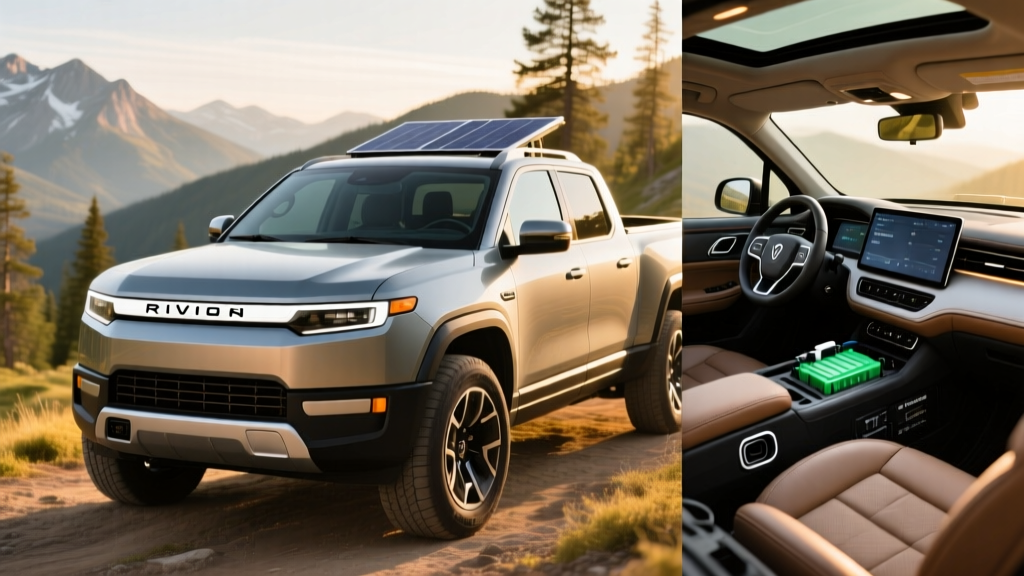
The R1T's 4.5-foot bed is shorter than a traditional full-size truck, but Rivian compensates with the signature Gear Tunnel — a 1.8-meter pass-through compartment behind the rear seats accessible from both sides. This lockable, weatherproof space holds roughly 11 cubic feet and is ideal for camping gear, golf bags, or tool cases you don't want exposed in the bed.
- Bed Volume: 21.7 cu ft (bed floor)
- Frunk (Front Trunk): 11 cu ft, drainable, with a power tonneau
- Rear Legroom: 38.4 inches
- Rear Headroom: 39.6 inches
- Ground Clearance: Up to 14.4 inches (with air suspension at max height)
The cab is a true five-seater, though the middle rear position is best for shorter trips. Interior materials are premium but utilitarian — vegan leather, real wood accents, and a minimalist layout dominated by a 15.6-inch landscape touchscreen running Rivian's in-house OS.
Pricing, Trims, and the Federal Tax Credit Question
Rivian simplified its trim structure for the current generation, offering Adventure and Ascend packages rather than the previous Explore/Adventure split. Pricing below reflects 2026 MSRP before any incentives:
| Configuration | Base MSRP | As-Tested (Typical Options) |
|---|---|---|
| Dual-Motor / Standard Pack / Adventure | $69,900 | $73,000–$76,000 |
| Dual-Motor / Max Pack / Ascend | $82,500 | $87,000–$92,000 |
| Tri-Motor / Max Pack / Ascend | $99,900 | $105,000+ |
| Quad-Motor / Max Pack / Ascend | $115,000 | $120,000+ |
Does the R1T Qualify for the §30D Federal Tax Credit?
This is where a Rivian truck lease becomes strategically interesting. Under current IRS rules (IRS §30D), the federal clean vehicle credit of up to $7,500 requires the buyer to meet adjusted gross income caps ($150,000 single / $300,000 joint), the vehicle must have an MSRP at or below $80,000 for trucks, and the battery must satisfy critical-mineral and component-sourcing thresholds that phase in annually.
For 2026, the Dual-Motor Standard Pack R1T (MSRP $69,900) clears the MSRP cap. However, Rivian's battery sourcing compliance varies by build date and pack chemistry — buyers must verify the specific VIN's eligibility via the IRS portal at fueleconomy.gov before signing. Income-eligible buyers taking delivery of a qualifying VIN can apply the credit as a point-of-sale rebate, reducing the effective purchase price by $7,500.
Here's the lease advantage: under IRS §45W, the commercial clean vehicle credit can apply to vehicles leased through a captive finance arm. The leasing company claims the credit and may (but is not required to) pass the savings through as a capitalized-cost reduction. This "lease loophole" has historically allowed buyers to access credit value on vehicles that would exceed MSRP or income caps if purchased outright. Rivian has offered lease programs through its financing partners, but pass-through of the credit is at the lessor's discretion — always confirm in writing before signing.
Warranty, Reliability, and Ownership Costs
Rivian backs the R1T with a competitive warranty structure:
- Vehicle Limited Warranty: 5 years / 60,000 miles
- Battery & Drive Unit Warranty: 8 years / 175,000 miles (retains ≥70% capacity)
- Roadside Assistance: 5 years / 60,000 miles
The 175,000-mile battery warranty is notably generous compared to the industry-standard 100,000 miles offered by most competitors. Rivian's vertical integration — building its own motors and managing its own battery packs — gives it control over warranty claims, though service-center density remains a concern outside major metro areas. Owners in rural regions may face 100+ mile tow distances to a certified Rivian Service Center, a factor worth weighing if you plan to use the truck for remote work or overlanding.
Driver Assistance and Standout Tech
SAE Automation Level: Level 2
Rivian's Driver+ system is a Level 2 driver-assistance suite. It provides adaptive cruise control, lane-centering, and automatic lane changes on divided highways, but the driver must remain fully engaged with hands on the wheel and eyes on the road at all times. This is not autonomous or "self-driving" capability.
Beyond Driver+, the R1T's software-defined architecture enables over-the-air updates that have materially improved the truck since launch — adding features like enhanced regenerative braking profiles, camp-mode power management, and improved route planning with charge-stop integration. The infotainment system is responsive, supports wireless CarPlay and Android Auto, and includes a built-in Wi-Fi hotspot. One notable drawback: the R1T still lacks native Apple Maps or Google Maps integration for route planning, relying on Rivian's proprietary navigation, which, while improved, occasionally miscalculates charger availability.
Lease vs. Buy: The Economic Case
Why consider a Rivian truck lease instead of purchasing? Three factors drive the math:
- Depreciation Protection: EV depreciation has been volatile. A 36-month lease caps your downside if residual values soften due to battery-tech advances or price competition.
- Tax Credit Access: As noted, the commercial-credit lease pathway may unlock $7,500 in value even for buyers over the §30D income cap or on trims exceeding the MSRP limit.
- Technology Risk: Rivian is developing its second-generation R1 platform with next-gen motors and a potential structural battery pack. A lease lets you upgrade without trading in a depreciated asset.
Lease terms vary by region and creditworthiness. As of early 2026, typical R1T Dual-Motor leases run $850–$1,050/month for 36 months with $5,000–$7,500 due at signing (before any credit pass-through). Compare that to financing at 6.5% APR, where a $73,000 purchase yields roughly $1,150/month over 72 months — and you own an asset that may be worth $45,000–$55,000 at term end.
Rivian R1T vs. Ford F-150 Lightning vs. Chevrolet Silverado EV
| Spec | Rivian R1T Dual-Motor | Ford F-150 Lightning Ext. Range | Chevy Silverado EV 4WT |
|---|---|---|---|
| EPA Range | 270 mi (Std) / 352 mi (Max) | 320 mi | 340 mi (est.) |
| Peak DC Charge | 200–220 kW | 150 kW | 200 kW |
| 0–60 mph | 4.5 sec | 4.5 sec | 5.5 sec |
| Towing Capacity | 11,000 lbs | 10,000 lbs | 10,000 lbs |
| Starting MSRP | $69,900 | $62,995 | $60,900 (est.) |
| Battery Warranty | 8 yr / 175,000 mi | 8 yr / 100,000 mi | 8 yr / 100,000 mi |
The R1T wins on performance, battery warranty, and off-road capability (thanks to air suspension and quad-motor torque vectoring). The Lightning wins on price, dealer-service access, and proven fleet reliability. The Silverado EV offers the longest projected range and a larger bed but trails in refinement and software quality.
Pros
- Class-leading battery warranty (175k miles)
- Gear Tunnel is genuinely useful, not a gimmick
- Quad-Motor acceleration is supercar-fast
- OTA updates add real features post-purchase
- NACS connector provides seamless Supercharger access
Cons
- Service-center coverage is sparse outside major cities
- Short 4.5-foot bed limits traditional truck utility
- Max Pack 10–80% charge takes 42+ minutes
- Proprietary navigation lags behind CarPlay-native options
- High MSRP pushes many trims above §30D credit cap
Who Is the R1T For?
The Rivian R1T is best suited for buyers who want a premium electric truck for weekend adventure, light-to-moderate towing, and daily commuting — not a fleet work truck. If you need a 6.5-foot bed for pallets or a 15,000-pound tow rating, look to the Lightning or a diesel. If you want the most refined EV truck experience with legitimate off-road chops and can accept the service-network trade-off, the R1T is the segment benchmark. A lease structure is particularly attractive for buyers who want to hedge depreciation risk or who may not qualify for the purchase-based tax credit due to income limits.
Frequently Asked Questions
What is the real-world range of the Rivian R1T?
The EPA rates the Standard Pack at 270 miles and the Max Pack at 352 miles. In real-world highway driving at 70 mph, expect 220–240 miles (Standard) and 290–315 miles (Max). Cold weather below freezing reduces these figures by 20–30%.
How fast does the R1T charge at home and on DC fast chargers?
On a DC fast charger, the Standard Pack reaches 10–80% in about 30 minutes (200 kW peak); the Max Pack takes roughly 42 minutes (220 kW peak). At home on a Level 2 11.5 kW charger, expect 16 miles of range per hour (Standard) or 25 miles per hour (Max).
How much does the R1T cost after the federal tax credit?
If your VIN qualifies under §30D and you meet income requirements, the Dual-Motor Standard Pack drops from $69,900 to an effective $62,400. Via a qualifying lease, the commercial credit may apply even if you exceed income caps — confirm pass-through with the lessor before signing.
Is the R1T worth it versus the Ford F-150 Lightning?
If you prioritize performance, off-road capability, battery warranty, and software sophistication, yes — the R1T is the more refined vehicle. If you prioritize lower cost, dealer service access, and a larger bed, the Lightning is the pragmatic choice.
Does the Rivian R1T qualify for the federal EV tax credit?
The Dual-Motor Standard Pack (MSRP $69,900) meets the $80,000 truck MSRP cap. Eligibility depends on your income (≤$150k single / ≤$300k joint) and the specific VIN's battery-sourcing compliance. Verify at fueleconomy.gov before committing.
Can I tow with the R1T without destroying range?
You can tow up to 11,000 pounds, but expect a 40–50% range reduction at maximum trailer weight. Plan charging stops accordingly — a Max Pack towing at highway speed may deliver only 170–190 miles between charges.