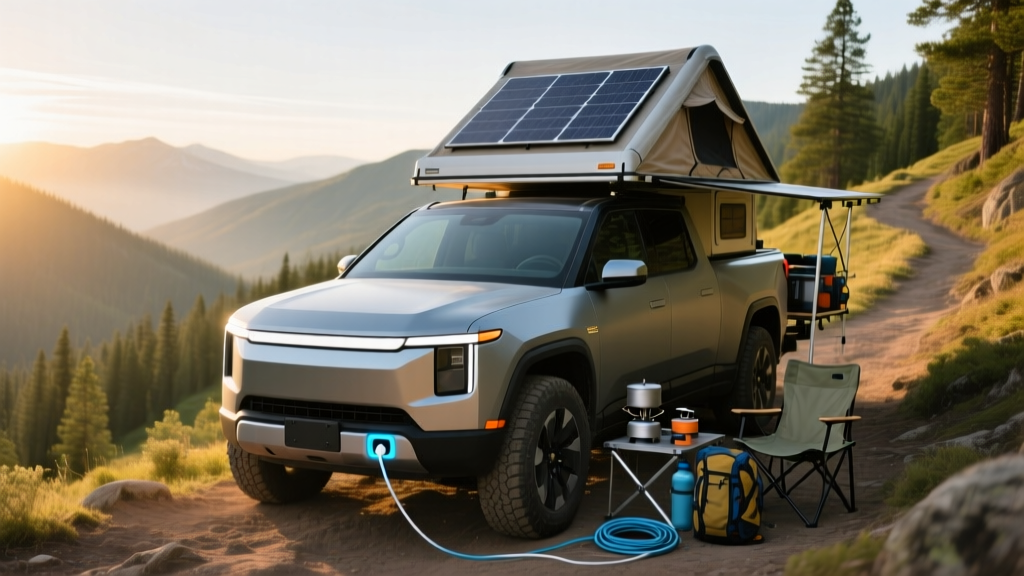
The Rivian R1T occupies a rare intersection in the EV market: a full-size electric pickup that doubles as a credible overlanding and truck-camper platform. For 2026, the R1T continues to attract buyers who want a daily driver that can also serve as the base for a truck camper, rooftop tent, or slide-in rig on weekend trips. But bolting a camper onto an electric truck changes the efficiency math in ways most spec sheets ignore.
This review covers the 2026 Rivian R1T through the lens of someone considering a truck camper setup — evaluating real-world range under load, charging logistics on remote trails, payload and bed constraints, and whether the federal tax credit still applies. We'll also compare it to the few alternatives that exist in the electric truck-camper space.
2026 Rivian R1T: Core Specs at a Glance
| Specification | R1T Dual-Motor (Standard) | R1T Dual-Motor (Max Pack) | R1T Tri-Motor |
|---|---|---|---|
| EPA Range | 270 mi | 420 mi | 420 mi |
| Battery Capacity (usable) | 92 kWh (LFP) | 149 kWh (NMC) | 149 kWh (NMC) |
| Max DC Fast Charge | 200 kW | 220 kW | 220 kW |
| 10–80% DC Charge Time | ~30 min | ~42 min | ~42 min |
| Level 2 Home Charging | 11.5 kW (~25 mi/hr) | 11.5 kW (~31 mi/hr) | 11.5 kW (~31 mi/hr) |
| Horsepower | 533 hp | 533 hp | 850 hp |
| 0–60 mph | 4.5 sec | 4.5 sec | 2.9 sec |
| Drivetrain | AWD (dual-motor) | AWD (dual-motor) | AWD (tri-motor) |
| Max Towing | 11,000 lb | 11,000 lb | 11,000 lb |
| Payload Capacity | ~1,760 lb | ~1,760 lb | ~1,760 lb |
| Bed Length | 4.5 ft (54 in) | 4.5 ft (54 in) | 4.5 ft (54 in) |
| Efficiency (EPA) | 73 MPGe / 46 kWh/100mi | 78 MPGe / 43 kWh/100mi | 70 MPGe / 48 kWh/100mi |
| Battery Warranty | 8 yr / 175,000 mi | 8 yr / 175,000 mi | 8 yr / 175,000 mi |
| Base MSRP | $69,900 | $83,900 | $99,900 |
Sources: EPA / fueleconomy.gov, Rivian official specs.
Real-World Range: What Happens With a Camper on Top
EPA sticker (Max Pack): 420 miles
Real-world highway (unloaded, 70 mph): ~330–350 miles
Real-world with truck camper / rooftop tent (highway, 65 mph): ~240–280 miles
Cold weather (below 32°F) with camper: ~190–230 miles
Range loss of 25–40% is typical when adding a camper shell, rooftop tent, or loaded bed rack to any EV pickup. Aerodynamic drag is the primary culprit at highway speeds.
The R1T's 420-mile Max Pack EPA figure is genuinely class-leading among electric pickups. But the EPA test cycle doesn't account for the 400–800 lb of a hard-shell camper, roof-top tent, or slide-in unit — or the significant increase in frontal area and drag coefficient that a camper creates.
In real-world overlanding conditions — loaded bed, all-terrain tires, 65–70 mph highway cruising — expect to lose roughly 30% of your EPA range. That brings a Max Pack R1T down to approximately 270–290 miles of practical range. For the Standard battery, that drops to roughly 180–200 miles, which makes remote overlanding considerably more challenging.
Cold weather compounds this further. Lithium-ion batteries lose efficiency below freezing, and cabin heating draws substantial power. Rivian's heat pump (standard on 2026 models) helps mitigate this, but plan for an additional 15–20% reduction in sub-freezing temperatures.
The practical takeaway: If overlanding and truck-camper use is a priority, the Max Pack (149 kWh NMC) is essentially mandatory. The Standard pack's ~180-mile loaded range creates genuine range limitations on remote forest roads where charging infrastructure is sparse or nonexistent.
Charging the R1T on the Road and at Camp
| Charging Level | Power (kW) | Miles Added per Hour | Typical Use Case |
|---|---|---|---|
| Level 1 (120V outlet) | ~1.4 kW | ~3 mi/hr | Emergency / campsite trickle |
| Level 2 (240V, 48A) | 11.5 kW | ~25–31 mi/hr | Home garage, RV parks, campgrounds |
| DC Fast Charge (peak) | 200–220 kW | ~700+ mi/hr (at peak) | Highway stops, Rivian Adventure Network |
DC Fast Charging: The Curve Matters
Rivian's Max Pack peaks at 220 kW on DC fast chargers, but that peak only holds between roughly 10–35% State of Charge (SoC). Above 50%, the charge rate tapers significantly — by 80%, you're typically seeing 60–80 kW. This is why the 10–80% time is ~42 minutes rather than the ~20 minutes a sustained 220 kW rate would suggest.
For truck-camper trips, this means planning 35–45 minute charging stops every 200–250 miles when loaded. The Rivian Adventure Network continues to expand, with chargers positioned near national parks and outdoor recreation areas — a genuine advantage for overlanders over relying solely on Electrify America or EVgo stations in highway corridors.
Campsite Charging Realities
Most established campgrounds and RV parks offer 240V / 50A (NEMA 14-50) outlets, which deliver roughly 11.5 kW to the R1T — adding about 25–31 miles of range per hour. An overnight stay (8–10 hours) can replenish 200–300 miles, which is often sufficient for next-day exploration.
The R1T ships with a portable charger that supports both 120V and 240V outlets. On a standard 120V campsite outlet, you'll gain roughly 3 miles per hour — enough to prevent stranding, but not enough to meaningfully recharge the Max Pack's 149 kWh battery in a single night.
Payload, Bed, and Camper Compatibility
The R1T's defining constraint as a truck-camper platform is its 4.5-foot (54-inch) bed. This is significantly shorter than the 5.5- or 6.5-foot beds found on midsize gas pickups like the Tacoma or Ranger, and it rules out most traditional slide-in truck campers designed for full-size beds.
What works with the R1T bed:
- Rooftop tents: The R1T's roof rack system (optional Gear Tunnel and Roof Rails) supports rooftop tents rated to ~165 lb dynamic / 660 lb static load. This is the most popular camper setup among R1T owners.
- Compact hard-shell campers: A handful of manufacturers (e.g., Scout Campers, AT Overland) make sub-1,000 lb, short-bed campers that physically fit the 54-inch bed. Verify the unit's dry weight stays well under the ~1,760 lb payload limit once you add water, gear, and passengers.
- Bed-rack + ground tent setups: Many overlanders use the R1T's integrated bed-rack channels to mount a platform for gear, sleeping on a ground tent or tailgate tent below.
- Gear Tunnel: The R1T's unique Gear Tunnel (a pass-through storage compartment between the cab and bed) adds ~11 cu ft of lockable, weather-sealed storage — useful for camping gear that doesn't need bed access.
What does NOT work:
- Standard full-size slide-in truck campers (designed for 6.5–8 ft beds)
- Heavy campers exceeding payload (water weighs 8.3 lb/gallon — a 20-gallon tank adds 166 lb)
- Any setup that blocks access to the NACS charge port (driver-side rear quarter panel)
Cargo and Interior Space
Inside, the R1T seats five with 41.4 inches of front legroom and 38.3 inches of rear legroom — competitive with midsize pickups. Behind the rear seats, you get roughly 28 cu ft of enclosed cabin storage. The 11-cu-ft front trunk (frunk) is sealed and drainable — ideal for ice, wet gear, or a cooler on camping trips.
Pricing, Trims, and Federal Tax Credit Eligibility
| Trim / Configuration | Base MSRP | Est. After §30D Credit | Credit Eligible? |
|---|---|---|---|
| R1T Dual-Motor (Standard, LFP) | $69,900 | ~$62,400 | Yes (up to $7,500), subject to income & sourcing rules |
| R1T Dual-Motor (Max Pack, NMC) | $83,900 | ~$83,900 | Likely ineligible — MSRP exceeds $80,000 truck cap |
| R1T Tri-Motor (Max Pack, NMC) | $99,900 | ~$99,900 | Ineligible — MSRP exceeds $80,000 truck cap |
Critical tax credit caveat: Under IRS §30D rules, the federal clean vehicle credit for new trucks is capped at vehicles with an MSRP of $80,000 or less. This means only the Standard-battery Dual-Motor R1T qualifies — and only if the buyer meets income thresholds ($150,000 single / $300,000 joint filing). Battery critical-mineral and component sourcing requirements also apply and change annually. The credit can now be transferred to the dealer at point of sale, effectively reducing the purchase price upfront.
For truck-camper buyers, this creates an awkward trade-off: the Standard pack gets the $7,500 credit but offers insufficient loaded range for serious overlanding. The Max Pack delivers the range you need but costs $83,900+ and falls outside the credit.
Performance, Drivetrain, and Off-Road Capability
The R1T Dual-Motor produces 533 hp and 610 lb-ft of torque, hitting 0–60 mph in 4.5 seconds — quick for any pickup, and remarkably so for one carrying a camper. The Tri-Motor variant's 850 hp and 2.9-second 0–60 time is supercar territory, though the range penalty and $99,900 price make it hard to justify for overlanding use.
All R1T trims feature standard AWD with independent torque vectoring per axle. The available air suspension provides up to 14.9 inches of ground clearance in Off-Road mode — more than a Ford F-150 Raptor — and the quad-motor torque control enables tank turns (on Tri-Motor) for tight trail maneuvers.
For truck-camper use, the R1T's 11,000-lb towing capacity is robust, though towing a trailer on top of a loaded camper setup would further erode range. Most overlanders will rely on the bed and roof rather than towing.
Tech, Driver Assistance, and Notable Drawbacks
Standout Features
- 15.6-inch center touchscreen with built-in trail maps and Rivian's Waypoints navigation (points of interest including charging, campsites, and trails)
- Rivian Driver+ (SAE Level 2): hands-on-wheel highway assist with automatic lane changes — useful on long drives to a campsite, but requires continuous driver supervision
- Over-the-air updates that have added features like Enhanced Off-Road mode and improved range estimation
- Vehicle-to-load (V2L) capability: The R1T can power external devices (camp lights, laptops, small appliances) via its bed outlet and cabin outlets — a genuine advantage over gas trucks for campsite power
- Camp Mode: Maintains cabin climate control while parked, using the traction battery — useful for sleeping in the truck during extreme temperatures
Notable Drawbacks for Camper Use
- Short bed (4.5 ft) limits slide-in camper options to a very small market segment
- No rear windshield — the R1T uses a camera-based digital rearview mirror, which some drivers find disorienting, especially with a camper blocking the rear
- Service center availability remains limited outside major metro areas — a breakdown on a remote trail could mean a long flatbed tow
- Insurance costs run 15–30% higher than comparable gas pickups, per industry data
- No spare tire from the factory (a tire-inflator kit is included); an aftermarket spare-tire mount is available but eats into bed or rack space
Pros
- Class-leading 420-mile Max Pack range (EPA)
- Genuine off-road capability with 14.9 in ground clearance
- V2L campsite power eliminates generator need
- Rivian Adventure Network targets outdoor destinations
- Standard-battery model qualifies for $7,500 federal credit
- Quick 200–220 kW DC fast charging
Cons
- 4.5-ft bed severely limits slide-in camper compatibility
- Max Pack (needed for overlanding) exceeds tax-credit MSRP cap
- Loaded range drops 25–40% with camper setup
- No factory spare tire
- Limited service-center footprint in rural/remote areas
- High insurance premiums
Who Should Buy the R1T as a Truck Camper Platform?
The R1T excels for: Weekend overlanders who prioritize rooftop tents or compact hard-shell campers, value V2L campsite power, and plan routes around the Rivian Adventure Network or established campgrounds with 240V access. The Max Pack's 420-mile EPA range provides a genuine buffer for remote exploration — even with a 30% loaded-range penalty, you're looking at ~280 practical miles.
Look elsewhere if: You need a full-size slide-in truck camper (the 4.5-ft bed won't accommodate one), you overland in extreme cold where range loss compounds, or you need a truck with a robust rural dealer/service network. The Ford F-150 Lightning (5.5-ft bed, wider service network) or a gas-powered midsize pickup remain more practical for traditional truck-camper setups.
Frequently Asked Questions
What is the real-world range of the Rivian R1T with a truck camper?
With a loaded rooftop tent or compact camper shell, expect approximately 240–280 miles from the Max Pack (420-mi EPA) and 180–200 miles from the Standard pack (270-mi EPA) at highway speeds. Cold weather can reduce this further by 15–20%.
How fast does the R1T charge on DC fast chargers and at home?
The Max Pack peaks at 220 kW DC, achieving a 10–80% charge in approximately 42 minutes. The Standard pack peaks at 200 kW with a ~30-minute 10–80% time. At home on a Level 2 (240V / 48A) charger, both packs charge at 11.5 kW, adding roughly 25–31 miles of range per hour.
Does the Rivian R1T qualify for the $7,500 federal EV tax credit?
Only the Standard-battery Dual-Motor R1T at $69,900 MSRP qualifies, because the §30D truck MSRP cap is $80,000. The Max Pack ($83,900) and Tri-Motor ($99,900) exceed this cap. Buyer income limits ($150K single / $300K joint) and battery-sourcing requirements also apply. Consult the IRS §30D guidance or a tax professional for your specific eligibility.
Can I put a slide-in truck camper on the Rivian R1T?
The R1T's 4.5-foot (54-inch) bed is too short for most conventional slide-in truck campers, which are designed for 6.5–8 ft beds. A small number of ultra-compact, short-bed-specific campers (e.g., from Scout Campers) may fit, but options are extremely limited. Rooftop tents and bed-rack tent setups are far more common R1T camper solutions.
Is the R1T worth buying vs. the Ford F-150 Lightning for camping?
The R1T offers superior off-road capability (14.9 in ground clearance, air suspension), more EPA range with the Max Pack (420 vs. 320 mi), and the Rivian Adventure Network's outdoor-focused charger placement. The F-150 Lightning has a longer 5.5-ft bed (better for campers), Pro Power Onboard for campsite electricity, and a much larger dealer/service network. If bed length and service access matter more than trail capability, the Lightning may be the better truck-camper platform.
What is the R1T's battery warranty?
Rivian covers the R1T battery pack and drive unit for 8 years or 175,000 miles, whichever comes first. The warranty guarantees the battery will retain at least 70% of its original capacity during that period — consistent with industry norms for EV battery coverage.