The Rivian R1T occupies a rare niche: a crew-cab electric pickup with the footprint of a midsize truck and the payload flexibility to swallow gear that larger trucks handle with ease. For buyers researching the R1T, one question consistently surfaces — what are the actual Rivian truck bed dimensions, and how do they translate to real-world hauling? This review breaks down the bed specs alongside the full ownership picture: range, charging, pricing, and where the R1T lands against the Ford F-150 Lightning and Chevrolet Silverado EV.
Rivian R1T Truck Bed Dimensions: What You Actually Get
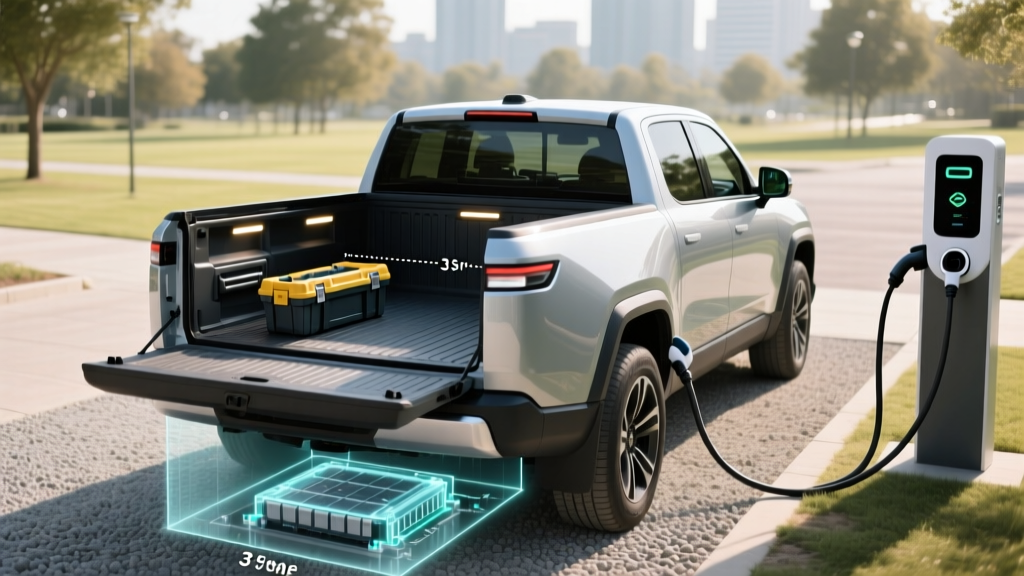
The R1T's bed is shorter than a traditional midsize pickup but gains versatility from the Gear Tunnel — a 14-cubic-foot pass-through storage compartment behind the cab that opens on both sides of the truck. Here are the exact measurements for the 2025/2026 model year:
| Measurement | Specification |
|---|---|
| Bed length (tailgate closed) | 54.5 inches |
| Bed length (tailgate open/down) | 82.6 inches |
| Bed width (between wheel wells) | 50.6 inches |
| Bed width (max at floor) | 58.2 inches |
| Bed depth | 22.2 inches |
| Bed volume (tailgate closed) | 33.9 cu ft |
| Gear Tunnel volume | 14.0 cu ft |
| Frunk (front trunk) | 11.0 cu ft |
| Max payload capacity | 1,764 lbs |
| Max towing capacity | 11,000 lbs |
The 54.5-inch closed bed won't fit a standard 4×8 sheet of plywood flat — you'll need the tailgate down for that, where the 82.6-inch length accommodates it. The Gear Tunnel is where the R1T differentiates itself: it's ideal for stowing golf bags, camping gear, tools, or groceries in a lockable, weather-sealed space that doesn't eat into bed length. Rivian sells a Gear Tunnel Shuttle (a sliding cargo tray) and camp kitchen modules that leverage this space.
For context, a Ford F-150 Lightning with the 5.5-foot bed offers roughly 52.8 inches of closed bed length but a full 67.1-inch option. The Silverado EV's bed stretches to 72 inches with its Multi-Flex midgate folded. The R1T trades raw bed length for overall vehicle compactness and the Gear Tunnel's bonus storage.
EPA Range and Real-World Expectations
The R1T is offered with three battery packs for 2025/2026, spanning Standard, Large, and Max configurations. Range varies significantly by pack size, motor configuration, and wheel selection.
The R1T Max Pack (Dual-Motor) carries an EPA-estimated 420 miles of range. In real-world highway driving at 70-75 mph, expect approximately 330-360 miles due to aerodynamic drag at speed. In cold weather (below 30°F), range can drop an additional 15-25%, putting a Max Pack R1T at roughly 270-310 miles on a winter road trip. Standard Pack models (EPA ~270 mi) should plan for stops at 200-220 miles in mixed driving.
| Pack | Usable Capacity (kWh) | Chemistry | Motor Config | EPA Range |
|---|---|---|---|---|
| Standard | ~92 kWh | LFP | Dual-Motor AWD | 270 mi |
| Large | ~128 kWh | NMC | Dual-Motor AWD | 352 mi |
| Max | ~149 kWh | NMC | Dual-Motor AWD | 420 mi |
| Large (Tri-Motor) | ~128 kWh | NMC | Tri-Motor AWD | 328 mi |
| Max (Quad-Motor) | ~149 kWh | NMC | Quad-Motor AWD | 371 mi |
The Standard Pack uses LFP (lithium iron phosphate) chemistry — heavier and lower energy density, but more durable over thousands of charge cycles and less reliant on cobalt/nickel. Rivian recommends charging LFP to 100% regularly. The Large and Max packs use NMC (nickel manganese cobalt) for higher energy density; daily charging to 80-90% is recommended for longevity.
Efficiency on the Dual-Motor Large Pack rates at approximately 73 MPGe combined (about 46 kWh/100 miles) per fueleconomy.gov. The Quad-Motor's added weight and power drop efficiency to roughly 65 MPGe. These figures are typical for a 7,000+ lb electric pickup — if efficiency is your priority, a smaller EV SUV will outperform.
Charging Speed: DC Fast, Level 2, and Home Setup
Charging speed is critical for truck buyers planning road trips or towing. The R1T's architecture supports competitive DC fast-charging, though it doesn't match the Hyundai Ioniq 5's 800V ultra-fast rates.
| Charging Type | Rate | Time / Notes |
|---|---|---|
| DC Fast Charge (Max) | Peak 200 kW | 10-80% in ~30 min (Large Pack); charge curve tapers above 80% |
| DC Fast Charge (Standard LFP) | Peak 165 kW | 10-80% in ~33 min |
| Level 2 (Home/Public AC) | 11.5 kW (48A) | ~25 mi/hr; full charge in 10-14 hrs depending on pack |
| Level 1 (120V outlet) | 1.4 kW (12A) | ~3 mi/hr; emergency/trickle only |
| Connector | NACS (Tesla Supercharger native on 2025+ models; CCS adapter available for older units) | |
At a DC fast charger, the R1T peaks at 200 kW but doesn't sustain that rate across the full curve. Expect peak speeds between 15-50% SoC, with a taper starting around 60% and significant slowdown above 85%. On a road trip, the practical routine is charging from 10-80% in about 30 minutes — adding roughly 220-250 miles of range on a Large Pack — then moving on rather than waiting for the slow final 20%.
For home charging, a Level 2 wall connector at 11.5 kW (48 amps on a 60A circuit) adds about 25 miles of range per hour. A Standard Pack R1T charges fully overnight in roughly 9 hours; a Max Pack takes 13-14 hours. If you're installing a home charger, budget $800-$2,000 for a quality Level 2 unit plus $500-$2,500 for electrician installation (panel upgrade may add $1,500-$3,000 if your service panel needs to go from 100A to 200A). Always consult a licensed electrician for final specifications.
Performance: 0-60, Horsepower, and Drivetrain Options
The R1T's electric powertrain delivers acceleration that defies its truck identity. Here's the performance breakdown by configuration:
| Configuration | Horsepower | Torque (lb-ft) | 0-60 mph | Drivetrain |
|---|---|---|---|---|
| Dual-Motor AWD | 533 hp | 610 | 4.5 sec | AWD (2 motors) |
| Performance Dual-Motor | 665 hp | 827 | 3.4 sec | AWD (2 motors) |
| Tri-Motor AWD | 850 hp | 1,103 | 2.9 sec (est.) | AWD (3 motors) |
| Quad-Motor AWD | 1,025 hp | 1,198 | 2.5 sec | AWD (4 independent motors) |
The Quad-Motor's 2.5-second 0-60 makes it one of the quickest production trucks ever built, rivaling supercars. But most buyers will find the Dual-Motor (533 hp) or Performance Dual-Motor (665 hp) more than adequate — and they gain range over the heavier multi-motor configs. All configurations feature true AWD with torque vectoring, and the Quad-Motor enables tank turns (rotating the truck in place by spinning left and right wheels in opposite directions).
Ground clearance is adjustable via air suspension: 7.9 inches in Standard mode up to 14.9 inches in Max mode for off-road use. The R1T can ford up to 36 inches of water. Approach, departure, and breakover angles are competitive with body-on-frame off-roaders when the suspension is raised.
Pricing, Trim Levels, and Federal Tax Credit
Rivian simplified its trim structure for 2025-2026, moving from Launch/Adventure/Explore editions to a cleaner lineup. Pricing below reflects the current model year as listed on Rivian's official site:
| Configuration | Base MSRP | As-Tested Range | §30D Credit Eligible? |
|---|---|---|---|
| Dual-Motor Standard Pack | $69,900 | $69,900 - $74,000 | Yes (if under MSRP & income caps) |
| Dual-Motor Large Pack | $75,900 | $75,900 - $82,000 | Yes (trucks cap at $80,000 MSRP) |
| Dual-Motor Max Pack | $85,900 | $85,900 - $94,000 | No (exceeds $80K MSRP cap) |
| Tri-Motor Large Pack | $89,900 | $89,900 - $97,000 | No (exceeds $80K MSRP cap) |
| Quad-Motor Max Pack | $99,900 | $99,900 - $110,000+ | No (exceeds $80K MSRP cap) |
- MSRP cap: Trucks/vans/SUVs must be ≤ $80,000 MSRP. The Dual-Motor Standard and Large Pack configurations qualify; Max, Tri-Motor, and Quad-Motor exceed the cap.
- Buyer income limits: AGI ≤ $150,000 (single), $225,000 (head of household), $300,000 (joint). Check your tax situation — if you exceed these, no credit.
- Battery sourcing: Critical minerals and battery components must meet escalating domestic-content thresholds. Rivian has worked to qualify; verify current-year status on IRS.gov §30D page.
- Point-of-sale transfer: You can transfer the credit to the dealer at purchase for an immediate price reduction rather than claiming it on your tax return.
- Final assembly: Must occur in North America (Rivian assembles in Normal, Illinois — qualifies).
The sweet spot for tax-credit-eligible buyers is the Dual-Motor Large Pack at $75,900. With a full $7,500 credit (if all sourcing and income requirements are met), the effective price drops to approximately $68,400 — competitive with a well-equipped F-150 Lightning Lariat. Always confirm eligibility with a tax professional before purchasing, as sourcing rules and credit availability can shift.
Interior, Technology, and Driver Assistance
The R1T seats five passengers in a crew-cab layout with generous space:
| Measurement | Specification |
|---|---|
| Front headroom | 40.8 in |
| Front legroom | 41.3 in |
| Rear headroom | 38.5 in |
| Rear legroom | 37.3 in |
| Infotainment screen | 15.6-inch center touchscreen |
| Driver display | 12.3-inch digital cluster |
Rivian's infotainment system is proprietary and receives over-the-air (OTA) updates regularly. It includes native navigation with route planning that factors in charging stops, elevation changes, and weather. Apple CarPlay and Android Auto are not supported — a deliberate choice by Rivian that frustrates some buyers who prefer phone mirroring. The system is capable but a learning curve for smartphone-projection loyalists.
Driver assistance falls under Rivian's Driver+ suite, which includes adaptive cruise control with stop-and-go, lane centering, automatic emergency braking, and blind-spot monitoring. This is an SAE Level 2 system — the driver must remain attentive with hands on or near the wheel at all times. It is not self-driving. Rivian has been developing a more advanced hands-free highway assist feature, but as of 2026, the production system requires active supervision.
Unique tech features include:
- Powered tonneau cover (available) that retracts into the bed front wall
- Integrated air compressor in the bed for tire inflation or gear
- Camp Kitchen module (accessory) that slides from the Gear Tunnel with a two-burner induction stove and sink
- Vehicle-to-load (V2L) capability via bed-mounted 120V outlets (up to 2.4 kW continuous)
- Gear Guard cable lock system with bed cameras that monitor cargo
Pros, Cons, and Ownership Costs
Pros
- Gear Tunnel adds 14 cu ft of secure, weather-sealed storage no competitor offers
- Up to 420 mi EPA range (Max Pack) is class-leading for electric pickups
- Quad-Motor performance (2.5s 0-60) is extraordinary for a truck
- Air suspension with 14.9 in max ground clearance and 36 in water fording
- 11,000 lb towing capacity covers most trailers, boats, and campers
- OTA updates continuously improve the vehicle post-purchase
- North American assembly qualifies for §30D credit (eligible configs)
Cons
- 54.5-inch bed (closed) is shorter than most midsize and full-size pickups
- No Apple CarPlay or Android Auto
- Efficiency (~46 kWh/100 mi) is low — expensive to charge on long road trips
- Max, Tri-Motor, and Quad-Motor exceed the $80K §30D MSRP cap
- Insurance premiums run 15-30% higher than comparable gas trucks
- Towing drastically reduces range — expect 150-200 mi at highway speeds with a heavy trailer
- Service center network still expanding — some owners face long wait times for repairs
Warranty coverage: Rivian provides a 5-year/60,000-mile bumper-to-bumper warranty and an 8-year/120,000-mile battery and drive unit warranty. The battery warranty guarantees the pack will retain at least 70% of its original capacity during the coverage period — consistent with industry norms. Rivian also covers the Gear Tunnel and powered tonneau under the base warranty.
5-year estimated cost of ownership (Dual-Motor Large Pack, 15,000 mi/yr, home charging at $0.14/kWh): approximately $6,200 in electricity over 75,000 miles. A comparable gas truck at 18 MPG and $3.50/gal would spend roughly $14,600 on fuel — an $8,400 fuel savings. Factor in higher insurance (~$2,800/yr vs ~$1,900/yr for a gas midsize), no oil changes, and reduced brake wear from regen, and the R1T breaks even with a loaded F-150 or Tacoma around year 4-5, before any tax credit.
Who Should Buy the Rivian R1T?
- You want an electric truck for daily driving with weekend adventure capability (camping, skiing, biking)
- Gear Tunnel storage solves a real cargo problem for you (long items, secure gear storage)
- You have home Level 2 charging and drive under 350 miles daily
- You value performance and tech as much as utility
- You tow a camper or boat under 8,000 lbs on trips under 150 miles each way
- You need a full 6+ foot bed for commercial work or frequent lumber/drywall hauling
- You tow heavy trailers (>8,000 lbs) long distances — range drops severely
- You rely on Apple CarPlay/Android Auto for infotainment
- Budget is under $65,000 (even the base R1T starts at $69,900)
- You live in a region with limited Rivian service centers and no DC fast-charging corridor
Frequently Asked Questions
Can a 4×8 sheet of plywood fit in the Rivian R1T bed?
Not with the tailgate closed (54.5 inches). With the tailgate down, the bed extends to 82.6 inches — enough for a 4×8 sheet (96 inches long) to rest at an angle on the closed tailgate, or flat if you use bed extenders. It's workable but not as seamless as a 6.5-foot or 8-foot full-size truck bed.
What is the real-world range when towing with the R1T?
Towing a 5,000-7,000 lb trailer at highway speeds typically cuts range by 40-55%. A Large Pack R1T (352 mi EPA) will deliver roughly 160-200 real-world miles while towing. Plan charging stops accordingly — this is the R1T's most significant limitation for long-haul towing.
Does the Rivian R1T qualify for the $7,500 federal tax credit in 2026?
The Dual-Motor Standard ($69,900) and Dual-Motor Large ($75,900) configurations fall under the $80,000 truck MSRP cap and are potentially eligible for the full $7,500 credit — assuming you meet income limits (≤$150K single, ≤$300K joint), battery sourcing requirements are satisfied, and final assembly is in North America (it is). Max, Tri-Motor, and Quad-Motor models exceed the MSRP cap and do not qualify. Verify current-year rules on IRS.gov and consult a tax professional.
How does the R1T compare to the Ford F-150 Lightning?
The F-150 Lightning offers a larger bed (67.1 in extended-range bed options), a lower starting price (~$55,000 base), and broader Ford dealer service access. The R1T counters with the Gear Tunnel, superior off-road capability (air suspension, 14.9 in clearance), faster acceleration, and higher max range (420 vs 320 mi). The Lightning is the pragmatic work truck; the R1T is the adventure-lifestyle premium truck.
Is the R1T reliable enough for a daily driver?
Rivian's build quality has improved significantly since the 2022 launch. Early models had software glitches and panel-gap issues; 2025-2026 models show marked improvement. The electric powertrain has far fewer moving parts than a gas truck (no transmission, no oil, no exhaust). The main risk is service access — Rivian's service center network is growing but doesn't match legacy automaker coverage in rural areas. For urban/suburban daily driving with home charging, owners report high satisfaction.
What charger does the R1T use — NACS or CCS?
2025 and newer R1T models ship with the NACS (North American Charging Standard) port natively, giving direct access to Tesla Superchargers (the largest fast-charging network in the US). Older R1T models with CCS can use a Rivian-provided NACS adapter. For Level 2 home charging, the R1T uses a standard J1772 connector (or NACS, depending on model year).