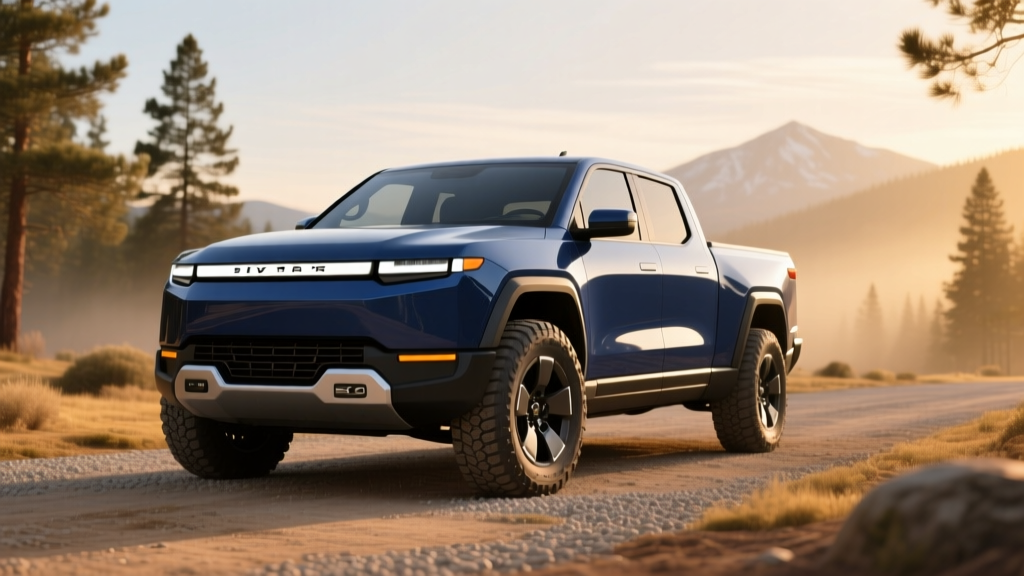
If you're eyeing a Rivian R1T and wondering how to fund it, one of the first questions is practical: does Rivian take trade-ins? The short answer is yes — Rivian accepts trade-in vehicles as part of the purchase process for both the R1T truck and R1S SUV. You can submit your trade-in details through your Rivian account during the configuration and checkout flow, and Rivian partners with industry appraisal tools to generate offers. However, as we'll cover in this review, the trade-in value is just one piece of a larger ownership equation that includes EPA range, charging speed, federal tax credit eligibility, and long-term battery health.
Below, we break down the 2026 Rivian R1T Dual-Motor with the Standard and Max battery packs — the two configurations most buyers cross-shop — with exact numbers on range, charging, performance, and pricing. This is the data you need to decide whether the R1T earns a spot in your driveway.
2026 Rivian R1T at a Glance: Core Specifications
| Spec | Dual-Motor Standard | Dual-Motor Max |
|---|---|---|
| EPA Range | 270 miles | 420 miles |
| Battery (usable) | ~95 kWh (NMC) | ~141 kWh (NMC) |
| Horsepower | 533 hp | 533 hp |
| 0–60 mph | 4.5 seconds | 4.5 seconds |
| Drivetrain | AWD (dual-motor) | AWD (dual-motor) |
| Max DC Fast Charge | 200 kW | 220 kW |
| 10–80% DCFC Time | ~28 minutes | ~42 minutes |
| Level 2 Home Charging | 11.5 kW (~25 mi/hr) | 11.5 kW (~25 mi/hr) |
| MPGe (combined) | 70 MPGe | 73 MPGe |
| Efficiency | 48 kWh/100 mi | 46 kWh/100 mi |
| Towing Capacity | 11,000 lbs | 11,000 lbs |
| Base MSRP | $69,900 | $83,900 |
| Battery Warranty | 8 yr / 175,000 mi | 8 yr / 175,000 mi |
Real-World Range: What the EPA Sticker Doesn't Tell You
EPA Estimated: 270 mi (Standard) / 420 mi (Max)
Real-World Expectation: Highway cruising at 70–75 mph typically yields 230–250 mi on the Standard pack and 350–380 mi on the Max pack. In cold weather (below 32°F), expect a 15–25% reduction, bringing the Standard pack down to roughly 200–215 mi and the Max to around 290–320 mi. Towing a 5,000-lb trailer can cut range by 40–50%.
The R1T's boxy truck profile creates meaningful aerodynamic drag at highway speeds, which is why real-world highway efficiency falls noticeably below the EPA combined cycle. Rivian's heat pump helps mitigate cold-weather losses compared to resistive heating systems, but the physics of a 7,100-lb vehicle moving through dense winter air still dominate. For daily commuting under 50 miles round-trip, even the Standard pack provides ample buffer with home charging overnight.
According to EPA data on fueleconomy.gov, the R1T Dual-Motor Max achieves 73 MPGe combined, translating to 46 kWh per 100 miles — competitive with full-size electric trucks but thirstier than smaller crossovers like the Hyundai Ioniq 5.
Charging Speed: DC Fast Charging and Home Level 2
| Charging Level | Standard Pack | Max Pack | Notes |
|---|---|---|---|
| Level 1 (120V / 12A) | ~1.4 kW — ~3 mi/hr | ~1.4 kW — ~3 mi/hr | Emergency/trickle only |
| Level 2 (240V / 48A) | 11.5 kW — ~25 mi/hr | 11.5 kW — ~25 mi/hr | Full charge overnight (~10 hrs Max) |
| DC Fast Charge (peak) | 200 kW | 220 kW | Peak rate, not sustained |
| DCFC 10–80% | ~28 min | ~42 min | Ideal conditions, preconditioned |
Rivian uses the NACS (North American Charging Standard) connector on 2026 models, granting native access to Tesla Supercharger V3 and V4 stations without an adapter. This is a significant practical advantage over CCS-only trucks when traveling through areas where Supercharger coverage dominates.
A critical nuance: the peak kW rating is not sustained. The R1T Max Pack may hit 220 kW briefly around 15–25% state of charge, but the charge curve tapers significantly above 60% SoC. A 10–80% session on a 350 kW Electrify America or Tesla V4 station will average closer to 130–150 kW across the full session. Always precondition the battery via the navigation system before arriving at a DC fast charger — skipping this step can add 10–15 minutes to your charge time, especially in cold weather.
For home Level 2 charging, Rivian recommends a 60-amp circuit with a 48-amp Wall Connector or equivalent hardwired EVSE. Expect installation costs of $500–$2,000 depending on your panel's proximity to the garage and whether a panel upgrade (to 200A service) is needed.
How Rivian's Trade-In Program Works
Rivian's trade-in process is integrated into the digital purchase flow. Here's how it functions in practice:
- Configure your R1T or R1S on Rivian's website and proceed to the order/checkout stage.
- Submit trade-in details — year, make, model, mileage, VIN, condition, and photos. Rivian uses a third-party valuation partner (similar to Kelley Blue Book Instant Cash Offer) to generate an offer.
- Review the offer — typically valid for 7 days or 500 miles. You can accept or decline; there's no obligation.
- Apply the trade-in value as a down payment reduction on your Rivian purchase, reducing the financed amount.
- Deliver the trade-in at your Rivian delivery appointment or Service Center.
Trade-in offers tend to be competitive with wholesale auction values but may come in below private-party sale prices. If you're trading in a conventional ICE truck (like an F-150 or Tacoma), you may find stronger offers from CarMax or a local dealer — but the convenience of handling everything through Rivian's portal has value for many buyers. Rivian accepts most makes and models, including non-electric vehicles, though salvage-title and heavily damaged vehicles may be declined.
Pricing, Trims, and Federal Tax Credit Eligibility
| Configuration | Base MSRP | As-Tested (typical) | §30D Credit Eligible? |
|---|---|---|---|
| Dual-Motor Standard | $69,900 | $74,000–$78,000 | Yes (up to $7,500) |
| Dual-Motor Max | $83,900 | $89,000–$95,000 | Partial — see below |
| Tri-Motor (Performance) | $99,900 | $105,000+ | No — exceeds MSRP cap |
The 2026 Rivian R1T Dual-Motor Standard, with a base MSRP of $69,900, falls under the IRS §30D truck MSRP cap of $80,000. However, eligibility for the full $7,500 credit depends on three factors:
- Buyer income caps: Modified AGI must not exceed $150,000 (single), $225,000 (head of household), or $300,000 (joint filers).
- MSRP cap: The vehicle's base MSRP plus factory-installed options must not exceed $80,000 for trucks (the R1T qualifies; the R1S SUV cap is also $80,000).
- Battery sourcing: A percentage of critical minerals and battery components must be sourced from the U.S. or free-trade-agreement countries. Rivian has been working to qualify, but sourcing rules tighten annually — verify current-year eligibility on the IRS clean vehicle list before purchasing.
The Dual-Motor Max at $83,900 base MSRP exceeds the $80,000 truck cap on its own, making it ineligible for the §30D new-vehicle credit regardless of buyer income. If the Max Pack is essential for your use case (towing, long road trips), factor in the full purchase price without the federal credit. Some buyers offset this with state-level incentives, which vary widely — check your state's energy office or AFDC incentive database for current programs.
As of 2026, the §30D credit can be transferred to the dealer at point of sale, reducing your out-of-pocket cost immediately rather than waiting for a tax refund. This transfer is elective — discuss with your tax professional before committing.
Performance, Interior, and Standout Tech
The R1T Dual-Motor delivers 533 horsepower and a 4.5-second 0–60 mph time — quick for a truck this size, though the discontinued Quad-Motor (835 hp, 3.0 sec) held the performance crown. The dual-motor AWD system provides genuine off-road capability with 14.9 inches of ground clearance in Max Raise mode, approach/departure angles suitable for trail use, and a wading depth of over 3 feet.
Cargo and passenger space:
- Bed length: 4.5 feet (54 inches) with the midgate closed; extends to ~6.5 feet with midgate open
- Gear Tunnel: 11 cu ft of lockable, pass-through storage behind the rear seats — a Rivian-exclusive feature
- Frunk (front trunk): 11 cu ft with a drain plug, useful as a cooler
- Rear seat legroom: 41.3 inches — comfortable for adults on long trips
- Max payload: ~1,760 lbs
The 15.6-inch center touchscreen runs Rivian's proprietary infotainment OS. It's responsive and visually clean, but notably lacks Apple CarPlay and Android Auto — a dealbreaker for some buyers who prefer phone-mirroring. Navigation, media, and vehicle controls are all native. Over-the-air updates add features regularly; recent updates improved route planning with charging stops and added enhanced highway assist features.
Driver assistance is branded as Rivian Driver Assist+, which includes adaptive cruise control, lane centering, and automatic lane changes on divided highways. This is a SAE Level 2 system — you must keep your hands on the wheel and eyes on the road at all times. It is not autonomous driving.
Warranty and Long-Term Ownership
Rivian's warranty coverage is competitive for the EV truck segment:
- Battery & Drive Unit: 8 years / 175,000 miles (whichever comes first), with a capacity retention threshold of 70% of original capacity. If the battery degrades below 70% within the warranty period, Rivian will repair or replace it.
- Vehicle (bumper-to-bumper): 5 years / 60,000 miles
- Corrosion: 12 years / unlimited miles
The 175,000-mile battery warranty is among the most generous in the industry (Tesla offers 8 yr / 120,000 mi on the Model S/X and 8 yr / 100,000 mi on Model 3/Y). For high-mileage drivers or those planning long-term ownership, this provides meaningful peace of mind. The NMC chemistry in both packs offers high energy density but is more sensitive to sustained 100% SoC storage — Rivian recommends daily charging to 80–85% for longevity and reserving 100% for road trips.
Pros and Cons: The Honest Assessment
Pros
- Class-leading Gear Tunnel and frunk storage versatility
- NACS connector — native Supercharger access without adapter
- 11,000-lb towing capacity with integrated trailer brake controller
- 175,000-mile battery warranty exceeds most competitors
- Genuine off-road capability with air suspension
- Over-the-air updates continuously improve the vehicle
Cons
- No Apple CarPlay or Android Auto
- Max Pack priced above §30D MSRP cap — no federal credit
- Short 4.5-ft bed (without midgate) limits traditional truck utility
- Highway efficiency drops significantly at 75+ mph
- Service center network still expanding — wait times in some regions
- Insurance premiums run 15–25% above comparable ICE trucks
Who the R1T Is For — and Who Should Look Elsewhere
Buy the R1T if: You need a daily-driver truck with genuine off-road chops, value unique storage solutions (Gear Tunnel, frunk), tow boats or campers on weekends, and want native Tesla Supercharger access for road trips. The Standard Pack suits commuters and weekend warriors; the Max Pack is for those who regularly tow or drive 300+ mile routes between charging stops.
Look elsewhere if: You need a full-size 6.5-ft bed for work hauling (consider the Ford F-150 Lightning or Chevy Silverado EV), depend on CarPlay/Android Auto for daily navigation, or require the lowest possible purchase price — the Hyundai Santa Cruz or Ford Maverick serve light-duty needs at half the cost, though neither is electric with this range.
Frequently Asked Questions
Does Rivian take trade-ins for the R1T and R1S?
Yes. Rivian accepts trade-in vehicles through its online purchase flow. You submit your vehicle's year, make, model, mileage, VIN, and condition photos, and Rivian's valuation partner generates an offer — typically within minutes. The offer is valid for 7 days or 500 miles and can be applied toward your Rivian purchase as a down payment reduction.
What is the real-world range of the 2026 Rivian R1T?
The EPA rates the Dual-Motor Standard at 270 miles and the Max at 420 miles. In real-world highway driving at 70–75 mph, expect roughly 230–250 miles (Standard) and 350–380 miles (Max). Cold weather below freezing reduces these figures by 15–25%. Towing a trailer can cut range by 40–50%.
How fast does the R1T charge at home and on the road?
On a Level 2 home charger (240V, 48A), the R1T charges at 11.5 kW, adding about 25 miles of range per hour — a full overnight charge. On DC fast chargers, the Standard Pack peaks at 200 kW (10–80% in ~28 min) and the Max Pack at 220 kW (10–80% in ~42 min), assuming the battery is preconditioned.
Does the 2026 Rivian R1T qualify for the $7,500 federal tax credit?
The Dual-Motor Standard (MSRP $69,900) qualifies for up to $7,500 under IRS §30D, provided the buyer meets income caps ($150K single / $300K joint) and the vehicle meets battery-sourcing requirements. The Dual-Motor Max ($83,900 MSRP) exceeds the $80,000 truck MSRP cap and does not qualify. Always verify current-year eligibility on IRS.gov before purchasing.
Is the Rivian R1T worth buying over the Ford F-150 Lightning or Tesla Cybertruck?
The R1T excels in off-road capability, unique storage (Gear Tunnel, frunk), and premium build quality. The F-150 Lightning offers a larger bed, Pro Power Onboard, and lower starting prices. The Cybertruck offers stainless-steel construction and Tri-Motor performance at a competitive price. Choose the R1T if adventure versatility and NACS Supercharger access are priorities; choose the Lightning for traditional work-truck utility.
What is the Rivian R1T battery warranty?
Rivian covers the battery and drive unit for 8 years or 175,000 miles, whichever comes first. The warranty guarantees at least 70% of original battery capacity. If degradation exceeds 30% within the warranty period, Rivian will repair or replace the battery pack at no cost.