Rivian R1T Towing: The Headline Number vs. Real-World Reality
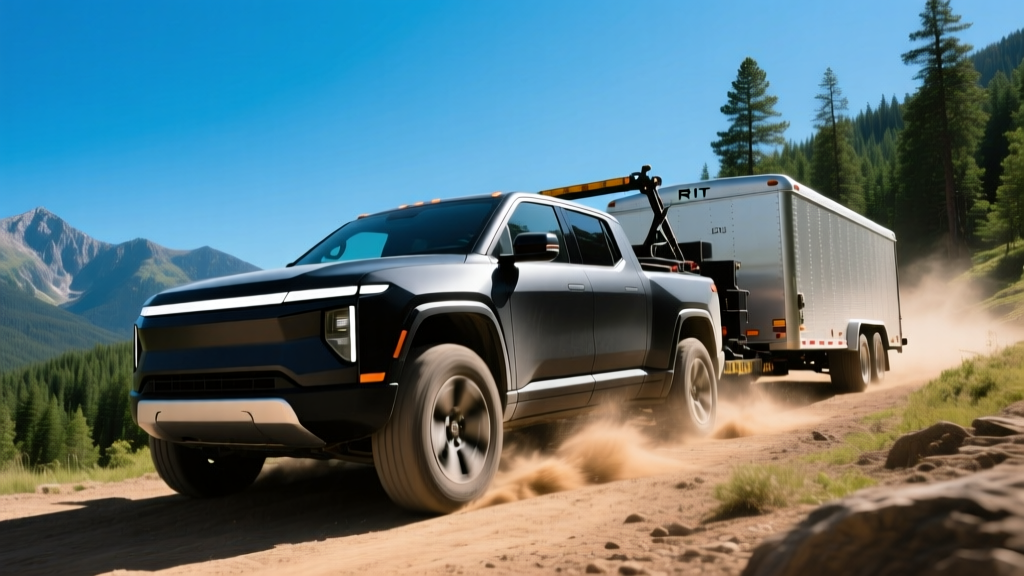
The Rivian R1T posts an impressive 11,000-pound maximum tow rating — competitive with many full-size gas trucks and the highest among production electric pickups. But any EV owner who has towed a trailer knows that the sticker rating is only half the story. The real question is: what happens to your range, charging logistics, and daily usability when you hook up 5,000, 8,000, or 11,000 pounds behind an electric truck?
This profile covers the current-generation Rivian R1T (Dual-Motor, Performance Dual-Motor, and Tri-Motor configurations) with a specific lens on towing performance, range degradation under load, and whether the R1T makes sense as a tow rig for boats, campers, and utility trailers. We also cover the essentials every buyer needs — battery specs, charging speeds, pricing, tax-credit eligibility, and how it stacks up against the Ford F-150 Lightning and Chevrolet Silverado EV.
| Spec | Dual-Motor (Standard) | Performance Dual-Motor | Tri-Motor |
|---|---|---|---|
| Max Tow Capacity | 11,000 lbs | 11,000 lbs | 11,000 lbs |
| EPA Range (Max Pack) | 420 mi | 420 mi | 380 mi (est.) |
| Battery (Max Pack) | ~149 kWh usable, NMC | ~149 kWh usable, NMC | ~149 kWh usable, NMC |
| Battery (Large Pack) | ~128 kWh usable, NMC | ~128 kWh usable, NMC | N/A |
| Battery (Standard Pack) | ~106 kWh, LFP | ~106 kWh, LFP | N/A |
| Horsepower | 533 hp | 665 hp | 850 hp (est.) |
| 0-60 mph | 4.5 sec | 3.5 sec | ~3.0 sec (est.) |
| Peak DC Fast Charge | 220 kW | 220 kW | 220 kW |
| 10-80% DC Time | ~21 min | ~21 min | ~21 min |
| Level 2 Home Charging | 11.5 kW (~25 mi/hr) | 11.5 kW (~25 mi/hr) | 11.5 kW (~25 mi/hr) |
| MPGe (Combined) | 70 MPGe | 70 MPGe | TBD |
| Base MSRP | $69,900 | $79,900 | $99,900 (est.) |
| Payload Capacity | 1,760 lbs | 1,760 lbs | 1,760 lbs |
| Bed Length | 4'6" (54") | 4'6" (54") | 4'6" (54") |
| Battery/Powertrain Warranty | 8 yr / 175,000 mi | 8 yr / 175,000 mi | 8 yr / 175,000 mi |
What Is the Rivian R1T's Tow Capacity — And What Can It Actually Pull?
The Rivian R1T is rated to tow 11,000 pounds across all powertrain configurations when properly equipped with the factory tow package. That number puts it in elite company:
- Ford F-150 Lightning: 10,000 lbs (Extended Range with Max Trailer Tow)
- Chevrolet Silverado EV: 10,000 lbs (standard), up to 12,500 lbs (4WT with Max Trailering)
- Tesla Cybertruck: 11,000 lbs (AWD and Cyberbeast)
For context on what 11,000 pounds looks like in practice: a typical 22-foot center-console boat on a dual-axle trailer weighs 5,000–6,500 lbs. A 25-foot travel camper (like an Airstream Flying Cloud) runs 6,000–7,500 lbs loaded. A two-horse trailer with horses lands around 7,000–8,500 lbs. The R1T can handle all of these within rating — but you'll want to stay at or below 80% of max (roughly 8,800 lbs) for comfortable highway margins, brake controller headroom, and acceptable range.
Towing's Impact on Range: The Numbers Nobody Advertises
Real-World Range (Unloaded): Expect 340–380 miles highway at 70-75 mph; 390+ miles in mixed city driving. In cold weather (below 32°F), subtract 15-25% — yielding roughly 290-330 miles highway in winter conditions.
Real-World Range (Towing): Expect roughly 50% range reduction when towing near max capacity. A 420-mile Max Pack R1T towing 8,000+ lbs at highway speeds will deliver approximately 180–220 miles before needing a charge. At 5,000 lbs, expect 230–280 miles.
This is the single most important data point for anyone considering the R1T as a tow rig. Towing is an energy hog — aerodynamic drag from a boxy trailer and the sheer mass of moving thousands of extra pounds crushes efficiency. Where the R1T achieves roughly 2.0–2.2 kWh/mile unloaded on the highway, towing a large camper can push consumption to 3.5–4.5 kWh/mile or more.
According to fueleconomy.gov, the R1T Dual-Motor with the Large Pack rates at 70 MPGe combined (48 kWh/100mi). Under tow, that efficiency figure can easily double. This isn't a Rivian-specific problem — every EV truck experiences similar degradation — but it fundamentally changes trip planning.
Practical towing range by scenario (Max Pack, 420 mi EPA):
- Light trailer (3,000 lbs, motorcycle/utility): ~280–320 miles
- Medium trailer (5,000–6,000 lbs, small boat): ~230–280 miles
- Heavy trailer (8,000–10,000 lbs, large camper): ~160–210 miles
- Max trailer (11,000 lbs): ~140–180 miles
If your typical tow trip is under 150 miles one-way — say, hauling a boat to a nearby lake or a camper to a state park within a few hours — the R1T handles it without requiring a mid-trip charge. Cross-country towing, however, means stopping every 2 hours or so at DC fast chargers that can accommodate a truck-and-trailer combination, which remains a significant infrastructure challenge in 2026.
Battery Options, Chemistry, and What They Mean for Towing
Rivian offers three battery pack sizes, and the chemistry differs between them — a detail that matters for long-term ownership and towing duty:
| Pack | Capacity (Usable) | Chemistry | EPA Range | Tow Rating | Notes |
|---|---|---|---|---|---|
| Standard | ~106 kWh | LFP (Lithium Iron Phosphate) | ~270 mi | 11,000 lbs | Lower range; excellent cycle life; can charge to 100% daily |
| Large | ~128 kWh | NMC (Nickel Manganese Cobalt) | ~352 mi | 11,000 lbs | Best balance of range and price; avoid frequent 100% charges |
| Max | ~149 kWh | NMC | ~420 mi | 11,000 lbs | Maximum towing buffer; premium price; heaviest pack |
Why chemistry matters for towing: LFP batteries (Standard Pack) tolerate regular 100% charging without significant degradation — a genuine advantage if you want to start every tow trip at full capacity. NMC packs (Large and Max) are best kept between 20-80% for daily use to maximize longevity, but you can charge to 100% before a tow trip without concern. The trade-off is that LFP is heavier per kWh and offers less total range, which directly limits towing distance.
For serious towing, the Max Pack (149 kWh, NMC) is the only rational choice. The Standard Pack's ~270-mile EPA range drops to roughly 120-140 miles under heavy tow — impractical for anything beyond short local hauls.
Charging Speed: How Long Are You Sitting at a Charger With a Trailer?
| Charging Method | Rate | Speed / Time |
|---|---|---|
| Level 1 (120V household) | ~1.4 kW | ~3 miles per hour |
| Level 2 (240V, 48A home charger) | 11.5 kW | ~25 miles per hour; Max Pack 0-100% in ~13 hours |
| DC Fast Charge (peak) | 220 kW | 10-80% in ~21 minutes (unloaded) |
| DC Fast Charge (sustained avg.) | ~150-170 kW | Average rate across 10-80% session |
| Tesla Supercharger (NACS adapter) | Up to 220 kW | Access to Supercharger network with Rivian-provided adapter |
The 220 kW peak DC fast-charge rate is solid but not class-leading — the Hyundai Ioniq 5 and Kia EV9 can hit 350 kW on compatible chargers, though their smaller batteries mean the practical advantage is modest. For the R1T's massive Max Pack, 220 kW means a 10-80% session takes roughly 21 minutes under ideal conditions.
The towing charging reality: When you arrive at a DC fast charger with a depleted battery after towing, the charge curve may behave differently. A hot battery from sustained high-load towing may need brief thermal management before accepting peak charge rates. Additionally, many public charging stations aren't designed for pull-through parking with a trailer — you may need to unhitch or find specific truck-friendly chargers. Rivian's Adventure Network chargers were designed with pull-through lanes, but coverage remains limited compared to Tesla Superchargers or Electrify America.
For home charging, a 48-amp Level 2 wall connector on a 240V/60A circuit adds roughly 25 miles of range per hour. Starting from a depleted Max Pack after a tow day, a full overnight charge (12-13 hours) gets you back to 100%. Most owners who tow locally find that overnight home charging covers their needs entirely.
Performance and Drivetrain: Power Is Not the Problem
If range under tow is the R1T's challenge, power is its triumph. Even the base Dual-Motor configuration delivers 533 horsepower and 610 lb-ft of torque — more than sufficient for merging onto highways with a heavy trailer. The Performance Dual-Motor bumps output to 665 hp, and the Tri-Motor pushes an estimated 850 hp with a sub-3-second 0-60 time (unloaded).
All R1T configurations use Rivian's quad-motor-available AWD system with torque vectoring. The electric drivetrain's instant torque delivery is a genuine towing advantage — there's no transmission hunting for gears on uphill grades, and the low-end pull from a stoplight with 8,000 lbs behind you is effortless in a way that gas trucks can't match without turbo spool-up time.
The R1T includes an integrated brake controller (available as an option or standard depending on trim) and trailer sway mitigation. The truck's air suspension automatically levels the vehicle when a trailer is connected, maintaining proper headlight aim and handling geometry without aftermarket weight-distribution add-ons for lighter loads.
Pricing, Trims, and Federal Tax Credit Eligibility
| Configuration | Base MSRP | Typical As-Tested | §30D Tax Credit Eligible? |
|---|---|---|---|
| Dual-Motor / Standard Pack | $69,900 | $74,000–$78,000 | See eligibility notes below |
| Dual-Motor / Large Pack | $75,900 | $80,000–$86,000 | See eligibility notes below |
| Dual-Motor / Max Pack | $83,900 | $88,000–$95,000 | See eligibility notes below |
| Performance Dual-Motor / Max Pack | $93,900 | $98,000–$105,000 | See eligibility notes below |
| Tri-Motor / Max Pack | $99,900 (est.) | $105,000+ | See eligibility notes below |
- MSRP Cap: Trucks/vans/SUVs must have an MSRP at or below $80,000. This eliminates the Performance Dual-Motor and Tri-Motor from new-vehicle credit eligibility. The base Dual-Motor with Standard or Large Pack may qualify depending on options.
- Buyer Income Cap: Modified AGI must not exceed $300,000 (joint), $225,000 (head of household), or $150,000 (single).
- Battery Sourcing: Critical minerals and battery components must meet phased-in percentages from US or FTA-partner countries. Rivian has been working to comply, but eligibility can change — verify at irs.gov or via the dealer's point-of-sale verification.
- Point-of-Sale Transfer: Eligible buyers can transfer the credit to the dealer for an immediate price reduction at purchase rather than waiting to claim it on their tax return.
- Final Assembly: Must occur in North America. Rivian manufactures in Normal, Illinois — this requirement is satisfied.
Bottom line: Only the base Dual-Motor configurations under the $80,000 MSRP cap are candidates for the full $7,500 federal credit, and only if battery-sourcing requirements are met at time of purchase. Always confirm current eligibility with your dealer and a tax professional before relying on the credit in your purchase math.
Cargo Space, Interior, and Practicality as a Daily Driver
The R1T is a midsize pickup, and its dimensions reflect that. The 4-foot-6-inch (54-inch) bed is shorter than most gas midsize trucks (the Toyota Tacoma offers a 60-inch bed). However, the R1T compensates with the Gear Tunnel — a lockable, pass-through storage compartment behind the cab that holds roughly 11 cubic feet of gear and is accessible from both sides of the truck. Combined with the bed, front trunk (frunk, ~11 cu ft), and under-bed storage, the R1T offers creative cargo solutions that gas trucks can't match.
Interior passenger space is generous for a midsize truck:
- Front legroom: 41.3 inches
- Rear legroom: 38.2 inches
- Seating: 5 passengers
- Frunk: ~11 cu ft (lockable, drainable — useful as a cooler)
- Bed volume: ~29 cu ft
- Gear Tunnel: ~11 cu ft
The 15.3-inch center touchscreen runs Rivian's proprietary infotainment system, which is responsive and well-designed but lacks Apple CarPlay and Android Auto — a notable drawback for buyers who prefer phone-mirroring. The digital instrument cluster and heads-up display are clear and configurable. Over-the-air updates continuously add features, including tow-mode optimizations and trailer-light-check functionality.
Driver Assistance and Towing Tech
Rivian's Driver+ system is a Level 2 driver-assistance feature. It provides adaptive cruise control, lane-centering, and highway assist on divided roads. The driver must remain attentive with hands on or near the wheel at all times. This is not autonomous or self-driving capability.
For towing specifically, the R1T offers several useful technologies: trailer assist for backing up (using a knob controller rather than the steering wheel for precise trailer-angle adjustment), integrated trailer brake controller, trailer tire-pressure monitoring (with compatible sensors), and a 360-degree camera system that provides visibility around a connected trailer. The air suspension's automatic load-leveling when a trailer is detected is a particularly elegant touch that eliminates the squat common in gas trucks without weight-distribution hitches.
Pros, Cons, and the Verdict
- Class-leading 11,000-lb tow rating among EV pickups
- Instant electric torque makes towing feel effortless
- Max Pack (420 mi EPA) provides best-in-class range buffer
- Gear Tunnel and frunk add creative storage gas trucks lack
- Air suspension auto-levels under trailer load
- Build quality and interior materials exceed most competitors
- 8-year/175,000-mile battery warranty
- Manufactured in the USA (Illinois)
- Towing cuts range by roughly 50% — 200 miles or less under heavy load
- Short 4'6" bed limits utility for long materials
- No Apple CarPlay or Android Auto
- Higher trims exceed $80K MSRP cap, losing federal tax credit
- Public charging with a trailer remains logistically difficult
- Standard Pack (LFP) range is too limited for practical towing
- Premium pricing — Max Pack configurations approach $100K
- Limited service center network compared to legacy brands
Rivian R1T vs. the Competition for Towing
| Vehicle | Max Tow Rating | Max EPA Range | Peak DC Charge | Starting MSRP |
|---|---|---|---|---|
| Rivian R1T (Dual-Motor, Max Pack) | 11,000 lbs | 420 mi | 220 kW | $83,900 |
| Ford F-150 Lightning (Ext. Range) | 10,000 lbs | 320 mi | 150 kW | $67,995 |
| Chevrolet Silverado EV (4WT) | 12,500 lbs | 440 mi | 350 kW | $79,900 (est.) |
| Tesla Cybertruck (AWD) | 11,000 lbs | 340 mi | 250 kW | $79,990 |
The R1T occupies a unique position: it matches the Cybertruck's tow rating, beats the Lightning's range by 100 miles, and offers build quality and interior refinement that outpace both. The Silverado EV's available 12,500-lb rating and 440-mile range are compelling, but its availability and real-world validation remain more limited. If towing is your primary use case, the R1T Max Pack is arguably the most well-rounded option available — provided your trips are within its tow-range envelope.
- Your typical tow trips are under 150 miles one-way (or you can charge at your destination)
- You value build quality, ride refinement, and creative storage
- You want 11,000-lb capacity with AWD and air suspension
- You can charge at home and mostly tow locally (boats, campers, horse trailers)
- You regularly tow cross-country and need 300+ mile tow range
- You need a full-size 6.5-foot bed for construction materials
- Your budget is under $70K and you need maximum tow capacity
- You rely on Apple CarPlay for navigation
Frequently Asked Questions
What is the real-world range of the Rivian R1T when towing?
Expect roughly 50% range reduction under heavy tow. A Max Pack R1T (420 mi EPA) towing 8,000+ lbs at highway speeds delivers approximately 180–220 real-world miles. At 5,000 lbs, expect 230–280 miles. Cold weather and high speeds further reduce these figures.
How fast does the Rivian R1T charge at home and on the road?
At home on a 240V Level 2 charger (48A/11.5 kW), the R1T adds roughly 25 miles of range per hour, with a full Max Pack charge taking about 13 hours. On DC fast chargers, it peaks at 220 kW and charges from 10-80% in approximately 21 minutes under ideal conditions.
Does the Rivian R1T qualify for the $7,500 federal EV tax credit?
Only configurations with an MSRP at or below $80,000 (the §30D truck cap) are eligible. This typically limits eligibility to the base Dual-Motor with Standard or Large Pack before options push the MSRP over the cap. Buyer income limits and battery-sourcing requirements also apply. Check IRS.gov for current rules.
Is the Rivian R1T good for towing a travel trailer or boat?
Yes, for trips within its range envelope. The 11,000-lb rating handles most travel trailers, boats, and horse trailers. The air suspension, integrated brake controller, and trailer backup assist make the towing experience refined. The limitation is range — plan charging stops for any trip over ~150 miles with a heavy trailer.
How does the R1T tow capacity compare to gas trucks?
The R1T's 11,000-lb rating matches or exceeds many gas-powered half-ton trucks and surpasses most gas midsize trucks (the Toyota Tacoma tops out around 6,800 lbs). However, heavy-duty gas trucks (Ford F-250, Ram 2500) can tow 15,000–22,000 lbs — a segment no EV pickup currently addresses.
What is the Rivian R1T battery warranty?
Rivian covers the battery pack and powertrain for 8 years or 175,000 miles, whichever comes first. This exceeds the industry-standard 8-year/100,000-mile warranty offered by most competitors and reflects confidence in long-term durability, even under demanding use like towing.
Sources: fueleconomy.gov, IRS §30D Clean Vehicle Credits, Rivian official specifications. Specifications reflect the latest available model-year data and are subject to change. Always verify current pricing, range, and tax-credit eligibility with Rivian and a qualified tax professional before purchasing.