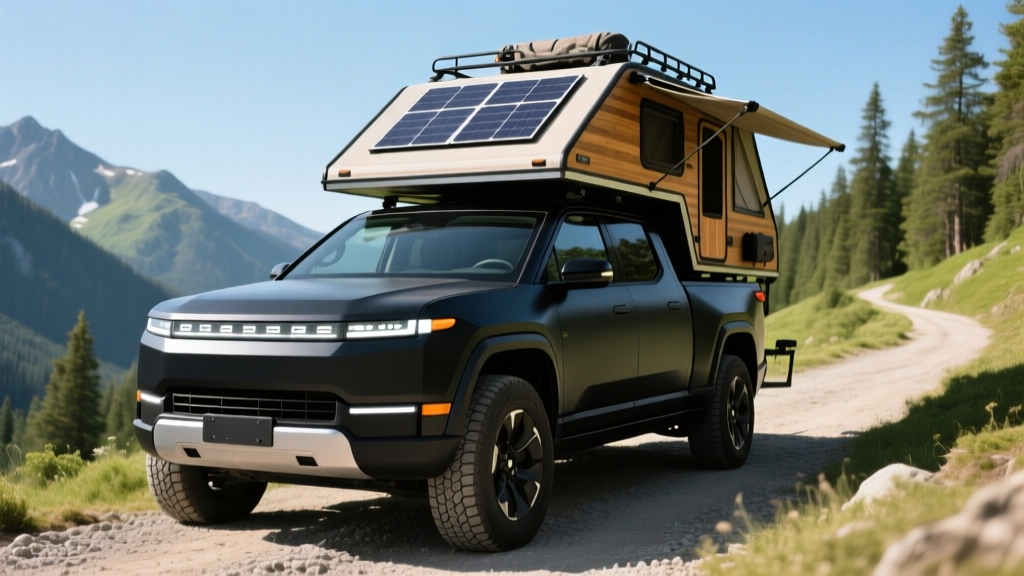
If you've searched for a Rivian R1T topper, you're likely eyeing one of the most capable electric trucks on the road as the foundation for an overlanding or truck-camper rig. The 2026 Rivian R1T pairs a high-strength stainless-steel bed with up to 420 miles of EPA-rated range, dual- and tri-motor powertrains, and a growing NACS charging network — making it a legitimate platform for a slide-in camper, wedge camper, or hard-shell topper. But bolting a topper onto an EV truck changes the aerodynamics, weight, and energy consumption in ways that matter far more than on a gas pickup. This guide covers the 2026 R1T's real-world specs, how a topper affects range and charging, and whether the math works for your build.
2026 Rivian R1T Specs at a Glance
| Spec | Dual-Motor Standard | Dual-Motor Max Pack | Tri-Motor Max |
|---|---|---|---|
| EPA Range | 270 mi | 420 mi | ~380 mi |
| Battery (usable) | 92 kWh (NMC) | 141 kWh (NMC) | 141 kWh (NMC) |
| Peak DC Fast Charge | 220 kW | 220 kW | 220 kW |
| 10–80% DC Time | ~30 min | ~42 min | ~42 min |
| Level 2 Charge Rate | 11.5 kW (~30 mi/hr) | 11.5 kW (~30 mi/hr) | 11.5 kW (~30 mi/hr) |
| 0–60 mph | 4.5 sec | 4.5 sec | 2.9 sec |
| Horsepower | 533 hp | 533 hp | 850 hp |
| Towing Capacity | 11,000 lbs | 11,000 lbs | 11,000 lbs |
| Bed Length | 54.2 in (4.5 ft) | 54.2 in (4.5 ft) | 54.2 in (4.5 ft) |
| Payload Capacity | ~1,760 lbs | ~1,760 lbs | ~1,500 lbs |
| MPGe (combined) | 73 MPGe | 70 MPGe | 65 MPGe |
| kWh / 100 mi | 46 | 48 | 52 |
| Base MSRP | $69,900 | $83,900 | $99,900 |
How a Topper Changes the R1T's Range & Efficiency
Electric trucks are uniquely sensitive to aerodynamic modifications. The R1T's 0.30 Cd (drag coefficient) is optimized for the bare bed. A topper — whether a lightweight SnugTop, an AT Overland Habitat, or a Four Wheel Camper slide-in — disrupts the laminar airflow over the bed and creates turbulence at the tailgate edge. Rivian's own engineering team has acknowledged that any bed-mounted enclosure measurably increases energy consumption.
Here's what the physics looks like in practice:
- Lightweight fiberglass topper (150–200 lbs, flush profile): 5–8% range loss. Barely noticeable on the Standard Pack; negligible on the Max.
- Hard-shell wedge camper (300–500 lbs, pop-up): 10–15% range loss when closed; 15–22% when open at highway speeds (never drive open).
- Slide-in truck camper (800–1,400 lbs, tall profile): 18–28% range loss. This is where payload capacity becomes the bigger constraint — a fully loaded slide-in can push the R1T past its 1,760-lb payload limit before you add passengers.
The R1T's 4.5-foot bed also limits which slide-in campers fit. Most purpose-built truck campers target 6.5- or 8-foot beds. Your best topper options for the R1T are wedge-style pop-ups (AT Overland, Alu-Cab, or similar), custom hard-shell caps, or the Rivian Camp Kitchen accessory, which integrates into the Gear Tunnel without affecting bed aerodynamics.
Charging Speed: DC Fast, Level 2, and Topper Considerations
| Charge Level | Power / Voltage | Miles Added per Hour | Notes |
|---|---|---|---|
| Level 1 (120V household) | 1.4 kW | ~3 mi/hr | Emergency/trickle only; full charge in 60+ hours |
| Level 2 (240V home) | 11.5 kW | ~30 mi/hr | Requires 60A circuit; Standard Pack full in ~8 hrs, Max Pack ~12 hrs |
| DC Fast Charge (CCS/NACS) | 220 kW peak | ~250 mi/hr (peak) | 10–80% in ~30 min (Standard) / ~42 min (Max); tapers sharply above 80% |
The R1T's 220 kW peak DC fast-charge rate is competitive for a truck-class EV, but the charge curve matters more than the headline number. On a 350 kW Electrify America or Tesla Supercharger stall, the R1T sustains roughly 180–200 kW between 10–50% State of Charge, then tapers to 100–120 kW from 50–70%, and drops further to 50–70 kW from 70–80%. Charging from 80–100% is slow — plan to leave at 80% on road trips unless you need the full pack.
For 2026, the R1T ships with the NACS (Tesla-style) charge port natively, giving direct access to the Tesla Supercharger network — over 25,000 stalls in North America — without an adapter. This is a significant advantage for overlanders who rely on Superchargers in rural corridors where CCS networks remain sparse.
Performance, Payload & Towing With a Topper
The Dual-Motor R1T's 533 hp and 4.5-second 0–60 time are sports-car quick for a 7,000-lb truck, and that performance holds even with a loaded topper. The instant torque of electric motors means you won't feel the power deficit that a gas truck experiences when loaded — but you will feel the efficiency penalty.
Payload is the real constraint for topper builds. The Dual-Motor R1T's ~1,760-lb payload capacity must account for:
- Topper/camper weight (300–1,400 lbs depending on type)
- Passengers (2 × 180 lbs = 360 lbs)
- Gear, water, propane, and supplies (100–300 lbs)
- The R1T's own Gear Tunnel and frunk cargo
A heavy slide-in camper can easily push you over the payload limit before adding a second passenger. The Tri-Motor's higher curb weight reduces payload to ~1,500 lbs, making it paradoxically less suited for heavy camper builds despite its 850 hp. For topper builds, the Dual-Motor Max Pack strikes the best balance: 420 miles of range to absorb the topper's efficiency hit, 1,760 lbs of payload, and the lowest starting price of the Max configurations.
Pricing, Trims & Federal Tax Credit Eligibility
| Configuration | Base MSRP | Typical As-Tested (w/ options) | §30D Federal Credit | Effective Price |
|---|---|---|---|---|
| Dual-Motor Standard Pack | $69,900 | $74,000–$78,000 | $3,750–$7,500* | ~$62,400–$74,250 |
| Dual-Motor Max Pack | $83,900 | $88,000–$93,000 | $3,750–$7,500* | ~$76,400–$89,250 |
| Tri-Motor Max Pack | $99,900 | $104,000–$115,000 | $3,750–$7,500* | ~$92,400–$111,250 |
*Federal tax credit amounts depend on current-year IRS §30D rules, including battery critical-mineral sourcing and component manufacturing requirements. The R1T qualifies as a light truck under the $80,000 MSRP cap, but buyers must also meet income limits: $150,000 single / $225,000 head of household / $300,000 joint filers. The credit can be transferred to the dealer as a point-of-sale discount. Always confirm eligibility with a tax professional before purchase, as sourcing rules tighten annually.
A quality topper adds $3,000–$15,000 to your total investment. A basic fiberglass cap runs $3,000–$5,000; an AT Overland Habitat wedge camper is roughly $12,000–$15,000; and a custom slide-in from a manufacturer like Scout Campers starts around $20,000. Factor this into your total build cost before choosing a trim — the Standard Pack's lower price may tempt you, but its 270-mile EPA range (dropping to ~180–210 with a topper) limits trip flexibility significantly.
Pros & Cons of the R1T as a Topper Platform
Pros
- 420-mile Max Pack range absorbs topper efficiency losses better than any competitor
- NACS native charging — direct Tesla Supercharger access for remote overlanding
- 54.2-inch bed with integrated tie-downs and a sealed Gear Tunnel for gear storage
- 533–850 hp with instant torque handles loaded climbs effortlessly
- Quad-motor Tank Turn (Tri/Quad-Motor) aids tight campsite maneuvering
- Over-the-air updates continuously improve range estimation and thermal management
Cons
- 4.5-foot bed limits slide-in camper compatibility — most require 6.5+ ft beds
- 1,760-lb payload (Dual-Motor) is tight for heavy campers + passengers + gear
- No high-wattage V2L/V2H — can't power a full camper electrical system off the truck
- Real-world range with a topper drops 10–28% — Standard Pack becomes range-limited
- Rivian service centers remain concentrated in metro areas — remote overlanders face long tow distances for repairs
- Insurance premiums run 15–25% higher than comparable gas trucks (per IIHS data)
R1T vs. F-150 Lightning vs. Silverado EV for Topper Builds
The R1T isn't the only electric truck that can wear a topper. Here's how it stacks up against the two most common alternatives for truck-camper builds:
| Attribute | Rivian R1T (Dual-Motor Max) | Ford F-150 Lightning (Ext. Range) | Chevy Silverado EV (4WT) |
|---|---|---|---|
| EPA Range | 420 mi | 320 mi | ~380 mi |
| Bed Length | 54.2 in (4.5 ft) | 67.1 in (5.5 ft) | 72.0 in (6.0 ft) |
| Payload | ~1,760 lbs | ~2,235 lbs | ~1,800 lbs |
| Pro Power / V2L | 120V outlet (limited) | 9.6 kW Pro Power Onboard | Up to 10.2 kW |
| Peak DC Charge | 220 kW | 150 kW | 200+ kW |
| Best Topper Type | Wedge/pop-up camper | Slide-in or wedge | Slide-in or wedge |
| Base MSRP | $83,900 | ~$67,990 | ~$75,000 |
- Choose the R1T if range is your top priority (420 mi EPA is best-in-class), you prefer the Supercharger network, and you're building a lightweight wedge-camper or cap setup.
- Choose the F-150 Lightning if you need a longer bed for a slide-in camper, want Pro Power Onboard for high-wattage camper loads, or need maximum payload (~2,235 lbs).
- Choose the Silverado EV if you want a balance of bed length, payload, and competitive range at a mid-range price point.
Battery, Warranty & Long-Term Ownership
The R1T uses NMC (nickel-manganese-cobalt) lithium-ion cells across all configurations. NMC offers higher energy density than LFP (lithium iron phosphate), which is critical for fitting 141 kWh into the Max Pack's physical footprint — but it comes with slightly faster long-term degradation. Rivian's battery management system (BMS) maintains a top and bottom buffer to protect cell health, and real-world data from early 2022–2023 R1T owners shows approximately 3–5% capacity loss over the first 60,000 miles, which is within industry norms.
Rivian's warranty coverage:
- Battery: 8 years / 175,000 miles (retains ≥70% capacity)
- Powertrain: 8 years / 175,000 miles
- Bumper-to-bumper: 5 years / 60,000 miles
- Corrosion: 12 years / unlimited miles
The 175,000-mile battery warranty is notably more generous than the industry-standard 100,000 miles, which matters if you're putting serious miles on the truck with a topper-equipped overlanding setup. Battery replacement cost, should it be needed out of warranty, is estimated at $18,000–$25,000 for the Max Pack — a figure to keep in mind for long-term ownership planning.
Frequently Asked Questions
What is the real-world range of the R1T with a topper?
With a lightweight hard-shell cap (150–200 lbs), expect roughly 240–255 miles from the Standard Pack (270 EPA) and 380–400 miles from the Max Pack (420 EPA) in mixed driving. A heavier wedge camper (300–500 lbs) drops those figures to 180–210 miles (Standard) and 280–320 miles (Max) at highway speeds. Cold weather (below 30°F) can reduce range an additional 15–25% on top of the topper penalty.
How fast does the R1T charge at home and on the road?
At home on a Level 2 (240V, 11.5 kW) charger, the R1T adds roughly 30 miles of range per hour — a full Standard Pack charge takes about 8 hours overnight, while the Max Pack takes around 12 hours. On DC fast chargers, the R1T peaks at 220 kW and charges from 10–80% in approximately 30 minutes (Standard) or 42 minutes (Max). Expect the charging rate to taper significantly above 80% SoC.
Does the Rivian R1T qualify for the federal EV tax credit?
The R1T qualifies as a light truck under IRS §30D, which carries an $80,000 MSRP cap. The Dual-Motor Standard ($69,900) and Dual-Motor Max ($83,900) base MSRPs are under that cap, but adding options can push the as-tested price above $80,000, which may disqualify the credit. Buyer income limits also apply ($150K single / $300K joint). Battery sourcing requirements may reduce the credit to $3,750 rather than the full $7,500. Confirm current-year eligibility on IRS.gov and with a tax professional.
What type of topper works best on the R1T's short bed?
The R1T's 54.2-inch (4.5-foot) bed rules out most conventional slide-in truck campers, which are designed for 6.5- or 8-foot beds. The best options are: (1) a wedge-style pop-up camper like the AT Overland Habitat or Alu-Cab Canopy Camper, (2) a custom-fit hard-shell cap (SnugTop, Leer, or ARE), or (3) Rivian's own Camp Kitchen and Gear Tunnel accessories for lighter-duty overlanding. Always verify the topper's weight against the R1T's ~1,760-lb payload limit.
Is the R1T worth buying over the F-150 Lightning for a camper build?
It depends on your build priorities. The R1T wins on range (420 vs. 320 miles EPA), DC fast-charge speed (220 vs. 150 kW peak), and Supercharger network access — critical for remote overlanding. The F-150 Lightning wins on bed length (5.5 ft vs. 4.5 ft), payload capacity (~2,235 vs. ~1,760 lbs), and high-wattage V2L via Pro Power Onboard (9.6 kW vs. limited 120V). If your camper fits the R1T's short bed and weight limits, the R1T is the better road-tripper. If you need a slide-in or heavy camper, the Lightning is the more practical platform.