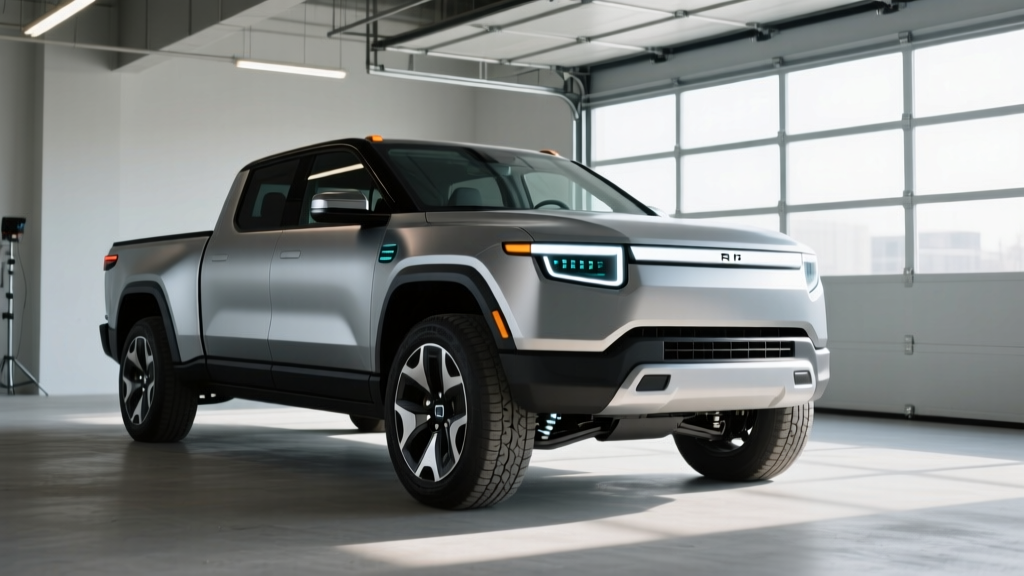
Rivian's second-generation R1T, introduced for the 2025 model year and refined into 2026, brought a suite of fundamental engineering changes beneath its familiar adventure-truck skin. Among the most discussed is the Rivian steer-by-wire system — a fully electronic steering architecture that replaces the traditional mechanical column with redundant sensors, actuators, and control units. It's a technology that directly affects how the R1T feels on pavement, trail, and tow, and it sits at the center of a broader generational leap that also includes an 800-volt battery architecture, updated drive units, and a redesigned interior.
This review covers the 2026 Rivian R1T lineup — Dual-Motor, Performance Dual-Motor, and Tri-Motor — with a focus on what the steer-by-wire system changes for real-world driving, alongside the range, charging, performance, pricing, and ownership data you need to evaluate the truck.
What Steer-by-Wire Means for the R1T
Traditional steering systems use a physical shaft connecting the steering wheel to the rack. Rivian's steer-by-wire setup eliminates that mechanical link. Instead, steering-wheel angle and torque inputs are read by redundant sensors, processed by independent control units, and transmitted to electric actuators at the rack. A force-feedback motor in the steering column simulates the road feel that drivers expect.
The practical implications are significant:
- Variable steering ratio: Rivian can adjust the ratio in software — fewer turns lock-to-lock at low speeds (tighter parking maneuvers, easier trail work) and a more relaxed ratio at highway speeds for stability.
- No mechanical vibration transfer: Road impacts and off-road jolts don't feed back through a physical column into the driver's hands.
- Redundancy: Rivian engineers dual-wound motors, dual sensor sets, and independent power supplies so that a single-point failure doesn't eliminate steering — a requirement for any production steer-by-wire system.
- Packaging freedom: Eliminating the column shaft simplifies crash-structure design and allows more flexibility in cabin layout, which contributes to the R1T's generous front legroom.
On the road, the system feels direct and well-damped. At parking-lot speeds, the quickened ratio means fewer arm-over-arm shuffles. At 75 mph on the interstate, the R1T tracks confidently without the slight deadness some drivers noticed in the first-generation hydraulic-assist setup. The transition between low-speed agility and high-speed stability is seamless — you don't notice the ratio changing.
The main adjustment period involves the simulated feel. It's convincing in most conditions, but drivers accustomed to granular feedback from a mechanical rack may notice a slight uniformity in the feedback texture. For the vast majority of R1T buyers — adventure seekers, families, commuters — this is a non-issue. For track-day purists, it's worth a test drive.
2026 Rivian R1T Specifications at a Glance
| Specification | Dual-Motor (Standard) | Dual-Motor (Max Pack) | Tri-Motor |
|---|---|---|---|
| EPA Range | 270 mi | 420 mi | 380 mi |
| Battery Capacity (usable) | 92 kWh (Standard) | 141 kWh (Max) | 141 kWh (Max) |
| Battery Chemistry | NMC (LG Energy Solution) | NMC (2170 cells, Samsung SDI) | NMC (2170 cells, Samsung SDI) |
| Horsepower | 533 hp | 533 hp | 850 hp |
| Torque | 610 lb-ft | 610 lb-ft | 1,103 lb-ft |
| 0–60 mph | 4.5 sec | 4.5 sec | 2.9 sec |
| Drivetrain | AWD (Dual-Motor) | AWD (Dual-Motor) | AWD (Tri-Motor) |
| Max DC Fast Charge | 200 kW | 220 kW | 220 kW |
| 10–80% DC Charge | ~28 min | ~42 min | ~42 min |
| Level 2 Home Charge | 11.5 kW (~25 mi/hr) | 11.5 kW (~25 mi/hr) | 11.5 kW (~25 mi/hr) |
| Towing Capacity | 11,000 lbs | 11,000 lbs | 11,000 lbs |
| Bed Length | 54 in (4.5 ft) | 54 in (4.5 ft) | 54 in (4.5 ft) |
Range and Efficiency: EPA Stickers vs. Reality
EPA Range: 270 mi (Standard) / 420 mi (Max Pack) / 380 mi (Tri-Motor)
Real-World Highway Expectation: ~230–250 mi (Standard), ~350–375 mi (Max Pack), ~320–340 mi (Tri-Motor) at 70–75 mph
Cold-Weather Reduction: Expect 15–25% range loss in sustained sub-30°F driving without preconditioning. Rivian's heat pump and battery thermal management mitigate this when preconditioning is active.
The Max Pack's 420-mile EPA figure is among the highest of any production pickup, but physics still applies. At sustained highway speeds above 70 mph, aerodynamic drag pushes consumption higher. In EPA testing data on fueleconomy.gov, the Dual-Motor R1T with the Standard battery achieves approximately 73 MPGe combined (46 kWh/100 mi). The Max Pack, carrying substantially more battery mass, posts a slightly lower efficiency figure despite its range advantage.
The Tri-Motor, with 850 horsepower on tap, trades some efficiency for performance. If you drive it like its 0–60 time suggests, expect real-world range well below the EPA sticker. If you drive conservatively, the gap narrows.
For towing — a core R1T use case — plan for roughly 50% of EPA range when pulling a 7,000+ lb trailer at highway speed. This is consistent with all full-size electric pickups and reflects the energy demand of moving combined mass through air.
Charging Performance: DC Fast, Level 2, and the 800V Advantage
The second-generation R1T uses an 800-volt battery architecture, which allows higher charge power with lower current — reducing heat and cable weight. Here's how charging breaks down across levels:
| Charging Level | Power | Rate (Approx.) | Notes |
|---|---|---|---|
| Level 1 (120V household) | ~1.4 kW | ~3 mi/hr | Emergency/trickle only |
| Level 2 (240V home) | 11.5 kW | ~25 mi/hr | Full charge overnight (~10–14 hrs for Max Pack) |
| DC Fast (peak) | 200–220 kW | ~140 mi in 20 min (Max Pack) | Peak rate sustained to ~60% SoC, then tapers |
The charge curve matters more than the peak number. The Max Pack sustains roughly 200+ kW from approximately 10% to 60% state of charge before tapering. From 60% to 80%, power drops progressively — this is normal lithium-ion behavior as the battery management system protects cell longevity. The 10–80% time of approximately 42 minutes for the Max Pack reflects the large battery size; the Standard pack completes the same interval in roughly 28 minutes due to its smaller capacity.
At home, a 48-amp Level 2 wall connector on a 60-amp circuit delivers the full 11.5 kW. For a Max Pack owner driving 40 miles daily, a single overnight session easily replenishes used energy. Installation costs for a Level 2 home setup typically range from $800 to $2,500 depending on panel proximity and whether a service upgrade is needed.
The R1T ships with the NACS (North American Charging Standard) connector, giving it native access to the Tesla Supercharger network without an adapter — a significant practical advantage for road-trip charging infrastructure access.
Performance: Dual-Motor Practicality and Tri-Motor Excess
The Dual-Motor R1T produces 533 hp and 610 lb-ft of torque, hitting 60 mph in 4.5 seconds. That's brisk for a 7,000-lb truck and more than adequate for highway merging, passing, and confident acceleration with a loaded bed.
The Tri-Motor is a different category entirely. With 850 hp and 1,103 lb-ft, it reaches 60 mph in 2.9 seconds — supercar territory in a vehicle with a bed and tow hitch. This is engineering theater as much as practical performance, but the instant torque delivery makes the Tri-Motor genuinely useful for heavy towing from a stop, where internal-combustion trucks need rev build and transmission downshifts.
All trims use Rivian's quad-motor-compatible platform, though the Dual-Motor uses two drive units (one per axle) and the Tri-Motor uses three (one front, two rear). The steer-by-wire system integrates with the stability control to provide torque-vectoring feel and lane-centering precision that a mechanical column couldn't match at the same response speed.
Pricing, Trims, and Federal Tax Credit Eligibility
| Trim | Base MSRP (2026) | As-Tested Range | §30D Credit Eligibility |
|---|---|---|---|
| Dual-Motor Standard | $69,900 | $72,000–$78,000 | Eligible (below $80K truck cap) |
| Dual-Motor Max Pack | $83,900 | $87,000–$95,000 | Not eligible (exceeds $80K truck MSRP cap) |
| Tri-Motor Max Pack | $99,900 | $105,000–$115,000 | Not eligible (exceeds $80K truck MSRP cap) |
The IRS §30D federal tax credit offers up to $7,500 for qualifying new EVs, but eligibility for the R1T depends on trim and buyer circumstances:
- MSRP Cap: Trucks, SUVs, and vans must have a base MSRP at or below $80,000. Only the Dual-Motor Standard battery R1T qualifies.
- Income Caps: Modified adjusted gross income (MAGI) must not exceed $300,000 (joint filers), $225,000 (head of household), or $150,000 (single).
- Battery Sourcing: The $7,500 credit splits into two $3,750 halves — one for critical-minerals sourcing and one for battery-component manufacturing. Rivian's supply chain has been evolving; verify current-year sourcing compliance with your dealer and consult a tax professional.
- Point-of-Sale Transfer: As of 2024, buyers can transfer the credit to the dealer at purchase, reducing the upfront price rather than waiting for a tax refund. This applies to eligible R1T trims.
For the Dual-Motor Standard at $69,900, a buyer meeting all criteria could see the effective price drop to approximately $62,400 at point of sale — a meaningful reduction that brings the R1T closer to competition with well-equipped Ford F-150 Lightning and Chevrolet Silverado EV trims.
Interior, Cargo, and Practicality
The R1T remains a midsize pickup by bed length (4.5 feet) but a full-size vehicle by weight, width, and cabin volume. Interior dimensions include:
- Front legroom: 41.3 inches
- Rear legroom: 38.2 inches
- Front headroom: 41.1 inches
- Bed volume: ~27 cu ft (with tailgate up)
- Gear Tunnel (available): 11 cu ft of enclosed, lockable cross-cab storage — a signature R1T feature with no competitor equivalent
- Frunk: 11 cu ft front trunk with drain, useful for wet gear or groceries
The second-generation interior brings upgraded materials, a redesigned center console, and Rivian's latest infotainment software running on a 15.6-inch center display. Wireless Apple CarPlay and Android Auto are standard. The digital driver display integrates with the steer-by-wire system to show steering angle and wheel position — useful off-road when the quick ratio makes it hard to gauge tire direction by the wheel alone.
The Gear Tunnel remains one of the R1T's strongest differentiators. It's a pass-through compartment spanning the width of the truck behind the rear seats, accessible from both sides. It swallows ski bags, camping gear, or tool cases that would otherwise eat bed space.
Driver Assistance and Safety Technology
The 2026 R1T ships with Rivian's Driver+ system, a Level 2 driver-assistance suite (per SAE J3016 classification) that includes:
- Adaptive cruise control with stop-and-go
- Lane-centering assist on divided highways
- Automatic emergency braking with pedestrian detection
- Blind-spot monitoring with rear cross-traffic alert
- Highway Assist (hands-on, semi-automated lane-keeping + adaptive cruise)
Important: Rivian Driver+ is a Level 2 system. The driver must remain engaged, keep hands on or near the wheel, and monitor the road at all times. It is not autonomous or self-driving. Rivian has not announced a hands-free Level 3 or Level 4 system for the R1T as of the 2026 model year.
The steer-by-wire system enhances Driver+ precision. Because the steering actuator receives electronic commands directly, lane-centering corrections are smoother and more accurate than with a mechanical column and electric power-steering motor. Rivian's camera-and-radar sensor suite feeds data to the steering controller in real time, and the result is some of the most natural-feeling lane-keeping in the pickup segment.
Safety ratings from NHTSA and IIHS should be verified at time of purchase, as second-generation testing results are still being published. The first-generation R1T earned strong marks in crashworthiness, and the redesigned structure with its lower, stiffer 800V battery pack is expected to perform at least as well.
Warranty and Long-Term Ownership
- Vehicle Limited Warranty: 5 years / 60,000 miles
- Battery & Drive Unit Warranty: 8 years / 175,000 miles (retains ≥70% capacity)
- Corrosion Warranty: 12 years, unlimited miles
Rivian's battery warranty threshold of 70% capacity retention at 8 years/175,000 miles is competitive with the broader EV industry. The NMC chemistry used across the R1T lineup offers high energy density but is somewhat more susceptible to calendar degradation than LFP chemistry — owners should avoid routinely charging to 100% and storing the vehicle at high state of charge in hot climates. Rivian's battery management software includes a daily-charge limit setting (typically 80–90%) that helps manage long-term health.
Steer-by-wire components are covered under the vehicle limited warranty. Rivian has not published separate wear-item exclusions specific to the steering actuators, but given the system's redundancy design and lack of mechanical wear surfaces (no rack-and-pinion teeth, no column U-joints), long-term maintenance is expected to be lower than a traditional steering system.
Pros, Cons, and the Verdict
Pros
- Class-leading 420-mile EPA range (Max Pack)
- Steer-by-wire delivers precise, variable-ratio steering with no mechanical compromise
- NACS connector = native Tesla Supercharger access
- Gear Tunnel storage is genuinely unique and useful
- 800V architecture enables competitive DC fast-charging speeds
- Tri-Motor offers absurd performance for those who want it
- Strong off-road capability with quad-motor torque control
Cons
- Max Pack and Tri-Motor trims exceed $80K MSRP cap — ineligible for §30D credit
- 4.5-foot bed is short for traditional pickup work
- 42-minute 10–80% DC charge on Max Pack is lengthy for road trips
- Steer-by-wire simulated feel may not satisfy enthusiasts
- Service center network still expanding in rural areas
- Towing cuts range roughly in half — true of all electric pickups
Who Should Buy the 2026 Rivian R1T?
Choose the Dual-Motor Standard ($69,900) if: You want tax-credit eligibility, commute under 100 miles daily, and value the R1T's adventure features without needing max range.
Choose the Dual-Motor Max Pack ($83,900) if: You take frequent road trips, need 350+ real-world highway miles between charges, and don't mind forgoing the federal credit.
Choose the Tri-Motor ($99,900) if: Performance is a priority, budget is flexible, and you want the fastest-accelerating pickup available.
The R1T is best suited for outdoor-active households who need a daily driver that can also handle weekend camping, light-to-moderate towing, and trail driving. It is not a fleet work truck — the short bed and premium pricing position it as a lifestyle vehicle. If you need an 8-foot bed for job-site hauling, the R1T isn't the answer. If you want a truck that charges at home, handles mountain roads with composure, and stores your gear in the Gear Tunnel, it's in a class of one.
Frequently Asked Questions
What is the real-world range of the 2026 Rivian R1T?
The EPA rates the Max Pack at 420 miles, but real-world highway driving at 70–75 mph yields approximately 350–375 miles. The Standard battery delivers roughly 230–250 highway miles. Cold weather (below 30°F) reduces range by 15–25% unless the battery is preconditioned.
How fast does the R1T charge at home and on the road?
At home on a 240V Level 2 charger, the R1T accepts 11.5 kW, adding about 25 miles per hour. On a DC fast charger, it peaks at 200–220 kW, with the Standard pack going 10–80% in roughly 28 minutes and the Max Pack in about 42 minutes.
Does the 2026 R1T qualify for the federal EV tax credit?
Only the Dual-Motor Standard battery trim (MSRP $69,900) qualifies, as it falls under the $80,000 MSRP cap for trucks. Buyers must also meet income limits ($150K single / $300K joint) and verify battery-sourcing compliance. Consult a tax professional and check IRS guidance for current rules.
Is the steer-by-wire system reliable?
Rivian designs the system with full redundancy — dual motors, dual sensors, and independent power supplies. There is no single point of failure. The system is covered under the 5-year/60,000-mile vehicle warranty. Long-term fleet data is still accumulating, but the architecture is proven in aerospace and increasingly adopted in production vehicles.
Is the R1T worth buying over the Ford F-150 Lightning or Chevy Silverado EV?
The R1T offers unique advantages (Gear Tunnel, off-road capability, steer-by-wire precision, NACS charging) and a premium price. The F-150 Lightning provides a larger bed and lower starting price; the Silverado EV offers a longer bed option and fleet-oriented trims. If adventure lifestyle and technology differentiation matter more than maximum cargo volume, the R1T is the stronger choice.
What are the biggest drawbacks of the R1T?
The short 4.5-foot bed limits utility for traditional pickup work. The Max Pack and Tri-Motor trims are ineligible for the federal tax credit. DC fast-charging the Max Pack takes 42 minutes (10–80%), which is slower than some competitors. And Rivian's service network, while growing, doesn't yet match legacy automaker dealer coverage in rural areas.