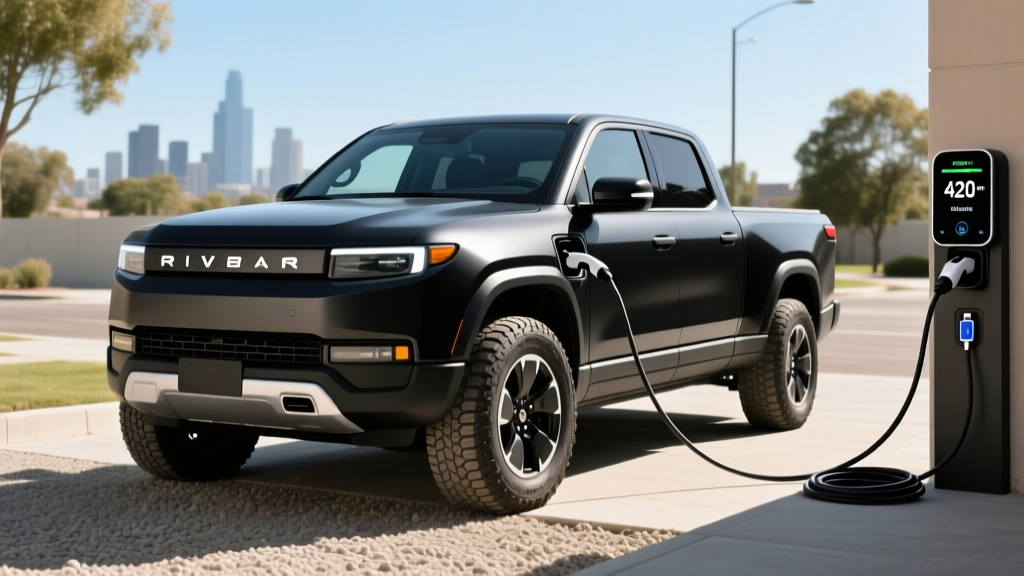
The Rivian R1T remains one of the few electric pickups that genuinely bridges the gap between adventure capability and daily-driver refinement. With the 2026 model year, Rivian has expanded the R1T lineup with a new tri-motor option, updated software, and a larger Max battery pack that pushes EPA range past 400 miles. But spec sheets only tell half the story. Below, we break down every critical Rivian R1T specification — from real-world range and charging curves to tax-credit math — so you can decide whether this truck earns a spot in your driveway.
2026 Rivian R1T Core Specifications at a Glance
| Spec | Dual-Motor Standard | Dual-Motor Max | Tri-Motor Max | Quad-Motor Max |
|---|---|---|---|---|
| EPA Range | 270 mi | 420 mi | 380 mi | 350 mi |
| Battery (usable) | 92 kWh (LFP) | 141 kWh (NMC) | 141 kWh (NMC) | 141 kWh (NMC) |
| Horsepower | 533 hp | 533 hp | 850 hp | 1,025 hp |
| Torque | 610 lb-ft | 610 lb-ft | 900 lb-ft | 1,100 lb-ft |
| 0-60 mph | 4.5 sec | 4.5 sec | 3.5 sec | 3.0 sec |
| Drivetrain | AWD (dual) | AWD (dual) | AWD (tri) | AWD (quad) |
| Max Tow Capacity | 11,000 lbs | 11,000 lbs | 11,000 lbs | 11,000 lbs |
| Payload | 1,760 lbs | 1,760 lbs | 1,640 lbs | 1,500 lbs |
| Starting MSRP | $69,900 | $83,900 | $99,900 | $109,900 |
| Federal Tax Credit (§30D) | Up to $7,500 | Up to $7,500 | Up to $7,500 | Up to $7,500 |
Source: Rivian official specifications and fueleconomy.gov. Specs reflect 2026 model year.
Real-World Range: What the EPA Number Doesn't Tell You
The R1T Max Pack's 420-mile EPA estimate is among the highest of any production EV. In practice, expect 340–380 miles on highway-heavy trips at 70–75 mph in moderate temperatures. Cold weather (below 32°F) reduces usable range by 20–30%, dropping real-world highway range to roughly 280–320 miles for the Max Pack.
The Standard Pack (270 mi EPA) delivers approximately 220–245 miles highway in fair weather and 175–200 miles in deep cold. Towing a 5,000-lb trailer cuts range roughly in half across all configurations.
Rivian's NMC Max Pack benefits from a heat pump and active thermal management, which mitigates — but does not eliminate — cold-weather losses. The LFP Standard Pack chemistry is more resilient to cold-induced degradation over time but has lower energy density, explaining the range gap. If your commute is under 60 miles round-trip with home charging, the Standard Pack is more than sufficient and saves $14,000. For road trips exceeding 300 miles between chargers, the Max Pack's buffer is the difference between confidence and anxiety.
Charging Speed: DC Fast, Level 2, and the Curve Reality
Charging speed is where kW (power, or how fast energy flows) meets kWh (energy, or battery capacity). A bigger battery takes longer to fill even at the same peak rate — and no EV sustains peak kW for the entire session. Here's how the R1T performs across charging levels:
| Charging Level | Max Power (kW) | Rate (mi/hr added) | 10–80% Time | Notes |
|---|---|---|---|---|
| Level 1 (120V / 12A) | 1.4 kW | ~3 mi/hr | N/A (days) | Emergency/trickle only |
| Level 2 (240V / 48A) | 11.5 kW | ~25 mi/hr | ~13 hr (Max) | Home overnight standard |
| DC Fast (CCS/NACS) | 220 kW peak | ~500 mi/hr (peak) | ~30 min (Max) | Tapers above 80% SoC |
| DC Fast (Standard Pack) | 190 kW peak | ~450 mi/hr (peak) | ~22 min | Smaller battery fills faster |
The R1T uses the NACS connector natively for 2026, granting access to Tesla Superchargers (with Rivian's included adapter for legacy CCS stations). On a 350-kW Electrify America or Tesla V4 stall, the Max Pack peaks near 220 kW but typically sustains 170–190 kW through the 20–60% state-of-charge window before tapering to under 80 kW past 80% SoC. This is normal charge-curve behavior for NMC chemistry at this capacity.
For home charging, Rivian's Wall Charger delivers 11.5 kW on a 48-amp circuit (60-amp breaker required). A full overnight charge from 20% to 100% on the Max Pack takes roughly 13 hours — plan accordingly if you're running a 200-amp panel with other heavy loads. A panel upgrade to 400 amps may be necessary for some homes; budget $1,500–$3,500 for electrical work depending on your existing infrastructure.
Performance and Drivetrain: From Efficient Cruiser to Supercar Truck
The R1T's modular motor architecture creates four distinct personalities. The Dual-Motor uses one motor per axle, delivering 533 hp and a 4.5-second 0-60 time — quick by any standard, and more than adequate for merging, passing, and towing. The new Tri-Motor adds a second rear motor, bumping output to 850 hp and dropping the 0-60 to 3.5 seconds while retaining most of the Max Pack's range (380 mi EPA).
The Quad-Motor remains the flagship, with four independent motors producing 1,025 hp and a 3.0-second 0-60. It's a party trick, but the independent motor control also enables genuine off-road capability: torque vectoring at each wheel, a virtual front differential lock, and Rivian's Gear Tunnel and Camp Kitchen accessories make this the most capable electric adventure truck on the market.
Efficiency varies with configuration. The Dual-Motor Standard achieves approximately 73 MPGe combined (roughly 46 kWh/100mi), while the Quad-Motor drops to around 64 MPGe (52 kWh/100mi). Heavier configurations and more motors consume more energy, particularly at highway speeds where aerodynamic drag dominates the truck's boxy profile.
Pricing, Trims, and Federal Tax Credit Eligibility
Rivian prices the R1T across a wide band depending on battery and motor configuration. Here's how the 2026 lineup breaks down before incentives:
| Configuration | Base MSRP | As-Tested (typical) | §30D Credit (est.) | Effective Price |
|---|---|---|---|---|
| Dual-Motor Standard | $69,900 | $74,500 | Up to $7,500 | ~$67,000 |
| Dual-Motor Max | $83,900 | $89,000 | Up to $7,500 | ~$81,500 |
| Tri-Motor Max | $99,900 | $105,000 | Up to $7,500 | ~$97,500 |
| Quad-Motor Max | $109,900 | $115,000 | Up to $7,500 | ~$107,500 |
- MSRP Cap: Pickup trucks must be under $80,000 MSRP to qualify. The Dual-Motor Standard ($69,900) qualifies; the Max Pack configurations at $83,900+ exceed the cap and do not qualify for the full credit unless the base MSRP is at or below $80,000.
- Income Cap: Modified AGI must not exceed $150,000 (single), $225,000 (head of household), or $300,000 (joint).
- Battery Sourcing: Critical minerals and battery components must meet escalating domestic-content thresholds. Rivian has worked to qualify, but verify current-year status at IRS.gov before purchase.
- Point-of-Sale Transfer: You can transfer the credit to the dealer at purchase, reducing the purchase price directly rather than waiting for a tax refund.
Important: The R1T Dual-Motor Standard at $69,900 MSRP is the configuration most likely to qualify for the full $7,500 credit. Consult a tax professional and verify eligibility at IRS.gov before committing.
Cargo, Passenger Space, and the Gear Tunnel Advantage
The R1T's 54-inch bed is shorter than a traditional full-size pickup, but Rivian compensates with clever design. The lockable Gear Tunnel — a 11.6-cubic-foot pass-through compartment between the cab and bed — is the R1T's signature feature. It's ideal for skis, fishing rods, or a Camp Kitchen slide-out module.
- Bed volume: 36.9 cu ft (to top of bed sides)
- Gear Tunnel: 11.6 cu ft
- Front trunk (frunk): 11.0 cu ft, with drain plug for use as a cooler
- Total lockable cargo: ~59.5 cu ft (bed + tunnel + frunk)
- Rear-seat legroom: 38.2 inches (comfortable for adults on long trips)
- Front-seat headroom: 41.1 inches
The crew-cab-only layout means rear seats are genuinely usable for adults, unlike some midsize gas trucks. The flat floor (no transmission tunnel) adds footroom. However, the short bed limits utility for construction materials or full-sheet plywood — if that's a regular need, a full-size truck with a 6.5- or 8-foot bed may serve you better.
Technology, Driver Assists, and Notable Drawbacks
Rivian's software is among the best in the EV space. The 15.6-inch center display runs a responsive, customizable interface with native trip planning that integrates charging stops, elevation changes, and weather into range estimates. Over-the-air updates regularly add features — recent additions include enhanced camp mode with climate control and Pet Mode with cabin monitoring.
The R1T's Driver+ system combines adaptive cruise control and lane-centering on divided highways. This is a Level 2 driver-assist system per SAE classification — meaning the driver must remain fully engaged with hands on the wheel and eyes on the road at all times. It is not self-driving. The system is competent for long highway stretches but doesn't match the hands-free capability of GM's Super Cruise or Ford's BlueCruise on mapped roads.
Rivian's Driver+ is a Level 2 SAE system. It does not handle city streets, stoplights, construction zones, or inclement weather without active driver intervention. You are the driver at all times.
Notable drawbacks:
- No Apple CarPlay or Android Auto — Rivian uses its own native infotainment, which some buyers will miss.
- Ride quality on the standard air suspension is firm over sharp impacts, especially with 21-inch wheels.
- Insurance premiums run 15–25% higher than comparable gas trucks due to repair costs and parts pricing.
- Service center network is still expanding — rural owners may face long tow distances for warranty work.
- The Quad-Motor's 1,500-lb payload is less than many gas half-tons, limiting work-truck utility.
Who the Rivian R1T Suits Best
- You want the most affordable entry point and qualify for the §30D credit
- Your daily commute is under 80 miles and you charge at home nightly
- You value adventure features (Gear Tunnel, frunk, wading mode) over maximum range
- You regularly take road trips exceeding 300 miles between charging stops
- You tow a boat or camper on weekends and need range buffer under load
- Budget allows the $83,900+ price and you accept the tax-credit uncertainty
- Performance is a priority (sub-3.5-second 0-60 in a pickup is extraordinary)
- You do serious off-roading and want independent torque vectoring per wheel
- Tax credit eligibility is not a factor at this price point
- You need a full-size bed for work (consider the Ford F-150 Lightning or Chevy Silverado EV)
- You want hands-free highway driving (GM Super Cruise is ahead here)
- Your budget is under $65,000 — no R1T configuration fits
Pros and Cons Summary
Pros
- Class-leading real-world range with Max Pack (340–380 mi highway)
- Gear Tunnel and frunk provide unmatched lockable cargo versatility
- Quad-motor torque vectoring is genuine off-road innovation
- Software and trip planning are best-in-class among EV trucks
- 11,000-lb tow rating covers most recreational trailers
- NACS native — full Supercharger network access
- Strong build quality and thoughtful interior materials
Cons
- Max Pack configurations exceed $80K MSRP cap, limiting §30D eligibility
- No Apple CarPlay or Android Auto
- Driver+ is competent but not hands-free like Super Cruise
- Short 54-inch bed limits work-truck utility vs. full-size pickups
- Insurance costs significantly higher than gas truck equivalents
- Service center footprint still growing in rural areas
- Quad-Motor payload (1,500 lbs) trails gas half-ton trucks
Frequently Asked Questions
What is the real-world range of the Rivian R1T?
The Max Pack (420 mi EPA) delivers roughly 340–380 miles on highway trips in moderate weather and 280–320 miles in sub-freezing cold. The Standard Pack (270 mi EPA) yields 220–245 miles highway in fair weather. Towing cuts range approximately 40–50%.
How fast does the R1T charge at home and on the road?
At home on a 240V Level 2 charger (11.5 kW), the R1T adds about 25 miles of range per hour — a full Max Pack charge takes roughly 13 hours. On DC fast chargers, the Max Pack peaks at 220 kW and charges 10–80% in about 30 minutes. The Standard Pack charges 10–80% in approximately 22 minutes thanks to its smaller battery.
Does the Rivian R1T qualify for the $7,500 federal EV tax credit?
The Dual-Motor Standard at $69,900 MSRP falls under the $80,000 pickup truck cap and is the most likely configuration to qualify for the full §30D credit, subject to buyer income limits ($300K joint / $150K single) and battery-sourcing requirements. Max Pack configurations starting at $83,900 exceed the MSRP cap. Always verify current eligibility at IRS.gov and consult a tax professional.
Is the R1T worth buying over the Ford F-150 Lightning or Tesla Cybertruck?
The R1T wins on adventure versatility (Gear Tunnel, off-road capability, build quality) and software experience. The F-150 Lightning offers a larger bed, lower starting price, and Pro Power Onboard for job-site use. The Cybertruck offers stainless-steel durability and polarizing styling. If you prioritize range, adventure features, and refinement, the R1T is the strongest pick. If you need a work truck with a full-size bed, the Lightning is more practical.
What is the R1T's battery warranty?
Rivian covers the battery and drive unit for 8 years or 175,000 miles, whichever comes first, with a capacity retention threshold of 70%. This is competitive with the industry standard and slightly more generous on mileage than some competitors.
Can the R1T tow a travel trailer or boat?
Yes — the R1T is rated for 11,000 lbs across all configurations. However, towing significantly reduces range (expect roughly 50% of EPA). For a 5,000-lb trailer on the Max Pack, plan for 180–200 miles of real-world range before needing to charge.