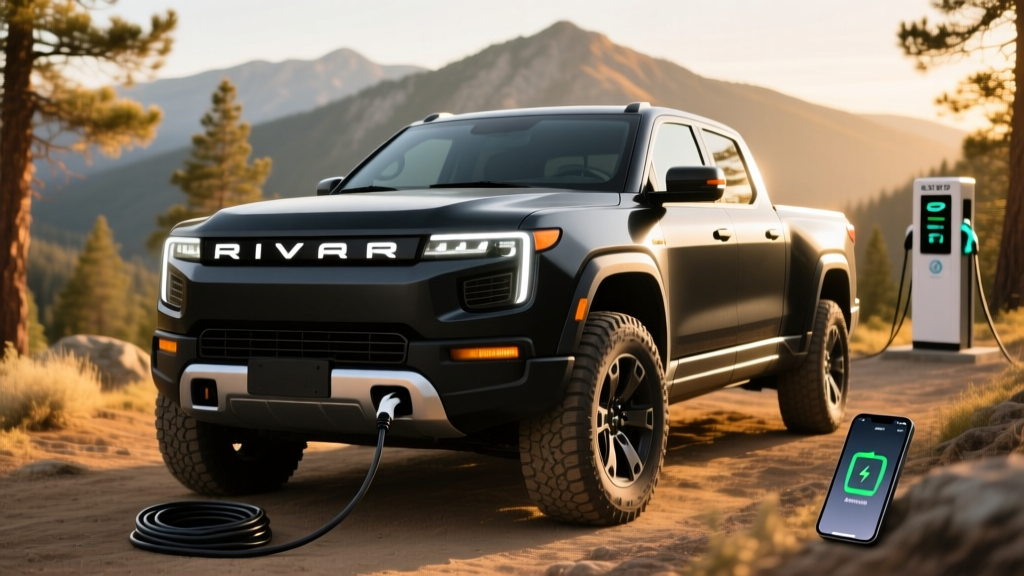
The Rivian R1T launched as the first serious electric pickup, blending trail capability with Silicon Valley tech. But heading into 2026, the truck faces a headwind it didn't anticipate: a growing Rivian R1T sales slump driven not by a bad product, but by a market that has shifted beneath it. New competitors have arrived, federal tax credit rules have tightened, and Rivian's own pricing has crept upward. This review examines the current-generation R1T through the lens of hard data — range, charging, pricing, and ownership economics — to determine whether the sales slowdown reflects a flawed truck or simply a more competitive landscape.
2026 Rivian R1T: Quick Verdict
The R1T remains one of the most capable electric vehicles on the road. Its dual-motor AWD powertrain delivers 533 horsepower in base form (665 hp with the Performance Dual-Motor), the available Max Pack battery pushes EPA range to 416 miles, and the truck's 11,000-lb towing capacity is legitimate. The gear tunnel — a 1.6-meter pass-through storage compartment — is a feature no competitor has matched. But the R1T's starting price now sits above $70,000, the IRS §30D tax credit is largely out of reach for new buyers, and rivals like the Ford F-150 Lightning and Chevrolet Silverado EV undercut it by $15,000 or more. The sales slump is a pricing and positioning story, not a quality one.
Range, Battery, and Real-World Efficiency
Rivian offers the R1T with three battery configurations for the 2025–2026 generation:
| Configuration | Battery (usable kWh) | Chemistry | EPA Range (mi) | MPGe (combined) | kWh/100 mi |
|---|---|---|---|---|---|
| Standard (Dual-Motor) | 95 kWh | NMC (2170 cells) | 270 | 73 MPGe | 46 |
| Large (Dual-Motor) | 128 kWh | NMC (2170 cells) | 352 | 70 MPGe | 48 |
| Max (Dual-Motor) | 149 kWh | NMC (4680-format) | 416 | 68 MPGe | 49 |
Efficiency is the R1T's weakest technical area. At 46–49 kWh/100 miles, it consumes significantly more energy per mile than a Tesla Model Y (28 kWh/100 mi) or even the Hyundai Ioniq 5 (30 kWh/100 mi). This is expected for a full-size truck, but it means home charging costs add up faster than EV sedan owners might anticipate.
Charging Speed: DC Fast and Home Level 2
The R1T's charging performance depends heavily on which battery pack you choose. The Max Pack, with its 4680-format cells, accepts higher peak charge rates than the Standard and Large packs.
| Charge Level | Standard Pack | Large Pack | Max Pack |
|---|---|---|---|
| Level 1 (120V, 12A) | ~3 mi/hr (1.4 kW) | ~3 mi/hr (1.4 kW) | ~3 mi/hr (1.4 kW) |
| Level 2 (240V, 48A) | 11.5 kW (~25 mi/hr) | 11.5 kW (~25 mi/hr) | 11.5 kW (~25 mi/hr) |
| DC Fast Charge (peak) | 200 kW | 200 kW | 220 kW |
| 10–80% DC time | ~30 min | ~40 min | ~42 min |
A critical detail often overlooked: peak kW is not sustained kW. The R1T's charge curve tapers significantly above 60% state of charge (SoC), and sharply above 80%. If you're road-tripping and need a quick top-off, plan your stops around the 10–80% window — pushing from 80–100% can add another 25–30 minutes. Rivian's navigation system preconditions the battery when a Supercharger or compatible DC station is set as your destination, which is essential for hitting these peak rates in cooler weather. Without preconditioning, a cold battery may accept only 50–80 kW initially, stretching your stop considerably.
Rivian uses the NACS (Tesla-style) connector on all 2025+ R1T models, giving native access to the Tesla Supercharger network — currently the most reliable DC fast-charging network in the U.S. by a wide margin. This is a significant advantage over CCS-equipped trucks that still rely on Electrify America or EVgo for highway charging.
Performance and Drivetrain
| Spec | Dual-Motor AWD | Performance Dual-Motor | Quad-Motor AWD |
|---|---|---|---|
| Horsepower | 533 hp | 665 hp | 1,025 hp |
| Torque | 610 lb-ft | 829 lb-ft | 1,198 lb-ft |
| 0–60 mph | 4.5 sec | 3.5 sec | 2.7 sec |
| Top Speed | 125 mph | 130 mph | 130 mph |
| Max Towing | 11,000 lbs | 11,000 lbs | 11,000 lbs |
| Payload | 1,760 lbs | 1,760 lbs | 1,760 lbs |
The Quad-Motor's 2.7-second 0–60 time makes it the quickest pickup ever sold, but the Dual-Motor at 4.5 seconds is already faster than most sports sedans and more than adequate for any real-world scenario. Where the R1T truly differentiates itself is off-road: with 14.9 inches of ground clearance (max), four-corner air suspension, and an integrated wading mode rated to 3+ feet of water, it outperforms the F-150 Lightning and Silverado EV on technical terrain. The tank-turn feature on the Quad-Motor (spinning the left and right wheels in opposite directions) is more than a party trick — it's genuinely useful on tight trails.
Pricing, Trims, and Tax Credit Reality
Here is where the Rivian R1T sales slump becomes clearly visible. Rivian has steadily increased pricing, and the 2026 model year is no exception:
| Configuration | Base MSRP | §30D Federal Credit | Effective Price |
|---|---|---|---|
| Dual-Motor, Standard Pack, Adventure | $71,700 | $0 (over MSRP cap) | $71,700 |
| Dual-Motor, Large Pack, Adventure | $78,200 | $0 | $78,200 |
| Perf. Dual-Motor, Large, Ascend | $88,500 | $0 | $88,500 |
| Quad-Motor, Max Pack, Ascend | $102,000 | $0 | $102,000 |
- MSRP Cap: The §30D credit caps eligibility at $80,000 for trucks, vans, and SUVs. Only the base Dual-Motor Standard Pack at $71,700 technically clears this threshold — but the next requirement eliminates it.
- Battery Sourcing: The credit requires that a growing percentage of critical minerals and battery components be sourced from the U.S. or free-trade-agreement countries. Rivian's NMC cells currently use supply chains that do not meet 2026 sourcing thresholds.
- Income Cap: Even if the R1T qualified, buyers with AGI above $150,000 (single) or $300,000 (joint) are excluded.
- Point-of-Sale Transfer: The credit can be transferred to the dealer at purchase — but only if the vehicle qualifies, which the R1T currently does not.
The absence of the federal tax credit is the single largest factor in the R1T's sales challenge. A buyer comparing a $71,700 R1T (no credit) against a ~$55,000 F-150 Lightning XLT (which may still qualify for partial credits depending on battery sourcing and MSRP) faces a $16,000+ gap before options. For fleet buyers and cost-conscious retail shoppers, that gap is decisive.
Cargo, Passenger Space, and the Gear Tunnel
The R1T is classified as a midsize truck, shorter than a full-size F-150 but with clever packaging that compensates:
- Bed length: 4.5 feet (54 inches) — short by truck standards, but the powered tonneau cover and integrated bed rails are well-executed.
- Frunk (front trunk): 11.0 cu ft — lockable, drainable, and large enough for a full-size cooler or two carry-on bags.
- Gear Tunnel: 11.6 cu ft — a 1.6-meter-long pass-through compartment behind the rear seats, accessible from both sides. This is Rivian's signature feature and ideal for skis, fishing rods, or camping gear that won't fit in the bed.
- Rear-seat legroom: 38.2 inches — adequate for adults on trips under 3 hours, but noticeably tighter than the F-150 Lightning's 43.6 inches.
- Total enclosed cargo: ~27 cu ft (frunk + gear tunnel + bed with tonneau) — more versatile than any competitor, even if the bed itself is shorter.
The trade-off is clear: if you regularly haul 4x8 sheets of plywood or tow heavy fifth-wheel trailers, the R1T's short bed and midsize frame are limiting. If you're an outdoor enthusiast who values secure, lockable storage over raw bed volume, the R1T's layout is unmatched.
Tech, Driver Assistance, and Software
Rivian runs its own vertically integrated software stack — no CarPlay or Android Auto, which is a dealbreaker for some buyers. The 15.6-inch center display is responsive and well-designed, with built-in navigation, streaming, and vehicle controls. Over-the-air (OTA) updates are frequent and substantive; Rivian has added features like enhanced camp mode and improved route planning post-launch.
The Driver+ suite is a Level 2 driver-assistance system (per SAE J3016) — it combines adaptive cruise control and lane-centering on highways, but requires the driver to remain engaged at all times. This is not autonomous driving. Rivian's system is competent but not class-leading; Ford's BlueCruise and GM's Super Cruise offer hands-free operation on mapped highways, which some buyers prefer for long-distance comfort. Rivian has announced enhanced hands-free highway assist for late 2026, but as of this writing, it requires steering-wheel contact.
Warranty and Long-Term Ownership
| Coverage | Term |
|---|---|
| Basic Vehicle | 5 years / 60,000 miles |
| Battery Pack | 8 years / 175,000 miles (70% capacity retention) |
| Drive Units (motors/inverters) | 8 years / 175,000 miles |
| Roadside Assistance | 5 years / 60,000 miles |
Rivian's battery warranty threshold of 70% capacity retention over 8 years / 175,000 miles is competitive with industry norms (Tesla, Ford, and GM all use 70% or 8 years/100,000 miles). The 175,000-mile drivetrain coverage is generous. NMC batteries in the R1T are expected to retain 85–90% capacity after 100,000 miles based on early fleet data, though long-term (200,000+ mile) data is still limited given the truck's 2022 launch. Rivian's vertical integration — they build their own drive units and manage their own battery packs — gives them control over replacements, but their service-center network remains smaller than legacy automakers. Buyers in rural areas should confirm proximity to a Rivian Service Center or mobile-service coverage zone before purchasing.
Pros and Cons
- Class-leading off-road capability (14.9" clearance, wading, tank turns)
- Gear tunnel storage is unique and highly practical
- NACS connector = native Tesla Supercharger access
- Quad-Motor performance is unmatched in any pickup
- Frequent, meaningful OTA updates
- 11,000-lb towing capacity is legitimate and tested
- No federal tax credit eligibility (MSRP + sourcing rules)
- Base price above $71,000 — $15K+ more than Lightning
- No Apple CarPlay or Android Auto
- Short 4.5-ft bed limits traditional truck utility
- Efficiency of 46–49 kWh/100 mi means higher charging costs
- Service network still expanding — rural gaps exist
- Driver+ requires hands-on (no hands-free highway assist yet)
Who Should Buy the R1T — and Who Shouldn't
- You prioritize off-road capability and outdoor-adventure features over traditional truck bed volume.
- You want native Supercharger access without adapters.
- The gear tunnel solves a real storage problem for your lifestyle (skis, bikes, overlanding gear).
- You can absorb a $70,000+ purchase without relying on the federal tax credit.
- Budget is your primary concern — the F-150 Lightning and Silverado EV offer more truck for less money.
- You need a full-size bed for work or regular 4x8 sheet goods.
- Apple CarPlay/Android Auto integration is non-negotiable for you.
- You live far from a Rivian service center and need dealer-level support infrastructure.
Why the Sales Slump Is Happening
The Rivian R1T sales slump in 2025–2026 isn't a product failure — it's a market collision. Three forces are converging:
- Competitor pricing: The Ford F-150 Lightning starts ~$55,000, the Chevy Silverado EV ~$57,000. Both offer 300+ miles of range, larger beds, and established dealer networks. For the majority of truck buyers, the R1T's premium is hard to justify.
- Tax credit exclusion: Without the §30D $7,500 credit, the R1T's effective price gap versus competitors widens to $20,000+ in some trim comparisons.
- Production scaling: Rivian's Normal, Illinois factory is also tasked with building the R1S SUV and the upcoming R2. Limited production slots mean Rivian has chosen margin over volume — selling fewer trucks at higher prices rather than cutting prices to chase volume.
The R1T is a better vehicle today than at launch. But the market around it has matured, and the truck's premium positioning is now tested by alternatives that are good enough for most buyers at a significantly lower price.
Frequently Asked Questions
What is the real-world range of the Rivian R1T?
The EPA rates the R1T at 270 miles (Standard), 352 miles (Large), and 416 miles (Max). In real-world highway driving at 75 mph, expect roughly 85–90% of those figures: ~230, ~300, and ~355 miles respectively. In freezing temperatures, subtract another 15–25%. The Max Pack is the only configuration that comfortably handles 300-mile road-trip legs without anxiety.
How fast does the R1T charge at home and on the road?
At home on a Level 2 (240V, 48A) charger, the R1T adds roughly 25 miles of range per hour — a full overnight charge (10 hours) restores ~250 miles. On DC fast chargers, peak rates are 200–220 kW depending on pack, with 10–80% taking 30–42 minutes. The NACS connector gives native Supercharger access.
Does the Rivian R1T qualify for the $7,500 federal EV tax credit?
No, as of 2026 the R1T does not qualify for the IRS §30D credit. Most trims exceed the $80,000 MSRP cap for trucks, and Rivian's battery supply chain does not currently meet the critical-mineral and component-sourcing requirements. Always verify current rules at IRS.gov and consult a tax professional.
Is the R1T worth buying versus the F-150 Lightning or Silverado EV?
If you value off-road capability, the gear tunnel, NACS Supercharger access, and premium build quality — and you can absorb the $15,000–$25,000 price premium — yes. If you need a full-size bed, maximum rear-seat space, or the lowest possible purchase price, the Lightning or Silverado EV is the more practical choice.
What are the biggest drawbacks of owning a Rivian R1T?
The short 4.5-foot bed, no CarPlay/Android Auto, high energy consumption (46–49 kWh/100 mi = higher charging bills), no federal tax credit, and a still-growing service network. The truck excels as an adventure vehicle but compromises on traditional truck utility and cost efficiency.