The Rivian Car Maker: What You Need to Know Before Buying
Rivian has carved out a distinct niche in the electric-vehicle market by building adventure-oriented trucks and SUVs that rival legacy off-roaders while delivering competitive range and tech. Founded in 2009 and headquartered in Irvine, California, the automaker began delivering its first vehicles—the R1T pickup and R1S three-row SUV—in late 2021. By the 2026 model year, Rivian has refined both platforms with its second-generation architecture, expanded battery options, and the rollout of the smaller, more affordable R2 crossover.
This profile covers the current Rivian lineup with exact EPA figures, real-world range expectations, charging performance, pricing, and tax-credit eligibility—everything you need to decide whether a Rivian fits your garage and budget.
Rivian R1T: The Electric Pickup That Started It All
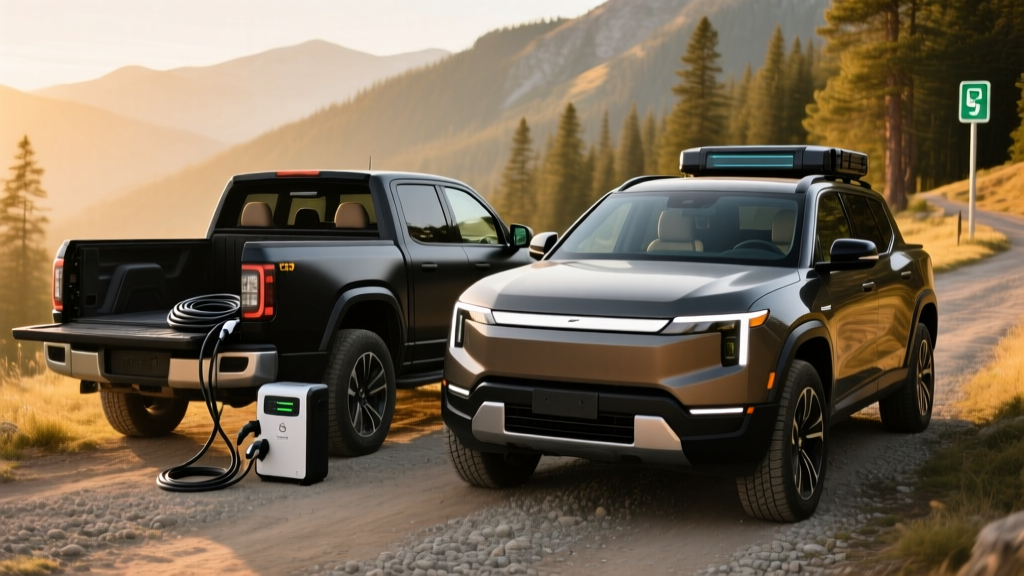
The R1T is a midsize crew-cab pickup with a unibody construction, a four-motor "Quad-Motor" option, and a distinctive Gear Tunnel storage compartment behind the cab. It competes directly with the Ford F-150 Lightning and the Chevrolet Silverado EV, though its footprint is closer to a Toyota Tacoma than a full-size truck.
| Spec | Dual-Motor Standard | Dual-Motor Max | Quad-Motor Max |
|---|---|---|---|
| EPA Range | 270 mi | 352 mi | 328 mi |
| Battery (usable) | 92 kWh (LFP) | 128 kWh (NMC) | 128 kWh (NMC) |
| Horsepower | 533 hp | 533 hp | 1,025 hp |
| 0–60 mph | 4.5 sec | 4.5 sec | 2.6 sec |
| Max DC Fast Charge | 200 kW | 225 kW | 225 kW |
| 10–80% DC Time | ~30 min | ~28 min | ~28 min |
| Level 2 Home Charge | 11.5 kW (~25 mi/hr) | 11.5 kW (~25 mi/hr) | 11.5 kW (~25 mi/hr) |
| Towing Capacity | 11,000 lb | 11,000 lb | 11,000 lb |
| Base MSRP | $69,900 | $79,900 | $93,900 |
Efficiency and MPGe
According to fueleconomy.gov, the R1T Dual-Motor Max achieves approximately 73 MPGe combined, translating to roughly 46 kWh per 100 miles. The heavier Quad-Motor variant drops to about 68 MPGe (49 kWh/100 mi). These figures are typical for a 6,800+ lb electric truck—substantially less efficient than a sedan but competitive within the truck segment.
Cargo and Passenger Dimensions
The R1T offers a 4.5-foot bed (54.3 inches long, 50.2 inches wide between wheel wells), which is shorter than a traditional midsize truck but compensated by the 11-cubic-foot Gear Tunnel and an 11-cubic-foot front trunk (frunk). Total cargo volume across all compartments reaches approximately 69 cubic feet. Front legroom measures 41.3 inches; rear legroom is 36.3 inches—adequate for adults on shorter trips but tighter than a full-size crew cab.
Rivian R1S: Three-Row SUV for the Adventure Family
The R1S shares the R1T's skateboard platform but wraps it in a three-row SUV body with seating for up to seven. It targets buyers who want Land Rover capability with Tesla-like efficiency. The second-generation R1S benefits from a revised interior, improved software, and the same battery options as the R1T.
| Spec | Dual-Motor Standard | Dual-Motor Max | Quad-Motor Max |
|---|---|---|---|
| EPA Range | 258 mi | 340 mi | 315 mi |
| Battery (usable) | 92 kWh (LFP) | 128 kWh (NMC) | 128 kWh (NMC) |
| Horsepower | 533 hp | 533 hp | 1,025 hp |
| 0–60 mph | 4.7 sec | 4.7 sec | 2.9 sec |
| Max DC Fast Charge | 200 kW | 225 kW | 225 kW |
| 10–80% DC Time | ~30 min | ~28 min | ~28 min |
| Level 2 Home Charge | 11.5 kW (~23 mi/hr) | 11.5 kW (~23 mi/hr) | 11.5 kW (~23 mi/hr) |
| Towing Capacity | 7,700 lb | 7,700 lb | 7,700 lb |
| Base MSRP | $74,900 | $84,900 | $99,900 |
Interior Space and Practicality
Behind the third row, the R1S provides 10.4 cubic feet of cargo space—tight for a three-row SUV. Fold the third row and you gain 46.7 cubic feet; fold both rear rows for a maximum of 91.6 cubic feet. Front legroom is 41.3 inches, second-row is 38.2 inches, and the third row offers 29.8 inches—best reserved for children on longer drives.
Charging Performance: DC Fast and Home Level 2
Rivian's Gen 2 vehicles feature an upgraded thermal management system that sustains peak charging rates longer than the first-generation models. On a 350 kW-capable DC fast charger (such as Electrify America or Tesla Supercharger stations open to non-Tesla vehicles), the Max Pack peaks at approximately 225 kW and sustains above 175 kW through roughly 50% state of charge before tapering. The 10–80% charge takes approximately 28 minutes under optimal conditions (battery preconditioned, ambient temp 65–85°F).
| Charging Level | Power (kW) | Miles Added Per Hour | Typical Use Case |
|---|---|---|---|
| Level 1 (120V household) | 1.4 kW | ~3 mi/hr | Emergency/overnight trickle |
| Level 2 (240V home, 48A) | 11.5 kW | ~23–25 mi/hr | Daily home charging |
| DC Fast Charge (Standard Pack) | 200 kW peak | ~140 mi in 15 min | Road trips |
| DC Fast Charge (Max Pack) | 225 kW peak | ~160 mi in 15 min | Road trips |
For home charging, Rivian recommends a hardwired Level 2 wall connector on a 60-amp circuit (48-amp continuous draw). This delivers 11.5 kW, replenishing the Max Pack from empty in roughly 11 hours—overnight for most owners. Installation typically costs $800–$2,000 depending on panel proximity and local permitting, and a licensed electrician should verify your panel can handle the additional 60-amp load.
Rivian also provides access to the Rivian Adventure Network, a proprietary DC fast-charging network deployed near national parks, ski resorts, and popular outdoor destinations. These stations deliver up to 200+ kW and are integrated into the vehicle's navigation for automatic battery preconditioning.
Pricing, Trims, and Federal Tax Credit Eligibility
Rivian's pricing has shifted considerably as the company scales production and introduces the Standard battery pack. Here is a breakdown of the current lineup and how the federal EV tax credit applies.
| Model / Trim | Base MSRP | §30D Tax Credit Eligible? | Effective Price (if eligible) |
|---|---|---|---|
| R1T Dual-Motor Standard | $69,900 | Partial (up to $3,750)* | ~$66,150 |
| R1T Dual-Motor Max | $79,900 | No (above MSRP cap) | $79,900 |
| R1S Dual-Motor Standard | $74,900 | Partial (up to $3,750)* | ~$71,150 |
| R1S Dual-Motor Max | $84,900 | No (above MSRP cap) | $84,900 |
*Under IRS §30D rules, SUVs must have an MSRP at or below $80,000 and pickups at or below $80,000 to qualify. Buyer adjusted gross income must not exceed $150,000 (single) or $300,000 (joint). Battery critical-mineral and component sourcing requirements determine whether the full $7,500 or partial $3,750 credit applies. Rivian's US-built vehicles may meet some but not all sourcing thresholds—verify current eligibility at the IRS Clean Vehicle Provisions page or with a tax professional before purchasing.
Buyers can also opt for a point-of-sale transfer of the credit to the dealer, reducing the purchase price directly rather than waiting to claim it on a tax return.
Tech, Driver Assistance, and Software
Rivian's software platform is proprietary and receives regular over-the-air updates. The 15.6-inch center touchscreen runs a custom interface that handles navigation, climate, media, and vehicle settings. A 12.3-inch digital driver display provides speed, range, and navigation prompts. Wireless Apple CarPlay and Android Auto are not supported—Rivian has opted for native integration, which has drawn mixed reactions from owners accustomed to phone mirroring.
Driver Assistance: Highway Assist and Driver+
Additional driver-assistance features include automatic emergency braking, blind-spot monitoring, rear cross-traffic alert, and a 360-degree camera system useful for off-road trail navigation. Rivian does not currently offer a hands-free driving system comparable to GM's Super Cruise or Ford's BlueCruise.
Standout Features
- Gear Tunnel (R1T): An 11-cubic-foot lockable pass-through compartment behind the cab—ideal for skis, camping gear, or groceries.
- Camp Kitchen: An optional slide-out kitchen module that integrates with the Gear Tunnel, featuring an induction cooktop and sink.
- Air Suspension: Standard adaptive air suspension provides up to 14.9 inches of ground clearance (Max Pack) and can lower for highway efficiency or raise for rock crawling.
- Tank Turn (Quad-Motor): The four independent motors can rotate the vehicle in place on loose surfaces—a party trick that's genuinely useful on tight trails.
- Vehicle-to-Load (V2L): The R1T and R1S can power external devices up to 3.5 kW through bed and cabin outlets, functioning as a mobile generator for camping or backup power.
Warranty and Long-Term Ownership
Rivian covers its vehicles with the following warranty structure:
- Battery & Drive Units: 8 years / 175,000 miles (whichever comes first), with a capacity retention threshold of 70%.
- Limited Vehicle Warranty: 5 years / 60,000 miles bumper-to-bumper.
- Corrosion Perforation: 12 years / unlimited miles.
The 175,000-mile battery warranty exceeds the federal minimum of 8 years/100,000 miles and provides meaningful peace of mind for a vehicle designed for high-mileage adventure use. Rivian publishes limited degradation data, but early first-generation R1T owners report approximately 4–7% range loss after 50,000 miles—within expected bounds for NMC chemistry. LFP-equipped Standard Pack models are expected to show slower degradation due to LFP's superior cycle life, though long-term R1T/R1S LFP data is still accumulating.
Rivian vs. the Competition: R1T and R1S Compared
| Attribute | Rivian R1T Dual-Motor Max | Ford F-150 Lightning Extended Range | Chevrolet Silverado EV 4WT |
|---|---|---|---|
| EPA Range | 352 mi | 320 mi | 450 mi |
| Max DC Charge | 225 kW | 150 kW | 350 kW (est.) |
| 0–60 mph | 4.5 sec | 4.0 sec | ~4.5 sec |
| Towing | 11,000 lb | 10,000 lb | 20,000 lb |
| Bed Length | 4.5 ft | 5.5 ft | 5.9 ft |
| Base MSRP (2026) | $79,900 | $76,995 | $79,900 |
| Unique Advantage | Gear Tunnel + off-road air suspension | Pro Power Onboard, wider dealer network | Longest range, largest bed, highest towing |
The R1T wins on off-road capability (14.9 inches of ground clearance, wading to 36 inches), unique storage solutions, and charging speed. The F-150 Lightning offers a more traditional truck bed, a broader service network, and generally lower pricing. The Silverado EV leads in range and towing but is significantly larger and less trail-friendly. According to IIHS, the R1T has earned top crash-test ratings, bolstering its safety case for families.
Who Should Buy a Rivian — and Who Shouldn't
- You need a capable off-road pickup that doubles as a daily driver
- You value unique storage (Gear Tunnel, frunk) over a long traditional bed
- You camp, ski, or overland regularly and want integrated V2L power
- You have home Level 2 charging access and mostly drive under 250 miles between charges
- You need three-row seating but want genuine off-road capability (not a crossover in disguise)
- You tow a small boat or trailer and want electric torque for hill climbs
- You prefer a premium, tech-forward interior over a traditional truck-cabin feel
- You need a full-size truck bed for commercial work or large payloads daily
- You tow heavy (8,000+ lb) trailers on long routes—range while towing drops sharply
- You want hands-free highway driving (GM Super Cruise or Ford BlueCruise are more mature)
- Budget is tight—the base Standard Pack models still start near $70,000
Pros and Cons at a Glance
- Class-leading off-road capability with air suspension and up to 14.9" ground clearance
- Gear Tunnel and frunk provide versatile, weatherproof storage
- 225 kW DC fast charging is among the best in the truck/SUV segment
- V2L capability turns the vehicle into a 3.5 kW mobile power station
- Strong build quality and thoughtful interior materials
- 8-year/175,000-mile battery warranty exceeds industry standard
- Short 4.5-foot bed limits utility for traditional truck work
- No Apple CarPlay or Android Auto—native-only infotainment
- Third-row space in the R1S is tight for adults
- Range drops significantly when towing (expect ~50% loss under heavy loads)
- Driver-assist system (Level 2) lags behind GM Super Cruise in hands-free capability
- Tax credit eligibility is limited by MSRP caps and battery-sourcing rules
Frequently Asked Questions
What is the real-world range of the Rivian R1T and R1S?
The R1T Dual-Motor Max Pack achieves an EPA-estimated 352 miles, but real-world highway driving at 70–75 mph typically yields 280–310 miles. In cold weather (below freezing), expect 250–270 miles. The R1S Max Pack is rated at 340 miles EPA with similar real-world reductions. Towing cuts range dramatically—to roughly 160–180 miles with a 5,000-pound trailer.
How fast does a Rivian charge at home and on the road?
At home on a Level 2 (240V, 48A) charger, Rivians add approximately 23–25 miles of range per hour, fully recharging overnight in 10–12 hours. On a DC fast charger, the Max Pack peaks at 225 kW and charges from 10–80% in roughly 28 minutes when preconditioned. The Standard Pack (LFP) peaks at 200 kW with a similar 10–80% time of about 30 minutes.
How much does a Rivian cost after tax credits?
The 2026 R1T Dual-Motor Standard starts at $69,900 and may qualify for a partial $3,750 federal tax credit under §30D, bringing the effective price to approximately $66,150 for eligible buyers. The Max Pack trims exceed the $80,000 MSRP cap for pickups and do not qualify. Always verify current income limits, MSRP thresholds, and battery-sourcing requirements on the IRS Clean Vehicle Credit page before purchasing.
Is the Rivian R1T worth buying over the Ford F-150 Lightning?
It depends on your priorities. The R1T excels at off-road capability, unique storage (Gear Tunnel), and faster DC charging. The F-150 Lightning offers a longer bed, a larger dealer/service network, Pro Power Onboard, and slightly lower pricing. If you need a traditional work truck, the Lightning is more practical. If you want an adventure vehicle that happens to be a truck, the R1T is the stronger choice.
Does Rivian qualify for the federal EV tax credit?
Select Rivian configurations may qualify for a partial §30D credit (up to $3,750) if the MSRP is at or below $80,000, the buyer's income falls within IRS limits ($150K single / $300K joint), and the vehicle meets critical-mineral and battery-component sourcing requirements. Max Pack trims priced above $80,000 do not qualify. Rules can change—consult a tax professional or the IRS website for current-year guidance.
What is the Rivian R2, and when will it be available?
The R2 is a smaller, more affordable two-row crossover built on a new platform at Rivian's Normal, Illinois factory. With a starting MSRP around $45,000, it targets the mainstream EV market. Deliveries began in early 2026 with limited configurations; broader availability is expected through mid-to-late 2026. Full EPA range and charging specs for the R2 are being published as the model rolls out.