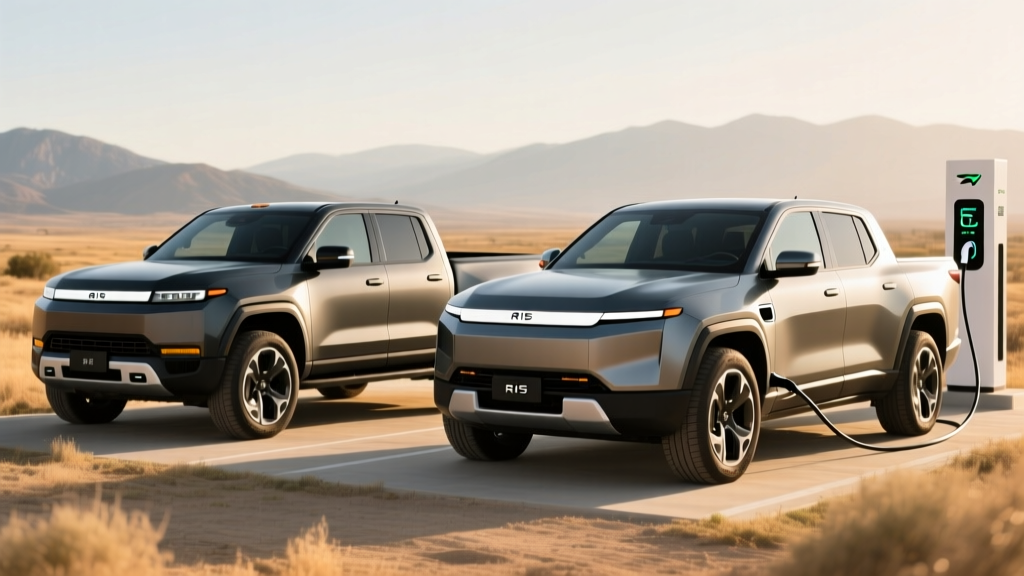
Rivian's lineup for the 2026 model year centers on two vehicles built on the company's updated Gen 2 platform: the R1T electric pickup and the R1S three-row SUV. Both share core architecture, battery options, and powertrain configurations, but serve distinctly different use cases. If you're researching Rivian car models to figure out which one fits your driving life — or whether either makes financial sense after federal incentives — this guide breaks down every spec that matters.
We'll walk through range, charging, performance, pricing, and real-world ownership considerations for both the R1T and R1S, with exact numbers rather than marketing generalities.
Rivian R1T and R1S: Quick Spec Comparison
Before diving into details, here's a side-by-side look at the core specifications for the most popular configurations of the 2026 Rivian R1T and R1S. Both vehicles offer Standard, Large, and Max battery packs, plus Dual-Motor and Quad-Motor drivetrains.
| Spec | R1T (Pickup) | R1S (SUV) |
|---|---|---|
| EPA Range | ~352 miles | ~341 miles |
| Battery Capacity (usable) | ~106 kWh (Large, NMC) | ~106 kWh (Large, NMC) |
| Battery Chemistry | NMC (Large/Max); LFP (Standard) | NMC (Large/Max); LFP (Standard) |
| Peak DC Fast Charge | ~220 kW | ~220 kW |
| 10–80% DC Charge Time | ~30 minutes | ~30 minutes |
| Level 2 Home Charging | 11.5 kW (~25 mi/hr) | 11.5 kW (~25 mi/hr) |
| 0–60 mph (Dual-Motor) | ~4.5 seconds | ~4.6 seconds |
| 0–60 mph (Quad-Motor) | ~3.0 seconds | ~3.1 seconds |
| Horsepower (Dual-Motor) | 533 hp | 533 hp |
| Horsepower (Quad-Motor) | 1,025 hp | 1,025 hp |
| MPGe (Combined) | ~73 MPGe | ~71 MPGe |
| Efficiency | ~46 kWh/100 mi | ~48 kWh/100 mi |
| Towing Capacity | 11,000 lbs | 7,700 lbs |
| Base MSRP | $69,900 | $74,900 |
| Battery/Powertrain Warranty | 8 yr / 175,000 mi | 8 yr / 175,000 mi |
Note: EPA figures vary by wheel size, drivetrain, and battery selection. Specs above reflect the Dual-Motor with Large battery pack on 20-inch wheels. Always verify at fueleconomy.gov for your exact configuration.
Real-World Range: What to Actually Expect
R1T Dual-Motor Large: EPA 352 mi → Expect ~290–310 mi highway at 70 mph; ~240–260 mi in sub-30°F winter conditions.
R1S Dual-Motor Large: EPA 341 mi → Expect ~280–300 mi highway at 70 mph; ~230–250 mi in sub-30°F winter conditions.
Quad-Motor trims: Subtract ~15–20% from EPA due to higher power draw and increased vehicle weight.
Max Pack: EPA exceeds 400 mi for both models; real-world highway still lands in the 330–360 mi range.
Rivian's EPA range numbers are competitive with other large-platform EVs, but the physics of a 7,000+ pound vehicle with the aerodynamic profile of a pickup or boxy SUV means highway efficiency drops noticeably above 65 mph. In our experience and consistent with independent testing, plan for roughly 15% below the EPA sticker on highway road trips and up to 25–30% reduction in sustained cold weather below freezing.
The Standard battery pack uses LFP (lithium iron phosphate) chemistry, which offers excellent cycle life and can be charged to 100% daily without degradation concerns — but at the cost of lower energy density and reduced range (roughly 270 miles EPA for the R1T). The Large and Max packs use NMC (nickel manganese cobalt), which delivers more range but benefits from daily charging limits around 80–90% for long-term battery health.
If your commute is under 80 miles round-trip and you have home charging, even the Standard pack covers most daily needs with significant buffer. The Max pack is the right call only if you frequently tow, drive in extreme cold, or regularly take road trips exceeding 300 miles between reliable DC fast chargers.
Charging Speed: DC Fast, Level 2, and the Curve Reality
Rivian's Gen 2 platform supports peak DC fast charging at approximately 220 kW via the NACS connector, giving both the R1T and R1S native access to the Tesla Supercharger network alongside Rivian's own Adventure Network and third-party providers like Electrify America.
| Charging Level | Power | Speed (Miles Added) | Typical Use Case |
|---|---|---|---|
| Level 1 (120V outlet) | ~1.4 kW | ~3–4 mi/hr | Emergency/overnight trickle |
| Level 2 (240V, home) | 11.5 kW | ~25 mi/hr | Daily home charging |
| DC Fast Charge (peak) | ~220 kW | ~140+ mi in 15 min | Road trips |
| DC Fast 10–80% | Variable (curve) | ~30 minutes | Typical road-trip stop |
Understanding the charge curve: The 220 kW peak is not sustained across the entire session. Like all modern EVs, the R1T and R1S charge fastest between roughly 10–40% state of charge, then taper progressively. By 70%, charge rate typically drops to around 100–120 kW; above 80%, it slows further to protect battery health. This is why manufacturers quote 10–80% times rather than 0–100%.
For home Level 2 charging, Rivian's onboard charger accepts up to 11.5 kW, which requires a 60-amp dedicated circuit (typically a NEMA 14-50 outlet or hardwired wall connector). A full overnight charge from 20% to 80% takes roughly 6–7 hours — more than adequate for daily use. Expect home installation costs between $800 and $2,500 depending on panel capacity and run length; older homes may need a 200-amp panel upgrade, adding $1,500–$3,000.
The Standard (LFP) pack charges at slightly lower peak DC rates — approximately 180 kW — but LFP chemistry tolerates frequent 100% charging, so the practical impact on daily usability is modest.
Performance and Drivetrain Configurations
Rivian offers two primary drivetrain layouts across the R1T and R1S:
- Dual-Motor (AWD): One motor per axle, producing 533 hp and 610 lb-ft of torque. 0–60 mph in approximately 4.5 seconds. This is the volume configuration and the one most buyers should choose — it delivers strong acceleration, better efficiency, and lower cost.
- Quad-Motor (AWD): One motor per wheel, producing 1,025 hp and over 1,000 lb-ft of torque. 0–60 mph in approximately 3.0 seconds. This is a performance flagship with independent wheel torque vectoring, but it reduces range by roughly 15% and adds significant cost.
Both configurations feature Rivian's air suspension with adjustable ride height (up to 14.9 inches of ground clearance on the R1T), making them genuinely capable off-road. The R1T's 11,000-pound towing capacity is best-in-class among electric pickups, though towing at max capacity will cut range roughly in half — plan for 150–175 miles between charges when pulling a heavy trailer.
The R1S tows up to 7,700 pounds, adequate for most boat and camper trailers but less suited for heavy fifth-wheel applications.
Pricing, Trims, and Federal Tax Credit Eligibility
Rivian simplified its trim structure for 2026, offering the R1T and R1S in Dual-Motor and Quad-Motor configurations across Standard, Large, and Max battery options. Here's how pricing breaks down:
| Model | Configuration | Base MSRP |
|---|---|---|
| R1T | Dual-Motor Standard | $69,900 |
| R1T | Dual-Motor Large | $75,900 |
| R1T | Dual-Motor Max | $85,900 |
| R1T | Quad-Motor Large | $87,900 |
| R1S | Dual-Motor Standard | $74,900 |
| R1S | Dual-Motor Large | $79,900 |
| R1S | Dual-Motor Max | $89,900 |
| R1S | Quad-Motor Large | $92,900 |
Federal tax credit (IRS §30D) eligibility is complex and configuration-dependent. As of 2026, the key rules are:
- MSRP cap: Vans, SUVs, and pickup trucks must have an MSRP at or below $80,000 to qualify. This means several R1T and R1S configurations (Max pack, Quad-Motor) exceed the cap and are ineligible.
- Buyer income cap: Modified adjusted gross income must not exceed $300,000 (joint), $225,000 (head of household), or $150,000 (single).
- Battery sourcing: A percentage of critical minerals and battery components must be sourced from the U.S. or free-trade-agreement countries. Rivian has been working to qualify its supply chain, but eligibility can change — always verify current status at IRS.gov before purchasing.
- Point-of-sale transfer: Eligible buyers can transfer the credit to the dealer at purchase, reducing the upfront price rather than waiting for a tax refund.
The R1T Dual-Motor Standard ($69,900) and Dual-Motor Large ($75,900) fall under the $80,000 truck MSRP cap and may qualify for up to $7,500 — if your income is within limits and battery-sourcing requirements are met. The R1S Dual-Motor Standard ($74,900) also qualifies under the SUV cap. Always confirm with your tax professional and check the latest IRS guidance before committing.
Interior, Cargo, and Technology
Both the R1T and R1S feature Rivian's minimalist interior anchored by a 15.6-inch center touchscreen and a 12.3-inch digital instrument cluster. The infotainment system runs Rivian's proprietary OS — responsive and well-designed, but without Apple CarPlay or Android Auto. Rivian provides its own navigation, music streaming, and phone integration, which works well for most users but is a dealbreaker for those who rely on CarPlay-based workflows.
R1T cargo and space:
- Bed length: 4.5 feet (with midgate closed); extends to ~6.5 feet with midgate open
- Gear Tunnel: 11.7 cu ft lockable, climate-controlled storage (unique to the R1T)
- Frunk (front trunk): 11.1 cu ft
- Front legroom: 41.3 in | Rear legroom: 38.2 in
- Seating: 5 passengers (two-row crew cab)
R1S cargo and space:
- Cargo behind third row: ~10.5 cu ft
- Cargo behind second row: ~46.7 cu ft
- Cargo with both rear rows folded: ~104.7 cu ft
- Frunk: 11.1 cu ft
- Front legroom: 41.3 in | Second row: 38.2 in | Third row: 30.4 in
- Seating: 7 passengers (three-row)
The R1S third row is best suited for children or occasional use — the 30.4 inches of legroom is tight for adults on longer trips. If you regularly carry more than five adults, a minivan or larger SUV remains more practical. But for families with two or three kids who need occasional extra seating, the R1S is one of the few three-row EVs on the market.
Driver assistance: Rivian's Driver+ system is a Level 2 driver-assist feature offering adaptive cruise control, lane centering, and hands-on-wheel highway assistance. It is not self-driving and requires continuous driver attention. Rivian has been progressively improving Driver+ via over-the-air updates, but it trails the sophistication of GM's Super Cruise and Ford's BlueCruise in hands-free highway coverage.
Warranty and Long-Term Ownership
Rivian provides a competitive warranty package:
- Vehicle limited warranty: 5 years / 60,000 miles
- Battery and powertrain warranty: 8 years / 175,000 miles (with at least 70% capacity retention)
- Roadside assistance: 5 years / 60,000 miles
The 175,000-mile battery warranty is among the most generous in the industry and signals confidence in long-term durability. The 70% capacity retention threshold is standard — if your battery degrades below 70% of original capacity within the warranty period, Rivian will repair or replace it.
Insurance costs for Rivian vehicles tend to run 15–25% higher than comparable gas-powered trucks and SUVs, reflecting repair costs, parts availability, and the vehicle's value. Get quotes before purchasing to avoid surprises.
Rivian operates its own service centers and mobile service fleet. Service availability has expanded but remains limited in rural areas compared to legacy automakers. Check Rivian's service locator for coverage in your area before buying.
Pros, Cons, and Who Should Buy a Rivian
- Class-leading combination of range, performance, and off-road capability
- NACS connector with native Supercharger access
- R1T's Gear Tunnel and midgate are genuinely innovative
- R1S is one of the only three-row electric SUVs available
- 11,000-lb towing (R1T) is best among electric pickups
- 8-year/175,000-mile battery warranty
- Over-the-air updates continuously improve the vehicle
- No Apple CarPlay or Android Auto
- Third-row space in R1S is tight for adults
- Higher configurations push well past $80,000 (losing tax credit eligibility)
- Service center network still limited in many regions
- Insurance premiums are notably higher than gas equivalents
- Driver+ (Level 2 assist) lags some competitors in hands-free coverage
- Towing cuts range approximately in half
Choose the R1T if: You need a pickup for work, towing, or adventure use and want electric powertrain benefits without sacrificing capability. The Dual-Motor Large pack offers the best balance of range, price, and utility.
Choose the R1S if: You need three rows of seating for family use and want an electric SUV that can handle light off-road duty and road trips. The Dual-Motor Standard is the value pick if your daily range needs are modest.
Look elsewhere if: You require CarPlay/Android Auto, need a service center within 20 miles, or regularly carry six adults (the third row is too tight). Budget-conscious buyers may also find the Ford F-150 Lightning or Chevy Silverado EV more accessible at lower price points, though neither matches Rivian's combination of range and performance.
Frequently Asked Questions
What is the real-world range of Rivian car models?
For the most common configuration (Dual-Motor with Large pack), expect roughly 290–310 highway miles in the R1T and 280–300 in the R1S under normal conditions. In cold weather below 30°F, subtract another 10–15%. The Max pack pushes real-world highway range to approximately 330–360 miles.
How fast do Rivian models charge at home and on the road?
At home on a Level 2 (240V) charger, both models accept 11.5 kW, adding roughly 25 miles of range per hour. A typical overnight session (8 hours) adds about 200 miles. On DC fast chargers, peak rate is ~220 kW with a 10–80% session taking approximately 30 minutes. The Standard (LFP) pack peaks at roughly 180 kW.
How much do Rivian models cost after tax credits?
If you qualify for the full $7,500 federal credit under IRS §30D (income limits, MSRP cap, and battery sourcing all met), the R1T Dual-Motor Standard drops to an effective $62,400 and the R1S Dual-Motor Standard to $67,400. Many state and utility incentives stack on top — check your local programs. Configurations above $80,000 MSRP do not qualify for the federal credit.
Do Rivian vehicles qualify for the federal EV tax credit?
Selectively. The R1T Dual-Motor Standard ($69,900) and Large ($75,900), and the R1S Dual-Motor Standard ($74,900) and Large ($79,900) all fall under the $80,000 MSRP cap for trucks/SUVs. However, buyer income limits and battery-sourcing requirements also apply. Verify current eligibility at IRS.gov and consult a tax professional.
Is a Rivian worth buying versus the competition?
The R1T is the most capable all-around electric pickup on the market — it outperforms the Ford F-150 Lightning on range and off-road ability, though the Lightning is cheaper and has broader service infrastructure. The R1S competes with the Tesla Model X and Kia EV9 as a three-row electric SUV, offering better off-road capability and a more distinctive design at a premium price. If you value adventure capability and build quality, Rivian is a strong choice. If budget or service proximity is paramount, explore alternatives.
Can Rivian vehicles use Tesla Superchargers?
Yes. The 2026 R1T and R1S come with the NACS (North American Charging Standard) connector, providing native access to Tesla's Supercharger network without an adapter. This is one of the strongest practical advantages of buying a new Rivian, as the Supercharger network remains the most reliable DC fast-charging infrastructure in the U.S.