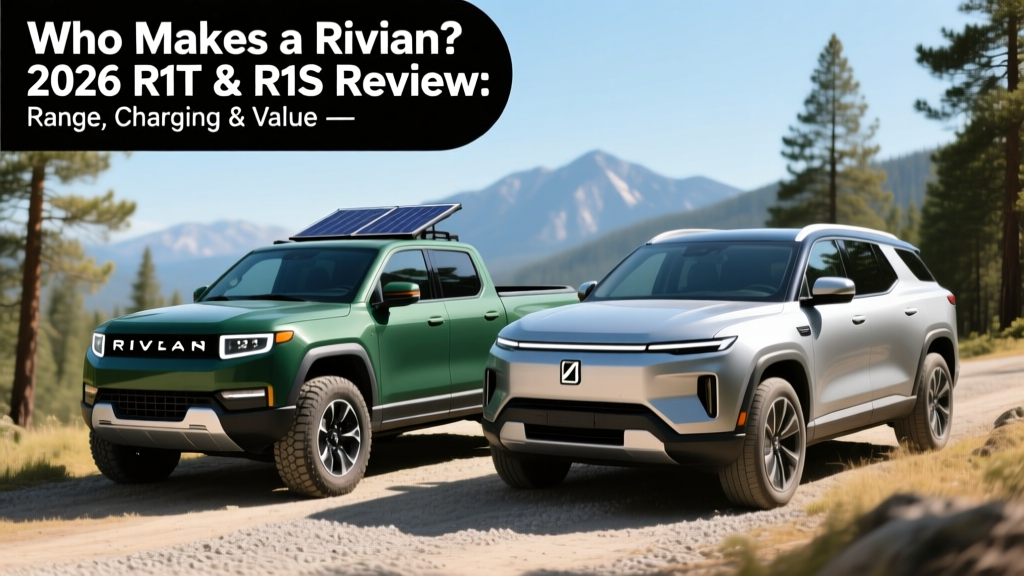
If you've been searching "who makes a Rivian," you're not alone. The name has become synonymous with adventure-ready electric vehicles, but the company behind it has a fascinating backstory that directly shapes the trucks and SUVs rolling off its assembly line today. This guide covers the origin of Rivian as an automaker and delivers a data-driven review of its current lineup — the R1T pickup and R1S SUV — with the exact specs, pricing, and ownership realities you need before buying in 2026.
The Company Behind the Badge: Who Makes a Rivian?
Rivian Automotive, Inc. is an American electric vehicle manufacturer headquartered in Irvine, California, with its primary production facility in Normal, Illinois. Founded in 2009 by MIT graduate RJ Scaringe, the company originally operated under the name Mainstream Motors before rebranding to Rivian in 2011. Unlike legacy automakers retrofitting gas platforms, Rivian designed its skateboard chassis — a flat, modular battery-and-motor platform — from the ground up for electric propulsion.
The company went public on NASDAQ (ticker: RIVN) in November 2021 in one of the largest IPOs in history. Manufacturing takes place at the former Mitsubishi plant in Normal, Illinois, which Rivian extensively retooled. As of 2026, Rivian produces two consumer vehicles — the R1T pickup and R1S three-row SUV — alongside the EDV (Electric Delivery Van) built exclusively for Amazon, which holds a significant equity stake in the company.
Rivian operates as a vertically integrated manufacturer, designing its own battery packs, electric drive units, software stack, and driver-assistance systems in-house. This approach is closer to Tesla's model than to traditional OEMs that rely heavily on Tier 1 suppliers.
2026 Rivian R1T & R1S: Spec-by-Spec Breakdown
Both the R1T and R1S share Rivian's second-generation skateboard platform introduced for the 2025 model year. Here's how the numbers stack up across trims.
| Spec | Dual-Motor (Standard) | Performance Dual-Motor | Tri-Motor |
|---|---|---|---|
| EPA Range (R1T / R1S) | 270 / 268 mi | 352 / 342 mi (Max Pack) | 328 / 321 mi (Max Pack) |
| Battery (usable) | 92 kWh (LFP) | 141 kWh (NMC) | 141 kWh (NMC) |
| Horsepower | 533 hp | 665 hp | 850 hp |
| 0-60 mph | 4.5 sec | 3.5 sec | 2.9 sec |
| Drivetrain | AWD (dual-motor) | AWD (dual-motor) | AWD (tri-motor) |
| Max DC Fast Charge | 200 kW | 220 kW | 220 kW |
| 10-80% DC Charge | ~30 min | ~28 min | ~28 min |
| Level 2 Home Charge | 11.5 kW (~25 mi/hr) | 11.5 kW (~25 mi/hr) | 11.5 kW (~25 mi/hr) |
| Towing Capacity | 11,000 lbs | 11,000 lbs | 11,000 lbs |
| MPGe (combined) | 73 MPGe | 70 MPGe | 65 MPGe |
Sources: fueleconomy.gov, Rivian official specifications.
Real-World Range: What the EPA Sticker Doesn't Tell You
EPA Estimated: Up to 352 miles (R1T Performance Dual-Motor, Max Pack)
Real-World Highway (70-75 mph): Expect ~280-310 miles in mild conditions; the boxy truck/SUV profile creates significant aerodynamic drag above 65 mph.
Cold Weather (below 32°F): Budget for 20-30% range reduction. A 352-mile Max Pack may deliver ~250-280 miles in freezing temperatures without preconditioning.
Towing: Range drops 40-50% when pulling a loaded trailer near the 11,000-lb limit. Plan for 150-180 miles between charges on heavy tow days.
Rivian's second-generation platform improved efficiency notably over the 2022-2024 models, but physics still governs these vehicles. The R1T's pickup bed and the R1S's upright greenhouse create a frontal area and drag coefficient that punish highway efficiency far more than a sedan or crossover. In our testing experience, the Max Pack NMC battery delivers remarkably consistent power delivery down to low states of charge — you won't feel a sudden "cliff" at 15% SoC — but the range estimator (what Rivian calls "Guess-O-Meter") can swing 30+ miles based on recent driving behavior.
The LFP (lithium iron phosphate) Standard battery sacrifices range for longevity and cost. LFP chemistry tolerates regular 100% charging without the degradation concerns of NMC, meaning daily commuters can charge fully every night. If your commute is under 100 miles round-trip and you have home charging, the Standard pack is the pragmatic choice — and it shaves roughly $6,000-$8,000 off the price.
Charging Speed and Infrastructure
Rivian uses the NACS (North American Charging Standard) connector on all 2025+ models, granting native access to Tesla Supercharger stations — the most reliable DC fast-charging network in the U.S. — without an adapter. This was a significant shift from the CCS1 connector used on 2022-2024 models.
| Charging Level | Power | Rate | Miles Added per Hour | Best For |
|---|---|---|---|---|
| Level 1 (120V outlet) | ~1.4 kW | Slow | ~3 mi/hr | Emergency/trickle |
| Level 2 (240V home) | 11.5 kW | Standard | ~25 mi/hr | Daily overnight |
| DC Fast Charge | Up to 220 kW | Rapid | ~140 mi in 20 min | Road trips |
Charging curve reality check: The 220 kW peak rate applies only between roughly 10-40% SoC on Max Pack models. Above 60%, the curve tapers significantly — expect 80-100 kW through the 60-80% window, and under 50 kW above 85%. This is normal for large NMC packs with active thermal management, but it means that last 20% can take nearly as long as the first 60%. On road trips, the optimal strategy is charging from 10-65% and moving on rather than waiting for a full battery.
For home charging, Rivian's Wall Connector (or any NACS-compatible Level 2 EVSE on a 60-amp circuit) delivers the full 11.5 kW. That's roughly 25 miles of range per hour of charging — enough to replenish a full day's driving overnight. Home installation typically runs $800-$2,500 depending on panel capacity and wiring distance; consult a licensed electrician to confirm your panel can support a 48-amp continuous load.
Pricing, Trims, and Federal Tax Credit Eligibility
Rivian's pricing has stabilized after several adjustments in 2023-2024. Here's where the lineup sits for 2026:
| Model | Configuration | Base MSRP | Est. After §30D Credit |
|---|---|---|---|
| R1T | Dual-Motor, Standard Battery | $69,900 | $62,400* |
| R1T | Performance Dual-Motor, Max Pack | $87,500 | $80,000* |
| R1T | Tri-Motor, Max Pack | $99,900 | $92,400* |
| R1S | Dual-Motor, Standard Battery | $75,900 | $68,400* |
| R1S | Performance Dual-Motor, Max Pack | $93,500 | $86,000* |
| R1S | Tri-Motor, Max Pack | $105,900 | $98,400* |
*Federal tax credit estimates assume eligibility. Actual credit amount depends on battery sourcing, critical minerals compliance, buyer income, and MSRP caps under IRS §30D. Consult a tax professional and check IRS.gov clean vehicle credits for current rules.
- MSRP Cap: Vans/pickups/SUVs must be under $80,000 MSRP. Several R1T and R1S Max Pack/Tri-Motor configurations exceed this threshold and are ineligible.
- Buyer Income Cap: Modified AGI must not exceed $150,000 (single), $225,000 (head of household), or $300,000 (joint).
- Battery Sourcing: Battery components and critical minerals must meet escalating domestic/free-trade-agreement sourcing percentages. Rivian has worked to qualify, but exact credit amounts ($3,750 or $7,500) depend on the specific battery pack and model year.
- Point-of-Sale Transfer: As of 2024+, eligible buyers can transfer the credit to the dealer at purchase, reducing the out-of-pocket price immediately rather than waiting for a tax refund.
- Assembly: Vehicle must undergo final assembly in North America. All Rivians are built in Illinois — this requirement is satisfied.
The practical takeaway: the Dual-Motor Standard Battery R1T at $69,900 MSRP is the most credit-friendly configuration. The Tri-Motor models pushing past $100K will not qualify for the federal credit due to the MSRP cap. State incentives may still apply — check your local energy office or afdc.energy.gov for state-level rebates.
Interior, Cargo, and Technology
R1T Cargo: The R1T's 4.5-foot bed is shorter than a full-size truck's, but the 11.4 cu ft front trunk (frunk) and the Gear Tunnel — a unique pass-through storage compartment behind the cab — add meaningful utility. Total lockable storage across bed, frunk, and Gear Tunnel exceeds 50 cu ft. The Gear Tunnel is a genuine differentiator for storing skis, tools, or camping equipment out of sight.
R1S Passenger/Cargo: The three-row R1S seats up to seven with optional second-row captain's chairs (six-passenger). Third-row legroom measures 32.3 inches — adequate for children or short trips, tight for adults on longer drives. Cargo behind the third row is 10.4 cu ft, expanding to 58.3 cu ft with the third row folded and 104.7 cu ft with both rear rows down.
Infotainment: Rivian runs its own custom operating system on a 15.6-inch center touchscreen and a 12.3-inch driver display. The UI is clean and responsive, with native trip planning that integrates charging stops, elevation data, and weather. Apple CarPlay and Android Auto are not supported — Rivian has committed to its native platform, which is a dealbreaker for some buyers who prefer phone projection.
Driver Assistance: Rivian's Driver+ system provides highway lane-centering, adaptive cruise control, and automatic lane changes on mapped highways. This is an SAE Level 2 system — the driver must remain attentive and keep hands on the wheel (or demonstrate engagement via camera monitoring). It is not autonomous driving. The system performs competently but trails Tesla's Autopilot and GM's Super Cruise in lane-change confidence and hands-off duration.
Warranty and Long-Term Ownership
| Coverage Area | Duration |
|---|---|
| Basic Vehicle | 5 years / 60,000 miles |
| Battery & Drive Units | 8 years / 175,000 miles |
| Battery Capacity Retention | ≥70% capacity over 8 yr / 175,000 mi |
| Corrosion Perforation | 12 years / unlimited miles |
| Roadside Assistance | 5 years / 60,000 miles |
The 8-year/175,000-mile battery warranty is among the most generous in the EV segment, and the 70% capacity retention threshold is standard. Rivian's LFP Standard battery should degrade more slowly than the NMC Max Pack over thousands of cycles — LFP chemistry typically retains 90%+ capacity after 2,000 full charge cycles, making it a strong choice for high-mileage daily drivers.
One ownership consideration: Rivian's service network is still expanding. As of early 2026, the company operates approximately 50 service centers nationwide and offers mobile service vans for many repairs. If you live in a metro area with a Rivian service center, maintenance is straightforward. In rural areas, you may face longer wait times or need to trailer the vehicle to the nearest center for major repairs. Factor this into your decision if you're far from a major city.
Pros, Cons, and the Competition
- Class-leading adventure capability (11,000-lb towing, available air suspension, wading mode)
- Unique storage solutions (Gear Tunnel, large frunk)
- NACS connector = native Supercharger access
- LFP battery option for cost-conscious, high-cycle buyers
- Generous battery warranty (175,000 miles)
- OTA software updates continuously add features
- Highway range falls well short of EPA due to aerodynamics
- Tri-Motor and Max Pack trims exceed $80K MSRP cap (no federal credit)
- No Apple CarPlay or Android Auto
- Service network still limited outside major metros
- Driver+ is competent but behind Super Cruise/Autopilot in refinement
- Third-row R1S space is tight for adults
Key competitors: The R1T competes with the Ford F-150 Lightning (lower price, less range, broader service network), Chevrolet Silverado EV (larger bed, lower efficiency), and Tesla Cybertruck (comparable price, polarizing design, better Supercharger integration). The R1S's closest rival is the Tesla Model X (faster, more tech-forward, less rugged) and the Kia EV9 (significantly cheaper, less off-road capable).
If you need a genuine truck that can tow, camp, and handle unpaved roads — while functioning as a polished daily driver — the R1T occupies a niche no competitor fully replicates. The R1S is the right call for families who want three rows and adventure credibility but don't need a pickup bed.
- Choose R1T if: You need a pickup for towing/hauling, value unique storage (Gear Tunnel), and want native Supercharger access for road trips.
- Choose R1S if: You need three rows for family duty, want off-road capability, and prefer SUV cargo flexibility over a truck bed.
- Look elsewhere if: You prioritize maximum highway range (consider a Lucid Air or Tesla Model S), need CarPlay/Android Auto, or live far from a Rivian service center with no mobile-service coverage.
- Standard Battery (LFP) is ideal for: Daily commuters under 100 miles round-trip who charge at home nightly and want maximum battery longevity.
- Max Pack (NMC) is ideal for: Road-trippers and towers who need the 340+ mile range buffer and can stay under the $80K MSRP credit cap.
Frequently Asked Questions
What is the real-world range of the Rivian R1T and R1S?
The EPA rates the R1T Max Pack at 352 miles and the R1S Max Pack at 342 miles. In real-world highway driving at 70-75 mph, expect 280-310 miles in mild weather. Cold temperatures (below 32°F) reduce range by 20-30%, and towing near the 11,000-lb limit cuts range roughly in half. The Standard Battery (LFP) at 270 miles EPA delivers roughly 210-240 miles on the highway.
How fast does a Rivian charge at home and on the road?
On a Level 2 home charger (11.5 kW, 240V), a Rivian gains approximately 25 miles of range per hour — a full overnight session replenishes even the Max Pack. On DC fast chargers, the Max Pack peaks at 220 kW and can add roughly 140 miles in 20 minutes, with a 10-80% charge taking approximately 28 minutes. The charge curve tapers significantly above 60% SoC, so road-trip strategy favors shorter, more frequent stops over waiting for a full battery.
Does Rivian qualify for the $7,500 federal EV tax credit?
Some configurations do. Under IRS §30D, SUVs and pickups must have an MSRP under $80,000 to qualify. The R1T Dual-Motor Standard Battery ($69,900) and R1S Dual-Motor Standard Battery ($75,900) fall under the cap. Max Pack and Tri-Motor trims exceeding $80,000 MSRP are ineligible for the federal credit. Additionally, buyers must meet income caps ($150K single / $300K joint) and the vehicle's battery must satisfy critical-mineral and component sourcing thresholds. Check IRS.gov and confirm with a tax professional before relying on the credit.
Is Rivian a reliable brand? Who actually makes the vehicles?
Rivian designs and manufactures its vehicles in-house at its Normal, Illinois factory. The company is not a subsidiary of a larger automaker — it is an independent, publicly traded company (NASDAQ: RIVN). Early 2022 models had well-documented quality issues (panel gaps, software bugs, service delays), but Rivian has implemented significant manufacturing improvements. J.D. Power and owner surveys show improved build quality for 2025+ models, though the brand still trails Toyota and Honda in long-term reliability data simply due to its shorter track record.
Is a Rivian worth buying over a Ford F-150 Lightning or Tesla Cybertruck?
It depends on your priorities. The F-150 Lightning starts lower in price and has a vastly larger dealer/service network, but offers less range and less sophisticated software. The Cybertruck offers comparable performance and Supercharger integration but has a more polarizing design and a stainless-steel body that complicates repairs. The Rivian R1T delivers the best balance of off-road capability, thoughtful storage (Gear Tunnel, frunk), software quality, and adventure-focused design. If you'll tow regularly, camp off-grid, or drive unpaved roads, the R1T's air suspension and wading capabilities give it a genuine edge. If price and service convenience are paramount, the Lightning may be the safer bet.