Rivian Safety in 2026: What the Crash Data Actually Shows
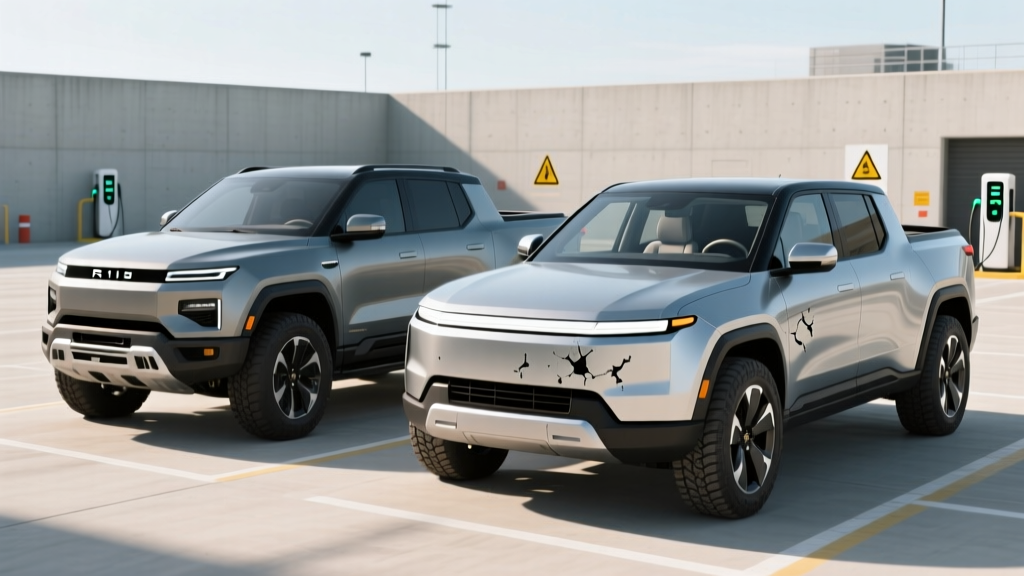
If you are researching a Rivian crash test score before signing a purchase agreement, you are asking the right question. The R1T pickup and R1S SUV share the same skateboard platform, battery architecture, and occupant-protection structure, which means their safety performance is nearly identical — but the way the two major U.S. testing bodies rate them is not.
As of the 2026 model year, the Insurance Institute for Highway Safety (IIHS) has evaluated the R1T across its updated moderate-overlap and side-impact protocols, while the National Highway Traffic Safety Administration (NHTSA) publishes its 5-star program results separately. Understanding the gap between these two scorecards — and how Rivian's 8,000-pound curb weight influences real-world collision physics — is essential before you spec your build.
IIHS and NHTSA Ratings Breakdown
The IIHS subjects vehicles to six tests: driver-side small overlap, passenger-side small overlap, the updated moderate overlap front, side impact, roof strength, and head-restraint/whiplash. NHTSA runs frontal barrier, side barrier, side pole, and rollover resistance tests. Here is where the R1T and R1S stand as of early 2026:
| Test Category | IIHS Rating | NHTSA Rating |
|---|---|---|
| Driver-Side Small Overlap Front | Good | — |
| Passenger-Side Small Overlap Front | Good | — |
| Moderate Overlap Front (Updated) | Acceptable | 5 Stars |
| Side Impact (Updated) | Good | 5 Stars |
| Roof Strength | Good | — |
| Head Restraints & Seats | Good | — |
| Frontal Barrier (NHTSA) | — | 5 Stars |
| Side Pole (NHTSA) | — | 5 Stars |
| Rollover Resistance | — | 4 Stars (10.7% risk) |
What this means in plain language: The R1 platform performs very well overall. The IIHS "Acceptable" rating in the updated moderate-overlap test — a tougher protocol introduced in 2023 that now measures rear-seat occupant injury risk — prevented the R1T from earning a Top Safety Pick+ designation for 2025-2026. Rivian has acknowledged the result and indicated that structural countermeasures are under evaluation for future model years. NHTSA, which uses a different test pulse and dummy configuration, awarded 5 stars across the board except rollover, where the R1's low center of gravity (battery pack under the floor) still yields a 10.7% rollover risk — far better than most body-on-frame pickups but not as low as a sedan.
Why Rivian's Weight Matters in a Crash
The R1T Dual-Motor tips the scales at roughly 7,150 pounds; the Tri-Motor with the Max Pack battery approaches 7,900 pounds. In vehicle-to-vehicle collisions, mass is a decisive advantage. A heavier vehicle pushes a lighter one backward during impact, reducing the deceleration forces experienced by its own occupants. This physics reality means the R1 platform has an inherent occupant-protection advantage over a 4,000-pound sedan in a two-vehicle crash.
However, mass works against you in single-vehicle incidents. A heavier EV requires more energy to redirect during an off-road excursion or guardrail impact, and braking distances from 60 mph are longer. The R1T's 60-0 mph stopping distance averages around 130 feet on all-season tires — respectable for its weight class but roughly 15 feet longer than a Tesla Model Y. The NHTSA rollover test reflects this trade-off: the R1's low polar moment of inertia (heavy battery low, light body high) keeps it stable, but the sheer mass means once a tip begins, momentum is harder to arrest.
Crash Avoidance Tech: Standard and Optional Systems
Rivian bundles its Rivian Driver+ suite as standard equipment on every 2026 R1T and R1S. This includes:
- Automatic Emergency Braking (AEB) with pedestrian and cyclist detection — earned a "Superior" rating from IIHS in vehicle-to-vehicle tests at 12 and 25 mph.
- Lane-Keeping Assist and lane-departure warning with gentle steering correction.
- Adaptive Cruise Control with stop-and-go and curve-speed adaptation.
- Blind-Spot Monitoring with rear cross-traffic alert — particularly useful given the R1T's 18-foot length and limited rear-quarter visibility.
- Highway Assist (SAE Level 2): combines adaptive cruise and lane-centering on divided highways. The driver must keep hands on the wheel and eyes on the road at all times. This is not autonomous driving.
What is not included: Rivian does not currently offer a hands-free highway system comparable to GM's Super Cruise or Ford's BlueCruise. If you frequently drive long interstate stretches and want eyes-off-capable Level 2 tech, this is a competitive gap worth noting.
Full Specs: Range, Charging, Performance, and Pricing
Safety is one pillar of the purchase decision. Here is how the 2026 Rivian lineup stacks up across every metric that matters:
| Specification | R1T Dual-Motor (Standard) | R1T Dual-Motor (Max) | R1T Tri-Motor |
|---|---|---|---|
| EPA Range | 270 mi | 420 mi | 380 mi |
| Battery (Usable) | ~92 kWh (NMC) | ~141 kWh (NMC) | ~141 kWh (NMC) |
| Horsepower | 533 hp | 533 hp | 850 hp |
| 0-60 mph | 4.5 sec | 4.5 sec | 2.9 sec |
| Peak DC Fast Charge | 200 kW | 220 kW | 220 kW |
| 10-80% DC Time | ~28 min | ~38 min | ~38 min |
| Level 2 Home Charge | 11.5 kW (~25 mi/hr) | 11.5 kW (~25 mi/hr) | 11.5 kW (~25 mi/hr) |
| Efficiency | 2.0 MPGe (kWh/100mi: 48) | 2.0 MPGe (kWh/100mi: 49) | 1.8 MPGe (kWh/100mi: 54) |
| Max Towing | 11,000 lbs | 11,000 lbs | 11,000 lbs |
| Base MSRP | $71,700 | $85,700 | $101,700 |
| Federal Tax Credit (§30D) | $3,750* | $3,750* | $3,750* |
*Tax credit figures reflect 2026 IRS §30D rules. The R1T qualifies for the $3,750 critical-minerals half-credit as of this writing; battery-component sourcing rules may reduce or eliminate eligibility. The truck's MSRP is under the $80,000 cap for pickups, but buyer income caps ($300K joint / $150K single) apply. Verify at IRS.gov and with your tax professional before purchasing.
Interior, Cargo, and Daily Practicality
The R1T's defining practicality feature is the Gear Tunnel — a 11-cubic-foot pass-through storage compartment between the cab and bed, accessible from both sides. Combined with the 11-cubic-foot frunk and the 4.5-foot bed (54.5 inches with the tailgate down), the R1T offers cargo flexibility no conventional pickup matches for gear-hauling without a cap.
| Dimension | R1T | R1S |
|---|---|---|
| Front Legroom | 41.3 in | 41.3 in |
| Rear Legroom | 38.2 in | 38.2 in |
| Frunk Volume | 11.0 cu ft | 11.0 cu ft |
| Gear Tunnel (R1T) / Rear Cargo (R1S) | 11.0 cu ft | 55.1 cu ft (behind 2nd row) |
| Bed Length (R1T) | 54.5 in (tailgate up) | — |
The R1S, as a three-row SUV, seats up to seven. Third-row legroom is tight at 30.5 inches — suitable for children on short trips but not adults on long hauls. With the third row folded, cargo volume expands to 55.1 cubic feet, which is competitive with midsize SUVs like the Kia EV9.
Warranty Coverage and Battery Longevity
Rivian provides the following warranty coverage for the 2026 model year:
- Battery & Drive Units: 8 years / 175,000 miles (whichever comes first), with a capacity-retention threshold of 70% of original kWh.
- Limited Vehicle Warranty: 5 years / 60,000 miles bumper-to-bumper.
- Corrosion Perforation: 5 years / unlimited miles.
The 175,000-mile battery warranty is among the most generous in the industry, exceeding the federal minimum of 8 years/100,000 miles mandated for emissions-related components and matching or beating most competitors. The 70% retention threshold is standard — if your Max Pack battery drops below ~99 kWh usable within the warranty period, Rivian will repair or replace it.
Long-term degradation data for Rivian's Samsung SDI-sourced NMC cells is still accumulating, as the oldest R1 vehicles on the road date to late 2021. Early fleet data from high-mileage owners suggests approximately 6-8% capacity loss over the first 60,000 miles, which tracks with typical NMC chemistry behavior. The large battery buffer (roughly 10-12 kWh held in reserve on the Max Pack) means you may not notice this degradation in daily driving for years.
Pros, Cons, and the Verdict
Pros
- Excellent IIHS small-overlap and side-impact scores
- Class-leading 11,000-lb towing for an EV pickup
- Gear Tunnel storage is genuinely innovative
- Tri-Motor performance (2.9s 0-60) rivals sports cars
- Over-the-air updates continuously add features
- 175,000-mile battery warranty exceeds most rivals
Cons
- IIHS moderate-overlap "Acceptable" blocks Top Safety Pick+
- High starting price; tax credit only $3,750 (not full $7,500)
- Efficiency lags lighter EVs (48-54 kWh/100mi)
- No hands-free Level 2 highway driving system
- Third row in R1S is cramped for adults
- Service center network still expanding in rural areas
Frequently Asked Questions
What is the real-world range of the Rivian R1T?
The EPA rates the Standard Pack at 270 miles, the Max Pack at 420 miles, and the Tri-Motor at 380 miles. Real-world highway driving at 75 mph in moderate temperatures yields roughly 85-90% of EPA — so expect about 230, 360, and 320 miles respectively. Cold weather (below freezing) reduces these figures by an additional 15-25%, and towing halves range entirely.
How fast does the R1T charge at home and on the road?
On a DC fast charger, the R1T peaks at 200-220 kW depending on the pack, reaching 10-80% in approximately 28 minutes (Standard) or 38 minutes (Max/Tri-Motor). At home on a Level 2 charger at 11.5 kW, you add about 25 miles of range per hour — meaning a full overnight charge (10 hours) replenishes roughly 250 miles, sufficient for the Standard Pack but not a full Max Pack refill.
Does the Rivian R1T qualify for the federal EV tax credit?
As of 2026, the R1T qualifies for $3,750 under the IRS §30D critical-minerals provision. It does not currently meet the battery-component sourcing requirement for the additional $3,750 half. Buyer income must not exceed $300,000 (joint) or $150,000 (single), and the truck's MSRP must remain under the $80,000 cap for pickups. The credit can be transferred to the dealer at point of sale as a purchase-price reduction. Always verify current eligibility at IRS.gov before finalizing your order.
Is the Rivian R1T worth buying versus the Ford F-150 Lightning or Tesla Cybertruck?
Choose the R1T if you want the best combination of crash-test performance, adventure-oriented design (Gear Tunnel, camp kitchen option), and driving dynamics. Choose the F-150 Lightning if you need a full-size bed (5.5 ft vs. R1T's 4.5 ft), a larger dealer/service network, or a lower starting price (~$55K). Choose the Cybertruck if you prioritize stainless-steel durability and 48-volt architecture, but note that it has not yet been crash-tested by IIHS or NHTSA as of early 2026.
What are the biggest drawbacks of owning a Rivian?
The primary friction points are: (1) high purchase price relative to ICE trucks, (2) a still-growing service-center network that may require long drives for warranty work in rural areas, (3) efficiency that lags lighter EVs due to the R1's mass and boxy aerodynamics, and (4) the absence of a hands-free highway driving feature that GM and Ford now offer.
Has Rivian issued any safety recalls?
Rivian has issued a small number of recalls since 2022, most notably for seat-belt fastener alignment and a software issue affecting the rearview camera display. All were addressed via over-the-air updates or service-center campaigns at no cost. Check the NHTSA recall database with your VIN for the latest status on any specific vehicle.
Sources: IIHS R1T Ratings, NHTSA 5-Star Safety Ratings, EPA Fuel Economy, IRS Clean Vehicle Credits, Rivian official specifications. All pricing and specifications reflect the 2026 model year and are subject to change.