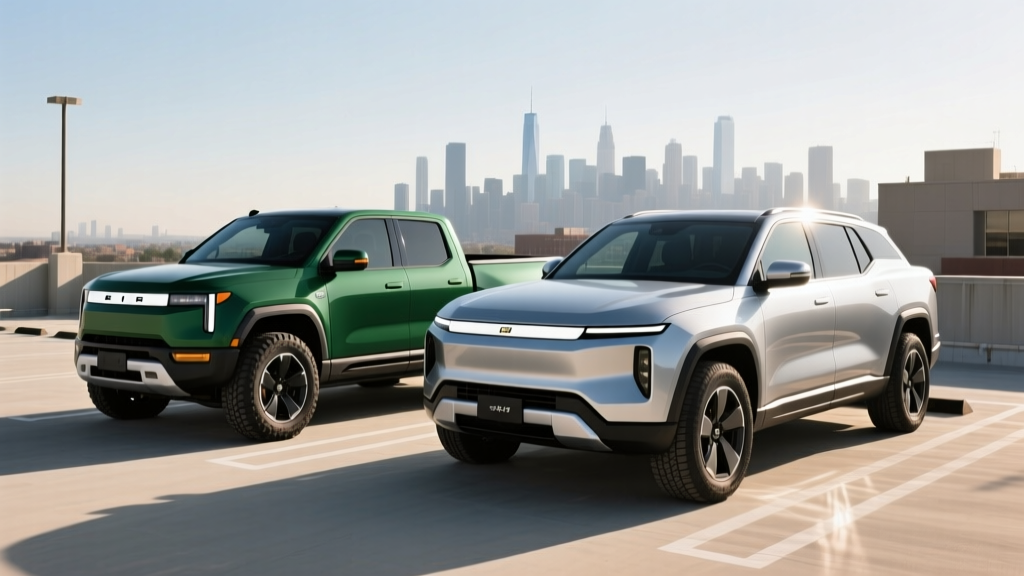
When news broke that Rivian awarded its CEO a massive 2025 compensation package, potential buyers and investors alike started asking the same question: does executive pay signal confidence in the company's future, or should it raise red flags for customers about to drop $75,000+ on an electric truck or SUV? The short answer is that RJ Scaringe's pay structure — largely tied to stock performance milestones — reflects Wall Street's bet on Rivian's long-term viability. But for the person actually shopping for a 2026 R1T pickup or R1S three-row SUV, what matters is metal, software, and charging infrastructure. Let's break down exactly what you're getting.
Range, Battery, and Real-World Efficiency
The 2026 Rivian R1T (crew-cab pickup) and R1S (three-row SUV) share the same Gen 2 skateboard platform and battery options. Rivian offers three pack sizes across its Dual-Motor, Performance Dual-Motor, and Tri-Motor configurations.
| Spec | R1T Dual-Motor (Standard) | R1T Dual-Motor (Max) | R1T Tri-Motor |
|---|---|---|---|
| EPA Range | 270 mi | 420 mi | 380 mi |
| Usable Battery | ~92 kWh (LFP) | ~141 kWh (NMC) | ~141 kWh (NMC) |
| Chemistry | LFP (prismatic) | NMC | NMC |
| MPGe (combined) | 73 MPGe | 70 MPGe | 65 MPGe |
| kWh/100 mi | 46 | 48 | 52 |
| 0-60 mph | 4.5 sec | 4.5 sec | 2.9 sec |
| Horsepower | 533 hp | 533 hp | 850 hp |
| Drivetrain | AWD (dual-motor) | AWD (dual-motor) | AWD (tri-motor) |
Rivian's move to LFP (lithium iron phosphate) chemistry for the Standard Pack is a smart trade-off: lower energy density means less range, but LFP offers longer cycle life, better thermal stability, and the ability to charge to 100% daily without accelerated degradation — ideal for commuters who plug in nightly.
Charging Speed: DC Fast and Home Level 2
Charging is where Rivian has made significant Gen 2 improvements. The R1T and R1S now use the NACS (Tesla-style) charge port natively, granting access to Tesla Superchargers without an adapter — a major advantage for road-trippers.
| Charge Level | Standard Pack (LFP) | Max Pack (NMC) | Miles Added/Hour (approx.) |
|---|---|---|---|
| Level 1 (120V, 12A) | 1.4 kW | 1.4 kW | ~3 mi/hr |
| Level 2 (240V, 48A) | 11.5 kW | 11.5 kW | ~25 mi/hr |
| DC Fast Charge (peak) | 200 kW | 220 kW | ~650 mi/hr (peak) |
| 10-80% DC time | ~28 min | ~41 min |
The 220 kW peak on the Max Pack is competitive, but remember that peak rate is only sustained between roughly 15–40% State of Charge (SoC). Above 60%, the charge curve tapers significantly — from 220 kW down to under 80 kW past 80%. This is normal for large NMC packs but worth understanding if you're planning road-trip stops. A typical 10–80% session on a 350 kW Electrify America or Tesla V4 Supercharger will take about 41 minutes for the Max Pack and 28 minutes for the Standard Pack.
At home on a 48A Level 2 circuit (requiring a 60A breaker), both trucks add about 25 miles of range per hour — meaning an overnight session (10 hours) restores roughly 250 miles. For Standard Pack owners who commute under 60 miles round-trip, this is effectively "full every morning."
Pricing, Trims, and Federal Tax Credit Eligibility
The 2026 R1T and R1S are premium-priced, and the Rivian CEO compensation package headline doesn't change what you'll pay at the dealership — but tax-credit rules absolutely do.
| Trim / Configuration | R1T Base MSRP | R1S Base MSRP | §30D Credit Eligible? |
|---|---|---|---|
| Dual-Motor Standard Pack | $69,900 | $74,900 | Yes (if under MSRP + income caps) |
| Dual-Motor Max Pack | $82,900 | $87,900 | No — exceeds $80K truck cap |
| Performance Dual-Motor | $84,900 | $89,900 | No — exceeds $80K truck cap |
| Tri-Motor | $99,900 | $104,900 | No — exceeds $80K truck cap |
- MSRP cap: Trucks (R1T) must be under $80,000; SUVs/vans (R1S) under $80,000. Only the R1T Dual-Motor Standard Pack at $69,900 qualifies on price.
- Buyer income cap: AGI must not exceed $150K (single), $225K (head of household), or $300K (joint).
- Battery sourcing: Critical minerals and battery components must meet phased-in percentages from US/FTA countries. Rivian's LFP Standard Pack sourcing has improved but verify current-year compliance on the DOE fueleconomy.gov listing before purchasing.
- Point-of-sale transfer: You can transfer the credit to the dealer at purchase for an instant price reduction rather than waiting until tax filing.
Interior Space, Cargo, and Practicality
The R1T's crew-cab layout offers generous interior volume with a unique 4.5-foot bed and the signature Gear Tunnel — a lockable, pass-through storage compartment behind the rear seats that holds roughly 11 cubic feet of cargo. Total bed + tunnel + frunk (11 cu ft) gives the R1T about 38 cubic feet of lockable exterior storage.
For the R1S, the three-row SUV offers:
- Behind 3rd row: 10.6 cu ft
- Behind 2nd row (3rd folded): 46.7 cu ft
- Behind 1st row (all rear folded): 91.6 cu ft
- Rear legroom (3rd row): 32.3 inches — tight for adults on long trips, fine for kids
- 2nd-row legroom: 38.9 inches — comfortable for adults
Towing capacity peaks at 11,000 lbs for the R1T and 7,700 lbs for the R1S — best-in-class for electric trucks, though towing at max capacity will cut range roughly in half.
Technology, Driver Assistance, and Software
Rivian runs a vertically integrated software stack on its own hardware, including:
- 15.6-inch center touchscreen with native navigation, over-the-air updates, and camp/kitchen/pet modes
- Driver+ (Level 2 ADAS): Adaptive cruise, lane-centering, and highway assist on mapped roads — competent but not class-leading versus GM Super Cruise or Ford BlueCruise
- Adventure Network: Rivian's own DC fast-charging network at trailheads and national parks, exclusive to Rivian owners
- Electric Camp Kitchen: Available slide-out induction kitchen in the Gear Tunnel (optional, ~$5,000)
Warranty and Long-Term Ownership
Rivian backs both the R1T and R1S with:
- Battery & Drive Units: 8 years / 175,000 miles (whichever comes first), with a capacity retention threshold of 70%
- Limited Vehicle Warranty: 5 years / 60,000 miles
- Roadside Assistance: 5 years / 60,000 miles
The 175,000-mile battery warranty is above the industry standard of 100,000 miles and signals confidence in the Gen 2 pack design. Rivian's service network has expanded, but rural owners should note that authorized service centers remain concentrated in metro areas — mobile service Rangers cover many regions but aren't available everywhere.
Who Should Buy the 2026 Rivian R1T or R1S?
- Class-leading off-road capability with quad-motor torque vectoring (Tri-Motor)
- Native NACS port — full Tesla Supercharger access
- 11,000-lb towing (R1T) — most of any EV pickup
- Gear Tunnel is a genuinely unique, practical feature
- LFP option for daily commuters who charge to 100% nightly
- 175,000-mile battery warranty
- Only the base R1T qualifies for the $7,500 federal tax credit
- Real-world highway range drops significantly from EPA (especially cold weather)
- Driver+ ADAS lags behind Super Cruise and BlueCruise in hands-free confidence
- Service center coverage still limited outside major metros
- Premium pricing — Max Pack and Tri-Motor push well past $90K
- 3rd-row space in the R1S is tight for adults
Choose the Rivian R1S if: You need three rows for family duty but want something more adventurous than a Tesla Model X or Kia EV9. Just know the 3rd row is kid-sized and the price premium over the R1T is substantial.
Look elsewhere if: Maximum range-per-dollar is your top priority (consider the Chevy Silverado EV or a Tesla Model Y), or if you need hands-free highway driving (GM Super Cruise vehicles).
Does the CEO Compensation Package Affect Your Purchase Decision?
The Rivian CEO 2025 compensation package was structured around performance-based stock awards — meaning Scaringe only realizes the full value if Rivian's stock hits specific milestones over several years. From a buyer's perspective, this is actually a more aligned incentive structure than a massive guaranteed cash salary. It suggests the board believes Rivian can scale production, improve margins, and compete with legacy OEMs long-term.
The real risk for buyers isn't executive pay — it's whether Rivian achieves production scale and service-network density to support a growing owner base. So far, the Normal, Illinois factory has ramped output significantly, the Gen 2 platform reduced parts count and cost, and the VW joint-venture investment has bolstered the balance sheet. But if you're buying in 2026, what matters most is the truck in front of you: its range, charge speed, warranty, and whether your local service infrastructure can support it.
Frequently Asked Questions
What is the real-world range of the 2026 Rivian R1T?
The EPA-rated range is 270 miles (Standard Pack), 420 miles (Max Pack), and 380 miles (Tri-Motor). In real-world highway driving at 70–75 mph, expect roughly 210–230 miles from the Standard Pack, 330–360 from the Max Pack, and 300–320 from the Tri-Motor. Cold weather (below 30°F) reduces these figures by 20–30%.
How fast does the Rivian R1T charge at home and on the road?
On a home Level 2 charger (240V, 48A), the R1T charges at 11.5 kW, adding about 25 miles of range per hour. On DC fast chargers, the Max Pack peaks at 220 kW with a 10–80% time of approximately 41 minutes. The Standard Pack peaks at 200 kW with a 10–80% time of about 28 minutes. Rivian uses the NACS connector natively, granting access to Tesla Superchargers.
Does the 2026 Rivian R1T qualify for the $7,500 federal EV tax credit?
Only the R1T Dual-Motor Standard Pack at $69,900 MSRP qualifies — it is the only trim under the $80,000 truck MSRP cap. You must also meet IRS income limits ($150K single / $300K joint) and the vehicle must satisfy battery critical-mineral and component sourcing requirements. Verify current eligibility on fueleconomy.gov before purchasing. The credit can be transferred to the dealer at point of sale.
Is the Rivian R1T worth buying versus the Ford F-150 Lightning or Chevy Silverado EV?
The R1T excels in off-road capability, towing (11,000 lbs), and unique storage (Gear Tunnel). The Ford F-150 Lightning offers a larger bed and lower entry price; the Chevy Silverado EV 4WT targets commercial fleets. If you prioritize adventure capability and premium build, the R1T is compelling. If you need a traditional full-size bed or the lowest price, look at Ford or Chevy.
What are the biggest drawbacks of the Rivian R1T and R1S?
The main cons are premium pricing (most trims exceed the tax-credit MSRP cap), real-world range that falls notably below EPA estimates on the highway and in cold weather, a driver-assist system that trails GM and Ford's hands-free offerings, and service center coverage that's still concentrated in urban areas. The R1S third row is also tight for adult passengers.
How long will the Rivian battery last?
Rivian warranties the battery for 8 years or 175,000 miles with a 70% capacity retention threshold. The LFP Standard Pack chemistry typically degrades more slowly than NMC over thousands of cycles, making it a strong choice for high-mileage daily drivers. Real-world degradation data on Gen 2 packs is still accumulating, but the warranty terms are above the industry average.