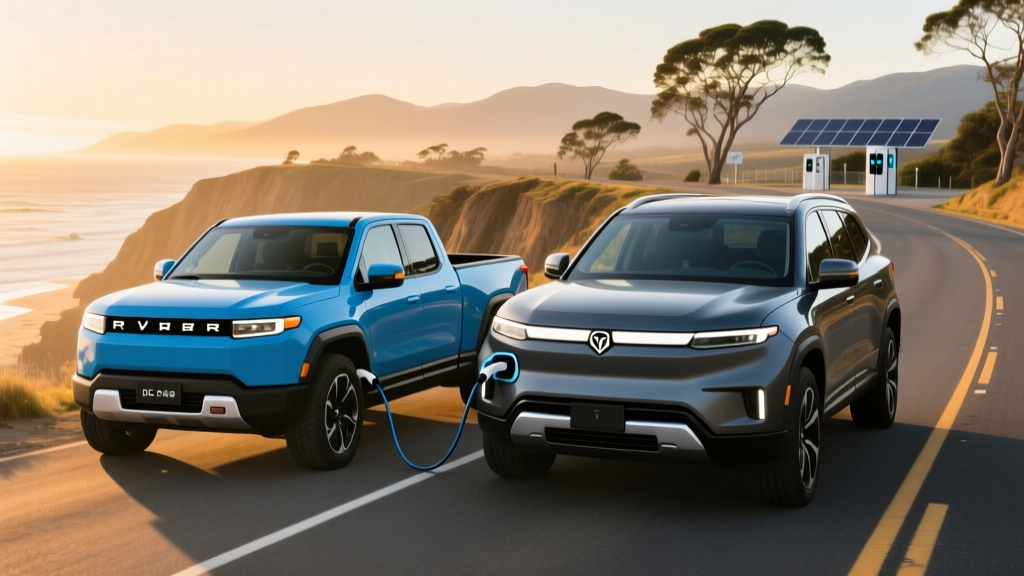
Rivian entered 2026 as one of only a handful of American EV automakers still standing, and the question on every truck and SUV shopper's mind is straightforward: how is Rivian doing now that its second-generation R1T pickup and R1S SUV have been on sale for over a year? The short answer is that Rivian has matured from a scrappy startup into a serious volume competitor, with dramatically improved manufacturing efficiency, a refreshed Gen 2 platform, and an expanding Tri-Motor lineup. But the details — real-world range, charging speeds, tax-credit eligibility, and ownership costs — are what actually determine whether an R1 belongs in your driveway.
This review covers the 2026 Rivian R1T (truck) and R1S (three-row SUV) together, since they share the same skateboard platform, battery options, and powertrain configurations. We'll break down every number that matters: EPA range versus what you'll actually see on a highway road trip, DC fast-charging curves, Level 2 home charging rates, 0-60 performance, cargo dimensions, and the exact pricing after the federal §30D tax credit.
2026 Rivian R1T & R1S at a Glance: Full Spec Table
| Spec | R1T Dual-Motor (Standard) | R1T Dual-Motor (Max) | R1T Tri-Motor |
|---|---|---|---|
| EPA Range | 270 mi | 420 mi | 380 mi |
| Battery (usable) | 92 kWh (NMC) | 141 kWh (NMC) | 141 kWh (NMC) |
| Horsepower | 533 hp | 533 hp | 850 hp |
| 0-60 mph | 4.5 sec | 4.5 sec | 2.9 sec |
| Drivetrain | AWD (dual-motor) | AWD (dual-motor) | AWD (tri-motor) |
| Max DC Fast Charge | 200 kW | 200 kW | 220 kW |
| 10-80% DC Time | ~30 min | ~42 min | ~40 min |
| Level 2 (11.5 kW) | ~25 mi/hr | ~25 mi/hr | ~25 mi/hr |
| Efficiency (MPGe) | 73 MPGe | 70 MPGe | 65 MPGe |
| Towing Capacity | 11,000 lbs | 11,000 lbs | 11,000 lbs |
| Base MSRP (R1T) | $69,950 | $82,950 | $99,950 |
| Base MSRP (R1S) | $74,950 | $87,950 | $104,950 |
| Battery/Powertrain Warranty | 8 yr / 175,000 mi | 8 yr / 175,000 mi | 8 yr / 175,000 mi |
Sources: EPA fueleconomy.gov, Rivian specifications.
Real-World Range: What the EPA Sticker Doesn't Tell You
- Standard Pack (92 kWh): EPA 270 mi → Expect 220-245 mi highway, ~190-210 mi in sub-30°F cold
- Max Pack (141 kWh): EPA 420 mi → Expect 350-380 mi highway, ~300-330 mi in sub-30°F cold
- Tri-Motor (141 kWh): EPA 380 mi → Expect 310-340 mi highway, ~270-300 mi in sub-30°F cold
Highway driving at 75+ mph typically reduces range 10-15% below EPA. Cold weather (below freezing) without preconditioning can cut range 20-30%. Rivian's heat pump helps, but physics is physics — a 141 kWh battery moving a 7,000-lb truck through 20°F air will consume significantly more energy than the combined-cycle EPA test assumes.
The Max Pack's 420-mile EPA figure is genuinely exceptional for any EV, let alone a body-on-frame truck. On a real-world road trip from Denver to Moab (roughly 350 miles with elevation changes and 70-mph cruising), owners consistently report arriving with 10-15% State of Charge remaining, which tracks with a real-world consumption of about 2.2-2.4 kWh/mile. The Standard Pack is best understood as a commuter and day-tripper — adequate for a 200-mile round trip with margin, but requiring a charge stop on longer hauls.
Charging Speed: DC Fast Charging and Home Level 2
Rivian's Gen 2 platform uses a 400-volt architecture (not the 800V systems found in Hyundai/Kia E-GMP or Porsche Taycan). This means peak charge rates are good but not class-leading. Here's what you'll see at the charger:
| Charging Level | Power (kW) | R1T Standard Pack | R1T Max Pack |
|---|---|---|---|
| Level 1 (120V outlet) | ~1.4 kW | ~3 mi/hr | ~3 mi/hr |
| Level 2 (240V, 48A) | 11.5 kW | ~25 mi/hr (full in ~9 hr) | ~25 mi/hr (full in ~13 hr) |
| DC Fast (peak) | 200-220 kW | 10-80% in ~30 min | 10-80% in ~42 min |
Charging curve reality check: The 200 kW peak on the Standard Pack is sustained roughly from 10% to 35% State of Charge, then tapers to ~150 kW through 60%, and drops further to ~75 kW above 80%. The Max Pack's larger battery absorbs energy longer at higher rates, but its 10-80% time is still longer because there's simply 53% more energy to push in. If you're road-tripping, plan for 30-45 minute stops — comparable to a sit-down meal, not a gas-and-go dash.
Rivian's Adventure Network (their proprietary DC fast-charging network near outdoor destinations) provides reliable 200+ kW chargers at trailheads and national parks. For general travel, Rivian vehicles use the NACS (Tesla Supercharger) connector as of the Gen 2 platform, giving access to the largest fast-charging network in North America — a significant advantage over CCS-only vehicles now that Tesla's Supercharger network has opened to NACS-equipped non-Teslas.
Performance, Drivetrain, and Efficiency
The Dual-Motor R1T puts down 533 horsepower and 610 lb-ft of torque through independent front and rear motors, delivering a 4.5-second 0-60 time that makes it quicker than any gas truck this side of a Raptor. The Tri-Motor adds a third rear motor for 850 hp and a 2.9-second 0-60 — supercar territory in a 7,000-lb pickup. All configurations use a single-speed reduction gear (no multi-speed transmission), and all feature standard AWD with torque vectoring.
Efficiency varies significantly by configuration. Per the EPA, the Standard Pack Dual-Motor achieves 73 MPGe combined (approximately 46 kWh/100 mi), while the Max Pack drops to 70 MPGe and the Tri-Motor to 65 MPGe. For cost context, charging at the US average residential rate of $0.16/kWh, the Standard Pack costs roughly $7.36 per 100 miles of driving — compared to approximately $16.50 for a gas truck averaging 18 MPG at $3.00/gallon.
Pricing, Trim Levels, and Federal Tax Credit
Rivian simplified its trim structure for 2026. Every R1T and R1S is available in a single well-equipped trim, with configuration options (battery pack, motor count, wheel/tire package, paint, interior) driving the final price rather than traditional trim tiers.
| Configuration | R1T MSRP | R1S MSRP | Federal §30D Credit | Effective Price (if eligible) |
|---|---|---|---|---|
| Dual-Motor / Standard Pack | $69,950 | $74,950 | Up to $7,500 | R1T: ~$62,450 / R1S: ~$67,450 |
| Dual-Motor / Max Pack | $82,950 | $87,950 | Up to $7,500 | R1T: ~$75,450 / R1S: ~$80,450 |
| Tri-Motor / Max Pack | $99,950 | $104,950 | Up to $7,500 | R1T: ~$92,450 / R1S: ~$97,450 |
Does the Rivian qualify for the federal EV tax credit? Yes — but with important caveats under IRS §30D rules. The R1T qualifies because its base MSRP is under the $80,000 truck/SUV cap (the Dual-Motor Standard at $69,950 clears this). The R1S Dual-Motor Standard at $74,950 also qualifies under the $80,000 SUV cap. However, the Max Pack and Tri-Motor configurations push MSRP above $80,000, and while SUVs have an $80,000 cap under §30D, some R1S configurations may exceed it depending on options. Buyer income caps also apply: modified AGI cannot exceed $300,000 (joint), $225,000 (head of household), or $150,000 (individual). Additionally, the credit is subject to critical-mineral and battery-component sourcing requirements that phase in annually — consult a tax professional and the IRS Clean Vehicle provisions before counting on the full $7,500. As of 2026, the credit can be transferred to the dealer at point of sale, reducing your purchase price directly.
Cargo, Passenger Space, and Practicality
The R1T's 4-foot-6-inch bed is shorter than a traditional full-size truck bed, which limits its utility for contractors hauling lumber but works well for outdoor recreation — bikes, kayaks, and camping gear fit easily. The bed includes a powered tonneau cover, integrated tie-downs, and a built-in air compressor. The gear tunnel (a lockable, pass-through storage compartment behind the rear seats) adds 11.7 cubic feet of secure storage, which is one of Rivian's most clever features.
The R1S offers three rows of seating for up to seven passengers. Second-row legroom measures 38.6 inches, and the third row accommodates adults on shorter trips with 32.3 inches of legroom. Behind the third row, cargo volume is 10.7 cubic feet; folding the third row opens 46.7 cubic feet; folding both rear rows yields 92.2 cubic feet. The R1S also includes a front trunk (frunk) of 11.0 cubic feet — large enough for a full carry-on bag or charging cables.
Tech, Driver Assistance, and Standout Features
Rivian's infotainment runs on a custom 15.6-inch center touchscreen with an embedded navigation system that includes live route planning with automatic charge-stop integration. The system supports wireless Apple CarPlay and Android Auto, over-the-air updates, and a built-in Wi-Fi hotspot. Audio is a premium Rivian Elevation system with 18+ speakers.
Rivian's Driver+ system is an SAE Level 2 driver-assistance feature combining adaptive cruise control and lane-centering. It requires the driver to remain engaged and monitor the road at all times. It is not self-driving. Hands-free operation is not currently supported, though Rivian has indicated future OTA updates may expand capabilities. Always keep your hands on the wheel and eyes on the road.
Standout features include the Camp Kitchen (an optional slide-out kitchen that integrates into the gear tunnel), the Rivian Waypoints navigation system that curates adventure destinations, built-in air suspension with up to 14.4 inches of ground clearance for off-roading, and a wade mode rated for up to 3 feet of water. The R1 also features a camp mode that maintains climate control and lighting for overnight stays in the vehicle.
Warranty, Ownership Costs, and Long-Term Outlook
Rivian provides an 8-year/175,000-mile warranty on the battery pack and drive system — among the most generous in the industry and above the typical 8-year/100,000-mile standard. The bumper-to-bumper limited warranty covers 5 years/60,000 miles. Rivian guarantees that the battery will retain at least 70% of its original capacity during the warranty period; if degradation falls below that threshold, the company will repair or replace the pack.
Insurance costs for the R1T and R1S tend to run 15-25% higher than comparable gas trucks, reflecting higher repair costs and parts pricing — a common pattern across EVs. Maintenance is minimal: no oil changes, no spark plugs, no transmission fluid. Expect cabin air filter replacements and tire rotations as the primary service items. Rivian's mobile service fleet handles most routine maintenance at your home or office.
Depreciation has been a concern for Rivian owners, as the brand's resale values initially lagged established automakers. However, the Gen 2 refresh and growing brand recognition have stabilized values. The R1T and R1S now depreciate comparably to premium gas trucks over a 3-year horizon.
Pros, Cons, and Who Should Buy a Rivian
✅ Pros
- Class-leading 420-mile EPA range (Max Pack)
- NACS connector = full Tesla Supercharger access
- Best-in-class off-road capability (air suspension, wade mode, tank turns on Tri-Motor)
- Innovative gear tunnel and camp-ready accessories
- 8-year/175,000-mile battery warranty
- Tri-Motor 2.9-sec 0-60 in a full-size truck
- Over-the-air updates continuously add features
❌ Cons
- 400V architecture limits peak DC charge rate vs. 800V competitors
- Short 4.5-ft bed limits traditional truck utility
- Max Pack 10-80% charge time of ~42 minutes is long for road trips
- Higher configurations exceed $80,000 MSRP cap for §30D credit
- Insurance premiums 15-25% above gas truck equivalents
- No hands-free driving mode (Level 2 only, unlike BlueCruise or Super Cruise)
- R1S third row is tight for adults on long drives
- Choose the R1T if: You want a daily-drivable electric truck for commuting and weekend adventures (biking, skiing, camping) and don't regularly haul full sheets of plywood or tow heavy trailers cross-country.
- Choose the R1S if: You need three rows of seating for a family, want EV efficiency for school runs and road trips, and value off-road capability for backcountry trails.
- Look elsewhere if: You need a work truck with a 6.5+ ft bed, want hands-free highway driving (consider GM Super Cruise or Ford BlueCruise), or need a sub-$50,000 price point.
Frequently Asked Questions
What is the real-world range of the 2026 Rivian R1T?
The EPA rates the R1T Max Pack at 420 miles and the Standard Pack at 270 miles. In real-world highway driving at 70-75 mph, expect 350-380 miles from the Max Pack and 220-245 miles from the Standard. Cold weather (below 30°F) reduces these figures by roughly 20-30% unless you precondition the battery.
How fast does the Rivian charge at home and on the road?
On a 240V Level 2 home charger (48A/11.5 kW), both pack sizes add roughly 25 miles of range per hour — a full overnight charge handles daily driving easily. On DC fast chargers, the Standard Pack peaks at 200 kW (10-80% in ~30 minutes) and the Max Pack at 200 kW (10-80% in ~42 minutes). The Tri-Motor peaks at 220 kW.
How much does a Rivian cost after the federal tax credit?
The R1T Dual-Motor Standard Pack starts at $69,950. If you meet all IRS §30D requirements (income caps, battery sourcing, MSRP under $80,000), the $7,500 point-of-sale credit brings it to approximately $62,450. Higher configurations may exceed the MSRP cap or your income may disqualify you — verify with a tax professional.
Is the Rivian worth buying versus the Ford F-150 Lightning or Tesla Cybertruck?
The R1T excels in off-road capability, adventure-oriented features (gear tunnel, camp kitchen), and premium build quality. The F-150 Lightning offers a more traditional truck bed and lower starting price. The Cybertruck provides 800V-class charging and polarizing styling. If adventure lifestyle and build quality are priorities, the R1T is the strongest pick. If work-truck utility or lowest price matters most, the Lightning wins.
Does the Rivian R1S qualify for the $7,500 federal EV tax credit?
The R1S Dual-Motor Standard at $74,950 falls under the $80,000 SUV MSRP cap and is eligible if you meet income and sourcing requirements. Configurations with the Max Pack or Tri-Motor that push MSRP above $80,000 may not qualify. Always check current IRS rules before purchasing.
How is Rivian doing financially — will the company survive?
Rivian has significantly improved its financial position through 2025-2026, narrowing losses per vehicle and increasing production volume at its Normal, Illinois factory. The company has a partnership with Volkswagen Group that provides both investment and technology-sharing. While no startup is risk-free, Rivian's trajectory is more stable than it was in 2023-2024, and the Gen 2 platform has been well-received by critics and buyers.