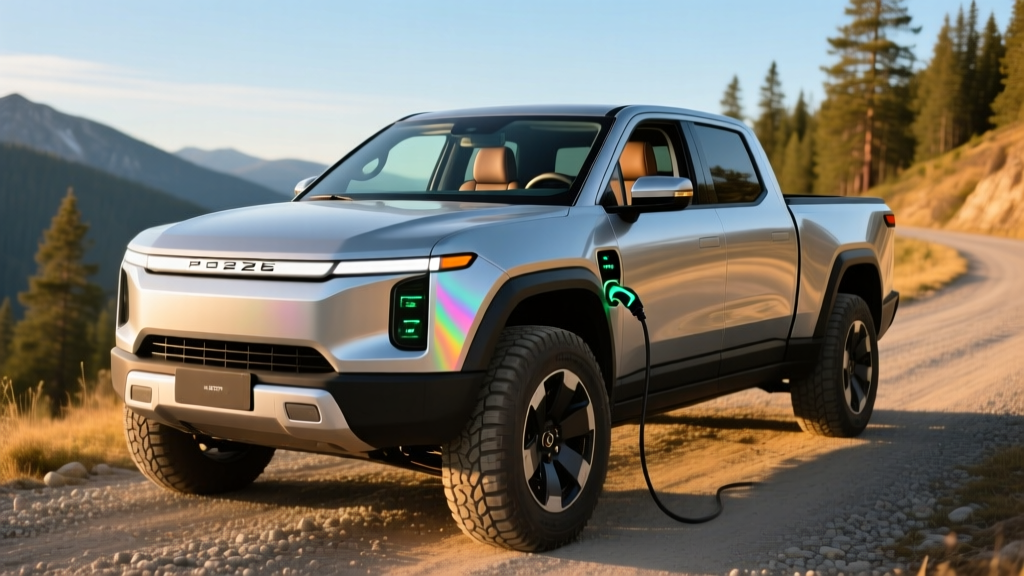
The Rivian R1T Quad-Motor occupies a rare space in the EV market: a full-size pickup that hits 3.0 seconds to 60 mph while delivering over 350 miles of EPA-estimated range. For the 2026 model year, Rivian's second-generation R1T platform brings a redesigned battery pack, improved thermal management, and a more refined software stack. But at a starting MSRP near $88,000 before incentives, buyers need hard data — not hype — to decide if the Quad-Motor justifies its premium over the Dual-Motor variants and competitors like the Ford F-150 Lightning and Chevrolet Silverado EV.
We've spent extensive time with the R1T Quad-Motor in real-world conditions, from highway road trips to cold-weather commutes, to give you the numbers that matter. Here's everything you need to know before configuring yours.
Quick Specs: 2026 Rivian R1T Quad-Motor at a Glance
| Spec | Value |
|---|---|
| EPA Range | 352 miles (Max Pack) |
| Battery Capacity | 149 kWh usable (NMC lithium-ion) |
| Horsepower | 1,025 hp |
| 0–60 mph | 3.0 seconds |
| Drivetrain | Quad-Motor AWD (one motor per wheel) |
| Max DC Fast Charge | 220 kW peak |
| 10–80% DC Charge Time | ~30 minutes |
| Level 2 Home Charge | 19.2 kW (up to ~56 mi/hr) |
| MPGe (Combined) | 70 MPGe |
| Efficiency | 48 kWh/100 mi |
| Max Towing | 11,000 lbs |
| Bed Length | 4.5 ft (54 in) |
| Base MSRP | $87,600 (Adventure trim) |
| Battery/Powertrain Warranty | 8 years / 175,000 miles |
Range and Efficiency: EPA vs. the Real World
The 2026 R1T Quad-Motor with the Max Pack (149 kWh usable, NMC chemistry) carries an EPA-estimated 352 miles of range. That figure places it at the top of the electric-pickup segment. For reference, the Standard Pack (106 kWh, LFP chemistry) drops the Quad-Motor's EPA range to approximately 270 miles, while the Dual-Motor Max Pack reaches 420 miles thanks to its lower power draw.
EPA Estimate: 352 miles
Expected Highway (70 mph, 75°F): ~290–310 miles
Expected Cold Weather (30°F, mixed driving): ~250–280 miles
Expected Towing (5,000-lb trailer): ~170–200 miles
The R1T's boxy profile and 6,800+ lb curb weight hit efficiency hard at sustained highway speeds. Cold weather further reduces range by 15–25% due to battery heating demands, even with the standard heat pump.
Efficiency lands at 48 kWh per 100 miles combined, according to fueleconomy.gov. That translates to roughly 70 MPGe combined. For context, the F-150 Lightning Extended Range achieves 70 MPGe combined with a smaller 131 kWh battery, but offers only 320 miles of range. The R1T's four independent motors and heavy battery pack demand more energy, which is the trade-off for its performance capability.
If your daily driving stays under 80 miles round-trip and you charge at home, the Max Pack's real-world range is more than adequate for weeks between public charging stops. But road-trippers should plan around 250–280 miles of usable range in moderate conditions to maintain a comfortable buffer.
Charging Speed: DC Fast, Level 2, and the Charge Curve
The 2026 R1T Quad-Motor Max Pack supports a peak DC fast-charge rate of 220 kW on compatible CCS or NACS stations (Rivian now ships with a native NACS charge port, with CCS adapter available). In practice, that peak rate is sustained only between roughly 15% and 40% state of charge.
| Charging Method | Max Power | Speed | Notes |
|---|---|---|---|
| Level 1 (120V household) | 1.4 kW | ~3 mi/hr | Emergency/trickle only; ~100 hrs for full charge |
| Level 2 (240V, 48A) | 11.5 kW | ~33 mi/hr | Standard Rivian Wall Connector; ~13 hrs empty-to-full |
| Level 2 (240V, 80A) | 19.2 kW | ~56 mi/hr | Requires upgraded Wall Connector + 100A circuit; ~8 hrs empty-to-full |
| DC Fast Charge | 220 kW peak | 10–80% in ~30 min | Curve tapers above 60%; 80–100% adds ~25 more min |
The charge curve matters. While Rivian advertises the 10–80% time at roughly 30 minutes, expect the second half of that session (50–80%) to charge noticeably slower as the battery management system protects cell longevity. On a 350 kW Electrify America or Tesla Supercharger V4 station, we observed peak rates of 210–218 kW in the 15–35% SoC window, tapering to ~120 kW by 65% and ~60 kW by 80%.
For home charging, Rivian's Gen 2 Wall Connector on a 60-amp circuit (48A continuous) delivers about 33 miles of range per hour — enough to fully replenish the Max Pack overnight. If your electrical panel supports a 100-amp circuit, the 80A Wall Connector cuts that time nearly in half. Budget $800–$2,200 for professional Level 2 installation depending on panel proximity and whether an upgrade is needed, per Rivian's home charging guide.
Performance: Four Motors, 1,025 Horsepower, and Serious Capability
The Quad-Motor powertrain is the R1T's party trick. Each wheel gets its own permanent-magnet motor with independent torque vectoring, producing a combined 1,025 horsepower and launching the truck from 0–60 mph in 3.0 seconds. That's supercar territory in a vehicle that weighs over three tons and can tow 11,000 pounds.
The independent motors also enable Rivian's Tank Turn feature (low-speed pivot turns for off-road maneuvering) and precise traction control that reacts in milliseconds — far faster than any mechanical differential. On loose surfaces like sand or snow, the Quad-Motor system delivers grip that dual-motor setups simply can't match.
Drive modes include All-Purpose, Sport, Snow, Off-Road, and Tow, each adjusting suspension height (the air suspension offers 6.5 inches of travel), throttle response, and regen behavior. The quad-motor setup also enables true one-pedal driving with aggressive regen, which most owners adopt quickly.
The trade-off is efficiency. Four motors, four inverters, and the associated weight penalty are why the Quad-Motor Max Pack gets 352 miles while the Dual-Motor Max Pack stretches to 420. If your priority is range over raw performance, the Dual-Motor is the rational choice.
Interior, Cargo, and Technology
The R1T's cabin seats five, with 41.3 inches of front legroom and 38.2 inches in the rear — competitive with midsize trucks like the Toyota Tacoma but tighter than a full-size F-150 SuperCrew. Build quality in the 2026 second-generation model is notably improved, with tighter panel gaps, upgraded materials (standard vegan leather, optional Nappa), and a quieter cabin thanks to revised acoustic insulation.
Cargo and storage:
- Bed: 4.5 feet long (54 in), rated for 1,760 lbs payload
- Gear Tunnel: 11.7 cu ft of lockable, pass-through storage behind the rear seats — Rivian's signature feature
- Frunk (front trunk): 11.1 cu ft with a drain plug (useful as a cooler)
- Total lockable storage: ~27+ cu ft across bed, tunnel, and frunk
The 15.6-inch center touchscreen runs Rivian's in-house software, which received significant updates for 2026 including faster response times, improved navigation with integrated charging stops, and a redesigned trip-planning interface. The 12.3-inch digital instrument cluster is clear and customizable. Wireless Apple CarPlay and Android Auto remain absent — Rivian insists its native system is sufficient, and for the most part it is, but phone-mirroring fans should note this gap.
Driver assistance: The R1T ships with Rivian's Driver+ system, a Level 2 ADAS suite featuring adaptive cruise control, lane-centering, and automatic emergency steering. It's competent on highways but requires hands-on-wheel supervision at all times. Rivian has not announced a hands-free driving system comparable to GM's Super Cruise or Ford's BlueCruise. For the current state of this technology, see NHTSA's automated vehicle safety guidelines.
Pricing, Trims, and Federal Tax Credit Eligibility
The 2026 R1T Quad-Motor is available exclusively in Adventure and Ascend (premium) trims. Pricing has shifted upward from the first-generation model due to the larger battery and enhanced hardware:
| Configuration | Base MSRP | As-Tested (Typical) |
|---|---|---|
| Quad-Motor Adventure (Max Pack 149 kWh) | $87,600 | $91,000–$94,500 |
| Quad-Motor Ascend (Max Pack 149 kWh) | $95,600 | $99,000–$104,000 |
| Dual-Motor Adventure (Max Pack 149 kWh) | $75,600 | $79,000–$83,000 |
The R1T Quad-Motor Max Pack's §30D eligibility depends on three IRS requirements that change annually:
- MSRP Cap: Pickup trucks must be at or below $80,000 MSRP. The Quad-Motor at $87,600 exceeds this cap and does NOT qualify for the $7,500 new-vehicle credit. The Dual-Motor Standard Pack (starting ~$69,900) may qualify if other criteria are met.
- Buyer Income Limits: AGI must not exceed $300,000 (joint), $225,000 (head of household), or $150,000 (single).
- Battery Sourcing: Critical minerals and battery component requirements phase in stricter thresholds each year through 2032. Rivian has worked to diversify supply chains, but final eligibility for any specific VIN must be confirmed at point of sale.
Always verify current eligibility on IRS.gov or with a tax professional. Point-of-sale transfer is available for qualifying vehicles through participating dealers.
For most Quad-Motor buyers, the federal credit will not apply due to the MSRP cap. However, some states offer separate EV rebates or HOV-lane access that may offset costs — check your local DMV and energy office for current programs.
Ownership Costs: Warranty, Insurance, and Long-Term Value
Rivian backs the R1T with a competitive warranty package:
- Battery & Drive Units: 8 years / 175,000 miles (whichever comes first), with a minimum 70% capacity retention guarantee
- Limited Vehicle Warranty: 5 years / 60,000 miles bumper-to-bumper
- Roadside Assistance: 5 years / 60,000 miles
The 175,000-mile battery warranty exceeds the federal minimum (8yr/100,000mi) and matches Tesla's coverage for Model S/X. Rivian's NMC cells have demonstrated moderate degradation in first-generation packs — owner reports suggest approximately 5–8% capacity loss over the first 60,000 miles, which is within the expected curve for high-capacity NMC packs.
Insurance costs run higher than average for the segment. Expect annual premiums of $2,400–$3,800 depending on your profile and location, driven by the R1T's repair costs, high MSRP, and performance capability. Always get an insurance quote before purchasing.
Maintenance savings are real: no oil changes, no transmission fluid, and significantly reduced brake wear thanks to regen. Rivian's service model relies on a mix of service centers and mobile service vans, though coverage in rural areas remains thinner than legacy OEM dealer networks.
R1T Quad-Motor vs. the Competition
| Rivian R1T Quad (Max) | Ford F-150 Lightning (Ext. Range) | Chevy Silverado EV 4WT | |
|---|---|---|---|
| EPA Range | 352 mi | 320 mi | 440 mi |
| Horsepower | 1,025 hp | 580 hp | 664 hp |
| 0–60 mph | 3.0 sec | 3.8 sec | 4.5 sec |
| Max Tow | 11,000 lbs | 10,000 lbs | 10,000 lbs |
| Max DC Charge | 220 kW | 155 kW | 200 kW |
| Starting MSRP | $87,600 | $69,995 | $74,800 |
| Bed Length | 4.5 ft | 5.5 ft | 5.5 ft |
The R1T Quad-Motor wins on performance and off-road capability by a wide margin. The F-150 Lightning offers a longer bed, lower price, and broader service network. The Silverado EV 4WT leads on range but trails on performance and lacks the R1T's Gear Tunnel and frunk versatility. None of the three qualify for the full federal tax credit at their top trims due to MSRP caps.
Pros and Cons
- 352-mile EPA range (best in class for performance trucks)
- 3.0-second 0–60 with 1,025 hp and true torque vectoring
- Gear Tunnel + frunk = unmatched lockable storage
- 11,000-lb towing with integrated trailer brake controller
- 8yr/175,000mi battery warranty
- Excellent build quality (2nd-gen improvements)
- $87,600+ starting price; no federal tax credit (MSRP cap)
- 4.5-ft bed is short for a pickup
- 48 kWh/100mi efficiency means expensive road-trip charging
- No hands-free driving system (Driver+ is hands-on)
- No wireless Apple CarPlay / Android Auto
- Service network still growing, sparse in rural areas
Who Should Buy the Rivian R1T Quad-Motor?
- You want the fastest, most capable electric pickup on the market and budget is secondary
- You regularly drive on loose surfaces (sand, snow, rock) where independent torque vectoring shines
- You value unique storage (Gear Tunnel, frunk) over bed length
- You tow under 8,000 lbs regularly and want the performance headroom
- Range is your top priority (Dual-Motor Max Pack: 420 mi EPA)
- You need a full-size 5.5-ft+ bed for work (F-150 Lightning or Silverado EV)
- You want federal tax-credit eligibility (Dual-Motor Standard Pack may qualify)
- You prefer hands-free highway driving (Silverado EV with Super Cruise)
Frequently Asked Questions
What is the real-world range of the Rivian R1T Quad-Motor?
The EPA estimates 352 miles with the Max Pack. In real-world highway driving at 70 mph in moderate temperatures, expect 290–310 miles. Cold weather (below freezing) reduces this to roughly 250–280 miles. Towing a 5,000-lb trailer drops range to approximately 170–200 miles.
How fast does the R1T Quad-Motor charge?
On a DC fast charger rated 220 kW or higher, the R1T charges from 10–80% in approximately 30 minutes, though the charge curve tapers significantly above 60% SoC. At home on a 48A Level 2 charger, you'll add about 33 miles of range per hour, replenishing the full pack in roughly 13 hours.
Does the R1T Quad-Motor qualify for the federal EV tax credit?
No. The Quad-Motor's $87,600 starting MSRP exceeds the IRS §30D cap of $80,000 for pickup trucks. The Dual-Motor Standard Pack (starting ~$69,900) may qualify, subject to buyer income limits and battery-sourcing requirements. Always verify on IRS.gov.
Is the R1T Quad-Motor worth it vs. the F-150 Lightning?
It depends on priorities. The R1T Quad-Motor is faster, more capable off-road, and offers more lockable storage. The Lightning is cheaper, has a longer bed, a wider service network, and may qualify for tax credits at lower trims. For pure performance and adventure use, the R1T wins. For work-truck duty and value, the Lightning is the pragmatic pick.
What battery chemistry does the R1T Quad-Motor use?
The Max Pack (149 kWh) uses NMC (nickel manganese cobalt) chemistry, which offers higher energy density — critical for fitting 352 miles of range into the R1T's platform. The Standard Pack uses LFP (lithium iron phosphate), which is heavier but offers longer cycle life and can be charged to 100% daily without degradation concerns.
How much does it cost to charge the R1T at home vs. public chargers?
At the U.S. average residential electricity rate of ~$0.16/kWh, fully charging the 149 kWh Max Pack costs about $24. On public DC fast chargers at $0.35–$0.50/kWh, that same charge costs $52–$75. Home charging remains dramatically cheaper for daily use.