The Rivian R1T remains the only true all-electric pickup truck that blends serious off-road capability with daily-driver refinement. For 2026, Rivian has expanded battery options, refined its dual- and tri-motor powertrains, and continued to iterate on the accessory that R1T owners ask about most: the Rivian power tonneau cover. This review covers everything you need to know about the 2026 R1T — from real-world range and DC fast-charging speeds to how the power retractable bed cover integrates with the truck's electrical system and whether the R1T still qualifies for the federal EV tax credit.
2026 Rivian R1T at a Glance: Key Specs
| Spec | Value |
|---|---|
| EPA Range (Max Pack) | 420 miles |
| EPA Range (Large Pack) | 352 miles |
| EPA Range (Standard Pack) | 270 miles |
| Battery Capacity (Max Pack, usable) | ~149 kWh, NMC lithium-ion |
| Battery Capacity (Large Pack, usable) | ~128 kWh, NMC lithium-ion |
| Battery Capacity (Standard Pack, usable) | ~95 kWh, LFP (lithium iron phosphate) |
| Max DC Fast Charge | 220 kW (Max/Large); 190 kW (Standard) |
| 10–80% DC Charge Time | ~21 min (Max Pack); ~20 min (Large); ~22 min (Standard) |
| Level 2 Home Charging | 11.5 kW (~25 mi/hr added) |
| 0–60 mph (Dual-Motor) | 4.5 seconds |
| 0–60 mph (Tri-Motor) | ~3.0 seconds |
| Horsepower (Dual-Motor) | 533 hp |
| Horsepower (Tri-Motor) | 850 hp |
| Drivetrain | AWD (Dual-Motor) / AWD (Tri-Motor) |
| Towing Capacity | 11,000 lbs |
| Bed Length | 54.0 inches (4.5 ft) |
| MPGe (Dual-Motor, Combined) | 70 MPGe |
| Efficiency | 48 kWh/100 mi (Dual-Motor Max) |
| Battery Warranty | 8 years / 175,000 miles |
| Vehicle Warranty | 5 years / 60,000 miles |
Real-World Range: What the EPA Sticker Doesn't Tell You
EPA (Max Pack): 420 miles
Real-world highway (70 mph): ~330–350 miles
Real-world cold weather (below 32°F): ~280–310 miles
Towing a 5,000-lb trailer: ~180–220 miles
The Max Pack's 420-mile EPA figure is impressive, but pickups are aerodynamically challenged. Expect 15–20% range loss at sustained highway speeds and up to 30% in freezing temperatures. Towing cuts range roughly in half.
Rivian's Max Pack uses a 149 kWh (usable) NMC battery — one of the largest packs in any production passenger vehicle. The EPA's 420-mile estimate for the Dual-Motor Max configuration is best-in-class for electric trucks. However, the R1T's boxy silhouette and 5,800+ lb curb weight work against it at highway speed.
In real-world mixed driving at 65–70 mph, owners consistently report 330–350 miles before needing to charge. Drop below freezing and the NMC chemistry loses efficiency — plan on 280–310 miles even with the heat pump and battery preconditioning active. If you tow frequently, the Standard or Large Pack won't cut it for long hauls; the Max Pack's extra capacity provides a necessary buffer.
The Standard Pack's switch to LFP (lithium iron phosphate) chemistry is worth noting. LFP offers a longer cycle life and can be charged to 100% daily without accelerated degradation — ideal for owners who can charge at home every night. The trade-off is lower energy density, which is why the Standard Pack tops out at 270 miles EPA.
Charging Speeds: DC Fast Charging and Home Level 2
Rivian migrated the R1T to the NACS (North American Charging Standard) connector for the 2025 model year, giving it native access to Tesla's Supercharger network — now the most extensive DC fast-charging network in North America. For 2026, CCS adapters are no longer needed for Electrify America or other CCS-based networks either, as most operators have added NACS cables.
| Charging Level | Power | Miles Added per Hour | Notes |
|---|---|---|---|
| Level 1 (120V household) | ~1.4 kW | ~3 mi/hr | Emergency/trickle only |
| Level 2 (240V, Rivian Wall Charger) | 11.5 kW | ~25 mi/hr | Full charge in ~13 hrs (Max Pack) |
| Level 2 (240V, 48A generic) | 11.5 kW | ~25 mi/hr | Requires NACS connector or J1772 adapter |
| DC Fast Charge (Max/Large Pack) | Peak 220 kW | N/A | 10–80% in ~21 min |
| DC Fast Charge (Standard Pack) | Peak 190 kW | N/A | 10–80% in ~22 min |
The R1T's charge curve peaks at 220 kW between roughly 10–30% state of charge (SoC), then tapers progressively. By 60% SoC, you're seeing ~150 kW; above 80%, it drops below 60 kW. This is normal for NMC packs but means that charging past 80% at a DC fast charger is painfully slow — plan your road-trip stops around the 10–80% window for the fastest turnaround.
At home on a Level 2 Rivian Wall Charger (11.5 kW / 48 amps), the Max Pack takes roughly 13 hours from empty to full. Most owners charge 20–30% overnight, adding 70–100 miles in 3–4 hours — more than enough for daily driving. A 200-amp electrical panel is typically sufficient for a 60-amp circuit installation, but older homes may need a panel upgrade. Budget $800–$2,000 for professional Level 2 installation depending on your panel and run distance.
The Rivian Power Tonneau Cover: What Owners Need to Know
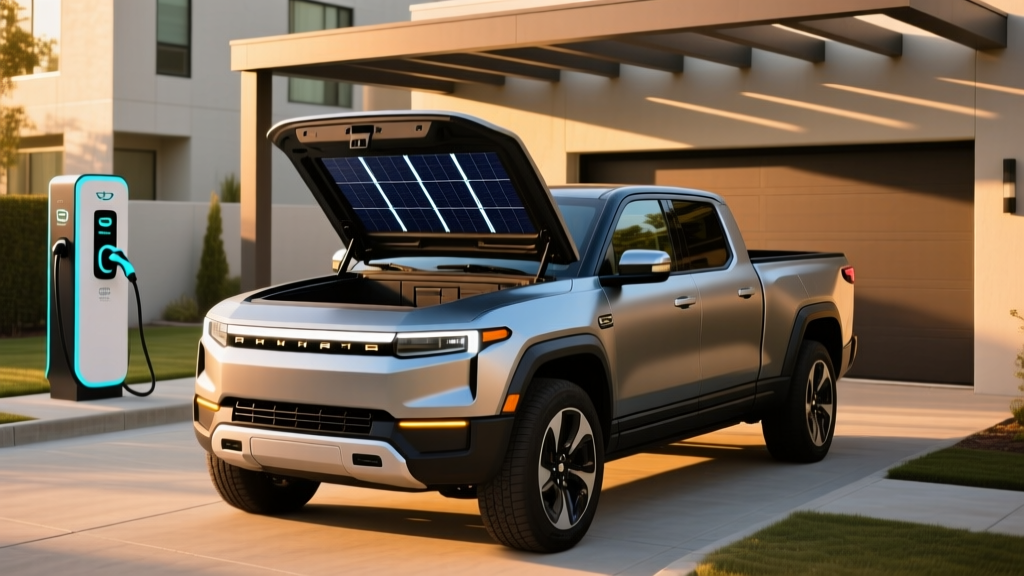
The Rivian power tonneau cover is one of the most popular factory accessories for the R1T, and for good reason. Unlike aftermarket retractable covers, the Rivian unit integrates directly with the truck's 12V electrical system and can be operated from the key fob, the Rivian mobile app, or the center touchscreen.
Key details on the power tonneau cover:
- Type: Electric retractable (aluminum slat design, rolls into a canister at the front of the bed)
- Operation: Key fob, app, touchscreen, or manual override
- Weather sealing: Drain tubes integrated into the bed rails; water-resistant but not fully waterproof
- Weight capacity: Supports distributed loads on top (e.g., gear, bikes with appropriate racks)
- Bed access trade-off: The canister reduces effective bed length by ~6–8 inches at the front
- Price (2026 accessory): ~$2,500 installed (check current Rivian shop pricing)
- Impact on range: Negligible — aerodynamic improvement at highway speed may add 1–2 miles of range, though this is difficult to isolate
The cover's integration with the R1T's software is its standout feature. You can set it to auto-open when the vehicle is unlocked in "Camp Mode" or configure it to close automatically when you drive away. It also pairs with the R1T's built-in bed lighting and the Gear Tunnel (the R1T's unique transverse storage compartment between the cab and bed) for a complete cargo-management system.
One drawback: if the 12V system loses power (e.g., a dead auxiliary battery), the manual override requires accessing a release cable inside the bed area, which isn't intuitive. Keep the owner's manual handy for this scenario.
Performance and Drivetrain: Dual-Motor vs. Tri-Motor
The 2026 R1T is offered in two powertrain configurations:
Dual-Motor AWD (533 hp, 610 lb-ft): The volume seller. A 0–60 mph time of 4.5 seconds makes it quicker than most sport sedans, let alone a 5,800-lb pickup. The independent front and rear motors provide torque vectoring that's genuinely useful off-road — Rivian's tank turn feature (braking one side while driving the other) can pivot the truck in tight trail situations.
Tri-Motor AWD (850 hp, 1,100+ lb-ft): Introduced with the refreshed R1 platform, the tri-motor adds a second rear motor for a 0–60 time of approximately 3.0 seconds. This is supercar territory in a truck that can tow 11,000 pounds. The tri-motor also enables more aggressive regenerative braking and finer torque distribution for rock crawling.
Both configurations come with Rivian's quad-motor-compatible air suspension (2.0 inches of adjustable ride height), which provides up to 14.9 inches of ground clearance in Off-Road mode. Approach, departure, and breakover angles are competitive with body-on-frame trucks when the suspension is at max height.
Pricing, Trims, and Federal Tax Credit Eligibility
| Configuration | Starting MSRP | Est. Price After §30D Credit |
|---|---|---|
| Dual-Motor Standard Pack | $69,900 | $62,400* |
| Dual-Motor Large Pack | $75,900 | $68,400* |
| Dual-Motor Max Pack | $84,900 | $77,400* |
| Tri-Motor Max Pack | $99,900 | $92,400* |
*Tax credit estimates assume full $7,500 eligibility. Actual credit depends on buyer income, battery sourcing compliance, and MSRP caps. See IRS rules below.
Under current IRS §30D guidelines, the R1T's tax credit eligibility depends on several factors:
- MSRP cap: Pickup trucks must have an MSRP at or below $80,000 to qualify. This means the Dual-Motor Max Pack (at ~$84,900) and all Tri-Motor configurations likely do not qualify unless optioned below the cap.
- Buyer income cap: Modified AGI must not exceed $150,000 (single), $225,000 (head of household), or $300,000 (joint filers).
- Battery sourcing: Critical minerals and battery components must meet escalating domestic-content thresholds. Rivian's battery cell sourcing has evolved, but the exact credit amount ($3,750 or $7,500) depends on the specific model year's compliance with IRS battery component rules.
- Point-of-sale transfer: As of 2024, eligible buyers can transfer the credit to the dealer at purchase, reducing the out-of-pocket price immediately rather than waiting for tax filing.
Cargo, Interior Space, and Daily Practicality
The R1T's 4.5-foot bed is shorter than a traditional full-size pickup, but Rivian compensates with the Gear Tunnel — a 11.7-cubic-foot lockable compartment that runs laterally between the cab and bed, accessible from both sides. It's ideal for storing charging cables, tools, or camping gear and keeps items secure without eating bed space.
Interior dimensions are generous for a midsize crew cab:
- Front legroom: 41.3 inches
- Rear legroom: 38.2 inches
- Front headroom: 41.0 inches
- Rear headroom: 38.5 inches
- Bed length: 54.0 inches (4.5 ft); extends to ~67 inches with tailgate down
- Bed payload: ~1,760 lbs
- Frunk (front trunk): 11.0 cubic feet, lockable, drainable — doubles as a cooler
The frunk is one of the R1T's most practical features. At 11 cubic feet, it's large enough for two carry-on bags or a full grocery run, and the drain plug means you can fill it with ice for tailgating.
Tech, Driver Assistance, and Notable Drawbacks
The R1T runs Rivian's in-house software on a 15.6-inch center touchscreen and a 12.3-inch driver display. The system is responsive and receives regular over-the-air (OTA) updates — Rivian has added features like improved route planning, Camp Mode enhancements, and refined regenerative braking profiles since launch.
Driver assistance (SAE Level 2): Rivian's Highway Assist provides adaptive cruise control with lane centering on divided highways. It is a Level 2 system — the driver must remain attentive and keep hands on the wheel at all times. It is not autonomous driving. The system works well on well-marked interstates but can struggle in construction zones and faded lane markings, as with all Level 2 systems from any manufacturer.
Rivian Highway Assist is an SAE Level 2 driver-assistance system. It does NOT make the R1T self-driving. The driver must monitor the road, keep hands on the steering wheel, and be prepared to take over instantly. Misuse of Level 2 systems has resulted in serious crashes across all brands. Never use it in city traffic, on winding roads, or in poor weather conditions where lane markings are obscured.
Notable drawbacks:
- Short bed: At 54 inches, the bed is too short for standard 4×8 sheets of plywood (even with the tailgate down, they won't lie flat). For contractors or frequent lumber haulers, this is a real limitation.
- No Apple CarPlay / Android Auto: Rivian uses its own infotainment system exclusively. While functional, many buyers expect phone mirroring at this price point.
- Service center availability: Rivian's service network is expanding but still sparse in rural areas. Mobile service handles many issues, but collision repair and major drivetrain work require a service center visit.
- Weight: At 5,800–6,400 lbs depending on configuration, the R1T is heavy even for a truck. This impacts tire wear, braking distances, and efficiency.
Who the 2026 Rivian R1T Suits Best
- You want an electric truck for outdoor recreation (camping, biking, skiing) and value the Gear Tunnel and frunk
- You need genuine off-road capability with adjustable air suspension and torque vectoring
- You can charge at home (Level 2) and your daily driving is under 200 miles
- You want the power tonneau cover integrated into the vehicle's software ecosystem
- You tow occasionally (up to 11,000 lbs) but not daily long-haul
❌ Look elsewhere if:
- You need a full 6- or 8-foot bed for work use (consider the Ford F-150 Lightning or Chevy Silverado EV)
- You tow heavy trailers long distances regularly — range while towing remains a fundamental EV limitation
- You rely on Apple CarPlay or Android Auto for navigation and media
- You live far from a Rivian service center and cannot tolerate potential wait times for repairs
Frequently Asked Questions
What is the real-world range of the 2026 Rivian R1T?
The EPA rates the Max Pack at 420 miles, the Large Pack at 352 miles, and the Standard Pack at 270 miles. Real-world highway driving at 70 mph typically yields 330–350 miles (Max), 280–300 miles (Large), and 215–230 miles (Standard). Cold weather below freezing reduces these figures by 15–30%, and towing a trailer can cut range by up to 50%.
How fast does the R1T charge at home and on the road?
On DC fast chargers, the Max and Large Packs peak at 220 kW, achieving a 10–80% charge in approximately 21 minutes. The Standard Pack peaks at 190 kW with a similar 10–80% time of ~22 minutes. At home on Level 2 (11.5 kW), expect about 25 miles of range added per hour — a full Max Pack charge takes roughly 13 hours.
Does the Rivian R1T qualify for the $7,500 federal EV tax credit?
It depends on configuration and buyer eligibility. Under IRS §30D rules, pickup trucks must have an MSRP at or below $80,000. The Dual-Motor Standard Pack (~$69,900) and Large Pack (~$75,900) fall under the cap. Buyer income must not exceed $300,000 (joint) / $150,000 (single), and the vehicle's battery must meet critical-mineral and component sourcing thresholds. Always verify on fueleconomy.gov before purchasing.
How does the Rivian power tonneau cover work?
The power tonneau cover is an aluminum-slat retractable design that rolls into a canister at the front of the bed. It operates via the key fob, the Rivian mobile app, or the center touchscreen. It integrates with vehicle software for features like auto-close on drive-away. The canister reduces usable bed length by about 6–8 inches. It costs approximately $2,500 as a factory accessory.
Is the R1T worth buying vs. the Ford F-150 Lightning or Chevy Silverado EV?
The R1T excels in off-road capability, tech integration, and adventure-oriented features (Gear Tunnel, frunk, air suspension). The F-150 Lightning offers a longer bed, Pro Power Onboard, and a more established dealer/service network. The Silverado EV provides a longer bed with the available Midgate and up to 440 miles of EPA range (4WT). If off-road recreation and software integration are priorities, the R1T leads. If you need a traditional work truck, the Lightning or Silverado EV may be better fits.
What is the R1T's battery warranty?
Rivian covers the battery pack for 8 years or 175,000 miles (whichever comes first), with a capacity retention threshold. The general vehicle warranty is 5 years / 60,000 miles. This battery warranty is competitive and slightly above the industry-standard 8-year/100,000-mile minimum for EV powertrains.