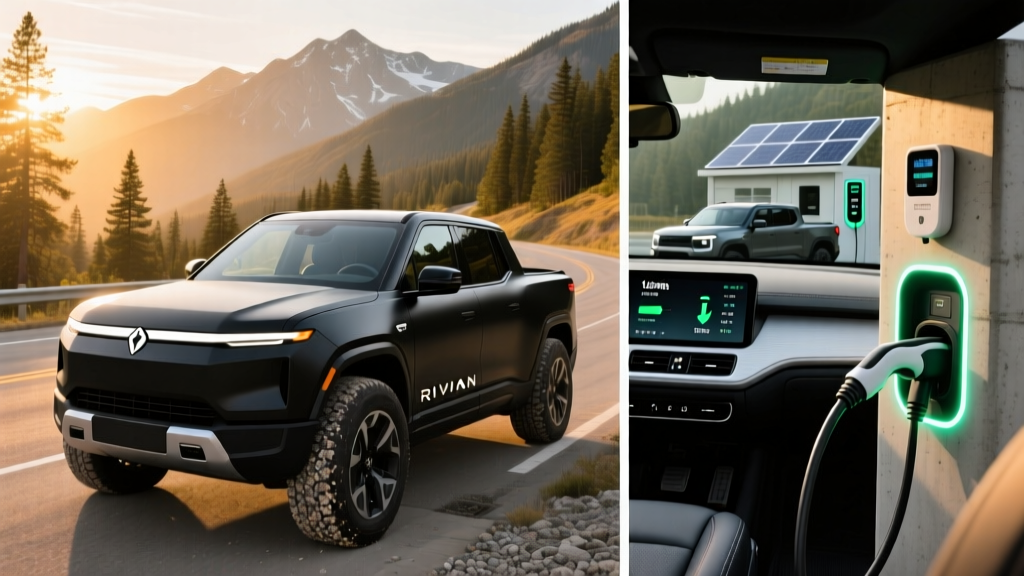
If you're researching what it actually means to be a Rivian owner in 2025, you've likely moved past the glossy adventure videos and into the weeds of battery chemistry, charge curves, and total cost of ownership. This profile dissects the 2025 Rivian R1T — the dual-motor electric pickup that started it all for the brand — with the exact numbers, real-world caveats, and ownership economics that matter when you're signing the paperwork.
Rivian updated the R1T significantly for the 2025 model year, introducing a new generation of drive units, a revised battery lineup (including a more affordable LFP option), a NACS charge port from the factory, and updated software. Let's break down what these changes mean on paper and on the pavement.
2025 Rivian R1T: At-a-Glance Specs
| Spec | Dual-Motor Standard | Dual-Motor Max |
|---|---|---|
| EPA Range | 270 mi | 420 mi |
| Battery (usable) | 92 kWh (LFP) | 141 kWh (NMC) |
| Drivetrain | AWD (Dual-Motor) | AWD (Dual-Motor) |
| Horsepower | 533 hp | 533 hp |
| 0-60 mph | 4.5 sec | 4.5 sec |
| Max DC Fast Charge | 200 kW | 220 kW |
| 10-80% DC Time | ~30 min | ~32 min |
| Level 2 Home Rate | 11.5 kW (~25 mi/hr) | 11.5 kW (~25 mi/hr) |
| MPGe (combined) | 73 MPGe | 70 MPGe |
| Efficiency | 46 kWh/100 mi | 48 kWh/100 mi |
| Towing Capacity | 11,000 lbs | 11,000 lbs |
| Base MSRP | $69,900 | $87,000 |
| Battery Warranty | 8 yr / 175,000 mi | 8 yr / 175,000 mi |
Source: fueleconomy.gov, Rivian R1T official specs. Specs reflect 2025 model-year Dual-Motor trims. Quad-Motor and Tri-Motor variants carry different figures.
Real-World Range: What the EPA Sticker Doesn't Tell You
The Dual-Motor Max Pack's 420-mile EPA estimate is among the highest of any production EV sold in the U.S. However, EPA range is a blended cycle. Here's what Rivian owners typically report in real-world conditions:
- Highway (70-75 mph, mild weather): ~340-360 miles — aerodynamic drag on a pickup body hits hard above 65 mph.
- City/suburban mixed driving: ~380-410 miles — regenerative braking recovers significant energy in stop-and-go conditions.
- Cold weather (below 32°F): Expect a 20-30% reduction, dropping the Max Pack to roughly 290-330 miles. The R1T's heat pump helps mitigate cabin energy draw, but battery chemistry still loses efficiency in the cold.
- Towing (5,000+ lb trailer): Range can drop to 150-200 miles depending on trailer weight and terrain. Plan charging stops accordingly.
The Standard Pack (LFP, 270 mi EPA) is better suited to commuters and daily drivers with reliable home charging. Its real-world highway range lands around 220-240 miles in moderate temperatures.
Battery Chemistry: LFP vs. NMC in the R1T
Rivian's 2025 lineup offers two distinct battery chemistries, and understanding the difference is critical for long-term ownership satisfaction:
| Attribute | Standard Pack (LFP) | Max Pack (NMC) |
|---|---|---|
| Chemistry | Lithium Iron Phosphate | Nickel Manganese Cobalt |
| Usable Capacity | 92 kWh | 141 kWh |
| Energy Density | Lower (heavier pack) | Higher (more range per lb) |
| Cycle Life | 3,000+ cycles | 1,500-2,000 cycles |
| Daily Charging to 100% | Recommended | Not recommended (80% daily) |
| Cold-Weather Performance | Slightly worse | Better low-temp discharge |
| Weight Impact | Heavier, slightly lower efficiency | Lighter per kWh, better efficiency |
| Best For | Daily commuters, cost-conscious buyers | Road-trippers, tow-heavy owners |
The LFP Standard Pack is a standout value play: it tolerates daily 100% charging without accelerated degradation, meaning a Rivian owner who charges at home every night can use the full 270 miles without battery-health anxiety. The NMC Max Pack delivers cross-country capability but benefits from the typical 80% daily charge ceiling to preserve long-term State of Health (SoH).
Charging Speed: DC Fast Charging and Home Setup
| Charging Level | Power | Miles Added Per Hour | Notes |
|---|---|---|---|
| Level 1 (120V outlet) | ~1.4 kW | ~3 mi/hr | Emergency/trickle only |
| Level 2 (240V, 48A) | 11.5 kW | ~25 mi/hr | Full overnight charge (~10-14 hrs for Max) |
| DC Fast (peak) | 200-220 kW | ~140 mi in 15 min | 10-80% in ~30-32 min |
| DC Fast (Taper above 80%) | Drops to <50 kW | Varies | Avoid charging past 80% on road trips unless necessary |
The 2025 R1T ships with a NACS (Tesla-style) charge port natively, giving Rivian owners direct access to the Tesla Supercharger network — over 25,000 stalls nationwide — without an adapter. This is arguably the single biggest quality-of-life improvement for new Rivian owners compared to early 2022-2023 models that relied on CCS adapters.
Charge curve reality check: The Max Pack's 220 kW peak rate only holds from roughly 10-35% State of Charge. From 35-60%, it tapers to ~170 kW, and above 80% it drops sharply to protect the NMC cells. On a road trip, plan your stops around the 10-80% window for the fastest turnaround. The LFP Standard Pack sustains its 200 kW peak a bit longer into the charge curve, making its 30-minute 10-80% time quite competitive despite the lower peak number.
For home charging, Rivian recommends a Wall Connector or equivalent Level 2 unit on a 60A circuit (48A continuous). Expect a full charge of the Max Pack in roughly 14 hours — fine for overnight replenishment. Budget $500-$1,500 for professional Level 2 installation depending on your panel capacity and run length. Rivian owners with 200A electrical panels may need a panel upgrade ($1,500-$3,000) if adding a hardwired 60A circuit.
Performance and Drivetrain
The 2025 Dual-Motor R1T uses Rivian's second-generation drive units, producing 533 horsepower and achieving a 4.5-second 0-60 mph time. That's a meaningful improvement in efficiency over the first-gen Dual-Motor while maintaining strong acceleration.
The AWD system uses one motor per axle with torque vectoring. Rivian's software-controlled differential locking and eight drive modes (including Rock Crawl, Snow, and Tow) make the R1T genuinely capable off-road — not just a lifestyle truck. Ground clearance adjusts from 7.9 to 14.9 inches via the air suspension, and the R1T can ford up to 36 inches of water.
For buyers who want more, the Tri-Motor (850 hp, 3.0 sec 0-60) and Quad-Motor (1,025 hp, 2.5 sec 0-60) variants exist at higher price points, but the Dual-Motor hits the best balance of performance and efficiency for most Rivian owners.
Pricing, Trims, and Federal Tax Credit Eligibility
| Trim / Pack | Base MSRP | Est. As-Tested | §30D Credit Eligible? |
|---|---|---|---|
| Dual-Motor Standard (LFP) | $69,900 | $73,000-$78,000 | Partial — see rules below |
| Dual-Motor Large (NMC) | $77,400 | $82,000-$88,000 | Partial — see rules below |
| Dual-Motor Max (NMC) | $87,000 | $92,000-$99,000 | Partial — see rules below |
| Tri-Motor Max | $99,900 | $105,000+ | Partial — see rules below |
The R1T qualifies as a light truck under IRS rules, so the MSRP cap is $80,000 (higher than the $55,000 sedan cap). Here's what determines your actual credit:
- MSRP cap: Only trims with an MSRP at or below $80,000 are eligible. The Dual-Motor Standard ($69,900) qualifies; the Max and Tri-Motor exceed the cap.
- Buyer income limits: AGI must not exceed $150,000 (single), $225,000 (head of household), or $300,000 (joint). Check IRS §30D guidelines for current-year thresholds.
- Battery sourcing: The credit is split into two halves ($3,750 each) — one for critical minerals sourcing, one for battery component manufacturing. Rivian's supply chain has been evolving; as of 2025, the R1T typically qualifies for $3,750 (critical minerals half). Verify on the IRS qualified vehicles list before purchase.
- Point-of-sale transfer: You can transfer the credit to the dealer at purchase, reducing your out-of-pocket cost immediately rather than waiting for tax filing.
Bottom line: A Dual-Motor Standard buyer who meets income requirements can expect roughly $3,750 off at point of sale — bringing the effective price to ~$66,150. Always confirm eligibility with your tax professional and the IRS qualified vehicle list at the time of purchase.
Cargo, Passenger Space, and Everyday Utility
The R1T's party trick is its 4.5-foot bed with the innovative Gear Tunnel — a lockable, pass-through storage compartment behind the rear seats that adds 11.7 cubic feet of enclosed cargo space. Total bed volume is 29.2 cubic feet with the tonneau closed.
- Front legroom: 41.3 inches
- Rear legroom: 38.2 inches — comfortable for adults on longer drives
- Frunk (front trunk): 11.0 cubic feet — lockable, drainable, perfect for groceries or wet gear
- Gear Tunnel: 11.7 cubic feet (standard on most trims, deleted on some Max Pack configurations to accommodate the larger battery)
- Max payload: ~1,760 lbs
- Towing: 11,000 lbs — but remember the range penalty (see above)
For a Rivian owner who camps, bikes, or toys, the combination of frunk, bed, and Gear Tunnel offers more enclosed, secure storage than most mid-size trucks. The trade-off: the 4.5-foot bed is shorter than a Tacoma or Colorado, so full sheets of plywood won't fit flat.
Tech, Driver Assistance, and Software
The R1T runs Rivian's in-house software stack on a 15.6-inch landscape touchscreen. Highlights include:
- Rivian Driver+: A Level 2 (SAE) driver-assistance system with adaptive cruise control, lane centering, and automatic lane changes on divided highways. This is a supervised system — you must keep your hands on the wheel and eyes on the road at all times. It is not autonomous driving.
- Over-the-air updates: Rivian regularly pushes software improvements. Recent updates have improved regenerative braking profiles, added camp mode features, and refined route planning with charging stops.
- Phone-as-key: Reliable Bluetooth LE-based keyless entry and start.
- Camp Kitchen option: A slide-out kitchen system designed for the Gear Tunnel (dealer-installed accessory).
Rivian Driver+ is an SAE Level 2 system. It does not make the R1T a self-driving vehicle. The driver is legally and operationally responsible for all vehicle control at all times. Hands-off or eyes-off use is not supported and is unsafe.
Warranty Coverage
Rivian's warranty is competitive within the EV truck segment:
- Battery & Drive Units: 8 years / 175,000 miles (whichever comes first), with a capacity retention threshold of 70% — meaning if your battery degrades below 70% of original capacity within the warranty period, Rivian will repair or replace it.
- Bumper-to-Bumper: 5 years / 60,000 miles
- Roadside Assistance: 5 years / 60,000 miles
The 175,000-mile battery warranty is generous compared to many competitors at 100,000 miles. For a Rivian owner planning high-mileage use (commuting, towing, road trips), this extra coverage matters.
Pros and Cons: The Honest Ownership Picture
- Class-leading 420-mile Max Pack range
- Native NACS port — full Supercharger access
- LFP option for daily 100% charging without degradation worry
- Genuine off-road capability with air suspension
- Gear Tunnel and frunk offer unmatched secure storage
- 175,000-mile battery warranty
- Regular OTA software improvements
- 4.5-foot bed is short for a pickup — limits utility for lumber, large cargo
- High starting price; most trims exceed the $80K tax credit MSRP cap
- Efficiency drops sharply when towing (150-200 mi range)
- Service center network still expanding — wait times in some markets
- No Apple CarPlay or Android Auto (Rivian's native system only)
- Driver+ is competent but lags behind GM Super Cruise in hands-free coverage
Who Should Buy the R1T — And Who Shouldn't
Choose the R1T if:
- You want an electric pickup for adventure, camping, and light-to-moderate towing — not commercial work hauling
- You have access to home Level 2 charging (the R1T's 141 kWh Max Pack is impractical on Level 1 alone)
- You value off-road capability and adjustable air suspension
- You want Supercharger network access without adapters
Look elsewhere if:
- You need a full-size 6+ foot bed for work (consider the Ford F-150 Lightning or Chevy Silverado EV)
- Your budget is under $65,000 (consider the used EV market or wait for Rivian's upcoming R2 platform)
- You tow heavy trailers frequently and need 300+ miles of range while towing — no EV pickup delivers this yet
- You require Apple CarPlay/Android Auto integration
Frequently Asked Questions
What is the real-world range of the 2025 Rivian R1T?
The Max Pack's 420-mile EPA estimate translates to roughly 340-360 miles at highway speeds in mild weather, and 290-330 miles in freezing temperatures. The Standard Pack (270 mi EPA) delivers around 220-240 miles on the highway. City and suburban driving with regenerative braking gets you closer to the EPA sticker on both packs.
How fast does the R1T charge at home and on the road?
On a Level 2 home charger (11.5 kW), expect about 25 miles of range per hour — a full Max Pack charge takes roughly 14 hours overnight. On DC fast chargers, the R1T peaks at 200-220 kW and charges from 10-80% in about 30-32 minutes. The native NACS port gives you seamless Tesla Supercharger access.
How much does the R1T cost after the federal tax credit?
The Dual-Motor Standard starts at $69,900 and may qualify for up to $3,750 in federal tax credit (critical minerals portion), bringing the effective price to ~$66,150 for income-eligible buyers. Higher trims exceed the $80,000 MSRP cap and are not eligible for the credit. Always verify current eligibility on the IRS qualified vehicles page.
Is the R1T worth buying vs. the Ford F-150 Lightning or Chevy Silverado EV?
The R1T excels in off-road capability, adventure-oriented storage (Gear Tunnel, frunk), and efficiency per mile. The F-150 Lightning offers a larger bed, Pro Power Onboard, and a lower starting price. The Silverado EV targets work-truck utility with a longer bed option. If you're an adventure-oriented buyer who doesn't need a full-size bed, the R1T is the strongest pick. If you need a work truck, the Lightning or Silverado EV is more practical.
Does the R1T qualify for the federal EV tax credit?
Only trims with an MSRP at or below $80,000 qualify — currently the Dual-Motor Standard ($69,900). Buyer income must fall below IRS thresholds ($300K joint, $150K single), and the credit amount depends on battery sourcing compliance. As of 2025, the R1T typically qualifies for $3,750. Confirm on the IRS site before purchasing.
What are the biggest complaints from current Rivian owners?
Common owner-reported concerns include service center availability in smaller metro areas, the lack of Apple CarPlay/Android Auto, and the short bed length for traditional truck tasks. Early build-quality issues (panel gaps, software glitches) have largely improved in 2024-2025 production. The Rivian owner community on forums and social media is active and supportive, which helps with troubleshooting.
How long will the R1T battery last?
Rivian warranties the battery for 8 years / 175,000 miles at 70% capacity retention. Industry data suggests NMC packs typically retain 80-85% capacity after 150,000 miles with proper charging habits (avoiding frequent 100% charges and prolonged low-SoC storage). LFP packs generally show even slower degradation and can be charged to 100% daily without concern.
Sources: fueleconomy.gov, Rivian official specifications, IRS §30D Clean Vehicle Credits. Pricing and credit eligibility reflect 2025 model year and are subject to change. Consult a tax professional for personalized credit guidance.