Quick Verdict: Is the R1T Lease Worth It?
The 2026 Rivian R1T remains the most capable electric pickup on the market for buyers who need genuine off-road chops, clever storage, and a premium cabin — without committing to a $70,000+ purchase. A Rivian R1T lease can be an attractive way to access the truck's dual-motor or quad-motor powertrain while sidestepping long-term battery-degradation concerns. However, the R1T's starting MSRP of $69,900 (Dual Standard) and the complexity of federal tax-credit rules mean you need to run the numbers carefully before signing. This guide covers everything from real-world range to charging infrastructure to the fine print on incentives.
R1T Specs at a Glance
| Spec | Dual Standard | Dual Max | Tri Max | Quad Max |
|---|---|---|---|---|
| EPA Range (est.) | 270 mi | 420 mi | 380 mi | 350 mi |
| Battery Usable (kWh) | ~95 kWh (LFP) | ~149 kWh (NMC) | ~149 kWh (NMC) | ~149 kWh (NMC) |
| Horsepower | 533 hp | 533 hp | 850 hp | 1,025 hp |
| 0-60 mph | 4.5 sec | 4.5 sec | 2.9 sec | 2.5 sec |
| Drivetrain | Dual-motor AWD | Dual-motor AWD | Tri-motor AWD | Quad-motor AWD |
| Max DC Fast Charge | 200 kW | 220 kW | 220 kW | 220 kW |
| 10-80% DC Time | ~27 min | ~30 min | ~30 min | ~32 min |
| Level 2 Charge Rate | 11.5 kW (30 mi/hr) | 11.5 kW (30 mi/hr) | 11.5 kW (30 mi/hr) | 11.5 kW (30 mi/hr) |
| Towing Capacity | 11,000 lb | 11,000 lb | 11,000 lb | 11,000 lb |
| Base MSRP | $69,900 | $83,900 | $99,900 | $99,900 |
Note: Rivian has transitioned the Standard pack to LFP (lithium iron phosphate) chemistry for 2025-2026. LFP batteries are heavier and less energy-dense than NMC but offer longer cycle life and tolerate daily 100% charging without accelerated degradation. The Max packs retain NMC (nickel manganese cobalt) chemistry for higher energy density.
Range and Efficiency: EPA vs. Real World
EPA Estimated Range: 270 mi (Dual Standard) | 420 mi (Dual Max) | 380 mi (Tri Max) | 350 mi (Quad Max)
Real-World Expectation: Plan for 220-250 mi highway (Dual Standard), 350-380 mi highway (Dual Max). Cold-weather (below 32°F) can reduce range 15-25%. Towing a 5,000 lb trailer can cut range by 40-50%.
The R1T's EPA numbers look strong on paper, especially the 420-mile Dual Max variant, which currently holds the longest EPA range among electric pickups. But the R1T is a 7,000+ lb brick-shaped vehicle, and real-world efficiency reflects that. According to fueleconomy.gov, the Dual Motor Standard achieves roughly 73 MPGe combined (46 kWh/100 mi), while the Max pack variants dip to around 70 MPGe due to the added battery weight.
On a 70 mph highway run in moderate temperatures (65-75°F), expect the Dual Standard to deliver 220-240 miles before you're hunting for a charger. The Dual Max comfortably covers 350-370 highway miles. Below freezing, add a 15-25% reduction — the R1T's heat pump helps mitigate cabin-energy draw, but battery chemistry slows in cold, and regenerative braking is limited until the pack warms.
If you tow, range planning becomes critical. A 5,000 lb boat or camper can drop the Dual Max to 220-250 miles. The R1T does not currently offer a range-extender or EREV option, so towing trips require route-planning around DC fast chargers — and not all chargers accommodate truck-trailer combos without unhitching.
Charging Speed: Home and DC Fast Charging
| Level | Power | Speed (Miles/Hour) | Notes |
|---|---|---|---|
| Level 1 (120V) | ~1.4 kW | ~3 mi/hr | Emergency/top-up only; 140+ hr for full charge |
| Level 2 (240V, 48A) | 11.5 kW | ~30 mi/hr | Full charge in ~8-13 hr depending on pack |
| DC Fast Charge | 200-220 kW peak | ~400-500 mi/hr (peak) | 10-80% in 27-32 min; tapers significantly above 80% |
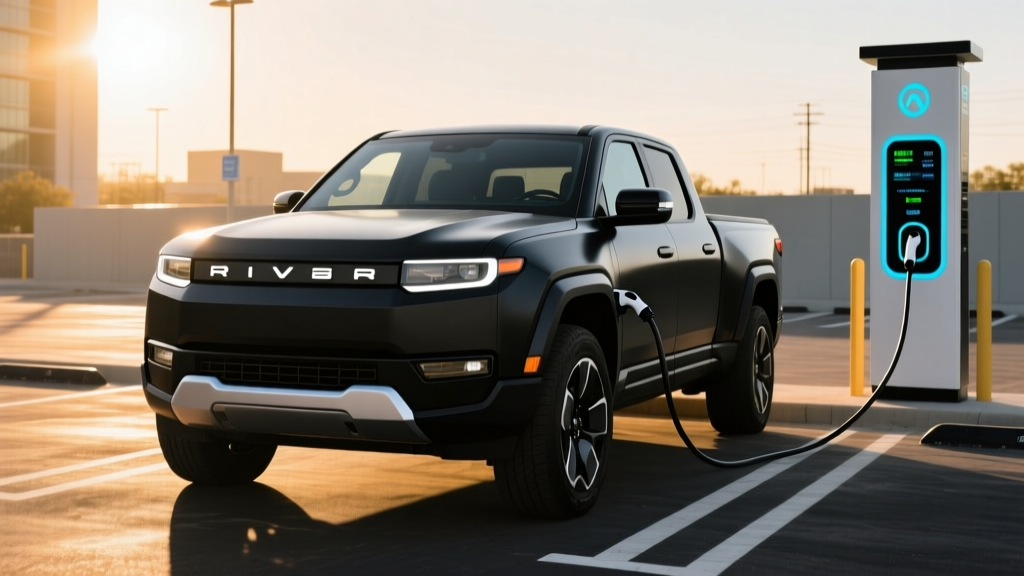
The R1T charges on the NACS (Tesla-style) connector as of the 2025 model year, giving it native access to the Tesla Supercharger network without an adapter — a major practical advantage over CCS-only trucks that still rely on Magic Dock or third-party adapters at many Superchargers.
At a 250 kW Supercharger or Electrify America station, the Dual Max pack peaks around 220 kW but sustains that rate only between roughly 15-40% state of charge. The charge curve tapers progressively: 40-60% runs at ~170 kW, 60-80% drops to ~120 kW, and 80-100% crawls at under 50 kW. This is standard for large NMC packs but means your actual 10-80% session takes 30 minutes, not the "under 20 minutes" some marketing materials imply.
At home, the R1T accepts 11.5 kW on a Level 2 wall connector (240V, 48 amps). This adds roughly 30 miles of range per hour of charging, meaning an overnight session (8-10 hours) replenishes 240-300 miles — enough to refill the Standard pack completely and the Max pack to about 70-80%. A licensed electrician will typically charge $600-$1,500 for a 240V/60A circuit installation, plus $400-$700 for a quality Level 2 wall connector (e.g., Tesla Wall Connector, ChargePoint Home Flex). If your home's electrical panel is maxed at 100A, a panel upgrade to 200A can add $1,500-$3,000.
Performance, Cargo, and Tech
Even the "base" Dual Standard R1T produces 533 horsepower and hits 60 mph in 4.5 seconds — quicker than most V8 pickups. The Tri Max (850 hp, 2.9 sec) and Quad Max (1,025 hp, 2.5 sec) enter supercar territory, though the added weight and cost make them niche choices. All configurations feature AWD with individual motor torque vectoring, and the Quad Max can execute Rivian's signature "tank turn" (rotating in place by spinning wheels in opposite directions).
Cargo and storage: The R1T's 4-foot-6-inch bed (extending to ~6 feet with the Gear Tunnel) is shorter than a traditional full-size pickup bed, which matters if you haul lumber or motorcycles. However, the lockable Gear Tunnel (11 cu ft per side, pass-through) is a standout feature for camping gear, tools, or luggage. The front trunk (frunk) provides 11 cu ft of sealed storage. Interior passenger space offers 41.1 inches of front legroom and 38.2 inches rear — comfortable for four adults on long trips, though the rear seat is tighter than an F-150 Lightning's.
Tech and driver assistance: The R1T runs Rivian's custom infotainment on a 15.6-inch landscape touchscreen, with a 12.3-inch digital cluster. The system is responsive, with native route planning that factors in charging stops and battery preconditioning. The R1T includes Rivian's Highway Assist — a SAE Level 2 driver-assistance system that combines adaptive cruise and lane-centering. It is competent for highway cruising but requires continuous driver attention (hands-on-wheel or torque-sensing). This is not autonomous driving; the driver remains responsible at all times.
Notable drawbacks: The R1T's ride quality, while improved with the 2025+ refresh, still transmits more road imperfections than a unibody SUV due to its body-on-frame construction. The rear seat lacks the fold-flat flexibility of competitors. And the short bed, while innovative with the Gear Tunnel, is a genuine limitation for buyers who need full-size truck utility.
Pricing, Lease Options, and Federal Tax Credit
| Trim | Base MSRP | Federal §30D Credit Eligibility | Est. Effective Price (with credit) |
|---|---|---|---|
| Dual Standard | $69,900 | Potentially up to $7,500 (see rules below) | ~$62,400 |
| Dual Max | $83,900 | Not eligible (MSRP exceeds $80,000 truck cap) | $83,900 |
| Tri Max | $99,900 | Not eligible (MSRP exceeds $80,000 truck cap) | $99,900 |
| Quad Max | $99,900 | Not eligible (MSRP exceeds $80,000 truck cap) | $99,900 |
The §30D federal EV tax credit has strict rules for 2026, and only the Dual Standard R1T (MSRP under $80,000 for trucks) has a path to the full $7,500. Even then, eligibility depends on:
- Buyer income caps: Modified AGI must not exceed $300,000 (joint filers), $225,000 (head of household), or $150,000 (single).
- Battery sourcing: A percentage of critical minerals and battery components must be sourced from the US or free-trade-agreement countries. These thresholds tighten annually. Verify current-year compliance on irs.gov.
- Point-of-sale transfer: As of 2024+, buyers can transfer the credit to the dealer at purchase, reducing the sale price directly — but this option is available for purchases, not always for leases.
Lease-specific nuance: Under §30D, the federal tax credit technically belongs to the lessor (the financing entity), not the lessee. Some lessors pass the $7,500 savings through as a capitalized-cost reduction (lowering your monthly payment), while others retain it. Rivian has historically passed the credit through on qualifying leases, but this is not guaranteed by statute. Always confirm in writing whether the lease offer reflects the credit before signing. A Dual Standard R1T lease with the $7,500 applied might run $799-$899/month (36 months, $5,000 down), depending on money factor and residual — but rates vary by region and creditworthiness.
R1T vs. Key Competitors: Buy, Lease, or Look Elsewhere?
The R1T competes in a small but growing segment:
- Ford F-150 Lightning: Larger bed (5.5 ft), lower starting price (~$55,000 for Pro), but less range (230-320 mi EPA) and no Gear Tunnel. Better for traditional truck buyers who prioritize bed length and dealer network.
- Chevrolet Silverado EV: Up to 440 mi range (Max pack), available 4WT steering, but higher trims push well past $90,000 and real-world availability is still ramping.
- Tesla Cybertruck: Polarizing design, stainless steel exoskeleton, up to 340 mi range (AWD), starting ~$79,990. More tech-forward but less refined interior and limited off-road articulation compared to R1T.
Pros
- Class-leading real-world off-road capability (up to 14.4" ground clearance with air suspension)
- Gear Tunnel provides secure, weatherproof storage no competitor matches
- NACS connector = native Supercharger access
- Quad-motor tank turns (Quad Max only)
- Strong build quality and premium interior materials
- OTA updates continue to add features post-delivery
Cons
- Short bed (4'6") limits traditional truck utility
- Only the base Dual Standard qualifies for §30D credit
- High starting price; well-equipped builds exceed $100,000
- Lease credit pass-through depends on lessor
- Ride quality firm compared to unibody SUVs
- Limited service center network vs. Ford/Chevy
Who Should Lease the R1T?
Choose an R1T lease if:
- You want a premium electric truck for 2-3 years without long-term battery-depreciation risk
- You prioritize off-road capability and clever storage over bed length
- You have home Level 2 charging and access to Superchargers for road trips
- You're in the Dual Standard trim and qualify for the §30D credit (income, sourcing)
Look elsewhere if:
- You need a full-size bed for work (consider F-150 Lightning or Silverado EV)
- You want the longest possible range on a budget (Silverado EV Max or R1T Dual Max, but both are $80,000+)
- You lack reliable home or workplace charging
- You plan to tow heavy loads long distances frequently (range drops 40-50%)
Warranty and Long-Term Ownership
Rivian covers the R1T with a 5-year/60,000-mile bumper-to-bumper warranty and an 8-year/175,000-mile battery and powertrain warranty (with a capacity-retention threshold of 70%). This is competitive with the segment, though Tesla's 8-year/150,000-mile battery warranty on the Cybertruck is slightly less generous on mileage. Rivian's service network is expanding but remains concentrated in metro areas — rural owners may face longer drive times for warranty work. Mobile service vans handle many software-related and minor hardware fixes at your home or office.
Frequently Asked Questions
What is the real-world range of the Rivian R1T?
The Dual Standard delivers roughly 220-250 highway miles; the Dual Max covers 350-380 highway miles. Cold weather (below 32°F) reduces these figures by 15-25%. Towing a 5,000 lb trailer can cut range by 40-50%.
How fast does the R1T charge at home and on DC fast chargers?
At home on Level 2 (240V, 48A), the R1T charges at 11.5 kW, adding ~30 miles per hour. On DC fast chargers, it peaks at 200-220 kW and charges 10-80% in 27-32 minutes, though the rate tapers significantly above 80%.
Does the Rivian R1T qualify for the federal EV tax credit?
Only the Dual Standard (MSRP $69,900) is under the $80,000 truck cap for §30D. Even then, eligibility depends on buyer income limits, battery-sourcing requirements, and lessor pass-through on leases. Verify current rules at irs.gov.
Is it better to lease or buy the R1T?
Leasing reduces upfront risk (no long-term battery-depreciation exposure) and may pass through the $7,500 credit on the Dual Standard. Buying makes sense if you plan to keep the truck 5+ years, want to customize, or can apply the credit at point of sale. Run both scenarios with your dealer.
How does the R1T compare to the F-150 Lightning?
The Lightning offers a longer bed (5.5 ft), lower entry price, and a broader dealer network. The R1T offers superior off-road capability, the Gear Tunnel, NACS/Supercharger access, and a more premium interior. If bed length and budget matter most, Lightning wins. If adventure capability and refinement matter most, R1T wins.
What is the battery warranty on the R1T?
Rivian provides an 8-year/175,000-mile battery and drive-unit warranty, guaranteeing at least 70% capacity retention over that period. LFP Standard packs are expected to degrade more slowly than NMC Max packs, though long-term data is still accumulating.