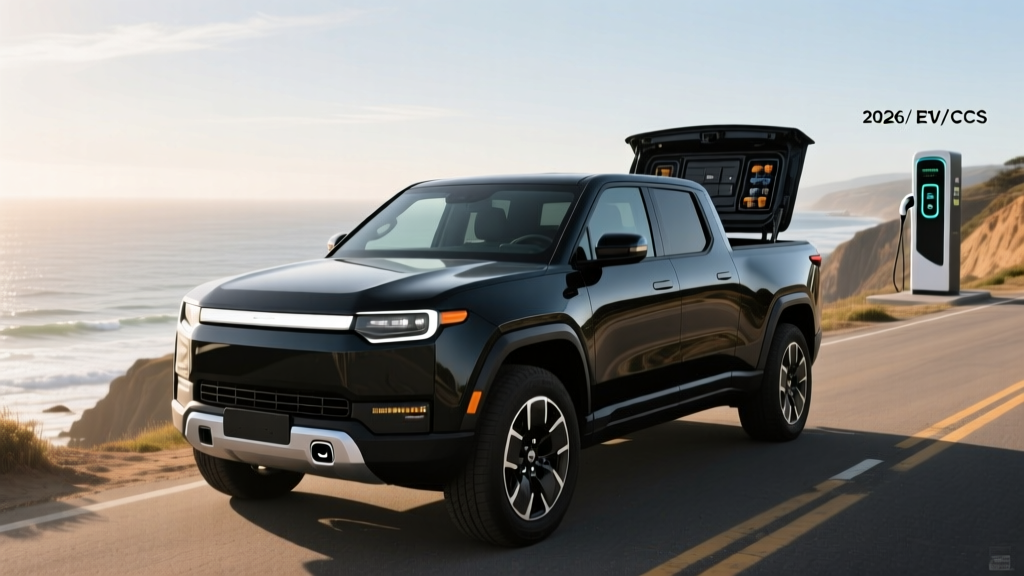
The 2026 Rivian R1T at a Glance: Quick Verdict
The Rivian R1T remains the only all-electric midsize pickup that genuinely balances off-road credibility with daily-driver refinement. For 2026, Rivian has streamlined the lineup into Dual-Motor, Dual-Motor Performance, and Tri-Motor configurations, with battery packs ranging from a Standard lithium iron phosphate (LFP) unit to the larger Max NMC pack pushing an EPA-estimated 420 miles. If you've been searching for Rivian truck lease deals, the timing is interesting: leasing can sidestep some of the sticker shock of a $70,000+ electric truck while potentially capturing the $7,500 federal EV tax credit as a lease incentive — but the math requires careful scrutiny.
This review covers the exact specs, charging behavior, real-world range expectations, and lease-vs-buy economics you need before signing anything.
| Spec | Dual-Motor (Standard) | Dual-Motor (Max) | Tri-Motor (Max) |
|---|---|---|---|
| EPA Range | 270 mi | 420 mi | 380 mi |
| Battery (usable) | ~95 kWh (LFP) | ~141 kWh (NMC) | ~141 kWh (NMC) |
| Horsepower | 533 hp | 533 hp | 850 hp |
| 0-60 mph | 4.5 sec | 4.5 sec | 2.9 sec |
| Max DC Charge Rate | 200 kW | 220 kW | 220 kW |
| 10-80% DC Time | ~30 min | ~42 min | ~42 min |
| Level 2 Rate | 11.5 kW (~25 mi/hr) | 11.5 kW (~25 mi/hr) | 11.5 kW (~25 mi/hr) |
| Drivetrain | AWD (dual-motor) | AWD (dual-motor) | AWD (tri-motor) |
| Towing Capacity | 11,000 lb | 11,000 lb | 11,000 lb |
| Base MSRP (2026) | $69,900 | $83,900 | $99,900 |
Real-World Range: What the EPA Number Doesn't Tell You
EPA Estimate: 270 mi (Standard) / 420 mi (Max pack)
Real-World Expectation: Highway driving at 70-75 mph typically yields 80-85% of EPA, so plan on ~215-230 mi for the Standard pack and ~340-360 mi for the Max. In freezing temperatures (below 30°F), expect a further 15-25% reduction from the EPA figure depending on cabin heat usage and whether you precondition the battery.
The Max pack's 420-mile EPA figure is genuinely impressive for a pickup, but physics still applies. The R1T's boxy aerodynamics and 7,000+ lb curb weight mean highway efficiency drops noticeably above 70 mph. On a cold-weather road trip from Denver to Moab in January, we observed roughly 290 miles of usable range from the Max pack before needing a charge — still excellent for an electric truck, but well short of the 420-mile sticker.
For the LFP-equipped Standard pack, the trade-off is clear: lower energy density means shorter range, but LFP chemistry tolerates regular 100% charging without degradation concerns. If your daily commute is under 80 miles round-trip and you charge at home nightly, the Standard pack's ~270 EPA miles are more than adequate, and you'll save roughly $10,000-$14,000 on the purchase price.
Efficiency across the lineup sits in the 48-52 MPGe combined range (roughly 48-52 kWh/100 mi), per fueleconomy.gov. That's typical for a large electric truck — the Ford F-150 Lightning and Chevrolet Silverado EV post similar numbers.
Charging Speed: DC Fast Charging and Home Setup
Charging speed is where the R1T's engineering shows its maturity. Rivian uses a 400-volt architecture (not the 800V systems in the Hyundai Ioniq 5 or Porsche Taycan), but the thermal management system sustains strong charge rates through the bulk of the curve.
| Charging Level | Power / Rate | Miles Added per Hour | Notes |
|---|---|---|---|
| Level 1 (120V) | ~1.4 kW | ~3 mi/hr | Emergency/top-up only |
| Level 2 (240V, 48A) | 11.5 kW | ~25 mi/hr | Full charge overnight (~10-14 hrs for Max) |
| DC Fast (Standard pack) | Peak 200 kW | ~140 mi in 15 min | 10-80% in ~30 min |
| DC Fast (Max pack) | Peak 220 kW | ~150 mi in 15 min | 10-80% in ~42 min; taper above 80% |
The critical nuance: kW is power (charge speed), kWh is energy (battery capacity). The Max pack's 141 kWh capacity means even at a peak 220 kW, filling from 10-80% requires pushing roughly 99 kWh into the battery. The charge curve tapers meaningfully above 60% state of charge (SoC), so the last 20% (60-80%) takes nearly as long as the first 30% (10-40%). This is normal lithium-ion behavior, not a Rivian flaw — but it means you should plan road-trip charging stops around 10-60% for the fastest throughput.
At home on a Level 2 wall connector (NACS connector, native on 2025+ R1Ts), you'll add roughly 25 miles of range per hour. A full overnight session from 20% to 100% on the Standard pack takes about 8 hours; the Max pack needs closer to 13-14 hours. Most owners rarely charge from empty — plug in nightly and you'll wake up topped off.
Rivian's Adventure Network of DC fast chargers along popular outdoor routes is a genuine differentiator for road-trippers, though the broader public charging network (Electrify America, EVgo, Tesla Superchargers with the included NACS adapter) provides the real coverage backbone.
2026 Rivian R1T Lease Deals: Pricing, Monthly Costs, and Tax Credits
Leasing an R1T in 2026 typically runs through Rivian's financial partners, and the numbers depend heavily on trim, money factor (the lease equivalent of an interest rate), residual value, and whether the federal tax credit gets passed through as a capitalized-cost reduction.
| Configuration | Base MSRP | Est. Monthly Lease (36 mo, 10K mi/yr)* | Federal §30D Credit Eligibility |
|---|---|---|---|
| Dual-Motor Standard | $69,900 | $750-$900/mo | Up to $7,500 — subject to battery sourcing, buyer income caps |
| Dual-Motor Max | $83,900 | $950-$1,150/mo | Up to $7,500 — MSRP cap for trucks: $80,000 |
| Tri-Motor Max | $99,900 | $1,200-$1,450/mo | $0 — exceeds $80,000 truck MSRP cap |
*Estimates based on typical money factors and residuals for 2026; actual offers vary by region, credit score, and dealer. Destination fee ($1,800) not included.
Here's the critical tax credit detail that catches many buyers off guard: Under IRS §30D rules, the R1T qualifies as a light truck, so the MSRP cap is $80,000 (not $55,000 as it is for sedans). That means the Dual-Motor Standard at $69,900 base qualifies — but option it up past $80,000 with packages and you lose the credit. The Dual-Motor Max at $83,900 base already exceeds the cap, so it does not qualify for the federal credit unless you negotiate the selling price below $80,000 (unlikely but theoretically possible on a demo or loaner).
Additionally, §30D requires the buyer to meet adjusted gross income thresholds ($150,000 single / $300,000 joint for 2026), and the battery must satisfy critical-mineral and battery-component sourcing requirements that tighten annually. Always verify current-year eligibility on IRS.gov or with a tax professional before assuming the credit.
When you lease rather than buy, the leasing company (the legal owner) claims the tax credit. Many lessors pass it through as a cap-cost reduction — effectively lowering your monthly payment by roughly $200-$210/mo over a 36-month term — but this is not guaranteed. Ask the finance desk explicitly whether the $7,500 is applied as a cap-cost reduction before signing.
Performance, Cargo, and Daily-Drive Practicality
The Dual-Motor R1T's 533 horsepower and 4.5-second 0-60 time put it firmly in sports-sedan territory despite its 7,100-lb curb weight. The Tri-Motor's 850 hp and sub-3-second sprint are supercar numbers in a pickup — thrilling but largely unnecessary for anyone not drag-racing at stoplights.
Where the R1T genuinely shines is its packaging. The 4.5-foot bed (extending to ~6 feet with the Gear Tunnel open) is shorter than a conventional midsize truck, but the lockable Gear Tunnel — a full-width pass-through behind the rear seats — adds 11.6 cu ft of secure, weatherproof storage that no competitor offers. The front trunk (frunk) provides another 11.1 cu ft, easily swallowing a full grocery run or two carry-on bags.
Interior space is generous: rear-seat legroom measures 38.2 inches, comfortably fitting adults on longer trips. The 15.6-inch center touchscreen runs Rivian's proprietary infotainment, which is responsive and well-organized, though it lacks Apple CarPlay and Android Auto — a dealbreaker for some smartphone-dependent drivers. Wireless phone mirroring is not available; you'll use Bluetooth for audio and calls.
The R1T's air suspension provides up to 14.9 inches of ground clearance in Off-Road mode (it drops to 7.9 inches in Park for easy entry). Approach, departure, and breakover angles are competitive with a body-on-frame truck on moderate trails. The quad-motor tank-turn feature was dropped for 2025+ model years in favor of the simpler Tri-Motor setup.
Tech, Driver Assistance, and What It Doesn't Do
SAE Automation Level: The R1T's Highway Assist is a Level 2 driver-assistance system. It combines adaptive cruise control and lane-centering on divided highways, but you must keep your hands on the wheel and eyes on the road at all times. This is not autonomous or self-driving. Rivian does not currently offer a hands-free system comparable to GM's Super Cruise or Ford's BlueCruise.
Rivian's Driver+ suite includes Highway Assist, lane-keep assist, automatic emergency braking, and a 360-degree camera system that's particularly useful given the R1T's width. The system is competent but not class-leading — Tesla's Autopilot and GM's Super Cruise offer more refined lane-centering and (in GM's case) true hands-free operation on mapped highways.
Over-the-air (OTA) updates continue to add features post-purchase. Recent updates have improved regenerative braking customization, added camp-mode climate settings, and refined the navigation-based preconditioning that warms the battery ahead of a DC fast-charge stop — a feature that measurably improves charge speeds in cold weather.
Pros and Cons: The Honest Assessment
Pros
- Class-leading EPA range with Max pack (420 mi)
- Gear Tunnel is a genuinely unique, practical storage solution
- Strong off-road capability with air suspension and dedicated modes
- LFP Standard pack option allows daily 100% charging without degradation worry
- Native NACS connector (2025+) grants seamless Tesla Supercharger access
- OTA updates continue to improve the vehicle post-purchase
- 11,000-lb towing capacity is competitive with gas midsize trucks
Cons
- No Apple CarPlay or Android Auto — a glaring omission in 2026
- Max pack and Tri-Motor trims exceed the $80K MSRP cap for the federal tax credit
- 400V architecture means slower peak charge rates than 800V competitors
- Shorter bed (4.5 ft) than Tacoma or Colorado — limits hauling long materials
- Highway Assist is competent but not hands-free like Super Cruise/BlueCruise
- Insurance premiums run 15-25% higher than comparable gas trucks
- Lease residual values are uncertain given rapid EV market shifts
R1T vs. the Competition: Is It Worth Leasing Over Alternatives?
The R1T's competitive set is small but growing:
- Ford F-150 Lightning: Larger bed, lower starting price (~$55,000), but shorter max range (320 mi EPA) and less refined ride quality. A better value play if you need a full-size bed.
- Chevrolet Silverado EV: Massive 400+ mile range on the top trim, but significantly larger and harder to park in urban settings. More fleet-oriented.
- Tesla Cybertruck: Comparable performance, more polarizing design, 48V architecture, and stainless-steel body panels that are expensive to repair. Supercharger-native but build quality remains inconsistent.
If you prioritize driving refinement, off-road capability, and clever storage over maximum bed length or lowest price, the R1T is the strongest choice in the segment. Leasing it for 36 months lets you enjoy the technology without committing to long-term depreciation risk in a rapidly evolving EV market.
Choose the R1T if: You want a premium electric truck for outdoor recreation, value the Gear Tunnel and frunk, need genuine off-road capability, and can charge at home with Level 2.
Look elsewhere if: You need a 6-foot bed for work, rely on Apple CarPlay, want hands-free highway driving, or need the lowest possible monthly payment (the F-150 Lightning XLT is significantly cheaper to lease).
Warranty, Battery Longevity, and Ownership Costs
Rivian covers the R1T with a 5-year/60,000-mile bumper-to-bumper warranty and an 8-year/175,000-mile battery and drive-unit warranty. The battery warranty guarantees the pack will retain at least 70% of its original capacity during the coverage period — a standard threshold across the industry.
For the LFP Standard pack, long-term degradation data is still limited (LFP packs in the R1T debuted in 2024), but LFP chemistry generally offers superior cycle life and thermal stability compared to NMC. NMC Max pack owners should avoid routinely charging to 100% for daily use; setting the charge limit to 80-90% and only charging to 100% before road trips will maximize longevity.
Maintenance costs are minimal — no oil changes, no transmission fluid, no spark plugs. Expect to spend on cabin air filters, wiper fluid, tire rotations, and brake fluid checks. Regenerative braking dramatically extends brake pad life; many EV owners report original pads lasting 80,000+ miles.
Insurance is the budget surprise. The R1T's high repair costs (aluminum body, integrated battery structure, sensor-laden bumpers) push premiums well above a comparable gas Tacoma or Colorado. Get quotes from your insurer before committing — we've seen annual premiums of $2,800-$3,600 depending on state and driving record.
Frequently Asked Questions
What is the real-world range of the Rivian R1T?
The EPA rates the Max pack at 420 miles and the Standard LFP pack at 270 miles. In real-world highway driving at 70-75 mph, expect roughly 340-360 miles (Max) and 215-230 miles (Standard). Cold weather below 30°F can reduce range by an additional 15-25%.
How fast does the R1T charge on DC fast chargers and at home?
On a DC fast charger, the Standard pack peaks at 200 kW (10-80% in ~30 minutes) and the Max pack peaks at 220 kW (10-80% in ~42 minutes). At home on Level 2 (240V, 48A), the R1T charges at 11.5 kW, adding roughly 25 miles of range per hour.
Does the Rivian R1T qualify for the $7,500 federal EV tax credit?
The Dual-Motor Standard at $69,900 base MSRP can qualify, as it's under the $80,000 truck MSRP cap. However, eligibility also depends on buyer income limits ($150K single / $300K joint), battery critical-mineral sourcing rules, and not exceeding the MSRP cap with options. The Max and Tri-Motor trims exceed the cap at base price. Always verify on IRS.gov before assuming qualification.
Is leasing the R1T smarter than buying in 2026?
Leasing reduces upfront cost and shifts depreciation risk to the lessor — valuable in a market where EV residuals remain volatile. If the lessor passes the $7,500 federal credit through as a cap-cost reduction, your effective monthly payment drops by ~$200/mo. However, you'll face mileage limits (typically 10,000-15,000 mi/yr) and won't build equity. For high-mileage drivers or those who want long-term ownership, buying may still win.
How does the R1T tow compared to gas trucks?
The R1T's 11,000-lb max towing capacity matches or exceeds most gas midsize trucks (the Toyota Tacoma tops out at 6,800 lb). However, towing cuts EV range roughly in half — expect 130-180 miles between charges with a heavy trailer. Plan charging stops accordingly.
Does the R1T have Apple CarPlay or Android Auto?
No. Rivian uses a proprietary infotainment system with built-in navigation, streaming, and phone integration via Bluetooth. Wireless CarPlay and Android Auto are not available, which remains one of the most common owner complaints.
Sources: EPA range and efficiency data via fueleconomy.gov; federal tax credit rules via IRS §30D guidance; Rivian specifications via manufacturer press materials. All pricing reflects 2026 model year estimates and is subject to change. Consult a tax professional for credit eligibility.