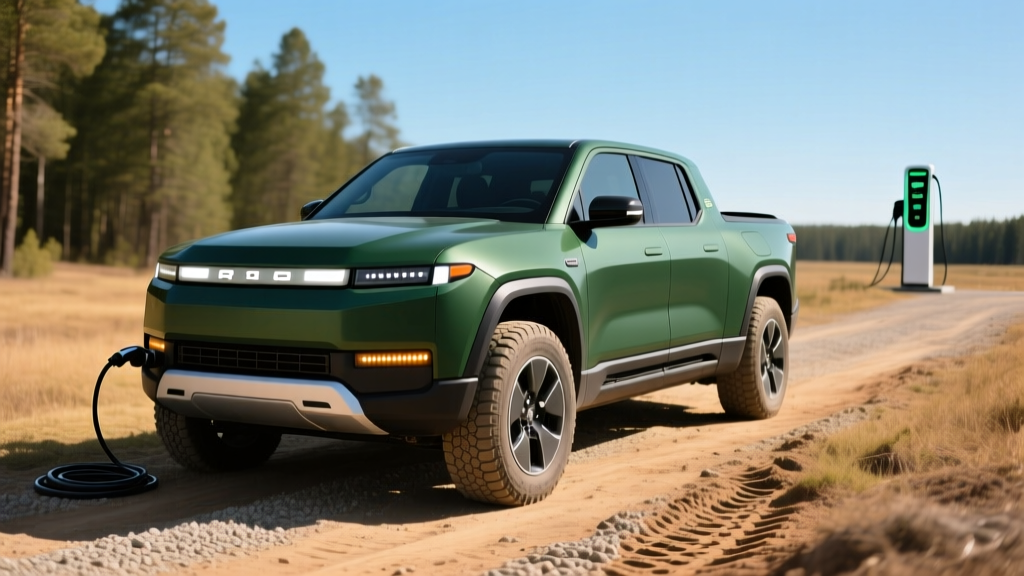
The Rivian R1T occupies a rare slot in the electric-truck market: it is compact enough to navigate tight trails and city streets, yet powerful enough to out-accelerate most sports cars while hauling a bed full of gear. For buyers researching the R1T, exterior and interior dimensions are often the deciding factor — will it fit your garage, your family, and your lifestyle? This guide covers every critical Rivian R1T dimension alongside the range, charging, performance, and pricing data you need to make an informed purchase in 2026.
Exterior Dimensions and Footprint
Understanding the R1T's physical size is essential before you commit. Rivian designed the truck on a skateboard platform with a relatively short wheelbase compared to full-size competitors like the Ford F-150 Lightning or Chevrolet Silverado EV. That shorter wheelbase is what gives the R1T its surprising off-road agility and tight turning circle.
| Dimension | Specification |
|---|---|
| Overall Length | 217.1 inches |
| Wheelbase | 135.9 inches |
| Overall Width (w/o mirrors) | 81.8 inches |
| Overall Width (w/ mirrors) | 87.2 inches |
| Overall Height (Standard suspension) | 73.0 inches |
| Ground Clearance (max, air suspension) | 14.9 inches |
| Ground Clearance (lowest setting) | 7.9 inches |
| Approach Angle | 35.5° |
| Departure Angle | 30.0° |
| Breakover Angle | 26.4° |
| Curb Weight (Dual-Motor) | ~7,149 lbs |
| Curb Weight (Quad-Motor) | ~7,400+ lbs |
For garage planning, the 217.1-inch length means most standard two-car garages (typically 20–22 feet deep) will accommodate the R1T with inches to spare. The 81.8-inch width without mirrors is wider than a Toyota Tacoma but narrower than an F-150 Lightning. If you have a narrow driveway or tight parking structure, the R1T's mid-size footprint is a genuine advantage over full-size electric pickups.
Interior Space, Cargo, and the Gear Tunnel
The R1T seats five across two rows. Interior volume is generous for a mid-size truck, though rear-seat legroom falls slightly short of the largest body-on-frame competitors. Where the R1T truly differentiates is cargo versatility — specifically the Gear Tunnel, a lockable, pass-through storage compartment spanning the width of the truck between the cab and the bed.
| Measurement | Specification |
|---|---|
| Front Headroom | 41.2 inches |
| Front Legroom | 41.3 inches |
| Rear Headroom | 38.3 inches |
| Rear Legroom | 36.2 inches |
| Front Trunk (Frunk) | 11.0 cu ft |
| Bed Length (standard) | 54.0 inches (4 ft 6 in) |
| Bed Width (between wheel wells) | 50.0 inches |
| Gear Tunnel Volume | 11.7 cu ft |
| Gear Tunnel Length | ~65 inches (full vehicle width) |
| Max Payload Capacity | ~1,760 lbs |
| Max Towing Capacity | 11,000 lbs |
The 54-inch bed is shorter than a traditional 5.5-foot truck bed, which means standard 4×8 sheets of plywood will not lie flat with the tailgate closed. However, the tailgate can support the sheet in an angled position, and the Gear Tunnel compensates by swallowing long items like skis, fishing rods, or camping gear that would otherwise clutter the bed. The frunk adds another 11 cubic feet of secure, drainable storage — useful for groceries or wet gear.
For families, the rear seat accommodates two child seats with LATCH anchors on the outboard positions. Headroom and legroom are adequate for adults on shorter trips but will feel snug on long hauls compared to a full-size crew cab.
Range, Battery Options, and Efficiency
Rivian offers the R1T with multiple battery pack sizes for the 2026 model year, spanning Standard, Large, and Max pack configurations. Battery chemistry varies by pack: the Standard pack uses LFP (lithium iron phosphate), which offers excellent cycle life and can be charged to 100% daily without degradation concerns, while the Large and Max packs use NMC (nickel manganese cobalt) chemistry for higher energy density and longer range.
| Configuration | Battery (usable kWh) | Chemistry | EPA Range | MPGe (combined) | kWh/100 mi |
|---|---|---|---|---|---|
| Dual-Motor, Standard Pack | ~92 kWh | LFP | ~270 mi | ~70 MPGe | ~48 |
| Dual-Motor, Large Pack | ~128 kWh | NMC | ~352 mi | ~72 MPGe | ~46 |
| Dual-Motor, Max Pack | ~149 kWh | NMC | ~420 mi | ~73 MPGe | ~45 |
| Performance Dual-Motor, Large | ~128 kWh | NMC | ~340 mi | ~70 MPGe | ~48 |
| Tri-Motor, Max Pack | ~149 kWh | NMC | ~400 mi | ~68 MPGe | ~49 |
| Quad-Motor, Max Pack | ~149 kWh | NMC | ~380 mi | ~65 MPGe | ~51 |
Efficiency is the R1T's weakest spec relative to lighter EVs. At 45–51 kWh per 100 miles, you are paying for 7,000+ pounds of truck with the aerodynamics of a brick. For comparison, a Tesla Model Y achieves roughly 28 kWh/100mi. If efficiency is your top priority, the R1T is not the vehicle — but if you need truck capability with electric propulsion, these numbers are competitive within the electric-truck segment. See fueleconomy.gov for official EPA figures.
Charging Speed: DC Fast and Home Level 2
Charging speed is where the R1T's large battery packs present a trade-off. More capacity means longer fill times, even at high charge rates. Rivian has steadily improved charge curves through over-the-air updates, but the R1T does not match the peak charge rates of 800V-architecture competitors like the Hyundai Ioniq 5 or the Tesla Cybertruck.
| Charge Level | Rate | Time / Speed |
|---|---|---|
| Level 1 (120V household) | ~1.4 kW | ~3–4 mi/hr added |
| Level 2 (240V, 48A Wall Connector) | 11.5 kW | ~25 mi/hr; Standard 0–100% in ~10 hr, Max ~15 hr |
| DC Fast Charge (peak) | Up to 220 kW (Max Pack) | 10–80% in ~30–35 min (Large/Max) |
| DC Fast Charge (Standard pack) | Up to 200 kW | 10–80% in ~25–30 min |
A critical note on the DC fast-charge curve: the R1T peaks near its maximum rate only between roughly 15–40% state of charge. Above 60%, the rate tapers significantly, and above 80% it slows to a trickle. On a road trip, plan to charge from 10–80% and then drive on — charging to 100% at a DC station adds negligible range for a substantial time penalty. Rivian's navigation system includes battery preconditioning, which warms the pack before you arrive at a charger to maximize the charge rate. Always enable a charger as your navigation destination to benefit from this feature.
For home charging, Rivian's Wall Connector delivers up to 11.5 kW on a 60-amp circuit (48 amps continuous). This is sufficient to fully replenish any R1T pack overnight. Expect a professional installation cost of $800–$2,000 for the charger and electrical work, depending on your panel capacity and run distance. If your home has a 100-amp panel, a panel upgrade to 200 amps may be necessary, adding $1,500–$3,000.
Performance and Drivetrain
The R1T's performance credentials are extraordinary for a vehicle with an 11,000-pound towing rating. Even the base Dual-Motor configuration delivers sports-car acceleration, and the upper powertrains enter hypercar territory.
| Drivetrain | Horsepower | Torque (lb-ft) | 0–60 mph | Drivetrain Type |
|---|---|---|---|---|
| Dual-Motor | 533 hp | 610 | 4.5 sec | AWD (2 motors) |
| Performance Dual-Motor | 665 hp | 820 | 3.5 sec | AWD (2 motors) |
| Tri-Motor | 850 hp | 1,100+ | ~2.9 sec | AWD (3 motors) |
| Quad-Motor | 1,025 hp | 1,195 | ~2.5 sec | AWD (4 independent motors) |
The Quad-Motor's four independent motors enable torque vectoring at each wheel, which is transformative off-road. You can execute tank turns (spinning the truck in place by driving left and right wheels in opposite directions) and achieve traction in situations that would strand a conventional 4WD truck. The Tri-Motor, introduced for the refreshed R1T, offers most of this capability with a lower price and slight weight reduction.
The air suspension is standard and provides adjustable ride height across a 7-inch range, from a low entry/exit mode to maximum off-road clearance. On-road, the R1T rides with a firmness that reminds you of its 7,000+ pound mass, but body control is well-managed. Steering is precise for a truck, though it lacks the feedback of a performance SUV.
Pricing, Trims, and Federal Tax Credit
The R1T's pricing spans a wide range depending on battery and drivetrain selection. Below is the current MSRP structure for the 2026 model year. Note that Rivian frequently adjusts pricing and package availability, so confirm current figures on the manufacturer's configurator.
| Trim / Configuration | Base MSRP | As-Tested (typical) | §30D Credit Eligible? |
|---|---|---|---|
| Dual-Motor, Standard Pack | ~$71,700 | $74,000–$78,000 | Potentially (see rules) |
| Dual-Motor, Large Pack | ~$78,700 | $82,000–$88,000 | Potentially (see rules) |
| Performance Dual-Motor, Large | ~$85,700 | $90,000–$96,000 | Yes (under truck MSRP cap) |
| Tri-Motor, Max Pack | ~$102,000 | $106,000–$115,000 | Yes (under truck MSRP cap) |
| Quad-Motor, Max Pack | ~$112,000 | $118,000–$125,000 | Yes (under truck MSRP cap) |
- MSRP Cap: Trucks, vans, and SUVs must have an MSRP at or below $80,000. The base Dual-Motor configurations qualify; higher trims may exceed this threshold depending on how the IRS classifies the vehicle. Confirm current classification at irs.gov.
- Buyer Income Caps: Modified AGI must not exceed $300,000 (joint), $225,000 (head of household), or $150,000 (single).
- Battery Sourcing: The full $7,500 credit requires meeting both critical-minerals and battery-component sourcing thresholds. Partial credit ($3,750) is available if only one requirement is met. Rivian's sourcing compliance changes over time — verify the current status on the DOE's tax credit lookup tool.
- Point-of-Sale Transfer: Eligible buyers can transfer the credit to the dealer at purchase, reducing the sale price directly rather than waiting for a tax refund.
Consult a tax professional before relying on credit eligibility. Rules are subject to legislative change.
Tech, Driver Assistance, and Ownership Experience
The R1T runs Rivian's proprietary software stack on a 15.6-inch center touchscreen and a 12.3-inch digital instrument cluster. The infotainment system is responsive and well-organized, with native integration for navigation, media, and vehicle controls. Wireless Apple CarPlay and Android Auto are not supported — Rivian has opted to build its own ecosystem, which works well but may frustrate users who prefer phone projection.
Rivian's driver-assistance suite, branded as Driver+, includes adaptive cruise control, lane-centering assist, and highway assist functionality. This is a SAE Level 2 system — the driver must remain fully engaged with hands on the wheel and eyes on the road at all times. It is not self-driving and does not approach the capability of Level 4 robotaxi services. The system is competent for highway cruising but requires frequent steering-wheel torque confirmation, which some drivers find intrusive compared to GM's Super Cruise hands-free system.
Notable tech features include:
- Over-the-air updates that regularly add features and improve performance
- Digital key via phone, with no physical key fob required
- Camp Kitchen accessory (Gear Tunnel-integrated slide-out kitchen, sold separately)
- V2L (vehicle-to-load) capability to power tools, appliances, or campsite equipment from the truck's battery
- Powered tonneau cover with integrated bed lighting
Drawbacks worth noting: the R1T has no rear-seat entertainment screens, no native phone projection, and service center availability remains limited outside major metro areas. Rivian's mobile service fleet helps, but body repair turnaround can be lengthy after a collision.
Warranty Coverage
Rivian provides competitive warranty coverage for the R1T's core electric components:
- Battery Pack: 8 years / 175,000 miles (whichever comes first), with a minimum 70% capacity retention threshold
- Powertrain (motors, reducer): 8 years / 175,000 miles
- Bumper-to-Bumper (limited): 5 years / 60,000 miles
- Corrosion Perforation: 5 years / unlimited miles
- Roadside Assistance: 5 years / 60,000 miles
The 175,000-mile battery warranty is generous by industry standards (many competitors offer 100,000 or 150,000 miles). The 70% retention threshold is standard — if your pack degrades below 70% of original capacity within the warranty period, Rivian will repair or replace it. Real-world data from early R1T owners suggests degradation is minimal in the first 50,000 miles, particularly for NMC packs that are not routinely charged to 100%.
Who Should Buy the Rivian R1T?
- Want genuine off-road capability (14.9 inches of ground clearance, approach/departure angles rivaling a Jeep Wrangler) without sacrificing daily-driver comfort
- Need truck utility (towing, hauling, the Gear Tunnel) in a mid-size footprint that fits standard garages
- Value performance and want a truck that can hit 0–60 in under 3 seconds in upper trims
- Have home charging access and primarily drive under 300 miles between charges
- Are willing to pay a premium for a boutique EV brand with strong software and OTA updates
- Need a full-size bed for construction or commercial work (the 54-inch bed is short)
- Require maximum rear-seat passenger comfort for long road trips
- Want hands-free Level 2+ driving (GM Super Cruise or Ford BlueCruise offer this)
- Prioritize lowest cost per mile — a Tesla Model Y or a hybrid truck like the Ford Maverick Hybrid will cost far less to operate
Frequently Asked Questions
What is the real-world range of the Rivian R1T?
The EPA-rated range spans from approximately 270 miles (Dual-Motor, Standard Pack) to 420 miles (Dual-Motor, Max Pack). In real-world highway driving at 70 mph, expect roughly 10–15% less than the EPA figure. In freezing temperatures, add another 15–25% of range loss. The Max Pack Dual-Motor delivers roughly 300–330 miles of real-world highway range in cold weather — sufficient for most road trips with one or two charging stops.
How fast does the R1T charge at home and on the road?
At home on a Level 2 (240V, 48A) Rivian Wall Connector, the R1T charges at up to 11.5 kW, adding roughly 25 miles of range per hour. A full charge from empty takes 10–15 hours depending on pack size. On DC fast chargers, the R1T peaks at up to 220 kW (Max Pack) and can charge from 10–80% in approximately 30–35 minutes. The Standard Pack peaks at around 200 kW with a 10–80% time of roughly 25–30 minutes.
Does the Rivian R1T qualify for the $7,500 federal EV tax credit?
It depends on the trim, your income, and current battery-sourcing rules. The R1T is classified as a truck, so the MSRP cap is $80,000 — meaning base Dual-Motor trims may qualify, while higher configurations exceed the limit. Buyer income must be below $300,000 (joint) / $150,000 (single). Battery-component and critical-minerals sourcing requirements determine whether you receive the full $7,500 or a partial $3,750 credit. Always verify current eligibility at fueleconomy.gov and consult a tax professional.
Is the R1T worth buying versus the Ford F-150 Lightning or Tesla Cybertruck?
The R1T excels in off-road capability, build quality, and adventure-oriented design (Gear Tunnel, Camp Kitchen, air suspension). The F-150 Lightning offers a larger bed, more rear-seat space, and a lower starting price — better for work and family hauling. The Cybertruck provides stainless-steel durability, faster peak charging, and a more futuristic platform but has polarizing styling and limited service infrastructure. If you prioritize trail capability and premium fit-and-finish in a mid-size package, the R1T is the strongest choice in its class.
What are the biggest pros and cons of the R1T?
- Class-leading off-road capability with 14.9" ground clearance
- Innovative Gear Tunnel and frunk storage
- Blistering acceleration across all drivetrains
- Strong OTA update cadence adding real features
- 175,000-mile battery warranty
- 11,000-lb towing capacity
- Short 54-inch bed limits commercial utility
- High starting price; most trims exceed $80K MSRP cap for tax credit
- Limited service center network outside major cities
- No wireless Apple CarPlay or Android Auto
- Rear seat is tighter than full-size competitors
- Efficiency of 45–51 kWh/100mi is costly for high-mileage drivers
Can the R1T tow a camper or boat?
Yes. The R1T is rated to tow up to 11,000 pounds across all configurations. That covers most travel trailers, boat trailers, and car-hauler loads. However, towing significantly reduces range — expect a 40–50% range reduction when towing at highway speeds with a loaded trailer. A Max Pack R1T rated at 420 miles EPA may deliver only 200–250 miles while towing, so plan charging stops accordingly.
Sources: EPA fuel economy data via fueleconomy.gov; Rivian official specifications at rivian.com/r1t; IRS §30D tax credit guidance at irs.gov.