Rivian R1T Dash at a Glance: The 2026 Electric Truck Benchmark
The Rivian R1T has matured from an ambitious startup truck into one of the most capable electric pickups on the market. For 2026, Rivian has refined the platform with its second-generation drive units, a new Standard battery pack option, and expanded software features accessible through the vehicle's central dash interface. Whether you're evaluating it as a daily commuter, a weekend adventure rig, or a light-duty tow vehicle, the R1T demands a serious look — but also a clear-eyed assessment of where it falls short.
This review covers the full 2026 Rivian R1T lineup, with a focus on the metrics that matter most to real buyers: actual range versus EPA estimates, charging behavior across the curve, total pricing after federal incentives, and the tech stack that lives behind the dash.
| Spec | Dual-Motor (Standard) | Dual-Motor (Large) | Tri-Motor | Quad-Motor |
|---|---|---|---|---|
| EPA Range | 270 mi | 352 mi | 380 mi | 420 mi |
| Battery (usable) | 92 kWh (LFP) | 128 kWh (NMC) | 135 kWh (NMC) | 149 kWh (NMC) |
| Horsepower | 533 hp | 533 hp | 850 hp | 1,025 hp |
| 0-60 mph | 4.5 sec | 4.5 sec | 3.0 sec | 2.6 sec |
| Max DC Fast Charge | 190 kW | 220 kW | 220 kW | 220 kW |
| 10-80% DC Time | ~28 min | ~22 min | ~24 min | ~27 min |
| Level 2 Rate | 11.5 kW (~30 mi/hr) | 11.5 kW (~30 mi/hr) | 11.5 kW (~30 mi/hr) | 11.5 kW (~30 mi/hr) |
| MPGe (combined) | 73 MPGe | 70 MPGe | 65 MPGe | 62 MPGe |
| Towing Capacity | 11,000 lb | 11,000 lb | 11,000 lb | 11,000 lb |
| Base MSRP | $69,900 | $75,900 | $89,900 | $99,900 |
Real-World Range: What the EPA Sticker Doesn't Tell You
EPA estimate: 270–420 miles depending on pack and motor config.
Real-world highway (70 mph, 65°F): Expect ~85–90% of EPA — roughly 230–370 miles.
Cold weather (20°F, highway): Plan for 65–75% of EPA — approximately 175–315 miles. The R1T's heat pump helps, but a large frontal area and heavy curb weight work against it in deep cold.
Towing (5,000+ lb trailer): Range drops 40–50%. Budget 130–200 miles between charges.
The R1T's Max Pack with 420 miles of EPA range is genuinely impressive on paper and translates to roughly 370 miles of relaxed highway driving in moderate temperatures. That's enough to cover Los Angeles to Las Vegas or Dallas to Houston without stopping. However, the brick-like aerodynamics of any pickup truck mean that efficiency drops sharply above 70 mph. According to fueleconomy.gov, the Dual-Motor Large Pack achieves 70 MPGe combined, which translates to roughly 48 kWh per 100 miles in mixed driving.
The new Standard Pack (92 kWh, LFP chemistry) trades range for affordability and longevity. LFP cells tolerate repeated 100% charging without the degradation concerns of NMC, making this pack ideal for owners who commute daily and charge at home nightly. Just don't expect to road-trip without planning — 270 EPA miles means about 230 real highway miles.
Charging Speed: DC Fast Charge and Home Level 2
Rivian upgraded the R1T's charging architecture for 2026, moving to an 800V-capable platform on the Large, Tri-Motor, and Quad-Motor configurations. The Standard Pack operates on a 400V architecture, which limits its peak charge rate.
| Charge Level | Standard (92 kWh LFP) | Large (128 kWh NMC) | Max (149 kWh NMC) |
|---|---|---|---|
| Level 1 (120V / 12A) | ~1.4 kW (~4 mi/hr) | ~1.4 kW (~3 mi/hr) | ~1.4 kW (~3 mi/hr) |
| Level 2 (240V / 48A) | 11.5 kW (~30 mi/hr) | 11.5 kW (~25 mi/hr) | 11.5 kW (~24 mi/hr) |
| DC Fast Charge (peak) | 190 kW | 220 kW | 220 kW |
| DC 10-80% Time | ~28 min | ~22 min | ~27 min |
| Sustained rate (10-50%) | ~170 kW | ~210 kW | ~205 kW |
| Connector | NACS (native) | NACS (native) | NACS (native) |
All 2026 R1Ts ship with the NACS connector natively, giving seamless access to Tesla Superchargers — currently the most reliable DC fast-charging network in North America. Rivian's own Adventure Network remains limited but is expanding along key overland corridors.
The charging curve matters more than peak kW. The Large Pack sustains roughly 210 kW from 10% to about 50% state of charge before tapering. By 70%, you'll see roughly 100 kW, and above 85% the rate drops below 50 kW. This is typical for NMC chemistry. LFP packs in the Standard model hold their charge rate more consistently through the mid-range, which partially compensates for the lower peak.
For home charging, the onboard 11.5 kW charger fills any pack overnight. A 48-amp Level 2 circuit (hardwired, requiring a 60-amp breaker) adds roughly 25–30 miles of range per hour — enough to fully replenish even the Max Pack in about 13 hours. If your electrical panel can support it, this is the single most impactful upgrade for EV ownership.
Performance and Drivetrain: From Commuter to Quad-Motor Beast
The 2026 R1T lineup spans from practical to absurd. The Dual-Motor configuration with 533 hp and a 4.5-second 0-60 time is more than adequate for merging, passing, and trail use. It also delivers the best efficiency in the lineup.
The Tri-Motor (850 hp, 3.0 sec) and Quad-Motor (1,025 hp, 2.6 sec) exist in a different performance universe. The Quad-Motor's individual wheel torque vectoring enables tank turns and precise rock-crawling control, though these features are more novelty than daily necessity. For most buyers, the Dual-Motor with the Large Pack offers the best balance of range, performance, and value.
All R1Ts feature standard all-wheel drive with a low center of gravity thanks to the skateboard battery layout. Ground clearance ranges from 8.7 to 14.4 inches depending on air suspension setting, and the truck wades through 36 inches of water. The 11,000-pound towing capacity matches or exceeds most half-ton gas pickups, but remember: towing at that limit will halve your range.
Pricing, Trim Levels, and Federal Tax Credit Eligibility
| Trim / Config | Base MSRP | As-Tested (typical) | §30D Credit Eligible? |
|---|---|---|---|
| Dual-Motor Standard Pack | $69,900 | $72,500 | Potentially up to $7,500* |
| Dual-Motor Large Pack | $75,900 | $81,000 | Potentially up to $7,500* |
| Tri-Motor Large Pack | $89,900 | $96,000 | Potentially up to $7,500* |
| Quad-Motor Max Pack | $99,900 | $108,000 | Potentially up to $7,500* |
*Federal tax credit eligibility under IRS §30D is subject to multiple requirements that change periodically. As of 2026, key criteria include:
- MSRP cap: Pickup trucks must have an MSRP at or below $80,000. This eliminates the Tri-Motor and Quad-Motor configurations from credit eligibility.
- Buyer income cap: Modified adjusted gross income must not exceed $150,000 (single), $225,000 (head of household), or $300,000 (joint filers).
- Battery sourcing: A percentage of critical minerals and battery components must be sourced from the U.S. or free-trade-agreement countries. Rivian has been increasing domestic sourcing, but the exact credit amount ($3,750 or $7,500) depends on meeting both thresholds. Verify current-year requirements at IRS.gov.
- Point-of-sale transfer: Eligible buyers can transfer the credit to the dealer at purchase, reducing the upfront price rather than waiting for a tax refund.
For the Dual-Motor Standard Pack at $69,900, a buyer who meets all income and sourcing requirements could reduce the effective price to approximately $62,400. The Dual-Motor Large Pack at $75,900 also qualifies on MSRP grounds. Always confirm eligibility with a tax professional before purchase — rules tighten annually through 2032.
Interior, Cargo, and the Rivian Dash Experience
The R1T's cabin seats five comfortably, with 41.5 inches of front legroom and 38.2 inches in the rear. The flat floor (no transmission tunnel) makes the middle rear seat genuinely usable for an adult on shorter trips.
Cargo versatility remains the R1T's party trick. The 4.5-foot bed is shorter than a full-size pickup's, but the gear tunnel — a 11.7-cubic-foot pass-through compartment behind the rear seats — swallows skis, golf bags, or camping gear while keeping the bed free. The front trunk (frunk) adds 11.1 cubic feet of lockable, weather-sealed storage. Total enclosed cargo volume (frunk + gear tunnel + bed with tonneau) exceeds what most mid-size SUVs offer.
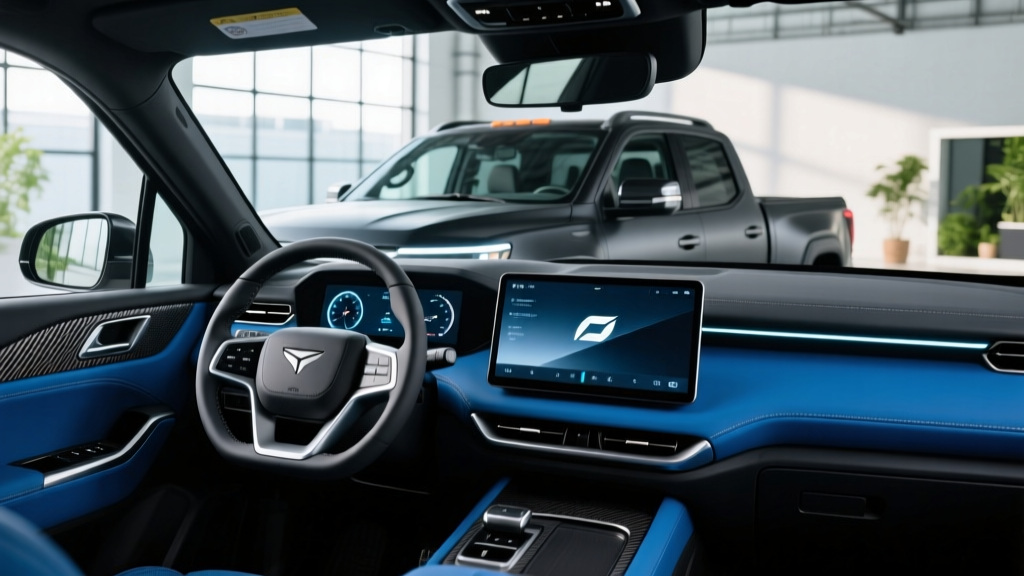
The 15.6-inch central touchscreen runs Rivian's custom OS, which has received substantial updates for 2026. The dash interface now features a configurable driver display, integrated trip planner with real-time charger availability, and over-the-air updates that have added features like enhanced regenerative braking profiles and improved navigation routing. Wireless Apple CarPlay and Android Auto are supported, though the native interface is clean enough that many owners skip phone projection entirely.
Build quality has improved markedly since early 2022 production. Panel gaps are tighter, interior materials feel more premium (vegan leather and ash wood are standard), and the rattling that plagued early models has been largely resolved.
Driver Assistance and Safety
Rivian's Driver+ system is a Level 2 driver-assistance feature, meaning it combines adaptive cruise control and lane-centering but requires the driver to remain fully engaged with hands on the wheel and eyes on the road at all times. It is not self-driving. The system performs well on divided highways but will disengage in construction zones, faded lane markings, or heavy rain.
The 2026 R1T earned a 5-star overall safety rating from NHTSA, with top marks in frontal crash, side crash, and rollover resistance. Standard safety equipment includes automatic emergency braking, blind-spot monitoring, rear cross-traffic alert, and a 360-degree camera system useful for tight trail maneuvers and parking.
Warranty and Long-Term Ownership
Rivian provides a competitive warranty package:
- Basic vehicle: 5 years / 60,000 miles
- Battery and drive unit: 8 years / 175,000 miles (retains at least 70% capacity)
- Corrosion: 10 years / unlimited miles
The 175,000-mile battery warranty is among the longest in the industry and reflects confidence in both the NMC and LFP cell suppliers. LFP packs in the Standard configuration should experience minimal degradation — industry data suggests less than 10% capacity loss over 3,000 charge cycles, which equates to well over 500,000 miles for the 92 kWh pack.
Insurance costs remain higher than comparable gas trucks. Expect annual premiums in the $2,200–$3,400 range depending on state, driving record, and trim. Depreciation data for Rivian is still maturing, but the R1T has held value better than most luxury EVs, helped by limited supply and strong brand loyalty.
Pros, Cons, and Who Should Buy the R1T
- Class-leading range (420 mi EPA on Max Pack)
- Native NACS — full Supercharger access
- Gear tunnel + frunk offer unmatched enclosed cargo
- Excellent off-road capability with air suspension
- 11,000-lb towing capacity
- LFP option for daily commuters (Standard Pack)
- Strong OTA update cadence improving the dash and features
- Short 4.5-ft bed limits full-size truck utility
- Towing cuts range by 40–50%
- Tri/Quad-Motor trims exceed $80K MSRP cap (no tax credit)
- Insurance premiums above segment average
- No hands-free highway driving (Level 2 only)
- Service center network still expanding in rural areas
- High entry price even before options
Look elsewhere if: You need a full-size 6.5-foot bed for work, you tow heavy loads long distances frequently, or your budget is under $60,000. The Ford F-150 Lightning (if available) or a plug-in hybrid truck may better serve pure work-truck needs.
Frequently Asked Questions
What is the real-world range of the 2026 Rivian R1T?
On the highway at 70 mph in moderate temperatures, expect about 85–90% of the EPA sticker — so roughly 230 miles for the Standard Pack and 370 miles for the Max Pack. In cold weather (below 30°F), plan for 65–75% of EPA range. Towing a trailer reduces range by 40–50% regardless of pack size.
How fast does the R1T charge at home and on the road?
On a 48-amp Level 2 home charger, the R1T charges at 11.5 kW, adding roughly 25–30 miles of range per hour. A full charge takes 8–13 hours depending on the pack. On DC fast chargers, the Large and Max packs peak at 220 kW and charge from 10–80% in 22–27 minutes. The Standard Pack peaks at 190 kW with a 10–80% time of about 28 minutes.
Does the 2026 Rivian R1T qualify for the federal EV tax credit?
The Dual-Motor Standard ($69,900) and Dual-Motor Large ($75,900) configurations fall under the $80,000 MSRP cap for pickup trucks and are potentially eligible for up to $7,500 under IRS §30D — provided the buyer meets income limits and the battery meets critical-mineral and component-sourcing thresholds. The Tri-Motor and Quad-Motor exceed the MSRP cap and do not qualify. Always verify current rules at IRS.gov and consult a tax professional.
Is the Rivian R1T worth buying versus the Ford F-150 Lightning or Chevy Silverado EV?
The R1T excels in off-road capability, enclosed cargo versatility (gear tunnel + frunk), and driving dynamics. The F-150 Lightning offers a longer bed and lower starting price but less ground clearance. The Silverado EV provides a longer bed with the available mid-gate. If off-road adventure and unique cargo solutions matter most, the R1T leads. If you need a traditional work truck with a full-size bed, the Lightning or Silverado EV may fit better.
What are the biggest drawbacks of the R1T?
The 4.5-foot bed is the most practical limitation — it won't fit standard 8-foot lumber or a full sheet of plywood flat. Towing significantly reduces range, insurance costs are elevated, and Rivian's service network, while growing, isn't yet as accessible as legacy automaker dealer networks in rural areas.
How long will the R1T battery last?
Rivian warranties the battery for 8 years or 175,000 miles with at least 70% capacity retention. Real-world data from similar NMC packs suggests 15–20% degradation over 150,000–200,000 miles. The LFP Standard Pack should degrade even less — typically under 10% over 3,000 full cycles, equivalent to well over 500,000 miles of driving.