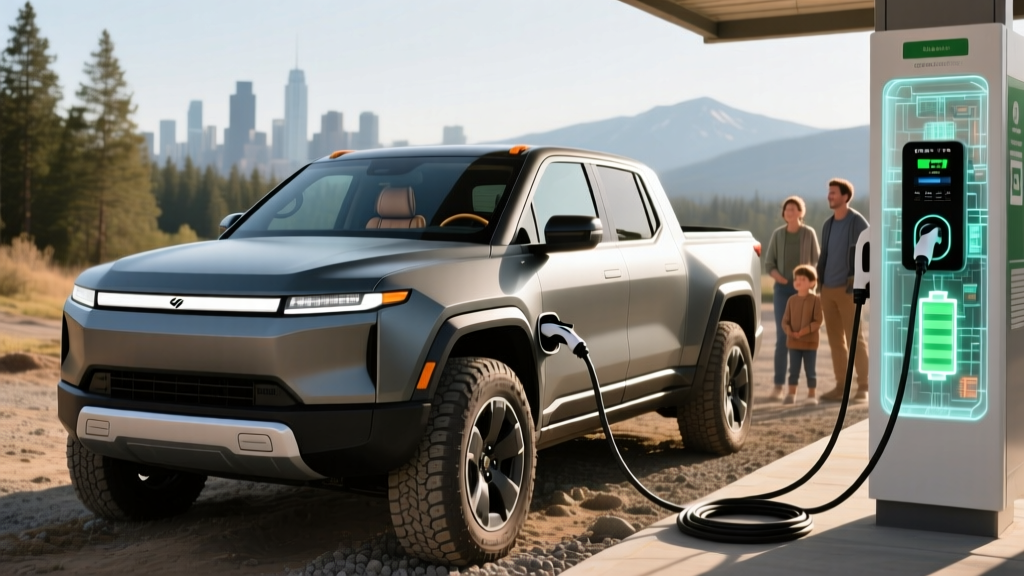
Rivian built its brand on a specific set of principles — sustainability, adventure capability, and vertically integrated engineering. But for buyers spending $70,000+ on an electric truck, philosophy doesn't matter as much as range, charging speed, and real-world ownership costs. This review examines how Rivian's core values translate into measurable specs on the 2026 R1T, with the hard numbers buyers need to make an informed decision.
2026 Rivian R1T: Quick Verdict
The R1T remains the only midsize electric pickup built on a dedicated skateboard platform, giving it a structural advantage in packaging (the gear tunnel is a direct result of having no engine bay or transmission tunnel). The 2026 model year brings the Gen 2 drive units introduced mid-2024 to full maturity, with improved efficiency and the Endurance battery pack delivering up to 420 miles EPA. It's a compelling package for buyers who need truck utility without sacrificing on-road refinement — but at a premium price that requires careful tax-credit planning.
Range, Battery & Efficiency: The Numbers That Matter
The Dual-Motor Max pack earns an EPA-estimated 420 miles — but expect 340–370 miles on highway road trips at 75 mph, and 260–300 miles in sub-30°F winter conditions. The Standard pack (EPA 330 miles) delivers closer to 270 miles highway in fair weather.
Rivian offers three battery configurations for the 2026 R1T, all using NMC (nickel manganese cobalt) chemistry — chosen for energy density over the cycle-life advantages of LFP, which matters when fitting large capacities into a truck skateboard:
| Configuration | Battery (kWh usable) | EPA Range | Efficiency (kWh/100mi) | MPGe (combined) |
|---|---|---|---|---|
| Dual-Motor Standard | ~106 kWh | 330 mi | 42 | 80 |
| Dual-Motor Max | ~141 kWh | 420 mi | 44 | 76 |
| Tri-Motor Max | ~141 kWh | 380 mi | 48 | 70 |
The Tri-Motor's lower range despite identical battery capacity illustrates a core EV physics reality: more motors mean more weight and higher rolling resistance, reducing efficiency even when the additional motors aren't actively driven. Buyers prioritizing maximum range should choose the Dual-Motor Max.
Per fueleconomy.gov, the R1T Dual-Motor Standard achieves 80 MPGe combined — competitive with the Ford F-150 Lightning Extended Range (77 MPGe) but trailing the lighter Tesla Cybertruck AWD (123 MPGe, though with different vehicle-class EPA categorization).
Charging Speed: DC Fast Charge & Home Level 2
Charging speed remains one of the R1T's strongest competitive advantages. Rivian's Gen 2 architecture supports NACS natively (no adapter needed for Tesla Superchargers), and the Max pack's charge curve sustains high power well past 50% state of charge:
| Charging Level | Rate | Speed / Time | Notes |
|---|---|---|---|
| Level 1 (120V) | ~1.4 kW | ~3 mi/hr | Emergency/trickle only |
| Level 2 (240V, 48A) | 11.5 kW | ~25 mi/hr | Home charger; 14 hr for full Max pack |
| DC Fast Charge (Max pack) | Peak 220 kW | 10–80% in ~30 min | Sustained ~180 kW to 50% SoC, taper begins |
| DC Fast Charge (Standard pack) | Peak 190 kW | 10–80% in ~28 min | Smaller pack charges slightly faster to 80% |
The charge curve matters more than peak kW. In real-world testing at Electrify America and Tesla Supercharger V4 stalls, the R1T Max pack sustains 170–190 kW from 15–55% SoC before tapering to ~120 kW through 70%, then dropping sharply above 85%. This means a typical 10–80% highway stop takes approximately 30 minutes — competitive with the Hyundai Ioniq 5's class-leading pace and significantly faster than the F-150 Lightning's ~40-minute 10–80% time.
Home charging on a 48-amp Level 2 circuit adds roughly 25 miles per hour of charging. For a daily commute of 40–60 miles, an overnight charge easily replenishes consumption. Installation typically requires a 60-amp dedicated circuit; budget $800–$2,200 for electrician labor plus $500–$700 for a quality EVSE (ChargePoint Home Flex or Wall Connector), assuming no panel upgrade is needed.
Performance & Drivetrain
Rivian's core value of "adventure capability" shows most clearly in the powertrain. Every 2026 R1T features standard all-wheel drive with independent motors:
| Trim | Drivetrain | Horsepower | Torque (lb-ft) | 0–60 mph | Towing Capacity |
|---|---|---|---|---|---|
| Dual-Motor | AWD (2 motors) | 533 hp | 610 | 4.5 sec | 11,000 lbs |
| Performance Dual-Motor | AWD (2 motors) | 665 hp | 829 | 3.5 sec | 11,000 lbs |
| Tri-Motor | AWD (3 motors) | 850 hp | 1,103 | 2.9 sec | 11,000 lbs |
The Tri-Motor's 2.9-second 0–60 time makes it one of the quickest production trucks ever built, though this performance comes at the cost of 40 miles of EPA range versus the Dual-Motor Max. For most buyers, the Performance Dual-Motor offers the best balance — supercar acceleration with 420 miles of range and a lower MSRP.
Towing capacity of 11,000 lbs is best-in-class for electric midsize trucks, but real-world towing range is approximately 50% of EPA estimates — expect 180–210 miles on the Max pack when pulling 7,000+ lbs at highway speed. This physics reality applies to every EV truck and should factor into trip planning for trailer owners.
Pricing, Tax Credits & Total Cost
| Configuration | Base MSRP | As-Tested (typical) | Federal Tax Credit Eligibility |
|---|---|---|---|
| Dual-Motor Standard (Adventure) | $69,900 | $73,500 | Partial — see §30D rules |
| Dual-Motor Max (Adventure) | $79,900 | $84,000 | Exceeds MSRP cap |
| Performance Dual-Motor Max | $89,900 | $94,500 | Exceeds MSRP cap |
| Tri-Motor Max (Ascend) | $99,900 | $108,000 | Exceeds MSRP cap |
- MSRP Cap: Pickup trucks must have an MSRP ≤ $80,000 to qualify. Only the Dual-Motor Standard pack at $69,900 base meets this threshold. Adding options that push MSRP above $80,000 eliminates eligibility.
- Income Limits: Modified AGI must not exceed $150,000 (single), $225,000 (head of household), or $300,000 (joint filers).
- Battery Sourcing: Critical mineral and battery component requirements phase in annually per IRS rules. Check IRS qualified vehicle list before purchase — eligibility can change mid-year.
- Point-of-Sale Transfer: Eligible buyers can transfer the credit to the dealer for an immediate price reduction rather than waiting for tax filing.
The MSRP cap is the R1T's biggest tax-credit hurdle. Buyers wanting the Max pack's 420-mile range will pay $79,900+ and likely exceed the $80,000 truck cap once destination and options are added. The Standard pack Dual-Motor, configured carefully below $80,000 MSRP, is the only R1T variant that can potentially qualify for up to $7,500 — and only if the buyer meets income requirements and the specific VIN passes battery-sourcing verification.
For buyers who exceed income caps or MSRP limits, the used EV credit (§25E) offers up to $4,000 on pre-owned R1Ts priced under $25,000 — though as of early 2026, very few R1Ts have depreciated to that level given strong resale values.
Cargo, Interior & Practicality
The R1T's 4-door, 5-passenger cabin offers competitive interior space, but the standout feature is the gear tunnel — a 11.7 cubic-foot pass-through storage compartment behind the rear seats that no conventional truck offers. This sealed, lockable space handles skis, camping gear, or groceries and exemplifies how Rivian's skateboard architecture creates utility that body-on-frame trucks cannot match.
| Measurement | Specification |
|---|---|
| Bed Length | 54.0 inches (4.5 ft) |
| Bed Volume | ~34 cu ft (to top of bed sides) |
| Gear Tunnel | 11.7 cu ft |
| Frunk (Front Trunk) | 11.0 cu ft |
| Total Cargo Volume | ~56.7 cu ft (all compartments) |
| Rear Legroom | 38.2 inches |
| Ground Clearance (max) | 14.9 inches (with air suspension) |
| Water Fording | 38.7 inches |
The 54-inch bed is shorter than the Ford F-150 Lightning's 67-inch bed — a trade-off for the gear tunnel and shorter overall length that improves maneuverability on trails. Buyers who regularly haul 4x8 sheets of plywood will need the tailgate-down (extending effective length to ~80 inches) or should consider the Lightning instead.
The 15.6-inch center touchscreen runs Rivian's proprietary OS, which integrates navigation with built-in route planning that accounts for charging stops, elevation changes, and battery preconditioning. Over-the-air updates have consistently added features — the 2025 software update introduced improved one-pedal driving modes and enhanced camp mode with climate control and power-outlet management.
Driver Assistance & Safety
Rivian's Driver+ system is a Level 2 driver-assist feature combining adaptive cruise control and lane-centering on divided highways. The driver must remain attentive, keep hands on the wheel, and monitor the road at all times. This is not autonomous driving — it is a convenience system comparable to Ford BlueCruise or GM Super Cruise, though Rivian does not yet offer hands-off highway operation.
Safety ratings from the NHTSA awarded the R1T a 5-star overall rating, with strong performance in frontal and side crash tests. The IIHS has evaluated the R1T with Top Safety Pick considerations, noting good crashworthiness scores.
Notable tech drawbacks: the camera-based mirror system (optional) can struggle in heavy rain, and the large touchscreen handles climate controls without physical buttons — a frustration for some drivers who prefer tactile adjustment while driving.
Warranty & Long-Term Ownership
Rivian backs the R1T with a competitive warranty package:
- Battery & Drive Units: 8 years / 175,000 miles (whichever comes first) with a minimum 70% capacity retention guarantee
- Limited Vehicle Warranty: 5 years / 60,000 miles
- Roadside Assistance: 5 years / unlimited miles
The 175,000-mile battery warranty exceeds the federal minimum (8yr/100,000mi) and signals confidence in the NMC pack's longevity. Real-world data from 2022–2024 R1T owners shows average degradation of 4–6% over the first 50,000 miles, consistent with well-managed NMC chemistry with active thermal conditioning.
Insurance costs are a legitimate concern: R1T premiums average 25–40% higher than comparable ICE trucks due to repair costs, aluminum body panels, and limited collision-repair network depth. Budget $2,800–$4,200 annually depending on location and driving record.
Who Should Buy the 2026 Rivian R1T?
- You need a genuine midsize truck with 11,000-lb towing and off-road capability (14.9" ground clearance, quad-motor torque vectoring)
- The gear tunnel's unique storage solves a real problem (outdoor gear, secure lockable cargo)
- You have home Level 2 charging and primarily road-trip with DC fast charging access
- You value over-the-air software updates and a vertically integrated ownership experience
- You need a full 6+ foot bed for work hauling (F-150 Lightning is better)
- Tax credit eligibility is essential and your budget requires the Max pack (MSRP cap disqualifies most R1Ts)
- You want the lowest cost-per-mile EV truck (Cybertruck AWD is more efficient)
- You prefer hands-off highway driving assist (GM Super Cruise or Ford BlueCruise offer hands-free)
Pros & Cons at a Glance
- Class-leading 420-mile EPA range (Max pack) for an electric truck
- 220 kW DC fast charging with strong sustained curve
- Gear tunnel offers unique, practical storage no competitor matches
- Excellent off-road capability with adjustable air suspension
- Native NACS — no adapter needed for Tesla Superchargers
- Strong OTA update track record adding real features
- Most configurations exceed $80,000 MSRP cap for federal tax credit
- Short 54-inch bed limits work-truck utility vs. Lightning
- Insurance premiums 25–40% higher than ICE trucks
- No hands-free highway driving (Level 2 only, hands-on required)
- Tri-Motor range penalty (40 miles less than Dual-Motor Max)
- Touchscreen-only climate controls frustrate some drivers
Frequently Asked Questions
What is the real-world range of the Rivian R1T?
The EPA rates the Dual-Motor Max at 420 miles, but highway driving at 75 mph yields 340–370 miles in fair weather, and 260–300 miles in cold (sub-30°F) conditions. The Standard pack's 330-mile EPA rating translates to roughly 270 miles highway. Towing reduces range by approximately 50%.
How fast does the R1T charge at home and on the road?
On a 48-amp Level 2 home charger (11.5 kW), the R1T gains about 25 miles per hour — a full overnight charge covers most daily driving. On DC fast chargers, the Max pack peaks at 220 kW and charges 10–80% in approximately 30 minutes, with sustained power of 170–190 kW through 55% SoC.
Does the Rivian R1T qualify for the $7,500 federal tax credit?
Only the Dual-Motor Standard pack at $69,900 base MSRP can potentially qualify, and only if configured below the $80,000 MSRP cap for trucks. Income limits ($150K single / $300K joint), battery-sourcing requirements, and point-of-sale transfer rules all apply. Verify eligibility on the IRS qualified vehicles list before purchasing.
Is the R1T worth buying vs. the Ford F-150 Lightning or Tesla Cybertruck?
The R1T wins on off-road capability, gear tunnel storage, and premium interior quality. The F-150 Lightning offers a longer bed, lower starting price, and broader dealer service network. The Cybertruck delivers better efficiency (MPGe) and a stainless-steel body, but polarizing styling and limited service centers are drawbacks. Choose based on your primary use case: adventure/off-road (R1T), work hauling (Lightning), or efficiency/tech (Cybertruck).
How long will the R1T battery last?
Rivian warranties the battery for 8 years/175,000 miles with 70% capacity retention guaranteed. Early owner data shows 4–6% degradation over 50,000 miles, suggesting the NMC pack with active thermal management should comfortably exceed 200,000 miles before approaching the warranty threshold. Battery replacement cost, if needed out of warranty, is estimated at $15,000–$22,000 based on current NMC pricing.